engine GMC SIERRA CLASSIC 2007 Owner's Manual
[x] Cancel search | Manufacturer: GMC, Model Year: 2007, Model line: SIERRA CLASSIC, Model: GMC SIERRA CLASSIC 2007Pages: 674, PDF Size: 3.5 MB
Page 152 of 674
Shift Speeds
{CAUTION:
If you skip a gear when you downshift,
you could lose control of your vehicle.
You could injure yourself or others. Do
not shift down more than one gear at a
time when you downshift.
Do not allow the engine Revolutions Per Minute
(RPM) to overspeed and enter the tachometer red
lines. Engine overspeed occurs when downshifting,
or descending a grade, at too high a vehicle
speed. When going down steep grades, always
select a gear at least one position lower than you
would use on climbing a grade. This will allow
the vehicle’s engine to provide some braking and
help to slow the vehicle as it goes down the
grade. Monitor your vehicle speed, acceleration
and engine RPM while applying the brakes as you
go down the grade to ensure you have complete
control over the vehicle.If your engine speed drops below 600 rpm, or if
the engine is not running smoothly, you should
downshift to the next lower gear. When operating
on slippery surfaces, downshift at lower than
normal vehicle speeds to prevent the tires from
slipping.
In vehicles that have a bench seat, move the
tallest beverage containers to the right cupholder
to provide additional clearance for the shift
lever.
For vehicles that have a center console, the front
cup holder pulls out and turns 180° to provide
additional clearance between tall beverage
containers and the shift lever.
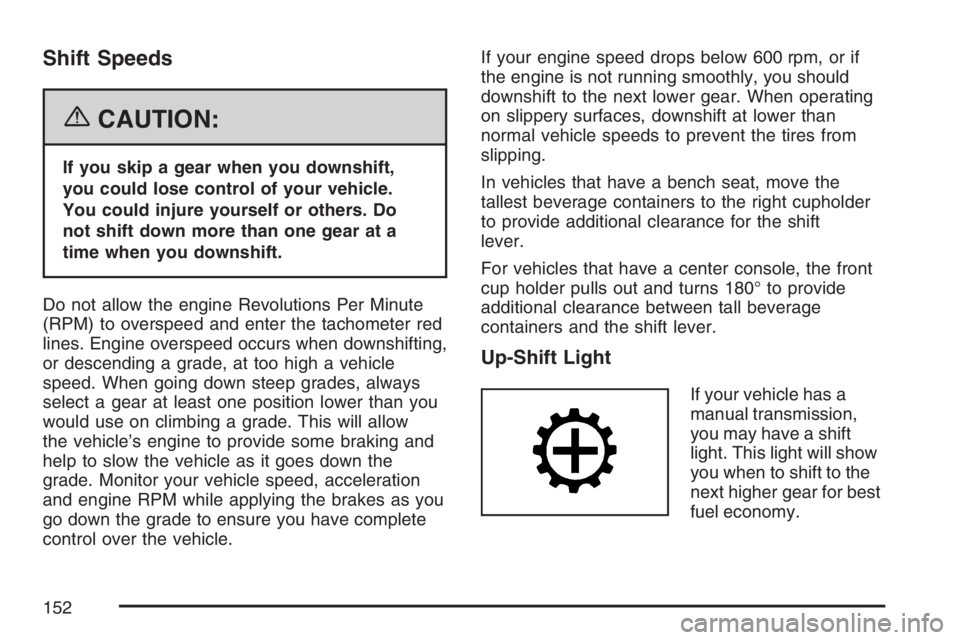
Up-Shift Light
If your vehicle has a
manual transmission,
you may have a shift
light. This light will show
you when to shift to the
next higher gear for best
fuel economy.
152
Page 153 of 674
When this light comes on, you can shift to the next
higher gear if weather, road and traffic conditions
allow. For the best fuel economy, accelerate slowly
and shift when the light comes on.
While you accelerate, it is normal for the light to
go on and off if you quickly change the position of
the accelerator.
If your vehicle has four-wheel drive and has a
manual transmission, disregard the shift light when
the transfer case is in Four-Wheel Low.
Ignore the shift light when you downshift.
Four-Wheel Drive
If your vehicle has four-wheel drive, you can send
your engine’s driving power to all four wheels
for extra traction. To get the most satisfaction out
of four-wheel drive, you must be familiar with
its operation. Read the part that follows before
using four-wheel drive. See the appropriate text for
the transfer case in your vehicle.
While driving on clean dry pavement and during
tight turns, you may experience a vibration in
the steering system.
Front Axle Locking Feature
The front axle locks and unlocks automatically
when you shift the transfer case. Some delay for
the axle to lock or unlock is normal.
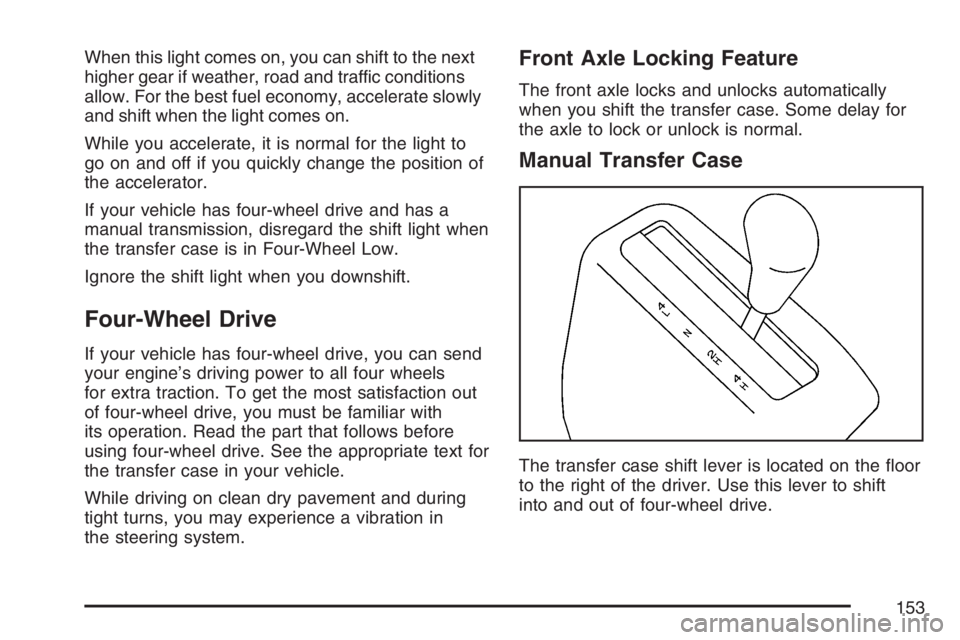
Manual Transfer Case
The transfer case shift lever is located on the oor
to the right of the driver. Use this lever to shift
into and out of four-wheel drive.
153
Page 157 of 674
Shifting In or Out of 4L (Four-Wheel
Drive Low)
Notice:Shifting the transfer case into 4L
while moving at speeds faster than 3 mph
(5 km/h) may cause premature wear to
the transfer case, and may cause the gears to
grind. To avoid causing premature wear,
and grinding the gears, do not shift the transfer
case into 4L while the vehicle is moving
faster than 3 mph (5 km/h).
Shifts into 4L can be made with the vehicle at a
stop, or while slowly rolling about 1 to 3 mph
(2 to 5 km/h).
Shift the automatic transmission into
NEUTRAL (N), or with a manual transmission,
press the clutch pedal, or shift into NEUTRAL.
Shift the transfer case shift lever in one
continuous motion into the 4L position.
When in 4L do not drive faster than 45 mph.
This will reduce wear and extend the life of
the transfer case.
Shifting In or Out of NEUTRAL
1. With the vehicle running and the engine at an
idle set the parking brake and apply the
regular brake.
2. Place the transmission into NEUTRAL (N).
Shift the transfer case in one continuous motion
into or out of the NEUTRAL position.
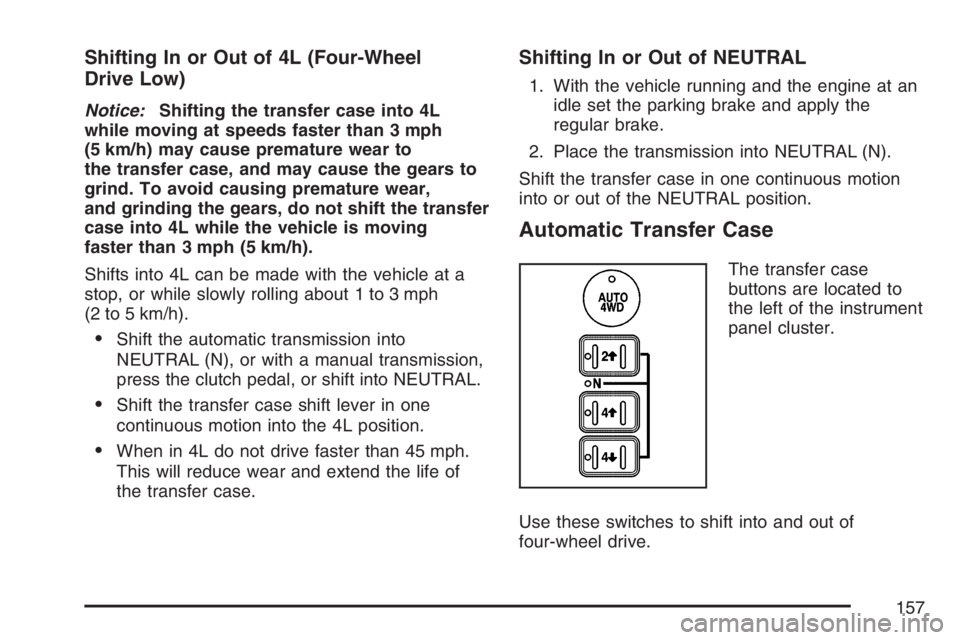
Automatic Transfer Case
The transfer case
buttons are located to
the left of the instrument
panel cluster.
Use these switches to shift into and out of
four-wheel drive.
157
Page 160 of 674
Shifting into Four-Wheel Drive High or
AUTO 4WD (Automatic Four-Wheel Drive)
Press and release the Four-Wheel Drive High
or AUTO 4WD switch. This can be done at any
speed, except when shifting from Four-Wheel
Drive Low. The indicator light will ash while
shifting. It will remain on when the shift is
completed.
Shifting into Two-Wheel Drive High
Press and release the Two-Wheel Drive High
switch. This can be done at any speed, except
when shifting from Four-Wheel Drive Low.
See shifting out of Four-Wheel Drive Low later in
this section for more information.
Shifting into Four-Wheel Drive Low
Notice:Shifting the transfer case into
Four-Wheel Drive Low while moving at speeds
faster than 3 mph (5 km/h) may cause
premature wear to the transfer case, and may
cause the gears to grind. To avoid causing
premature wear, and grinding the gears, do not
shift the transfer case into Four-Wheel Drive
Low while the vehicle is moving faster
than 3 mph (5 km/h).To shift to Four-Wheel Drive Low, the ignition
must be in RUN and the vehicle must be stopped
or moving less than 3 mph (5 km/h) with the
transmission in NEUTRAL (N). The preferred
method for shifting into Four-Wheel Drive Low
is to have your vehicle moving 1 to 2 mph
(1.6 to 3.2 km/h). Press and release the
Four-Wheel Drive Low switch. You must wait for
the Four-Wheel Drive Low indicator light to
stop ashing and remain on before shifting the
transmission into gear.
Notice:Shifting the transmission into gear
before the Four-Wheel Drive Low indicator light
has stopped ashing could damage the
transfer case. To help avoid damaging your
vehicle, always wait for the Four-Wheel
Drive Low indicator light to stop ashing
before shifting the transmission into gear.
It is typical for your vehicle to exhibit signicant
engagement noise and bump when shifting
between Four-Wheel Drive Low and Four-Wheel
Drive High ranges or from NEUTRAL (N) with
the engine running.
160
Page 161 of 674
If the Four-Wheel Drive Low switch is pressed
when your vehicle is in gear and/or moving,
the Four-Wheel Drive Low indicator light will ash
for 30 seconds and the vehicle will not complete
the shift unless it is moving less than 3 mph
(5 km/h) and the transmission is in NEUTRAL (N).
After 30 seconds the transfer case will shift to
Four-Wheel Drive High mode.
Shifting Out of Four-Wheel Drive Low
To shift from Four-Wheel Drive Low to Four-Wheel
Drive High, AUTO 4WD, or Two-Wheel Drive
High, your vehicle must be stopped or moving less
than 3 mph (5 km/h) with the transmission in
NEUTRAL (N) and the ignition in RUN. The
preferred method for shifting out of Four-Wheel
Drive Low is to have your vehicle moving 1 to
2 mph (1.6 to 3.2 km/h). Press and release the
Four-Wheel Drive High, AUTO 4WD, or
Two-Wheel Drive High switch. You must wait for
the Four-Wheel Drive High, AUTO 4WD, or
Two-Wheel Drive High indicator light to stop
ashing and stay on before shifting the
transmission into gear.Notice:Shifting the transmission into gear
before the Four-Wheel Drive Low indicator light
has stopped ashing could damage the
transfer case. To help avoid damaging your
vehicle, always wait for the Four-Wheel
Drive Low indicator light to stop ashing
before shifting the transmission into gear.
The transfer case may make noise and the vehicle
may jerk when the transfer case is shifted
between Four-Wheel Drive Low and Four-Wheel
Drive High ranges or from NEUTRAL with the
engine running.
If the Four-Wheel Drive high, AUTO 4WD, or
Two-Wheel Drive High switch is pressed when
your vehicle is in gear and/or moving, the
Four-Wheel Drive High, AUTO 4WD, or
Two-Wheel Drive High indicator light will ash for
30 seconds but the vehicle will not complete
the shift unless it is moving less than 3 mph
(5 km/h) and the transmission is in NEUTRAL (N).
161
Page 162 of 674
Shifting Into NEUTRAL
{CAUTION:
Shifting the transfer case to NEUTRAL
can cause your vehicle to roll even if the
transmission is in PARK (P). You or
someone else could be seriously injured.
Be sure to set the parking brake before
placing the transfer case in NEUTRAL.
SeeParking Brake on page 169.
To shift the transfer case to NEUTRAL do the
following:
1. Make sure the vehicle is parked so that it will
not roll.
2. Set the parking brake and apply the regular
brake pedal.
3. Start the vehicle or turn the ignition to RUN.4. Put the transmission in NEUTRAL (N).
5. Shift the transfer case to Two-Wheel
Drive High.
6. Simultaneously press and hold the Two-Wheel
Drive High and Four-Wheel Drive Low buttons
for 10 seconds. The red NEUTRAL light will
come on when the transfer case shift to
NEUTRAL is complete.
7. If the engine is running, shift the transmission
to REVERSE (R) for one second, then shift
the transmission to DRIVE (D) for one second,
or FIRST (1) for vehicles that have a manual
transmission.
8. Turn the engine off, by turning the key to
ACCESSORY.
9. Place the transmission shift lever in
PARK (P).
10. Release the parking brake prior to moving the
vehicle.
11. Turn the ignition to LOCK.
162
Page 163 of 674
Shifting Out of NEUTRAL
To shift out of NEUTRAL:
1. Set the parking brake and apply the regular
brake pedal.
2. Turn the ignition to RUN with the engine off.
3. Shift the transmission to NEUTRAL (N).
4. Press the button for the desired transfer case
shift position (Two-Wheel Drive High,
Four-Wheel Drive High, AUTO 4WD, or
Four-Wheel Drive Low).5. After the transfer case has shifted out of
NEUTRAL the red light will go out.
6. Release the parking brake prior to moving the
vehicle.
7. You may start the engine and shift the
transmission to the desired position.
Excessively shifting the transfer case into or out of
the different modes may cause the transfer
case to enter the shift protection mode. This mode
protects the transfer case from possible damage
and only allows the transfer case to respond
to one shift per 10 seconds. The transfer case may
stay in this mode for up to three minutes.
163
Page 168 of 674
5. Simultaneously press and hold the Two-Wheel
Drive High and Four-Wheel Drive Low buttons
for 10 seconds. The red NEUTRAL light will
come on when the transfer case shift to
NEUTRAL is complete.
6. Start the engine if it is not already running.
7. Press and hold the foot brake pedal and
Shift the transmission to REVERSE (R)
for one second, then shift the transmission for
one second to DRIVE (D) for an automatic
transmission, or FIRST (1) for vehicles
that have a manual transmission. Then let out
the clutch. This is to ensure the transfer
case is in NEUTRAL. If not, repeat this
procedure starting at Step 3.
8. Turn the engine off, by turning the key to
ACCESSORY.
9. Place the transmission shift lever in PARK (P)
for an automatic transmission, or FIRST (1)
for vehicles that have a manual transmission.
10. Release the parking brake prior to moving the
vehicle.
11. Turn the ignition to LOCK.Shifting Out of NEUTRAL
To shift out of NEUTRAL:
1. Set the parking brake and press and hold the
regular brake pedal.
2. Shift the transmission to NEUTRAL (N) for an
automatic transmission, or press the clutch
pedal for vehicles that have a manual
transmission. Then turn the ignition to RUN
with the engine off.
3. Press the button for the desired transfer case
shift position (Two-Wheel Drive High,
Four-Wheel Drive High, or Four-Wheel
Drive Low).
4. After the transfer case has shifted out of
NEUTRAL the red light will go out.
5. Release the parking brake prior to moving the
vehicle.
168
Page 169 of 674
6. You may start the engine and shift the
transmission to the desired position.
Excessively shifting the transfer case into or
out of the different modes may cause the
transfer case to enter the shift protection
mode. This mode protects the transfer case
from possible damage and only allows
the transfer case to respond to one shift per
10 seconds. The transfer case may stay in this
mode for up to three minutes.
7. After the transfer case has shifted out of
NEUTRAL the red light will go out.
Parking Brake
To set the parking brake, hold the regular brake
pedal down with your right foot. Push down
the parking brake pedal with your left foot.
A chime will activate and the warning light will
ash when the parking brake is applied and
the vehicle is moving at least 3 mph (5 km/h) for
at least three seconds.To release the parking brake, hold the regular brake
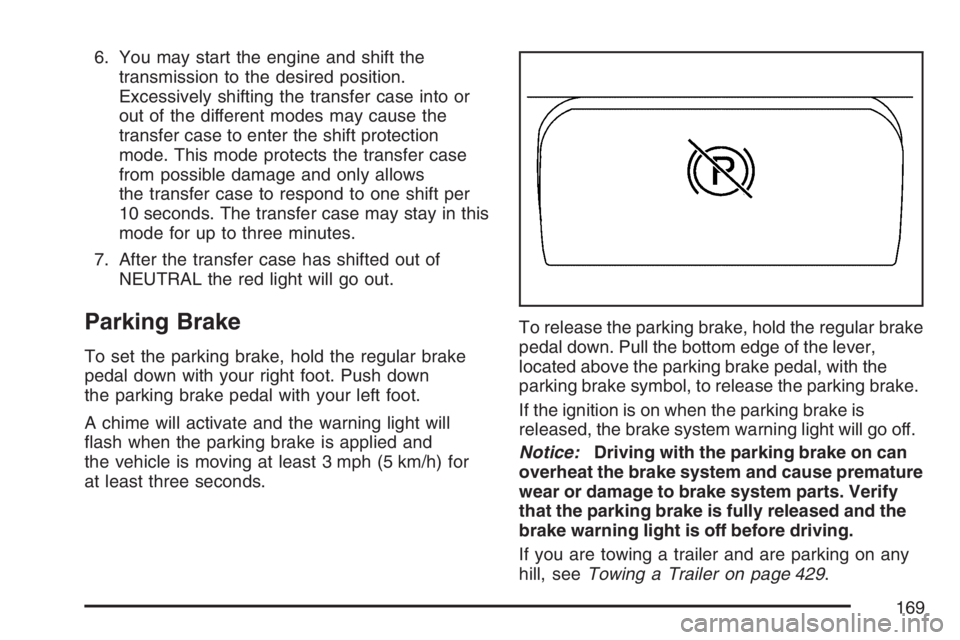
pedal down. Pull the bottom edge of the lever,
located above the parking brake pedal, with the
parking brake symbol, to release the parking brake.
If the ignition is on when the parking brake is
released, the brake system warning light will go off.
Notice:Driving with the parking brake on can
overheat the brake system and cause premature
wear or damage to brake system parts. Verify
that the parking brake is fully released and the
brake warning light is off before driving.
If you are towing a trailer and are parking on any
hill, seeTowing a Trailer on page 429.
169
Page 170 of 674
Shifting Into Park (P)
(Automatic Transmission)
{CAUTION:
It can be dangerous to get out of your
vehicle if the shift lever is not fully in
PARK (P) with the parking brake rmly set.
Your vehicle can roll. If you have left the
engine running, the vehicle can move
suddenly. You or others could be injured.
To be sure your vehicle will not move, even
when you are on fairly level ground, use
the steps that follow. With four-wheel drive,
if your transfer case is in NEUTRAL, your
vehicle will be free to roll, even if your shift
lever is in PARK (P). So, be sure the
transfer case is in a drive gear — not in
NEUTRAL. If you are pulling a trailer, see
Towing a Trailer on page 429.1. Hold the brake pedal down with your right foot
and set the parking brake.
2. Move the shift lever into the PARK (P)
position by pulling the shift lever toward
you and moving it up as far as it will go.
3. If your vehicle has four-wheel drive, be sure
the transfer case is in a drive gear – not in
NEUTRAL.
4. Turn the ignition key to LOCK.
5. Remove the key and take it with you. If you
can leave your vehicle with the ignition key in
your hand, your vehicle is in PARK (P).
170