tires GMC SIERRA CLASSIC 2007 Owner's Manual
[x] Cancel search | Manufacturer: GMC, Model Year: 2007, Model line: SIERRA CLASSIC, Model: GMC SIERRA CLASSIC 2007Pages: 674, PDF Size: 3.5 MB
Page 402 of 674
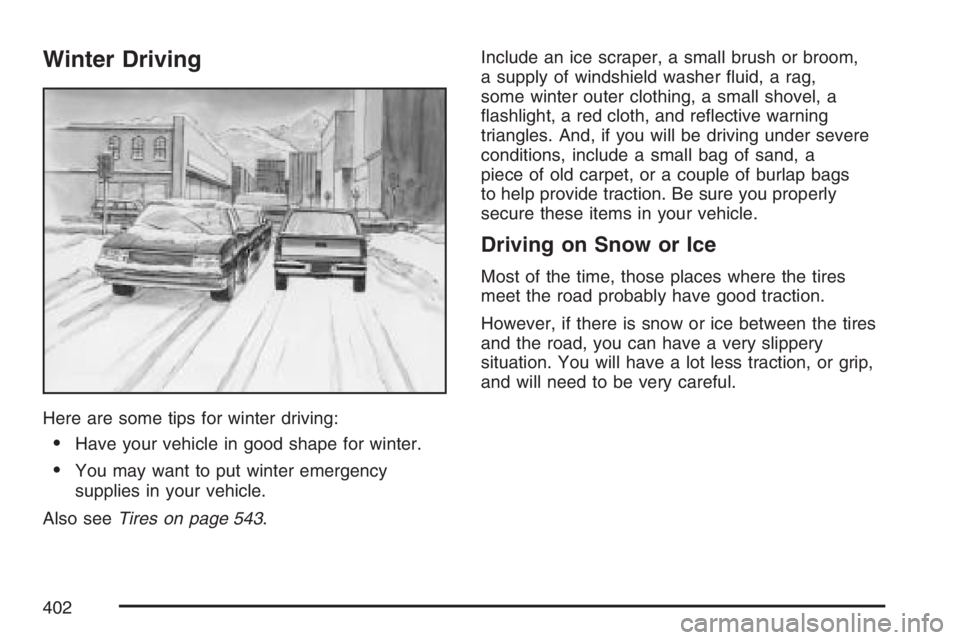
Winter Driving
Here are some tips for winter driving:
Have your vehicle in good shape for winter.
You may want to put winter emergency
supplies in your vehicle.
Also seeTires on page 543.Include an ice scraper, a small brush or broom,
a supply of windshield washer uid, a rag,
some winter outer clothing, a small shovel, a
ashlight, a red cloth, and reective warning
triangles. And, if you will be driving under severe
conditions, include a small bag of sand, a
piece of old carpet, or a couple of burlap bags
to help provide traction. Be sure you properly
secure these items in your vehicle.
Driving on Snow or Ice
Most of the time, those places where the tires
meet the road probably have good traction.
However, if there is snow or ice between the tires
and the road, you can have a very slippery
situation. You will have a lot less traction, or grip,
and will need to be very careful.
402
Page 403 of 674
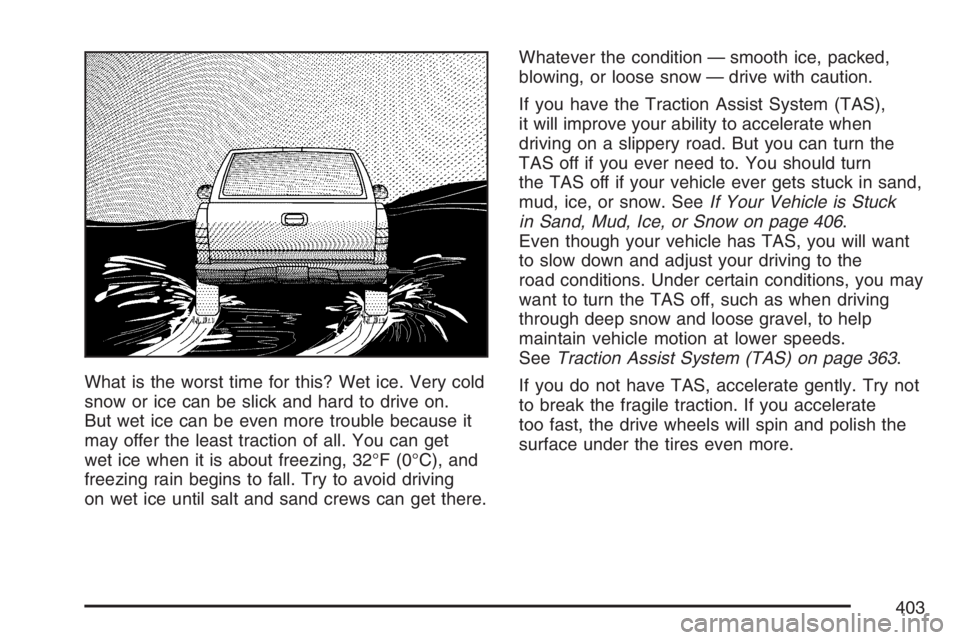
What is the worst time for this? Wet ice. Very cold
snow or ice can be slick and hard to drive on.
But wet ice can be even more trouble because it
may offer the least traction of all. You can get
wet ice when it is about freezing, 32°F (0°C), and
freezing rain begins to fall. Try to avoid driving
on wet ice until salt and sand crews can get there.Whatever the condition — smooth ice, packed,
blowing, or loose snow — drive with caution.
If you have the Traction Assist System (TAS),
it will improve your ability to accelerate when
driving on a slippery road. But you can turn the
TAS off if you ever need to. You should turn
the TAS off if your vehicle ever gets stuck in sand,
mud, ice, or snow. SeeIf Your Vehicle is Stuck
in Sand, Mud, Ice, or Snow on page 406.
Even though your vehicle has TAS, you will want
to slow down and adjust your driving to the
road conditions. Under certain conditions, you may
want to turn the TAS off, such as when driving
through deep snow and loose gravel, to help
maintain vehicle motion at lower speeds.
SeeTraction Assist System (TAS) on page 363.
If you do not have TAS, accelerate gently. Try not
to break the fragile traction. If you accelerate
too fast, the drive wheels will spin and polish the
surface under the tires even more.
403
Page 406 of 674
You will need a well-charged battery to restart the
vehicle, and possibly for signaling later on with
your headlamps. Let the heater run for a while.
Then, shut the engine off and close the window
almost all the way to preserve the heat. Start
the engine again and repeat this only when you
feel really uncomfortable from the cold. But do it as
little as possible. Preserve the fuel as long as
you can. To help keep warm, you can get out of
the vehicle and do some fairly vigorous exercises
every half hour or so until help comes.If Your Vehicle is Stuck in Sand,
Mud, Ice, or Snow
In order to free your vehicle when it is stuck,
you will need to spin the wheels, but you do not
want to spin your wheels too fast. The method
known as rocking can help you get out when you
are stuck, but you must use caution.
{CAUTION:
If you let your vehicle’s tires spin at high
speed, they can explode, and you or others
could be injured. And, the transmission or
other parts of the vehicle can overheat.
That could cause an engine compartment
re or other damage. When you are stuck,
spin the wheels as little as possible. Do not
spin the wheels above 35 mph (55 km/h) as
shown on the speedometer.
406
Page 407 of 674
Notice:Spinning the wheels can destroy parts
of your vehicle as well as the tires. If you
spin the wheels too fast while shifting
the transmission back and forth, you can
destroy the transmission.
For information about using tire chains on your
vehicle, seeTire Chains on page 562.
Rocking Your Vehicle to Get It Out
First, turn the steering wheel left and right.
That will clear the area around the front wheels.
If you have a four-wheel-drive vehicle, shift
into Four-Wheel High. If your vehicle has the
Traction Assist System (TAS), you should
turn it off by pressing the TAS on/off button.Then shift back and forth between REVERSE (R)
and a forward gear, or with a manual transmission,
between FIRST (1) or SECOND (2) and
REVERSE (R), spinning the wheels as little as
possible. Release the accelerator pedal while you
shift, and press lightly on the accelerator pedal
when the transmission is in gear. By slowly
spinning the wheels in the forward and reverse
directions, you will cause a rocking motion
that may free your vehicle. If that does not get
your vehicle out after a few tries, it may need to be
towed out. Or, you can use the recovery hooks
if your vehicle has them. If your vehicle does need
to be towed out, seeTowing Your Vehicle on
page 423.
407
Page 410 of 674
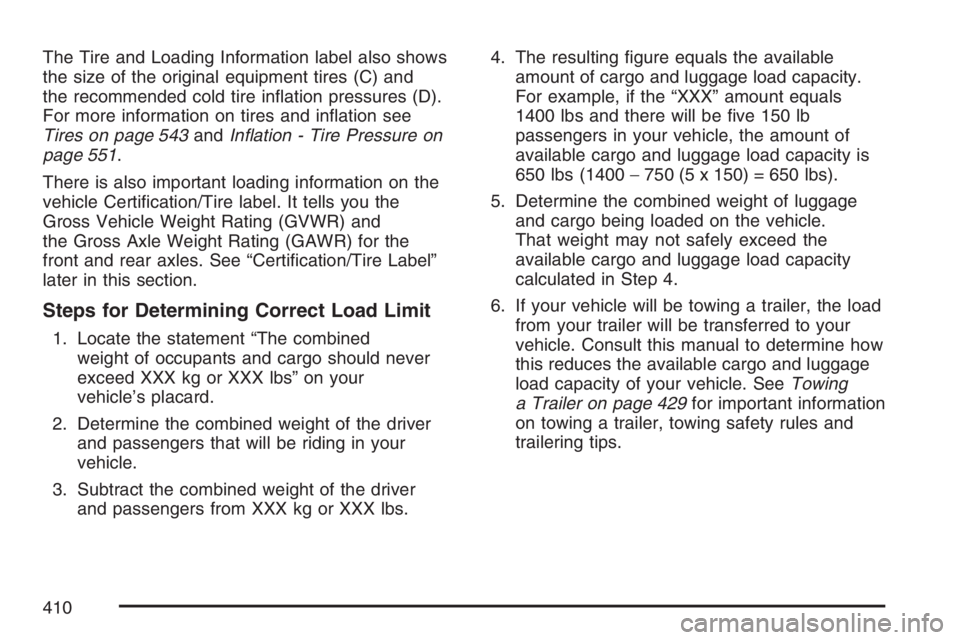
The Tire and Loading Information label also shows
the size of the original equipment tires (C) and
the recommended cold tire ination pressures (D).
For more information on tires and ination see
Tires on page 543andInation - Tire Pressure on
page 551.
There is also important loading information on the
vehicle Certication/Tire label. It tells you the
Gross Vehicle Weight Rating (GVWR) and
the Gross Axle Weight Rating (GAWR) for the
front and rear axles. See “Certication/Tire Label”
later in this section.
Steps for Determining Correct Load Limit
1. Locate the statement “The combined
weight of occupants and cargo should never
exceed XXX kg or XXX lbs” on your
vehicle’s placard.
2. Determine the combined weight of the driver
and passengers that will be riding in your
vehicle.
3. Subtract the combined weight of the driver
and passengers from XXX kg or XXX lbs.4. The resulting gure equals the available
amount of cargo and luggage load capacity.
For example, if the “XXX” amount equals
1400 lbs and there will be ve 150 lb
passengers in your vehicle, the amount of
available cargo and luggage load capacity is
650 lbs (1400−750 (5 x 150) = 650 lbs).
5. Determine the combined weight of luggage
and cargo being loaded on the vehicle.
That weight may not safely exceed the
available cargo and luggage load capacity
calculated in Step 4.
6. If your vehicle will be towing a trailer, the load
from your trailer will be transferred to your
vehicle. Consult this manual to determine how
this reduces the available cargo and luggage
load capacity of your vehicle. SeeTowing
a Trailer on page 429for important information
on towing a trailer, towing safety rules and
trailering tips.
410
Page 412 of 674
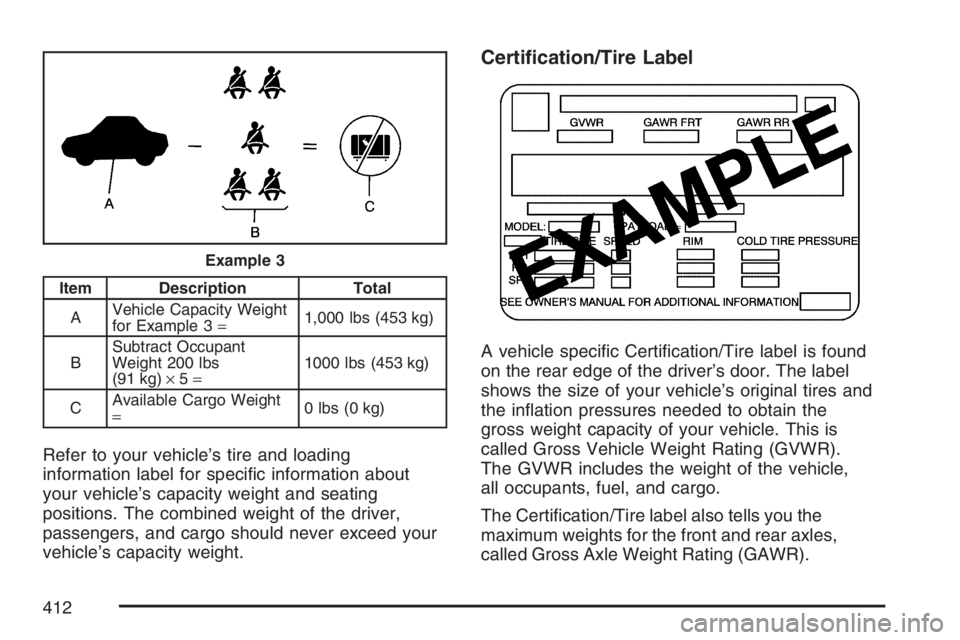
Item Description Total
AVehicle Capacity Weight
for Example 3=1,000 lbs (453 kg)
BSubtract Occupant
Weight 200 lbs
(91 kg)×5=1000 lbs (453 kg)
CAvailable Cargo Weight
=0 lbs (0 kg)
Refer to your vehicle’s tire and loading
information label for specic information about
your vehicle’s capacity weight and seating
positions. The combined weight of the driver,
passengers, and cargo should never exceed your
vehicle’s capacity weight.
Certication/Tire Label
A vehicle specic Certication/Tire label is found
on the rear edge of the driver’s door. The label
shows the size of your vehicle’s original tires and
the ination pressures needed to obtain the
gross weight capacity of your vehicle. This is
called Gross Vehicle Weight Rating (GVWR).
The GVWR includes the weight of the vehicle,
all occupants, fuel, and cargo.
The Certication/Tire label also tells you the
maximum weights for the front and rear axles,
called Gross Axle Weight Rating (GAWR).
Example 3
412
Page 430 of 674
If You Do Decide To Pull A Trailer
If you do, here are some important points:
There are many different laws, including speed
limit restrictions, having to do with trailering.
Make sure your rig will be legal, not only where
you live but also where you’ll be driving.
A good source for this information can be state
or provincial police.
Consider using a sway control. See “Hitches”
later in this section.
Don’t tow a trailer at all during the rst
500 miles (800 km) your new vehicle is driven.
Your engine, axle or other parts could be
damaged.
Then, during the rst 500 miles (800 km) that
you tow a trailer, don’t drive over 50 mph
(80 km/h) and don’t make starts at full throttle.
This helps your engine and other parts of
your vehicle wear in at the heavier loads.
If you have an automatic transmission, you
can tow in DRIVE (D). You may want to
shift the transmission to THIRD (3) or, if
necessary, a lower gear selection if the
transmission shifts too often, such as under
heavy loads and/or hilly conditions. If you have
a manual transmission and you are towing a
trailer, it’s better not to use the highest
gear. SeeTow/Haul Mode Light on page 264.
Three important considerations have to do
with weight:
The weight of the trailer
The weight of the trailer tongue
The weight on your vehicle’s tires
Tow/Haul Mode
Tow/Haul is a feature on automatic transmission
equipped vehicles that assists when pulling a heavy
trailer or a large or heavy load. SeeTow/Haul Mode
on page 147for more information.
430
Page 448 of 674
The effect of tongue weight is about 1.5 times the
actual weight. Dividing the 900 lbs (408 kg) by
1.5 leaves you with being able to handle only
600 lbs (272 kg) of tongue weight. Since tongue
weight is usually at least
10 percent of total loaded trailer weight, you can
expect that the largest trailer your vehicle can
properly handle is 6,000 lbs (2 721 kg).
It is important that you make sure your vehicle
does not exceed any of its ratings — GCWR,
GVWR, RGAWR, Maximum Trailer Rating
or Tongue Weight. The only way to be sure you
are not exceeding any of these ratings is to weigh
your vehicle and trailer.Total Weight on Your Vehicle’s Tires
Be sure your vehicle’s tires are inated to the
upper limit for cold tires. You’ll nd these numbers
on the Certication label at the rear edge of the
driver’s door or see Loading Your Vehicle for more
information. Then be sure you don’t go over the
GVW limit for your vehicle, or the GAWR, including
the weight of the trailer tongue. If you use a
weight distributing hitch, make sure you don’t go
over the rear axle limit before you apply the weight
distribution spring bars.
Hitches
It’s important to have the correct hitch equipment.
Crosswinds, large trucks going by and rough roads
are a few reasons why you’ll need the right hitch.
448
Page 452 of 674
Before you start, check all trailer hitch parts and
attachments, safety chains, electrical connector,
lamps, tires and mirror adjustment. If the trailer has
electric brakes, start your vehicle and trailer
moving and then apply the trailer brake controller
by hand to be sure the brakes are working.
This lets you check your electrical connection at
the same time.
During your trip, check occasionally to be sure
that the load is secure, and that the lamps and any
trailer brakes are still working.
While towing a trailer or when exposed to long
periods of sunshine, the oor of the truck bed may
become very warm. Avoid putting items in the
truck bed that might be affected by high ambient
temperatures.
Following Distance
Stay at least twice as far behind the vehicle ahead
as you would when driving your vehicle without
a trailer. This can help you avoid situations
that require heavy braking and sudden turns.
Passing
You’ll need more passing distance up ahead when
you’re towing a trailer. And, because you’re a
good deal longer, you’ll need to go much farther
beyond the passed vehicle before you can
return to your lane.
Backing Up
Hold the bottom of the steering wheel with
one hand. Then, to move the trailer to the left, just
move that hand to the left. To move the trailer to the
right, move your hand to the right. Always back up
slowly and, if possible, have someone guide you.
Making Turns
Notice:Making very sharp turns while
trailering could cause the trailer to come in
contact with the vehicle. Your vehicle could be
damaged. Avoid making very sharp turns
while trailering.
When you’re turning with a trailer, make wider
turns than normal. Do this so your trailer
won’t strike soft shoulders, curbs, road signs,
trees or other objects. Avoid jerky or sudden
maneuvers. Signal well in advance.
452
Page 466 of 674
Noise Control System................................. 531
Tampering with Noise Control System
Prohibited.............................................. 531
Bulb Replacement....................................... 532
Halogen Bulbs........................................... 532
Headlamps................................................ 533
Front Turn Signal, Sidemarker and
Daytime Running Lamps........................ 534
Roof Marker Lamps................................... 535
Center High-Mounted Stoplamp (CHMSL)
and Cargo Lamp.................................... 537
Pickup Box Identication and Fender
Marker Lamps........................................ 538
Taillamps, Turn Signal, Stoplamps and
Back-up Lamps...................................... 539
License Plate Lamp................................... 541
Replacement Bulbs................................... 541
Windshield Wiper Blade Replacement....... 542
Tires............................................................ 543
Tire Sidewall Labeling............................... 544
Tire Terminology and Denitions............... 548
Ination - Tire Pressure............................. 551
Dual Tire Operation................................... 552Tire Inspection and Rotation...................... 553
When It Is Time for New Tires.................. 555
Buying New Tires...................................... 556
Different Size Tires and Wheels................ 558
Uniform Tire Quality Grading..................... 559
Wheel Alignment and Tire Balance............ 560
Wheel Replacement.................................. 560
Tire Chains............................................... 562
If a Tire Goes Flat.................................... 563
Changing a Flat Tire................................. 564
Removing the Spare Tire and Tools.......... 566
Removing the Flat Tire and Installing
the Spare Tire....................................... 571
Secondary Latch System........................... 580
Storing a Flat or Spare Tire and Tools...... 584
Spare Tire................................................. 588
Appearance Care........................................ 589
Cleaning the Inside of Your Vehicle.......... 589
Fabric/Carpet............................................. 590
Leather...................................................... 591
Instrument Panel, Vinyl, and Other
Plastic Surfaces..................................... 591
Care of Safety Belts.................................. 592
Weatherstrips............................................ 592
Section 5 Service and Appearance Care
466