steering wheel GMC SIERRA CLASSIC 2007 Owner's Guide
[x] Cancel search | Manufacturer: GMC, Model Year: 2007, Model line: SIERRA CLASSIC, Model: GMC SIERRA CLASSIC 2007Pages: 674, PDF Size: 3.5 MB
Page 407 of 674
Notice:Spinning the wheels can destroy parts
of your vehicle as well as the tires. If you
spin the wheels too fast while shifting
the transmission back and forth, you can
destroy the transmission.
For information about using tire chains on your
vehicle, seeTire Chains on page 562.
Rocking Your Vehicle to Get It Out
First, turn the steering wheel left and right.
That will clear the area around the front wheels.
If you have a four-wheel-drive vehicle, shift
into Four-Wheel High. If your vehicle has the
Traction Assist System (TAS), you should
turn it off by pressing the TAS on/off button.Then shift back and forth between REVERSE (R)
and a forward gear, or with a manual transmission,
between FIRST (1) or SECOND (2) and
REVERSE (R), spinning the wheels as little as
possible. Release the accelerator pedal while you
shift, and press lightly on the accelerator pedal
when the transmission is in gear. By slowly
spinning the wheels in the forward and reverse
directions, you will cause a rocking motion
that may free your vehicle. If that does not get
your vehicle out after a few tries, it may need to be
towed out. Or, you can use the recovery hooks
if your vehicle has them. If your vehicle does need
to be towed out, seeTowing Your Vehicle on
page 423.
407
Page 425 of 674
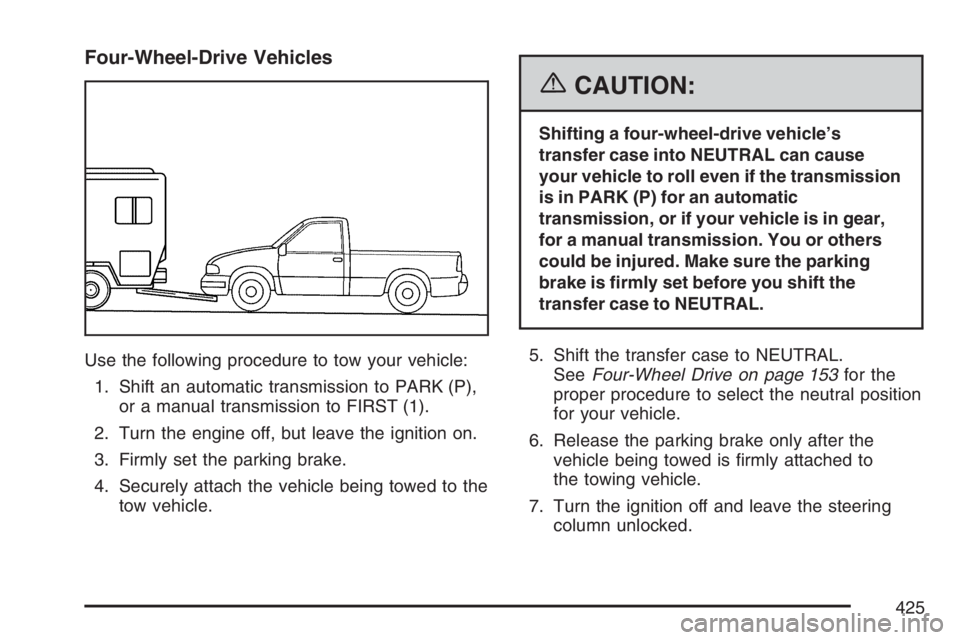
Four-Wheel-Drive Vehicles
Use the following procedure to tow your vehicle:
1. Shift an automatic transmission to PARK (P),
or a manual transmission to FIRST (1).
2. Turn the engine off, but leave the ignition on.
3. Firmly set the parking brake.
4. Securely attach the vehicle being towed to the
tow vehicle.
{CAUTION:
Shifting a four-wheel-drive vehicle’s
transfer case into NEUTRAL can cause
your vehicle to roll even if the transmission
is in PARK (P) for an automatic
transmission, or if your vehicle is in gear,
for a manual transmission. You or others
could be injured. Make sure the parking
brake is rmly set before you shift the
transfer case to NEUTRAL.
5. Shift the transfer case to NEUTRAL.
SeeFour-Wheel Drive on page 153for the
proper procedure to select the neutral position
for your vehicle.
6. Release the parking brake only after the
vehicle being towed is rmly attached to
the towing vehicle.
7. Turn the ignition off and leave the steering
column unlocked.
425
Page 427 of 674
{CAUTION:
Shifting a four-wheel-drive vehicle’s
transfer case into NEUTRAL can cause
your vehicle to roll even if the transmission
is in PARK (P) for an automatic
transmission, or if your vehicle is in gear,
for a manual transmission. You or others
could be injured. Make sure the parking
brake is rmly set before you shift the
transfer case to NEUTRAL.
6. Shift the transfer case to NEUTRAL.
SeeFour-Wheel Drive on page 153for the
proper procedure to select the neutral position
for your vehicle.
7. Release the parking brake only after the
vehicle being towed is rmly attached to
the towing vehicle.
8. Turn the ignition off and lock the steering
column.
Rear Towing
(Rear Wheels Off the Ground)
Two-Wheel-Drive Vehicles
Use the following procedure to tow your vehicle
from the rear:
1. Drive the vehicle onto the dolly.
2. Firmly set the parking brake. SeeParking
Brake on page 169
3. Put an automatic transmission in PARK (P) or
a manual transmission in FIRST (1).
4. Follow the dolly manufacturer’s instructions to
attach and secure the vehicle being towed to
the dolly and then the loaded dolly to the
tow vehicle. Make sure the wheels are straight
before towing.
For manual transmission vehicles, make sure
the wheels are straight before proceeding
to the next steps. On automatic transmission
vehicles, use an adequate clamping device
to ensure that the front wheels are locked into
the straight position.
5. Release the parking brake only after the
vehicle being towed is rmly attached to
the tow vehicle.
6. Turn the ignition to LOCK.
427
Page 452 of 674
Before you start, check all trailer hitch parts and
attachments, safety chains, electrical connector,
lamps, tires and mirror adjustment. If the trailer has
electric brakes, start your vehicle and trailer
moving and then apply the trailer brake controller
by hand to be sure the brakes are working.
This lets you check your electrical connection at
the same time.
During your trip, check occasionally to be sure
that the load is secure, and that the lamps and any
trailer brakes are still working.
While towing a trailer or when exposed to long
periods of sunshine, the oor of the truck bed may
become very warm. Avoid putting items in the
truck bed that might be affected by high ambient
temperatures.
Following Distance
Stay at least twice as far behind the vehicle ahead
as you would when driving your vehicle without
a trailer. This can help you avoid situations
that require heavy braking and sudden turns.
Passing
You’ll need more passing distance up ahead when
you’re towing a trailer. And, because you’re a
good deal longer, you’ll need to go much farther
beyond the passed vehicle before you can
return to your lane.
Backing Up
Hold the bottom of the steering wheel with
one hand. Then, to move the trailer to the left, just
move that hand to the left. To move the trailer to the
right, move your hand to the right. Always back up
slowly and, if possible, have someone guide you.
Making Turns
Notice:Making very sharp turns while
trailering could cause the trailer to come in
contact with the vehicle. Your vehicle could be
damaged. Avoid making very sharp turns
while trailering.
When you’re turning with a trailer, make wider
turns than normal. Do this so your trailer
won’t strike soft shoulders, curbs, road signs,
trees or other objects. Avoid jerky or sudden
maneuvers. Signal well in advance.
452
Page 465 of 674
Service........................................................ 468
Accessories and Modications................... 468
California Proposition 65 Warning.............. 469
Doing Your Own Service Work.................. 469
Adding Equipment to the Outside of
Your Vehicle.......................................... 470
Fuel............................................................. 470
Gasoline Octane........................................ 470
Gasoline Specications.............................. 471
California Fuel........................................... 471
Additives................................................... 472
Fuel E85 (85% Ethanol)............................ 473
Fuels in Foreign Countries........................ 474
Filling the Tank......................................... 474
Filling a Portable Fuel Container............... 477
Checking Things Under the Hood.............. 478
Hood Release........................................... 479
Engine Compartment Overview.................. 480
Engine Oil (Gasoline Engine).................... 486
Engine Oil Life System
(Gasoline Engine).................................. 489
Engine Air Cleaner/Filter
(Gasoline Engines)................................. 491Automatic Transmission Fluid
(Allison Transmission®) .......................... 494
Automatic Transmission Fluid
(Except Allison Transmission
®) ............... 497
Manual Transmission Fluid........................ 500
Hydraulic Clutch........................................ 501
Engine Coolant.......................................... 502
Coolant Surge Tank Pressure Cap............ 505
Engine Overheating................................... 505
Overheated Engine Protection
Operating Mode (V8 Engines Only)........ 508
Cooling System......................................... 508
Engine Fan Noise..................................... 514
Power Steering Fluid ................................. 515
Windshield Washer Fluid........................... 516
Brakes...................................................... 517
Battery...................................................... 520
Jump Starting............................................ 521
Rear Axle.................................................... 527
Four-Wheel Drive........................................ 528
Front Axle................................................... 529
Section 5 Service and Appearance Care
465
Page 479 of 674
Hood Release
To open the hood do the following:
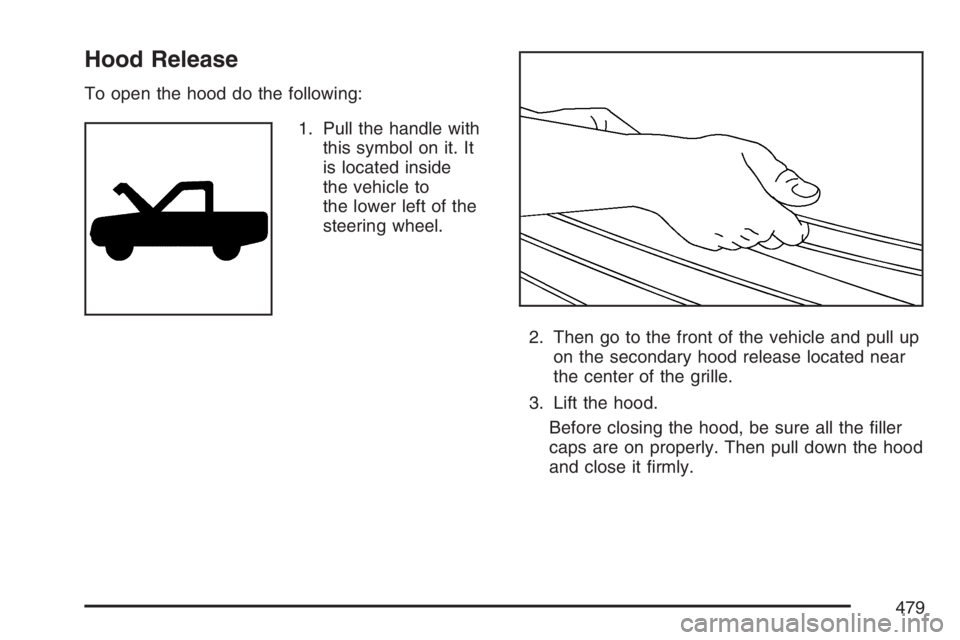
1. Pull the handle with
this symbol on it. It
is located inside
the vehicle to
the lower left of the
steering wheel.
2. Then go to the front of the vehicle and pull up
on the secondary hood release located near
the center of the grille.
3. Lift the hood.
Before closing the hood, be sure all the ller
caps are on properly. Then pull down the hood
and close it rmly.
479
Page 548 of 674
(C) Aspect Ratio:A two-digit number that
indicates the tire height-to-width measurements.
For example, if the tire size aspect ratio is 75, as
shown in item C of the light truck (LT-Metric) tire
illustration, it would mean that the tire’s sidewall is
75 percent as high as it is wide.
(D) Construction Code:A letter code is used to
indicate the type of ply construction in the tire.
The letter R means radial ply construction;
the letter D means diagonal or bias ply
construction; and the letter B means belted-bias
ply construction.
(E) Rim Diameter:Diameter of the wheel in
inches.
(F) Service Description:The service description
indicates the load range and speed rating of a
tire. The load index can range from 1 to 279.
Speed ratings range from A to Z.Tire Terminology and Denitions
Air Pressure:The amount of air inside the tire
pressing outward on each square inch of the
tire. Air pressure is expressed in pounds
per square inch (psi) or kilopascal (kPa).
Accessory Weight:This means the combined
weight of optional accessories. Some examples of
optional accessories are, automatic transmission/
transaxle, power steering, power brakes, power
windows, power seats, and air conditioning.
Aspect Ratio:The relationship of a tire’s height
to its width.
Belt:A rubber coated layer of cords that is
located between the plies and the tread. Cords
may be made from steel or other reinforcing
materials.
Bead:The tire bead contains steel wires wrapped
by steel cords that hold the tire onto the rim.
Bias Ply Tire:A pneumatic tire in which the plies
are laid at alternate angles less than 90 degrees
to the centerline of the tread.
548
Page 563 of 674
CAUTION: (Continued)
Use another type of traction device
only if its manufacturer recommends
it for use on your vehicle and tire size
combination and road conditions. Follow
that manufacturer’s instructions. To help
avoid damage to your vehicle, drive
slowly, readjust or remove the device if it
is contacting your vehicle, and do not
spin your vehicle’s wheels.
If you do nd traction devices that will t,
install them on the rear tires.
Notice:If your vehicle does not have dual
wheels and is equipped with a tire size other
than P265/75R16, LT265/75R16, P265/70R17
or P275/55R20, use tire chains only where legal
and only when you must. Use chains that
are the proper size for your tires. Install them
on the tires of the rear axle. Don’t use
chains on the tires of the front axle.Tighten them as tightly as possible with the
ends securely fastened. Drive slowly and follow
the chain manufacturer’s instructions. If you
can hear the chains contacting your vehicle,
stop and retighten them. If the contact
continues, slow down until it stops. Driving
too fast or spinning the wheels with chains on
will damage your vehicle.
If a Tire Goes Flat
It is unusual for a tire to blowout while you are
driving, especially if you maintain your vehicle’s
tires properly. If air goes out of a tire, it is
much more likely to leak out slowly. But if you
should ever have a blowout, here are a few tips
about what to expect and what to do:
If a front tire fails, the at tire will create a drag
that pulls the vehicle toward that side. Take
your foot off the accelerator pedal and grip the
steering wheel rmly. Steer to maintain lane
position, and then gently brake to a stop well out
of the traffic lane.
563
Page 564 of 674
A rear blowout, particularly on a curve, acts much
like a skid and may require the same correction
you would use in a skid. In any rear blowout
remove your foot from the accelerator pedal. Get
the vehicle under control by steering the way
you want the vehicle to go. It may be very bumpy
and noisy, but you can still steer. Gently brake
to a stop, well off the road if possible.
{CAUTION:
Lifting a vehicle and getting under it to
do maintenance or repairs is dangerous
without the appropriate safety equipment
and training. The jack provided with your
vehicle is designed only for changing a
at tire. If it is used for anything else, you
or others could be badly injured or killed
if the vehicle slips off the jack. Use the
jack provided with your vehicle only for
changing a at tire.
If a tire goes at, the next part shows how to
use the jacking equipment to change a at
tire safely.
Changing a Flat Tire
If a tire goes at, avoid further tire and wheel
damage by driving slowly to a level place. Turn on
your hazard warning ashers. SeeHazard Warning
Flashers on page 212for more information.
{CAUTION:
Changing a tire can be dangerous. The
vehicle can slip off the jack and roll over
or fall on you or other people. You and
they could be badly injured or even killed.
Find a level place to change your tire. To
help prevent the vehicle from moving:
1. Set the parking brake rmly.
2. Put an automatic transmission shift
lever in PARK (P), or shift a manual
transmission to FIRST (1) or
REVERSE (R).
CAUTION: (Continued)
564
Page 623 of 674
Maintenance Footnotes
(Gasoline Engine)
This maintenance section applies to vehicles with
a gasoline engine. If your vehicle has a diesel
engine, see the maintenance schedule section in
the DURAMAX
®Diesel Engine Supplement.
†The U.S. Environmental Protection Agency or
the California Air Resources Board has determined
that the failure to perform this maintenance item
will not nullify the emission warranty or limit
recall liability prior to the completion of the
vehicle’s useful life. We, however, urge that all
recommended maintenance services be performed
at the indicated intervals and the maintenance
be recorded.
#Lubricate the front suspension, steering linkage,
transmission shift linkage, and parking brake
cable guides. Control arm ball joints require
lubrication but should not be lubricated unless
their temperature is 10°F (−12°C) or higher, or they
could be damaged. Vehicles used under severe
commercial operating conditions require lubrication
on a regular basis every 3,000 miles (5 000 km).(a)Visually inspect brake lines and hoses for
proper hook-up, binding, leaks, cracks, chang,
etc. Inspect disc brake pads for wear and rotors for
surface condition. Inspect drum brake
linings/shoes for wear or cracks. Inspect other
brake parts, including drums, wheel cylinders,
calipers, parking brake, etc.
(b)Visually inspect front and rear suspension and
steering system for damaged, loose or missing
parts, signs of wear or lack of lubrication. Inspect
power steering lines and hoses for proper
hook-up, binding, leaks, cracks, chang, etc.
Visually check constant velocity joints, rubber
boots, and axle seals for leaks.
(c)Visually inspect hoses and have them replaced
if they are cracked, swollen, or deteriorated.
Inspect all pipes, ttings and clamps; replace with
genuine GM parts as needed. To help ensure
proper operation, a pressure test of the cooling
system and pressure cap and cleaning the outside
of the radiator and air conditioning condenser is
recommended at least once a year.
(d)Visually inspect wiper blades for wear or
cracking. Replace wiper blades that appear worn
or damaged or that streak or miss areas of
the windshield.
623