If your vehicle has a diesel engine GMC SIERRA CLASSIC 2007 Owners Manual
[x] Cancel search | Manufacturer: GMC, Model Year: 2007, Model line: SIERRA CLASSIC, Model: GMC SIERRA CLASSIC 2007Pages: 674, PDF Size: 3.5 MB
Page 137 of 674
Retained Accessory Power (RAP)
If the vehicle has Retained Accessory Power
(RAP), certain features will continue to operate for
up to 10 minutes after the ignition key is turned
to LOCK unless a door is opened.
Starting the Engine
Your vehicle has a Starter Motor Control. This
feature assists in starting the engine and protects
the electrical system. This feature may cause
the engine to crank even after the ignition key is
not in START.
Automatic Transmission
Move your shift lever to PARK (P) or
NEUTRAL (N). Your engine will not start in any
other position — that is a safety feature. To restart
when you are already moving, use NEUTRAL (N)
only. If you have a diesel engine refer to the
diesel supplement for the starting procedure.Notice:Do not try to shift to PARK (P) if your
vehicle is moving. If you do, you could
damage the transmission. Shift to PARK (P)
only when your vehicle is stopped.
Manual Transmission
The gear selector should be in NEUTRAL (N) and
the parking brake engaged. Hold the clutch
pedal to the oor and start the engine. Your
vehicle will not start if the clutch pedal is not all
the way down — that is a safety feature.
137
Page 146 of 674
Low Traction Mode
(Allison Transmission®)
If your vehicle has the DURAMAX®diesel engine
and the Allison Transmission®,ithasaLow
Traction Mode that assists in vehicle acceleration
when road conditions are slippery, such as
with ice or snow. While at a stop, selecting the
second gear range using the Range Selection
system, will allow the Allison Transmission
®to limit
torque to the wheels after it detects wheel slip,
preventing the tires from spinning.
Notice:Spinning the tires or holding the
vehicle in one place on a hill using only the
accelerator pedal may damage the
transmission. The repair will not be covered by
your warranty. If you are stuck, do not spin
the tires. When stopping on a hill, use the
brakes to hold the vehicle in place.
Cold Weather Operation
(Allison Transmission®)
On cold days, approximately 32°F (0°C) or colder,
your automatic transmission is designed to shift
differently. The transmission uses a warm-up mode
shift schedule until the engine reaches normal
operating temperature. While the transmission is
in warm-up mode it is normal for transmission
upshifts to be delayed or held longer. This feature
improves heater performance by giving quicker
vehicle warm-ups.
When temperatures are below−13°F (−25°C), the
transmission will prevent certain operations to
protect against damage. When active the DIC will
display the message “Trans in Warm-up”.
SeeDIC Warnings and Messages on page 270for
more information.
146
Page 149 of 674
Cruise Grade Braking is available on the 6.6L
DURAMAX®diesel engine. Cruise Grade Braking
monitors a vehicle’s cruise state, engine torque,
acceleration, vehicle speed, and the cruise set
speed. Using this information, it detects when the
truck is accelerating on a downhill grade and will
automatically downshift to slow the vehicle if it
exceeds the cruise set speed by a certain amount.
SeeCruise Control on page 217for more
information.
The Tow/Haul mode and Grade Braking shift
modes can be activated by pressing the button on
the end of the shift control stalk. If your vehicle
has the DURAMAX
®diesel Engine or the
8.1L VORTEC™ gasoline engine, Grade Braking
is only available while the Tow/Haul Mode is
selected. While in the Range Selection Mode,
Grade Braking is deactivated allowing the driver to
select a desired range of gears.
SeeAutomatic Transmission Operation on
page 140for more information.
Also seeTowing a Trailer on page 429for more
information.
Manual Transmission Operation
Five-Speed
(VORTEC™ 6.0L V8 Engine)
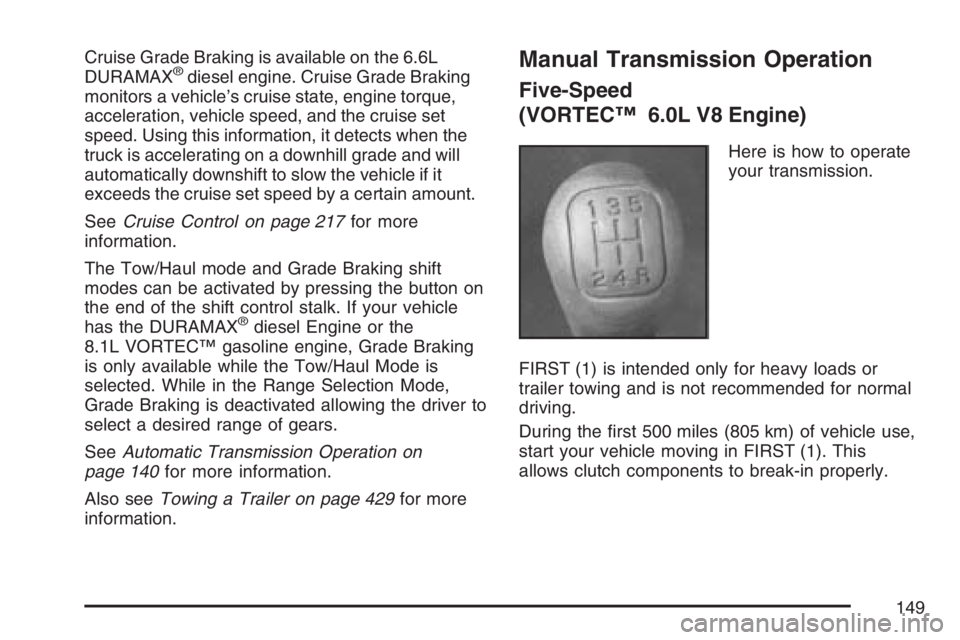
Here is how to operate
your transmission.
FIRST (1) is intended only for heavy loads or
trailer towing and is not recommended for normal
driving.
During the rst 500 miles (805 km) of vehicle use,
start your vehicle moving in FIRST (1). This
allows clutch components to break-in properly.
149
Page 265 of 674
Here are some situations you may experience with
your fuel gage. None of these indicate a problem
with the fuel gage.
At the gas station, the fuel pump shuts off
before the gage reads full.
It takes a little more or less fuel to ll up than
the fuel gage indicated. For example, the
gage may have indicated the tank was half full,
but it actually took a little more or less than
half the tank’s capacity to ll the tank.
The gage goes back to empty when you turn
off the ignition.
If you have a diesel engine, see “Fuel Gage” in
the Diesel Engine Supplement.
Low Fuel Warning Light
The light next to the fuel gage will come on briey
when you are starting the engine.
This light comes on when the fuel tank is low on
fuel. To turn it off, add fuel to the fuel tank.
SeeFuel on page 470.
Driver Information Center (DIC)
The Driver Information Center (DIC) display is
located on the instrument panel cluster, below the
speedometer. If your vehicle has DIC buttons,
they are located on the steering wheel. The DIC
can display information such as the trip odometer,
fuel economy, customization features, and
warning/status messages.
If your vehicle does not have DIC steering wheel
buttons, you will not have all of the features
listed. Scroll through the odometer, trip odometer,
engine hours, and selected range if your vehicle
has an Allison Transmission
®by pressing the
trip odometer reset stem located on the instrument
panel cluster. Turn off, or acknowledge, DIC
messages by pressing the trip odometer reset
stem. SeeSpeedometer and Odometer on
page 246for information on features for vehicles
without DIC buttons.
265
Page 470 of 674
Adding Equipment to the Outside
of Your Vehicle
Things you might add to the outside of your
vehicle can affect the airow around it. This may
cause wind noise and affect windshield washer
performance. Check with your dealer before
adding equipment to the outside of your vehicle.
Fuel
If your vehicle has a diesel engine, see “Diesel
Fuel Requirements and Fuel System” in the
DURAMAX
®Diesel Supplement.
For vehicles with gasoline engines, please
read this.
Gasoline
Use of the recommended fuel is an important part
of the proper maintenance of your vehicle. To
help keep your engine clean and maintain optimum
vehicle performance, GM recommends the use
of gasoline advertised as TOP TIER Detergent
Gasoline.The 8th digit of your Vehicle Identication Number
(VIN) shows the code letter or number that
identies your engine. You will nd the VIN at
the top left of the instrument panel. SeeVehicle
Identication Number (VIN) on page 598.
If your vehicle has the 5.3L V8 engine
(VIN Code Z), you may use either regular
unleaded gasoline or ethanol fuel containing
up to 85% ethanol (E85); also seeFuel E85
(85% Ethanol) on page 473. In all other gasoline
engines, use only regular unleaded gasoline.
Gasoline Octane
For all vehicles, except those with the 6.0L V8
engine (VIN Code N), use regular unleaded
gasoline with a posted octane rating of 87 or
higher. If the octane rating is less than 87,
you may notice an audible knocking noise when
you drive, commonly referred to as spark knock.
If this occurs, use a gasoline rated at 87 octane
or higher as soon as possible. If you are using
gasoline rated at 87 octane or higher and you hear
heavy knocking, your engine needs service.
470
Page 486 of 674
Engine Oil (Gasoline Engine)
If your vehicle has a diesel engine, see “Engine
Oil” in the DURAMAX®Diesel Engine Supplement.
If the CHECK OIL LEVEL light appears on the
instrument cluster, except vehicles that have the
4.3L engine, it means you need to check the
engine oil level right away.
For more information, seeDriver Information
Center (DIC) on page 265. You should check
your engine oil level regularly; this is an added
reminder.
Checking Engine Oil
It is a good idea to check the engine oil every time
you get fuel. In order to get an accurate reading,
the oil must be warm and the vehicle must be
on level ground.
The engine oil dipstick handle is a yellow loop.
SeeEngine Compartment Overview on page 480
for the location of the engine oil dipstick.
1. Turn off the engine and give the oil several
minutes to drain back into the oil pan. If you
do not do this, the oil dipstick might not
show the actual level.
2. Pull out the dipstick and clean it with a paper
towel or cloth, then push it back in all the
way. Remove it again, keeping the tip down,
and check the level.
486
Page 491 of 674
Engine Air Cleaner/Filter
(Gasoline Engines)
If your vehicle has a diesel engine, see “Pickup
Models” under “Engine Air Cleaner/Filter” in
the DURAMAX
®Diesel Supplement for the correct
inspection and replacement procedures.
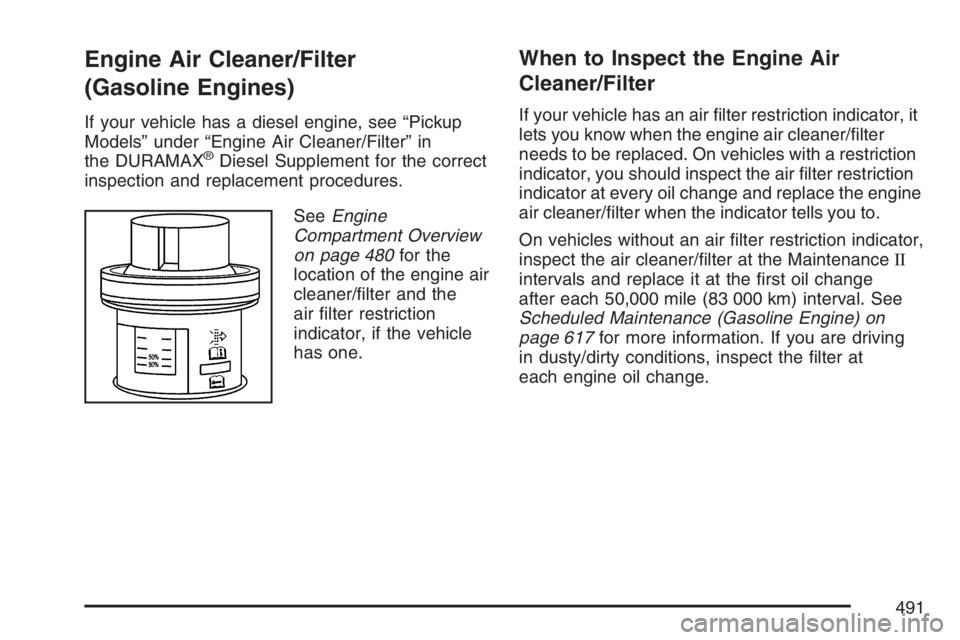
SeeEngine
Compartment Overview
on page 480for the
location of the engine air
cleaner/lter and the
air lter restriction
indicator, if the vehicle
has one.
When to Inspect the Engine Air
Cleaner/Filter
If your vehicle has an air lter restriction indicator, it
lets you know when the engine air cleaner/lter
needs to be replaced. On vehicles with a restriction
indicator, you should inspect the air lter restriction
indicator at every oil change and replace the engine
air cleaner/lter when the indicator tells you to.
On vehicles without an air lter restriction indicator,
inspect the air cleaner/lter at the MaintenanceII
intervals and replace it at the rst oil change
after each 50,000 mile (83 000 km) interval. See
Scheduled Maintenance (Gasoline Engine) on
page 617for more information. If you are driving
in dusty/dirty conditions, inspect the lter at
each engine oil change.
491
Page 511 of 674
How to Add Coolant to the Coolant
Surge Tank for Gasoline Engines
If your vehicle has a diesel engine, see “Cooling
System” in the DURAMAX®Diesel Supplement for
the proper coolant ll procedure.
If you have not found a problem yet, check to see
if coolant is visible in the surge tank. If coolant
is visible but the coolant level is not at or above
the FULL COLD mark, add a 50/50 mixture
of clean, drinkable water and DEX-COOL
®coolant
at the coolant surge tank, but be sure the
cooling system, including the coolant surge tank
pressure cap, is cool before you do it. SeeEngine
Coolant on page 502for more information.If no coolant is visible in the surge tank, add
coolant as follows:
{CAUTION:
Steam and scalding liquids from a hot
cooling system can blow out and burn
you badly. They are under pressure, and if
you turn the coolant surge tank pressure
cap — even a little — they can come out at
high speed. Never turn the cap when the
cooling system, including the coolant
surge tank pressure cap, is hot. Wait for
the cooling system and coolant surge
tank pressure cap to cool if you ever have
to turn the pressure cap.
511
Page 521 of 674
Jump Starting
If your vehicle’s battery (or batteries) has run
down, you may want to use another vehicle and
some jumper cables to start your vehicle. Be sure
to use the following steps to do it safely.
{CAUTION:
Batteries can hurt you. They can be
dangerous because:
They contain acid that can burn you.
They contain gas that can explode or
ignite.
They contain enough electricity to
burn you.
If you do not follow these steps exactly,
some or all of these things can hurt you.
Notice:Ignoring these steps could result in
costly damage to your vehicle that would
not be covered by your warranty.Trying to start your vehicle by pushing or
pulling it will not work, and it could damage
your vehicle.
1. Check the other vehicle. It must have a
12-volt battery with a negative ground system.
Notice:If the other vehicle’s system is
not a 12-volt system with a negative ground,
both vehicles can be damaged. Only use
vehicles with 12-volt systems with negative
grounds to jump start your vehicle.
2. If you have a vehicle with a diesel engine
with two batteries (or more), you should
know before you begin that, especially in cold
weather, you may not be able to get enough
power from a single battery in another vehicle
to start your diesel engine.
If your vehicle has more than one battery, use
the battery that is closer to the starter — this
will reduce electrical resistance.
521
Page 523 of 674
5. Open the hoods and locate the positive (+)
and negative (−) terminal locations of the
other vehicle.
Your vehicle has a remote positive (+) jump
starting terminal and a remote negative (−)
jump starting terminal. You should always
use these remote terminals instead of
the terminals on the battery.
The remote positive (+) terminal is located
behind a red plastic cover, near the engine
accessory drive bracket, if your vehicle
has one. To uncover the remote positive (+)
terminal, open the red plastic cover.
The remote negative (−) terminal is located
on the engine drive bracket on all V8 and
diesel engines, and on the thermostat housing
on the 8.1L engine. On V8 engines it is
marked GND (Ground).
On V6 engines the remote negative (−)
terminal is located on a tab attached to the
engine accessory drive bracket where it
is marked GND (Ground).
SeeEngine Compartment Overview on
page 480for more information on the location
of the remote positive (+) and remote
negative (−) terminals.
{CAUTION:
Using a match near a battery can cause
battery gas to explode. People have been
hurt doing this, and some have been
blinded. Use a ashlight if you need more
light.
Be sure the battery has enough water.
You do not need to add water to the
battery installed in your new vehicle. But
if a battery has ller caps, be sure the
right amount of uid is there. If it is low,
add water to take care of that rst. If you
do not, explosive gas could be present.
Battery uid contains acid that can
burn you. Do not get it on you. If you
accidentally get it in your eyes or on your
skin, ush the place with water and get
medical help immediately.
523