oil GMC SIERRA DENALI 2003 Owner's Guide
[x] Cancel search | Manufacturer: GMC, Model Year: 2003, Model line: SIERRA DENALI, Model: GMC SIERRA DENALI 2003Pages: 428, PDF Size: 20.35 MB
Page 310 of 428
Notice:
Using the wrong fluid can badly damage brake
system parts. For example, just a few drops of
mineral-based
oil, such as engine oil, in your
brake system can damage brake system
parts
so badly that they’ll have to be replaced.
Don’t let someone
put in the wrong kind of fluid.
If you spill brake fluid on your vehicle’s painted
surfaces, the paint finish can be damaged.
Be careful not to spill brake fluid on your
vehicle.
If you do, wash it off immediately.
See “Appearance Care” in the Index.
Brake Wear
Your vehicle has four-wheel disc brakes.
Disc brake pads have built-in wear indicators that make
a high-pitched warning sound when the brake pads
are worn and new pads are needed. The sound
may come and go or be heard all the time your vehicle
is moving (except when you are pushing on the
brake pedal firmly). The
brake wear warning sound means that soon
your brakes won’t work well. That could lead to
an accident. When you hear the brake wear
Notice: Continuing to drive with worn-out brake
pads could result
in costly brake repair.
Some driving conditions or climates may cause a brake
squeal when the brakes are first applied or lightly applied.
This does not mean something is wrong with your brakes.
Properly torqued wheel nuts are necessary to help
prevent brake pulsation. When tires are rotated, inspect
brake pads for wear and evenly tighten wheel nuts in
the proper sequence
to GM torque specifications.
Brake linings should always be replaced as complete
axle sets.
See
Brake System Inspection on page 6- 15
5-41
Page 349 of 428
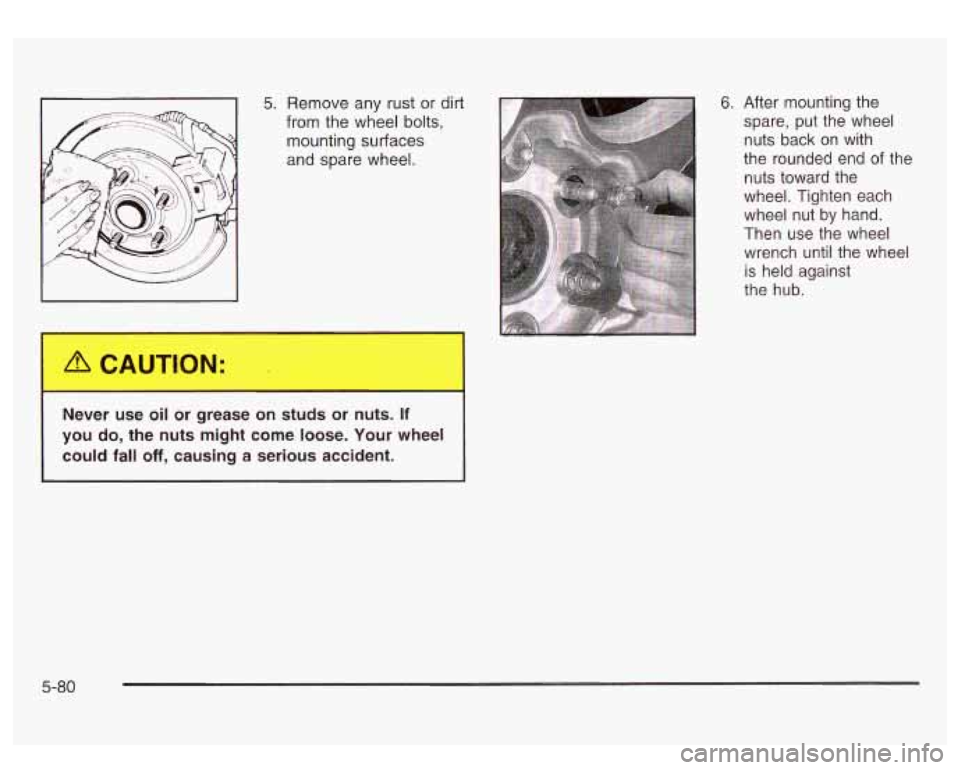
5. Remove any rust or dirt
from the wheel bolts,
mounting surfaces
and spare wheel.
Never use
oil or grease on studs or nuts. It
you do, the nuts might come loose. Your wheel
could fall
off, causing a serious accident.
6. After mounting the
spare, put the wheel
nuts back on with
the rounded end
of the
nuts toward the
wheel. Tighten each
wheel nut by hand.
Then use the wheel
wrench until the wheel is held against
the hub.
5-80
Page 356 of 428
FabricKarpet Leather
Your dealer has cleaners for the cleaning of fabric and
carpet. They will clean normal spots and stains
very well.
You can get
GM - approved cleaning products from
your dealer. See
GM Vehicle Care/Appearance
Materials
on page 5-92.
Here are some cleaning tips:
Always read the instructions on the cleaner label.
Clean up stains as soon as you can - before
they set.
0 Carefully scrape off any excess stain.
Use a clean cloth or sponge, and change to a clean
area often.
A soft brush may be used if stains are
stubborn.
If a ring forms on fabric after spot cleaning, clean
the entire area immediately or it will set.
Vinyl
Use warm water and a clean cloth.
Rub with a clean, damp cloth to remove dirt. You
may have to do this more than once.
Things like tar, asphalt and shoe polish will stain if
you don’t get them off quickly. Use a clean cloth
and vinyl/leather cleaner. See your dealer for
this product. Use a
soft cloth with lukewarm water and a mild soap or
saddle soap and wipe dry with a soft cloth. Then, let
the leather dry naturally.
Do not use heat to dry.
For stubborn stains, use a leather cleaner. See your
dealer for this product.
Never use oils, varnishes, solvent-based or abrasive
cleaners, furniture polish or shoe polish on leather.
immediately.
If dirt is allowed to work into the finish,
it can harm the leather.
Soiled or stained leather should be cleaned
Top of the Instrument Panel
Use only mild soap and water to clean the top surfaces
of the instrument panel. Sprays containing silicones
or waxes may cause annoying reflections in the
windshield and even make it difficult to see through the
windshield under certain conditions.
Interior Plastic Components
Use only a mild soap and water solution on a soft cloth
or sponge. Commercial cleaners may affect the
surface finish.
Wood Panels
Use a clean cloth moistened in warm, soapy water (use
mild dish washing soap).
Dry the wood immediately
with a clean cloth.
5-87
Page 358 of 428
See GM Vehicle Care/Appearance Materials on
page
5-92. Don’t use cleaning agents that are petroleum
based, or that contain acid or abrasives. All cleaning
agents should be flushed promptly and not allowed
to dry on the surface, or they could stain. Dry the finish
with a soft, clean chamois or an all-cotton towel to
avoid surface scratches and water spotting.
High pressure car washes may cause water to enter
your vehicle.
If your vehicle is equipped with QUADRASTEERTM see
QUADRASTEERTM on page 4-10.
Cleaning Exterior Lamps/Lenses
Use only lukewarm or cold water, a soft cloth and a car
washing soap to clean exterior lamps and lenses.
Follow instructions under “Washing Your Vehicle.”
Finish Care
Occasional waxing or mild polishing of your vehicle by
hand may be necessary to remove residue from the
paint finish. You can get GM-approved cleaning products
from your dealer. See
GM Vehicle Care/Appearance
Materials on page
5-92.
If your vehicle has a “basecoat/clearcoaf” paint finish.
The clearcoat gives more depth and gloss to the colored
basecoat. Always use waxes and polishes that are
non-abrasive and made for a basecoatklearcoat paint
finish.
Notice: Machine compounding or aggressive
polishing on a basecoat/clearcoat paint finish may
dull the finish or leave swirl marks.
Foreign materials such as calcium chloride and other
salts, ice melting agents, road oil and tar, tree sap, bird
droppings, chemicals from industrial chimneys, etc.,
can damage your vehicle’s finish
if they remain
on painted surfaces. Wash the vehicle as soon as
possible.
If necessary, use non-abrasive cleaners that
are marked safe for painted surfaces to remove
foreign matter.
Exterior painted surfaces are subject to aging, weather
and chemical fallout that can take their toll over a
period of years. You can help to keep the paint finish
looking new by keeping your vehicle garaged or covered
whenever possible.
Protecting Exterior Bright Metal Parts
Bright metal parts should be cleaned regularly to keep
their luster. Washing with water is all that is usually
needed. However, you may use chrome polish on
chrome or stainless steel trim,
if necessary.
Use special care with aluminum trim.
To avoid damaging
protective trim, never use auto or chrome polish,
steam or caustic soap to clean aluminum. A coating of
wax, rubbed to high polish, is recommended for all
bright metal parts.
5-89
Page 361 of 428
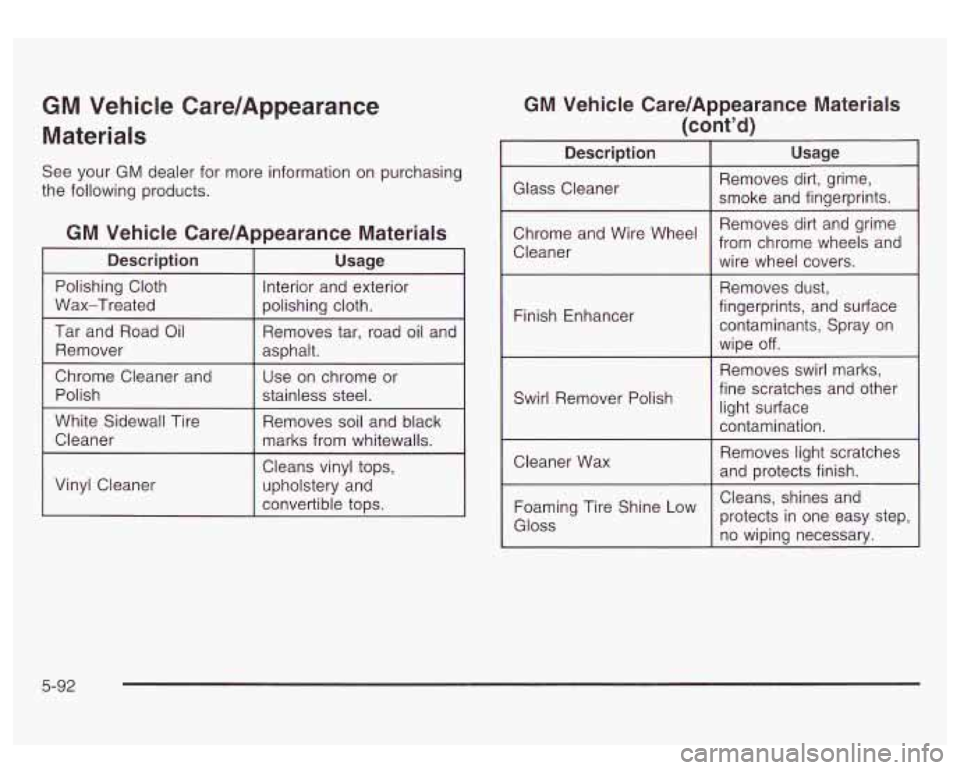
GM Vehicle Care/Appearance
Materials
See your GM dealer for more information on purchasing
the following products.
GM Vehicle Care/Appearance Materials
I Description I Usage I
Polishing Cloth
polishins cloth.
Wax-Treated Interior
and exterior
Tar and Road Oil
Removes tar, road oil and
Remover
I asphalt.
Chrome Cleaner and
Use on chrome or
I Polish stainless steel.
White Sidewall Tire
marks from whitewalls.
Cleaner Removes
soil and black
Vinyl Cleaner Cleans
vinyl tops,
upholstery and
convertible tom.
GM Vehicle Care/Appearance Materials
(cont’d)
I Description
1 Glass Cleaner
I
Chrome and Wire Wheel
Cleaner
Finish Enhancer
I
Swirl Remover Polish
I
Foaming Tire Shine Low
Gloss Usage
Removes dirt, grime,
smoke and fingerprints.
Removes dirt and grime
from chrome wheels and
wire wheel covers.
Removes dust,
fingerprints, and surface
contaminants, Spray on
wipe
off.
Removes swirl marks,
fine scratches and other
light surface
contamination.
Removes light scratches
and protects finish.
Cleans, shines and
protects in one easy step,
no wiping necessary.
5-92
Page 373 of 428
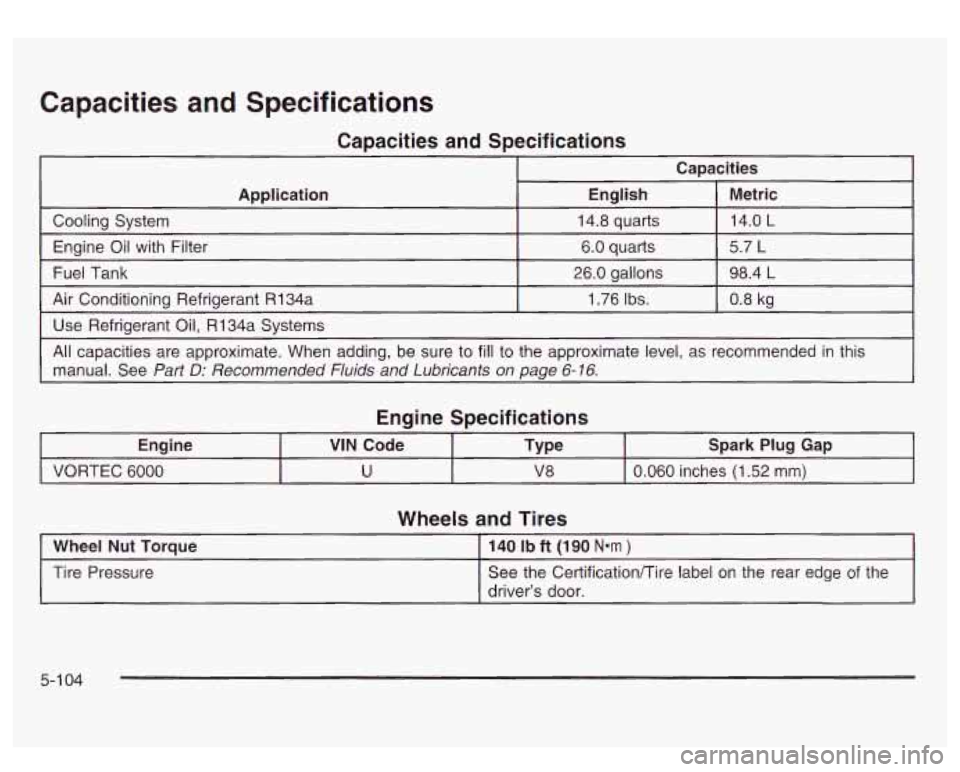
Capacities and Specifications
Capacities and Specifications
Capacities
Application
All capacities are approximate. When adding, be sure to
fill to the approximate level, as recommended in this
Use
Refrigerant Oil, R134a Systems 0.8
kg
1.76 Ibs.
Air Conditioning Refrigerant R134a 98.4
L 26.0 gallons
Fuel
Tank 5.7
L 6.0 quarts
Engine Oil
with Filter 14.0
L 14.8 quarts
Cooling
System Metric
English
manual. See
Part D: Recommended Fluids and Lubricants on page 6-16.
Engine Specifications
Engine Spark Plug Gap
Type
VIN Code
VORTEC 6000
0.060 inches (1.52 mm) V8
U
Wheels and Tires
Wheel Nut Torque
See the CertificationKire label on the rear edge of the
Tire
Pressure 140 Ib ft (190 N*m )
driver’s door.
5-1 04
Page 377 of 428
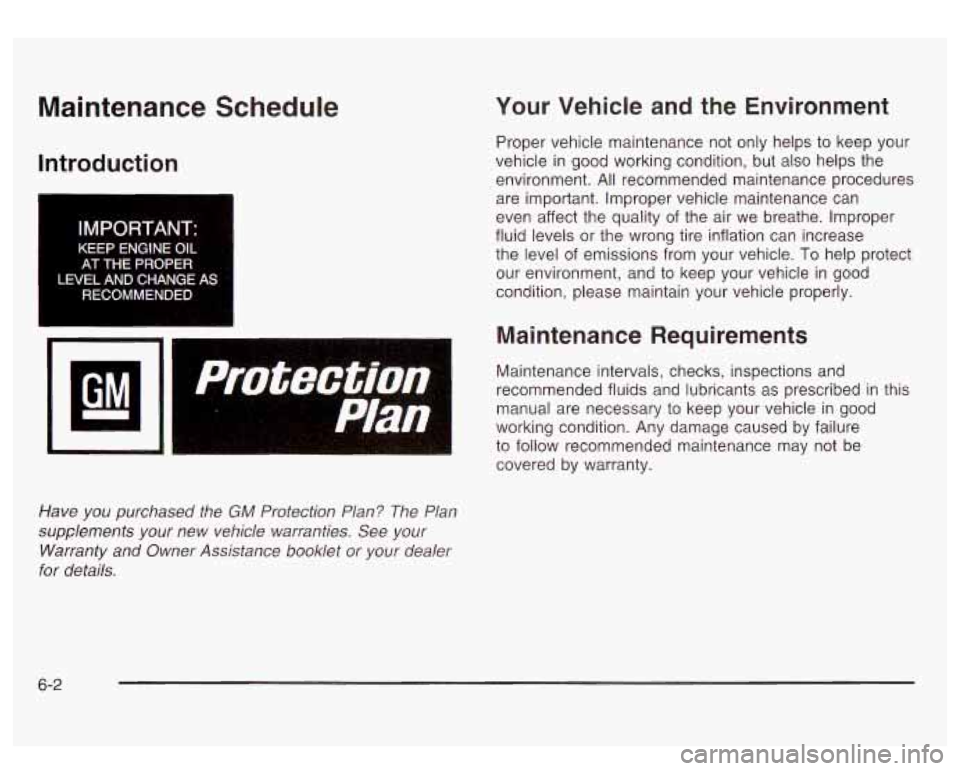
Maintenance Schedule
Introduction
I
IMPORTANT:
KEEP ENGINE OIL
AT THE PROPER
LNEL AND CHANGE
AS
RECOMMENDED
Have you purchased the GM Protection Plan? The Plan
supplements your new vehicle warranties. See your
Warranty and Owner Assistance booklet or your dealer
for details.
Your Vehicle and the Environment
Proper vehicle maintenance not only helps to keep your
vehicle in good working condition, but also helps the
environment. All recommended maintenance procedures
are important. Improper vehicle maintenance can
even affect the quality of the air we breathe. Improper
fluid levels or the wrong tire inflation can increase
the level of emissions from your vehicle.
To help protect
our environment, and to keep your vehicle in good
condition, please maintain your vehicle properly.
Maintenance Requirements
Maintenance intervals, checks, inspections and
recommended fluids and lubricants as prescribed in this
manual are necessary to keep your vehicle in good
working condition. Any damage caused by failure
to follow recommended maintenance may not be
covered by warranty.
6-2
Page 379 of 428
Part A: Scheduled Maintenance
Services
This part contains engine oil and chassis lubrication scheduled maintenance which explains the engine oil life
system and how it indicates when to change the
engine oil and filter. Lubricate chassis components with
each oil change.
Also, listed are scheduled maintenance
services which are to be performed at the mileage
intervals specified.
Using Your Maintenance Schedule
We at General Motors want to help you keep your
vehicle in good condition. But we don’t know exactly how
you’ll drive it. You may drive very short distances only
a few times a week. Or you may drive long distances in
very hot, dusty weather. You may use your vehicle in
making deliveries. Or yo may drive
it to work, to
do errands or in many other ways.
Because
of all the different ways people use their
vehicles, maintenance needs vary. You may need more
frequent checks and replacements.
So please read
the following and note how you drive.
If you have any
questions on how to keep your vehicle in good condition,
see your dealer. This part tells
you the maintenance services you should
have done and when you should schedule them.
When you go to your dealer for your service needs,
you’ll know that GM-trained and supported service
people will perform the work using genuine
GM parts.
The proper fluids and lubricants
so use are listed in Part
D. Make sure whoever services your vehicle uses
these.
All parts should be replaced and all necessary
repairs done before you or anyone else drives the
vehicle.
This schedule is for vehicles that:
carry passengers and cargo within recommended
limits. You will find these limits on your vehicle’s
Certification/Tire label. See
Loading Your Vehicle on
page 4-45.
are driven on reasonable road surfaces within legal
driving limits.
are driven off-road in the recommended manner.
See
Operating Your All- Wheel-Drive Vehicle Off
Paved Roads on page 4- 16.
use the recommended fuel. See Gasoline Octane
on page 5-5.
6-4
Page 380 of 428
Scheduled Maintenance
The services shown in this schedule up to 100,000 miles
(1 66 000 km) should be repeated after 100,000 miles
(1 66 000 km) at the same intervals for the life of
this vehicle. The services shown at
150,000 miles
(240
000 km) and 200,000 miles (332 000 km) should
be repeated at the same intervals after 150,000 miles
(240
000 km) and 200,000 miles (332 000 km) for the life
of this vehicle.
See
Part B: Owner Checks and Services on page 6-10
and Part C: Periodic Maintenance Inspections on
page
6- 14.
Footnotes
t The U.S. Environmental Protection Agency or the
California Air Resources Board has determined that the
failure to perform this maintenance item will not nullify
the emission warranty or limit recall liability prior to
the completion of the vehicle
's useful life. We, however,
urge that all recommended maintenance services be
performed at the indicated intervals and the
maintenance be recorded.
+ A good time to check your brakes is during tire
rotation. See Brake System Inspection on page
6-15.
Engine Oil and Chassis Lubrication
Scheduled Maintenance
Change engine oil and filter as indicated by the GM
Oil Life SystemTM (or every 12 months, whichever
occurs first). Reset the system.
Your vehicle has a computer system that lets you know
when to change the engine oil and filter. This is
based on engine revolutions and engine temperature,
and not on mileage. Based on driving conditions,
the mileage at which an oil change will be indicated can
vary considerably. For the oil life system to work
properly, you must reset the system every time the oil is
changed.
When the system has calculated that oil life has been
diminished, it will indicate that an oil change
is
necessary. A CHANGE ENGINE OIL message will
come on. Change your oil as soon as possible within
the next two times you stop for fuel. It is possible that,
it
you are driving under the best conditions, the oil life
system may not indicate that an
oil change is necessary
for over a year. However, your engine
oil and filter
must be changed at least once a year and at this time
the system must be reset. It
is also important to
check your oil regularly and keep
it at the proper level.
6-5
Page 381 of 428
If the system is ever reset accidentally, you must
change your oil at
3,000 miles (5 000 km) since your
last oil change. Remember to reset the oil life system
whenever the oil is changed. See
Engine Oil on
page 5-73
for information on resetting the system.
An Emission Control Service.
Lubricate chassis components with each engine oil
and filter change.
Lubricate the front suspension, ball joints, steering
linkage, transmission shift linkage, transfer case shift
linkage and parking brake cable guides. Ball joints
should not be lubricated unless their temperature is
10°F (-12°C) or higher or they could be damaged.
After the services are performed, record the date,
odometer reading and who performed the service on the
maintenance record pages in Part
E of this schedule.
7,500 Miles (12 500 km)
0 Check readfront axle fluid level and add fluid as
needed. Check constant velocity joints and axle seals
for leaking.
page 5-62 for proper rotation pattern and additional
information.
(See footnote +.)
0 Rotate tires. See Tire Inspection and Rotation on
15,000 Miles (25 000 km)
0 Inspect engine air cleaner filter if you are driving in
dusty conditions. Replace filter
if necessary. An
Emission Control Service. (See footnote
t.)
0 Check readfront axle fluid level and add fluid as
needed. Check constant velocity joints and axle seals
for leaking.
0 Rotate tires. See Tire Inspection and Rotation on
page 5-62
for proper rotation pattern and additional
information.
(See footnote +.)
6-6