tow GMC SIERRA DENALI 2003 Repair Manual
[x] Cancel search | Manufacturer: GMC, Model Year: 2003, Model line: SIERRA DENALI, Model: GMC SIERRA DENALI 2003Pages: 428, PDF Size: 20.35 MB
Page 344 of 428
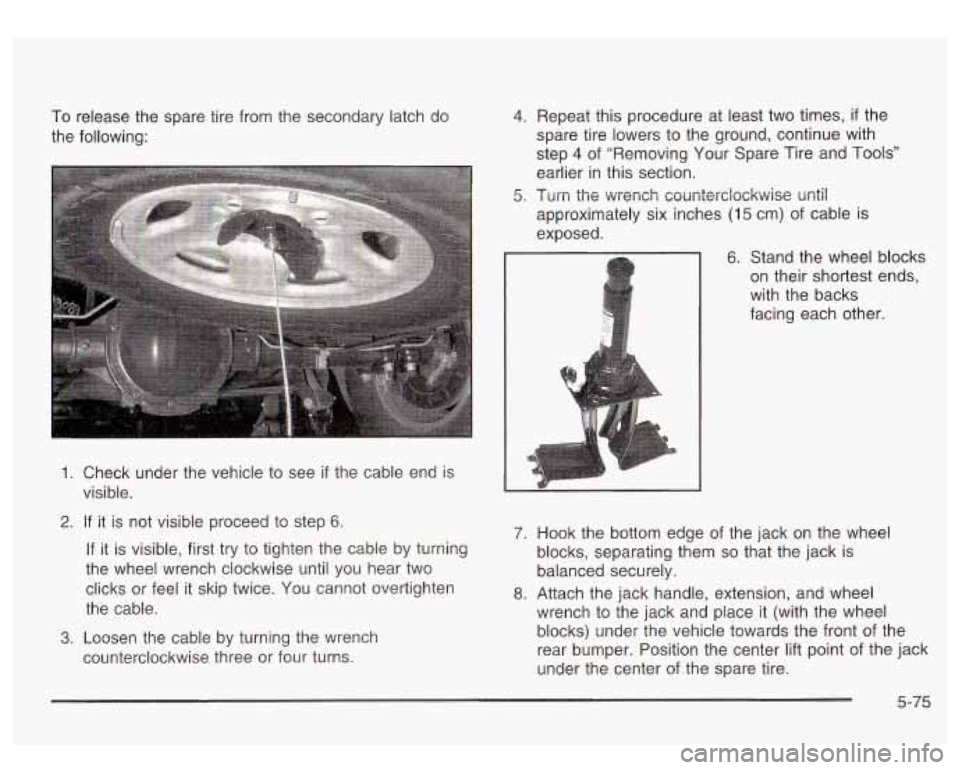
To release the spare tire from the secondary latch do
the following:
1. Check under the vehicle to see if the cable end is
visible.
2. If it is not visible proceed to step 6.
If it is visible, first try to tighten the cable by turning
the wheel wrench clockwise until you hear two
clicks or feel it skip twice. You cannot overtighten
the cable.
3. Loosen the cable by turning the wrench
counterclockwise three or four turns.
4. Repeat this procedure at least two times, if the
spare tire lowers to the ground, continue with
step
4 of “Removing Your Spare Tire and Tools”
earlier in this section.
approximately six inches
(1 5 cm) of cable is
5. Turn the wrench counterclockwise until
exposed.
6. Stand the wheel blocks
on their shortest ends,
with the backs
facing each other.
7. Hook the bottom edge of the jack on the wheel
blocks, separating them
so that the jack is
balanced securely.
8. Attach the jack handle, extension, and wheel
wrench to the jack and place it (with the wheel
blocks) under the vehicle towards the front of the
rear bumper. Position the center
lift point of the jack
under the center of the spare tire.
5-75
Page 348 of 428
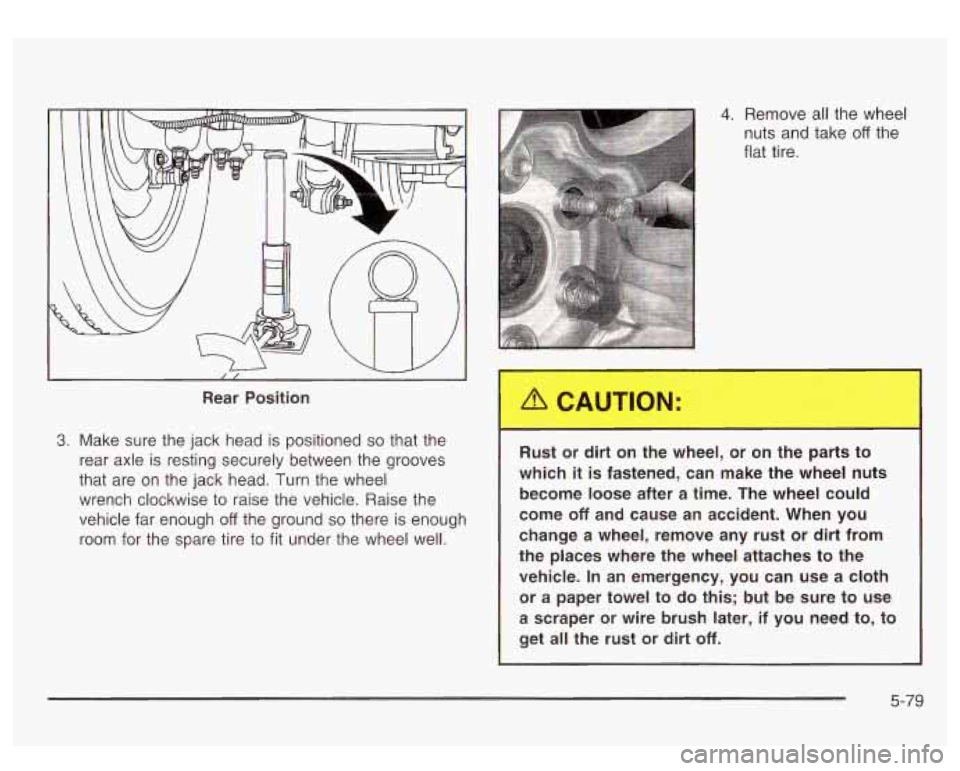
Rear Position
3. Make sure the jack head is positioned so that the
rear axle
is resting securely between the grooves
that are on the jack head. Turn the wheel
wrench clockwise to raise the vehicle. Raise the
vehicle far enough
off the ground so there is enough
room for the spare tire to
fit under the wheel well.
4. Remove all the wheel
nuts and take
off the
flat tire.
Rust or dirt on the wheel, or on the parts to
which
it is fastened, can make the wheel nuts
become loose after a time. The wheel could
come
off and cause an accident. When you
change
a wheel, remove any rust or dirt from
the places where the wheel attaches to the
vehicle. In an emergency, you can use a cloth
or
a paper towel to do this; but be sure to use
a scraper or wire brush later, if you need to, to
get all the rust
or dirt off.
5-79
Page 349 of 428
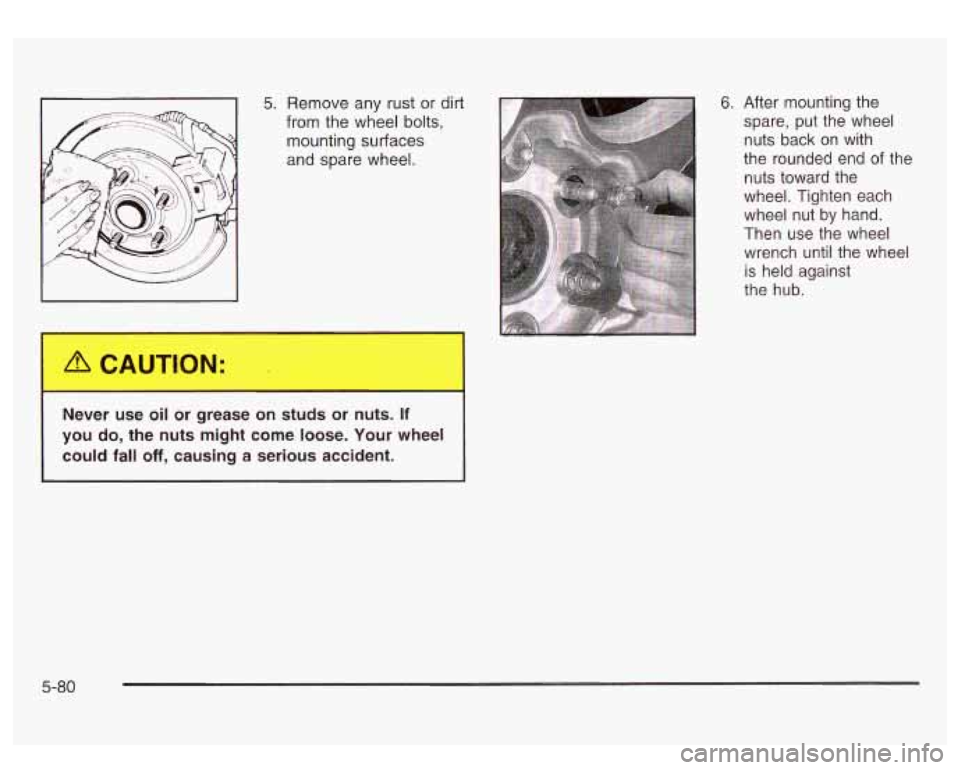
5. Remove any rust or dirt
from the wheel bolts,
mounting surfaces
and spare wheel.
Never use
oil or grease on studs or nuts. It
you do, the nuts might come loose. Your wheel
could fall
off, causing a serious accident.
6. After mounting the
spare, put the wheel
nuts back on with
the rounded end
of the
nuts toward the
wheel. Tighten each
wheel nut by hand.
Then use the wheel
wrench until the wheel is held against
the hub.
5-80
Page 352 of 428
Storing a Flat or Spare Tire and Tools
--xing a jack, a --:e, or ---ier equipment in the
passenger compartment
of the vehicle could
cause injury. In a sudden stop or collision,
loose equipment could strike someone. Store
all these in the proper place.
Notice: An aluminum wheel with a flat tire should
always be stored under the vehicle with the hoist. However, storing
it that way for an extended
period
of time could damage the wheel. To avoid
this, always stow the wheel properly with the valve
stem pointing down and have the wheel repaired
as soon as possible.
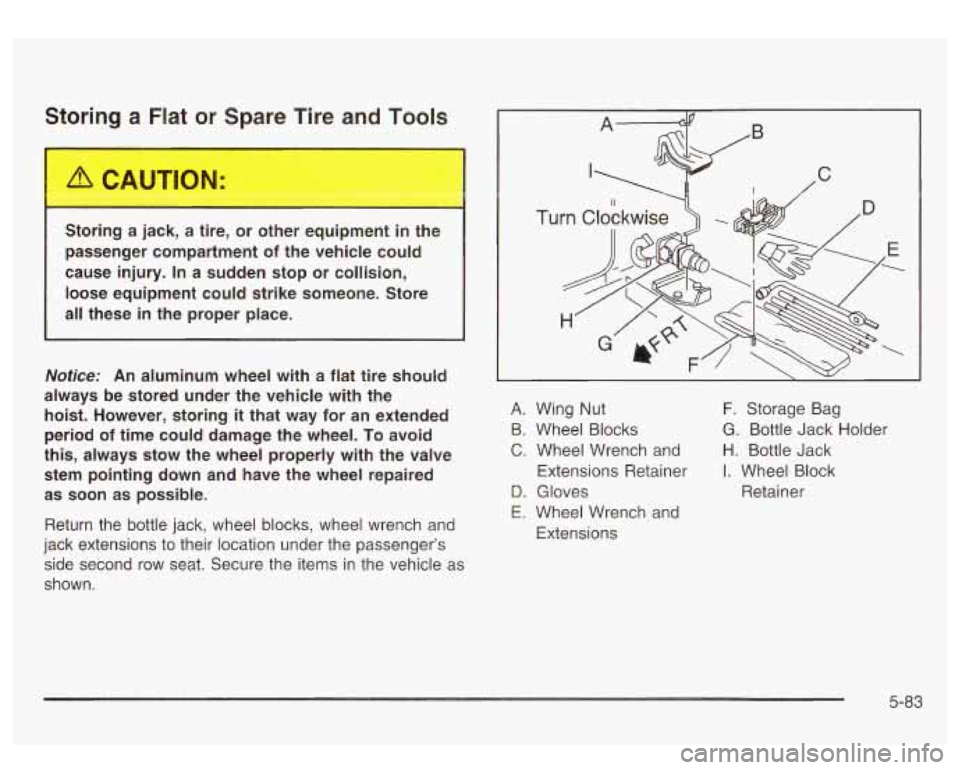
Return the bottle jack, wheel blocks, wheel wrench and
jack extensions to their location under the passenger’s
side second row seat. Secure the items in the vehicle as
shown.
Tu
A. Wing Nut F. Storage Bag
B. Wheel Blocks G. Bottle Jack Holder
C. Wheel Wrench and H. Bottle Jack
Extensions Retainer
I. Wheel Block
D. Gloves Retainer
E. Wheel Wrench and
Extensions
5-83
Page 353 of 428
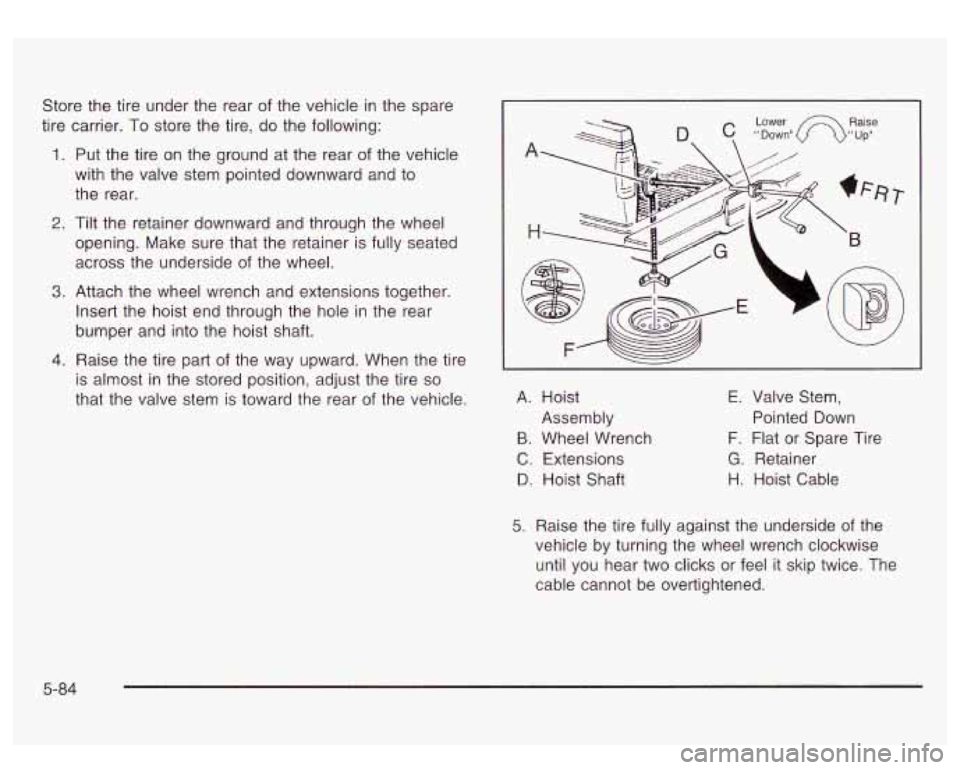
Store the tire under the rear of the vehicle in the spare
tire carrier. To store the tire, do the following:
1. Put the tire on the ground at the rear of the vehicle
with the valve stem pointed downward and to
the rear.
2. Tilt the retainer downward and through the wheel
opening. Make sure that the retainer is fully seated
across the underside of the wheel.
3. Attach the wheel wrench and extensions together.
Insert the hoist end through the hole in the rear
bumper and into the hoist shaft.
4. Raise the tire part of the way upward. When the tire
is almost in the stored position, adjust the tire
so
that the valve stem is toward the rear of the vehicle. A.
Hoist
B. Wheel Wrench
C. Extensions
D. Hoist Shaft
Assembly
E. Valve Stem,
Pointed Down
F. Flat or Spare Tire
G. Retainer
H. Hoist Cable
5. Raise the tire fully against the underside of the
vehicle by turning the wheel wrench clockwise
until you hear two clicks or feel it skip twice. The
cable cannot be overtightened.
5-84
Page 358 of 428
See GM Vehicle Care/Appearance Materials on
page
5-92. Don’t use cleaning agents that are petroleum
based, or that contain acid or abrasives. All cleaning
agents should be flushed promptly and not allowed
to dry on the surface, or they could stain. Dry the finish
with a soft, clean chamois or an all-cotton towel to
avoid surface scratches and water spotting.
High pressure car washes may cause water to enter
your vehicle.
If your vehicle is equipped with QUADRASTEERTM see
QUADRASTEERTM on page 4-10.
Cleaning Exterior Lamps/Lenses
Use only lukewarm or cold water, a soft cloth and a car
washing soap to clean exterior lamps and lenses.
Follow instructions under “Washing Your Vehicle.”
Finish Care
Occasional waxing or mild polishing of your vehicle by
hand may be necessary to remove residue from the
paint finish. You can get GM-approved cleaning products
from your dealer. See
GM Vehicle Care/Appearance
Materials on page
5-92.
If your vehicle has a “basecoat/clearcoaf” paint finish.
The clearcoat gives more depth and gloss to the colored
basecoat. Always use waxes and polishes that are
non-abrasive and made for a basecoatklearcoat paint
finish.
Notice: Machine compounding or aggressive
polishing on a basecoat/clearcoat paint finish may
dull the finish or leave swirl marks.
Foreign materials such as calcium chloride and other
salts, ice melting agents, road oil and tar, tree sap, bird
droppings, chemicals from industrial chimneys, etc.,
can damage your vehicle’s finish
if they remain
on painted surfaces. Wash the vehicle as soon as
possible.
If necessary, use non-abrasive cleaners that
are marked safe for painted surfaces to remove
foreign matter.
Exterior painted surfaces are subject to aging, weather
and chemical fallout that can take their toll over a
period of years. You can help to keep the paint finish
looking new by keeping your vehicle garaged or covered
whenever possible.
Protecting Exterior Bright Metal Parts
Bright metal parts should be cleaned regularly to keep
their luster. Washing with water is all that is usually
needed. However, you may use chrome polish on
chrome or stainless steel trim,
if necessary.
Use special care with aluminum trim.
To avoid damaging
protective trim, never use auto or chrome polish,
steam or caustic soap to clean aluminum. A coating of
wax, rubbed to high polish, is recommended for all
bright metal parts.
5-89
Page 359 of 428
Windshield and Wiper Blades
If the windshield is not clear after using the windshield
washer, or
if the wiper blade chatters when running,
wax, sap or other material may be on the blade or
windshield.
Clean the outside of the windshield with a full-strength
glass cleaning liquid. The Windshield is clean
if beads do
not form when you rinse it with water.
Grime from the windshield will stick to the wiper blades
and affect their performance. Clean the blade by
wiping vigorously with a cloth soaked in full-strength
windshield washer solvent. Then rinse the blade
with water.
Check the wiper blades and clean them as necessary;
replace blades that look worn.
Aluminum or Chrome-Plated Wheels
Your vehicle may be equipped with either aluminum or
chrome-plated wheels.
Keep your wheels clean using a soft clean cloth with
mild soap and water. Rinse with clean water. After
rinsing thoroughly, dry with a
soft clean towel. A wax
may then be applied. The
surface of these wheels is similar to the painted
surface of your vehicle. Don’t use strong soaps,
chemicals, abrasive polishes, abrasive cleaners,
cleaners with acid, or abrasive cleaning brushes on
them because you could damage the surface. Do not
use chrome polish on aluminum wheels.
Use chrome polish only on chrome-plated wheels, but
avoid any painted surface of the wheel, and buff
off
immediately after application.
Don’t take your vehicle through an automatic car wash
that has silicone carbide tire cleaning brushes. These
brushes can also damage the surface of these wheels.
Tires
To clean your tires, use a stiff brush with tire cleaner.
Nofice: When applying a tire dressing, always take
care to wipe
off any overspray or splash from all
painted surfaces
on the body or wheels of the
vehicle. Petroleum-based products may damage the paint finish and tires.
5-90
Page 382 of 428
22,500 Miles (37 500 km)
0 Check readfront axle fluid level and add fluid as
needed. Check constant velocity joints and axle seals
for leaking.
page 5-62 for proper rotation pattern and additional
information.
(See footnote +.)
0 Rotate tires. See Tire Inspection and Rotation on
30,000 Miles (50 000 km)
CI Check readfront axle fluid level and add fluid as
needed. Check constant velocity joints and axle seals
for leaking.
page 5-62 for proper rotation pattern and additional
information.
(See footnote +.)
0 Replace fuel filter. An Emission Control Service. (See
0 Rotate tires. See Tire Inspection and Rotation on
footnote
t.)
Control Service.
Ll Replace engine air cleaner filter. An Emission
37,500 Miles (62 500 km)
0 Check readfront axle fluid level and add fluid as
needed. Check constant velocity joints and axle
s
for leaking.
0 Rotate tires. See Tire Inspection and Rotation on
ea1 S
45,000 Miles (75 000 km)
0 Inspect engine air cleaner filter if you are driving in
dusty conditions. Replace filter
if necessary. An
Emission Control Service. (See footnote
t.)
0 Check readfront axle fluid level and add fluid as
needed. Check constant velocity joints and axle seals
for leaking.
page 5-62 for proper rotation pattern and additional
information.
(See footnote +.)
CI Rotate tires. See Tire Inspection and Rotation on
50,000 Miles (83 000 km)
0 Change automatic transmission fluid and filter if the
vehicle is mainly driven under one or more of these
conditions:
- In heavy city traffic where the outside
temperature regularly reaches
90°F (32°C) or
higher.
- In hilly or mountainous terrain.
- When doing frequent trailer towing.
- Uses such as found in taxi, police or delivery
service.
If you do not use your vehicle under any of these
conditions, change the fluid and filter at
100,000 miles
(166
000 km).
page 5-62
for proper rotation pattern and additional
information.
(See footnote +.)
6-7
Page 384 of 428
90,000 Miles (150 000 km)
0 Check readfront axle fluid level and add fluid as
needed. Check constant velocity joints and axle seals
for leaking.
0 Replace fuel filter. An Emission Control Service. (See
Footnote
t.)
0 Replace engine air cleaner filter. An Emission
Control Service.
0 Rotate tires. See Tire Inspection and Rotation on
page 5-62
for proper rotation pattern and additional
information.
(See footnote +.)
97,500 Miles (162 500 km)
c[I Check readfront axle fluid level and add fluid as
needed. Check constant velocity joints and axle seals
for leaking.
page 5-62 for proper rotation pattern and additional
information.
(See footnote +.)
0 Rotate tires. See Tire Inspection and Rotation on
100,000 Miles (166 000 km)
0 Inspect spark plug wires. An Emission Control
0 Replace spark plugs. An Emission Control Service.
Service.
0 Change automatic
transmission fluid and filter if the
vehicle
is mainly driven under one or more of these
conditions:
- In heavy city traffic where the outside
temperature regularly reaches
90°F (32°C) or
higher.
- In hilly or mountainous terrain.
- When doing frequent trailer towing.
- Uses such as found in taxi, police or delivery
service.
0 If you haven’t used your vehicle under severe service
conditions listed previously and, therefore, haven’t
changed your automatic transmission fluid, change
both the fluid and filter.
0 Inspect Positive Crankcase Ventilation (PCV) valve.
An Emission Control Service.
150,000 Miles (240 000 km)
0 Drain, flush and refill cooling system (or every
60 months since last service, whichever occurs first).
See
Engine Coolant on page 5-24 for what to use.
Inspect hoses. Clean radiator, condenser, pressure
cap and neck. Pressure test the cooling system
and pressure cap.
An Emission Control Service.
0 Inspect engine accessory drive belt. An Emission
Control Service.
6-9
Page 400 of 428
GM Mobility Program for Persons
with Disabilities
This program, available to
qualified applicants, can
reimburse you up to
$1,000 toward aftermarket
driver or passenger
adaptive equipment you
may require for your
vehicle (hand controls,
wheelchair/scooter lifts, etc.).
This program can also provide you with free resource
information, such as area driver assessment centers and
mobility equipment installers. The program is available
for a limited period
of time from the date of vehicle
purchase/lease. See your dealer for more details or call
the GM Mobility Assistance Center at 1-800-323-9935.
Text telephone (TTY) users, call 1-800-833-9935.
GM of Canada also has a Mobility Program. Call
1-800-GM-DRIVE (463-7483) for details. All TTY users
call 1-800-263-3830.
Roadside Assistance Program
GMC’s Roadside Assistance Provides stranded owners
with over-the-phone roadside repairs, location of the
nearest GMC dealer or the following special
services:
Flat Tire Change: Installation of spare tire will be
covered at no charge (customer is responsible for repair
or replacement of tire).
Fuel Delivery: Delivery of enough fuel for the customer
to get to the nearest service station (up to
$5.00)
will be covered.
Jump Start: No-start situations which require a battery
jump start will be covered at
no charge.
Lock Out: Replacement keys or locksmith service will be
covered at no charge
if you are unable to gain entry
into your vehicle. Delivery of the replacement key will be
covered within 10 miles (16 km).
Emergency Towing Sewice: Towing to the nearest GMC
dealer for warranty related disablements will be
covered.
7-5