brake light GMC SIERRA DENALI 2005 User Guide
[x] Cancel search | Manufacturer: GMC, Model Year: 2005, Model line: SIERRA DENALI, Model: GMC SIERRA DENALI 2005Pages: 428, PDF Size: 2.5 MB
Page 229 of 428
Driving Downhill
When off-roading takes you downhill, you will want to
consider a number of things:
How steep is the downhill? Will I be able to maintain
vehicle control?
What is the surface like? Smooth? Rough?
Slippery? Hard-packed dirt? Gravel?
Are there hidden surface obstacles? Ruts? Logs?
Boulders?
What is at the bottom of the hill? Is there a hidden
creek bank or even a river bottom with large rocks?
If you decide you can go down a hill safely, then try to
keep your vehicle headed straight down, and use a
low gear. This way, engine drag can help your brakes
and they will not have to do all the work. Descend
slowly, keeping your vehicle under control at all times.
{CAUTION:
Heavy braking when going down a hill can
cause your brakes to overheat and fade. This
could cause loss of control and a serious
accident. Apply the brakes lightly when
descending a hill and use a low gear to keep
vehicle speed under control.
Q:Are there some things I should not do when
driving down a hill?
A:Yes! These are important because if you ignore
them you could lose control and have a serious
accident.
When driving downhill, avoid turns that take you
across the incline of the hill. A hill that is not too
steep to drive down may be too steep to drive
across. You could roll over if you do not drive
straight down.
Never go downhill with the transmission in
NEUTRAL (N). This is called “free-wheeling.” Your
brakes will have to do all the work and could
overheat and fade.
4-21
Page 237 of 428
{CAUTION:
Wet brakes can cause accidents. They will not
work as well in a quick stop and may cause
pulling to one side. You could lose control of
the vehicle.
After driving through a large puddle of water
or a car wash, apply your brake pedal lightly
until your brakes work normally.
Hydroplaning
Hydroplaning is dangerous. So much water can build up
under your tires that they can actually ride on the
water. This can happen if the road is wet enough and
you are going fast enough. When your vehicle is
hydroplaning, it has little or no contact with the road.
Hydroplaning does not happen often. But it can if your
tires do not have much tread or if the pressure in
one or more is low. It can happen if a lot of water is
standing on the road. If you can see reections
from trees, telephone poles, or other vehicles, and
raindrops dimple the water’s surface, there could be
hydroplaning.Hydroplaning usually happens at higher speeds. There
just is not a hard and fast rule about hydroplaning.
The best advice is to slow down when it is raining.
Driving Through Deep Standing Water
Notice:If you drive too quickly through deep
puddles or standing water, water can come in
through your engine’s air intake and badly damage
your engine. Never drive through water that is
slightly lower than the underbody of your vehicle. If
you cannot avoid deep puddles or standing water,
drive through them very slowly.
4-29
Page 270 of 428
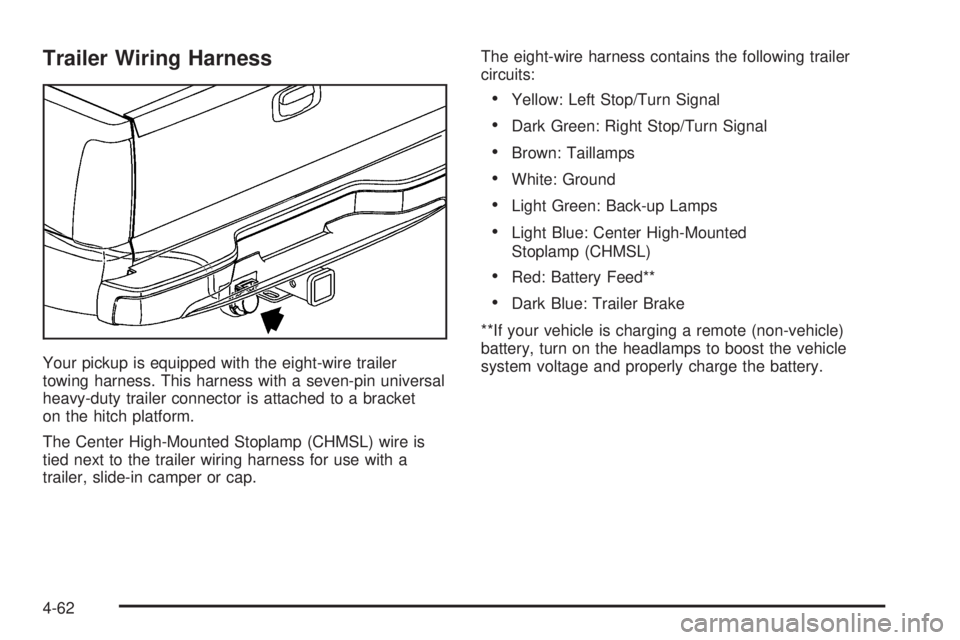
Trailer Wiring Harness
Your pickup is equipped with the eight-wire trailer
towing harness. This harness with a seven-pin universal
heavy-duty trailer connector is attached to a bracket
on the hitch platform.
The Center High-Mounted Stoplamp (CHMSL) wire is
tied next to the trailer wiring harness for use with a
trailer, slide-in camper or cap.The eight-wire harness contains the following trailer
circuits:
Yellow: Left Stop/Turn Signal
Dark Green: Right Stop/Turn Signal
Brown: Taillamps
White: Ground
Light Green: Back-up Lamps
Light Blue: Center High-Mounted
Stoplamp (CHMSL)
Red: Battery Feed**
Dark Blue: Trailer Brake
**If your vehicle is charging a remote (non-vehicle)
battery, turn on the headlamps to boost the vehicle
system voltage and properly charge the battery.
4-62
Page 311 of 428
Brake Wear
Your vehicle has four-wheel disc brakes.
Disc brake pads have built-in wear indicators that make a
high-pitched warning sound when the brake pads are
worn and new pads are needed. The sound may come
and go or be heard all the time your vehicle is moving,
except when you are pushing on the brake pedal rmly.
{CAUTION:
The brake wear warning sound means that soon
your brakes will not work well. That could lead
to an accident. When you hear the brake wear
warning sound, have your vehicle serviced.
Notice:Continuing to drive with worn-out brake
pads could result in costly brake repair.Some driving conditions or climates may cause a brake
squeal when the brakes are rst applied or lightly
applied. This does not mean something is wrong with
your brakes.
Properly torqued wheel nuts are necessary to help
prevent brake pulsation. When tires are rotated, inspect
brake pads for wear and evenly tighten wheel nuts in
the proper sequence to GM torque specications.
Brake linings should always be replaced as complete
axle sets.
Brake Pedal Travel
See your dealer if the brake pedal does not return to
normal height, or if there is a rapid increase in
pedal travel. This could be a sign of brake trouble.
Brake Adjustment
Every time you make a brake stop, your disc brakes
adjust for wear.
5-39
Page 332 of 428
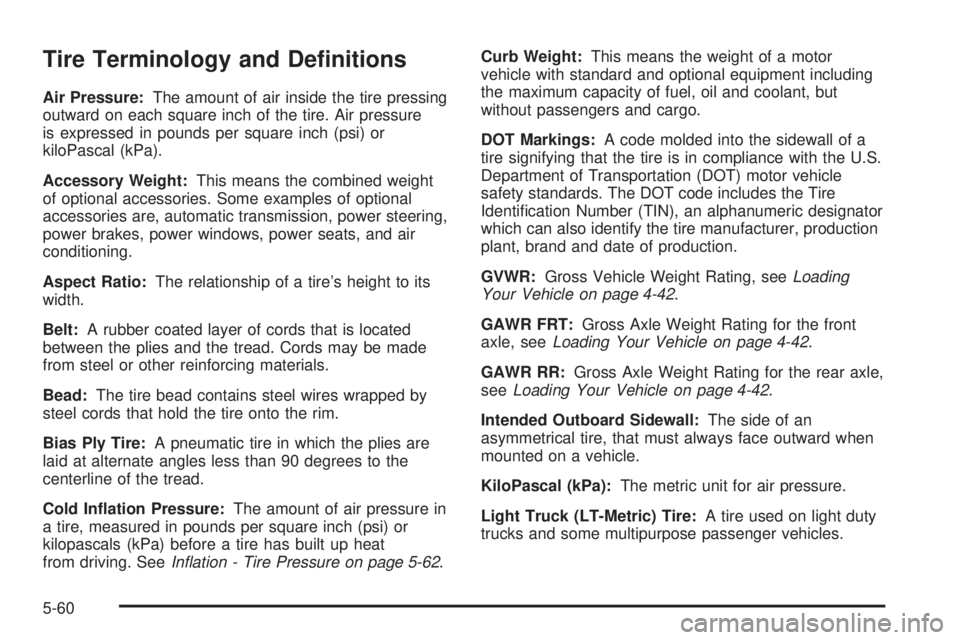
Tire Terminology and Denitions
Air Pressure:The amount of air inside the tire pressing
outward on each square inch of the tire. Air pressure
is expressed in pounds per square inch (psi) or
kiloPascal (kPa).
Accessory Weight:This means the combined weight
of optional accessories. Some examples of optional
accessories are, automatic transmission, power steering,
power brakes, power windows, power seats, and air
conditioning.
Aspect Ratio:The relationship of a tire’s height to its
width.
Belt:A rubber coated layer of cords that is located
between the plies and the tread. Cords may be made
from steel or other reinforcing materials.
Bead:The tire bead contains steel wires wrapped by
steel cords that hold the tire onto the rim.
Bias Ply Tire:A pneumatic tire in which the plies are
laid at alternate angles less than 90 degrees to the
centerline of the tread.
Cold Ination Pressure:The amount of air pressure in
a tire, measured in pounds per square inch (psi) or
kilopascals (kPa) before a tire has built up heat
from driving. SeeInation - Tire Pressure on page 5-62.Curb Weight:This means the weight of a motor
vehicle with standard and optional equipment including
the maximum capacity of fuel, oil and coolant, but
without passengers and cargo.
DOT Markings:A code molded into the sidewall of a
tire signifying that the tire is in compliance with the U.S.
Department of Transportation (DOT) motor vehicle
safety standards. The DOT code includes the Tire
Identication Number (TIN), an alphanumeric designator
which can also identify the tire manufacturer, production
plant, brand and date of production.
GVWR:Gross Vehicle Weight Rating, seeLoading
Your Vehicle on page 4-42.
GAWR FRT:Gross Axle Weight Rating for the front
axle, seeLoading Your Vehicle on page 4-42.
GAWR RR:Gross Axle Weight Rating for the rear axle,
seeLoading Your Vehicle on page 4-42.
Intended Outboard Sidewall:The side of an
asymmetrical tire, that must always face outward when
mounted on a vehicle.
KiloPascal (kPa):The metric unit for air pressure.
Light Truck (LT-Metric) Tire:A tire used on light duty
trucks and some multipurpose passenger vehicles.
5-60
Page 382 of 428
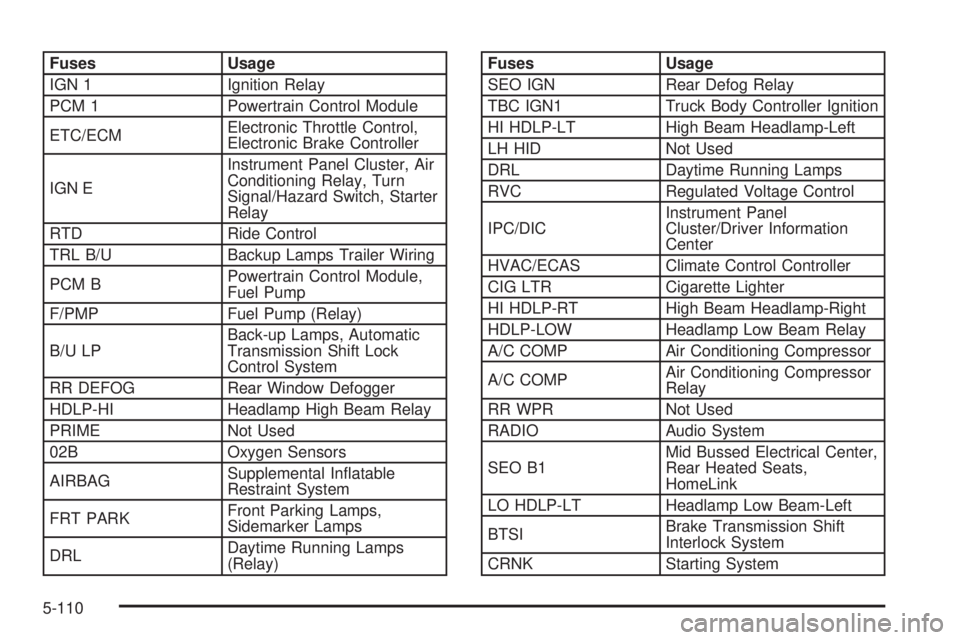
Fuses Usage
IGN 1 Ignition Relay
PCM 1 Powertrain Control Module
ETC/ECMElectronic Throttle Control,
Electronic Brake Controller
IGN EInstrument Panel Cluster, Air
Conditioning Relay, Turn
Signal/Hazard Switch, Starter
Relay
RTD Ride Control
TRL B/U Backup Lamps Trailer Wiring
PCM BPowertrain Control Module,
Fuel Pump
F/PMP Fuel Pump (Relay)
B/U LPBack-up Lamps, Automatic
Transmission Shift Lock
Control System
RR DEFOG Rear Window Defogger
HDLP-HI Headlamp High Beam Relay
PRIME Not Used
02B Oxygen Sensors
AIRBAGSupplemental Inatable
Restraint System
FRT PARKFront Parking Lamps,
Sidemarker Lamps
DRLDaytime Running Lamps
(Relay)Fuses Usage
SEO IGN Rear Defog Relay
TBC IGN1 Truck Body Controller Ignition
HI HDLP-LT High Beam Headlamp-Left
LH HID Not Used
DRL Daytime Running Lamps
RVC Regulated Voltage Control
IPC/DICInstrument Panel
Cluster/Driver Information
Center
HVAC/ECAS Climate Control Controller
CIG LTR Cigarette Lighter
HI HDLP-RT High Beam Headlamp-Right
HDLP-LOW Headlamp Low Beam Relay
A/C COMP Air Conditioning Compressor
A/C COMPAir Conditioning Compressor
Relay
RR WPR Not Used
RADIO Audio System
SEO B1Mid Bussed Electrical Center,
Rear Heated Seats,
HomeLink
LO HDLP-LT Headlamp Low Beam-Left
BTSIBrake Transmission Shift
Interlock System
CRNK Starting System
5-110
Page 415 of 428
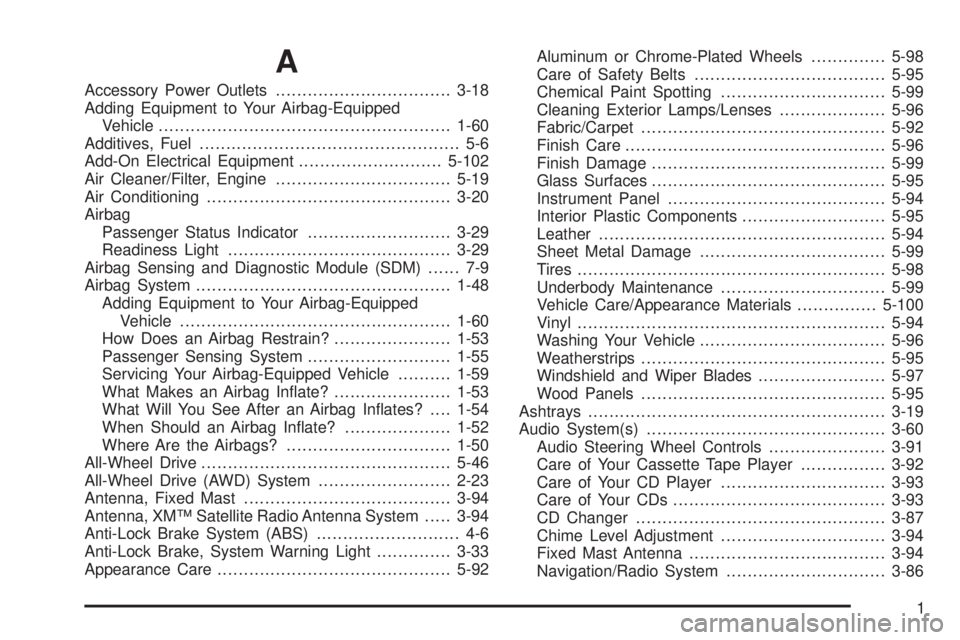
A
Accessory Power Outlets.................................3-18
Adding Equipment to Your Airbag-Equipped
Vehicle.......................................................1-60
Additives, Fuel................................................. 5-6
Add-On Electrical Equipment...........................5-102
Air Cleaner/Filter, Engine.................................5-19
Air Conditioning..............................................3-20
Airbag
Passenger Status Indicator...........................3-29
Readiness Light..........................................3-29
Airbag Sensing and Diagnostic Module (SDM)...... 7-9
Airbag System................................................1-48
Adding Equipment to Your Airbag-Equipped
Vehicle...................................................1-60
How Does an Airbag Restrain?......................1-53
Passenger Sensing System...........................1-55
Servicing Your Airbag-Equipped Vehicle..........1-59
What Makes an Airbag Inate?......................1-53
What Will You See After an Airbag Inates?....1-54
When Should an Airbag Inate?....................1-52
Where Are the Airbags?...............................1-50
All-Wheel Drive...............................................5-46
All-Wheel Drive (AWD) System.........................2-23
Antenna, Fixed Mast.......................................3-94
Antenna, XM™ Satellite Radio Antenna System.....3-94
Anti-Lock Brake System (ABS)........................... 4-6
Anti-Lock Brake, System Warning Light..............3-33
Appearance Care............................................5-92Aluminum or Chrome-Plated Wheels..............5-98
Care of Safety Belts....................................5-95
Chemical Paint Spotting...............................5-99
Cleaning Exterior Lamps/Lenses....................5-96
Fabric/Carpet..............................................5-92
Finish Care.................................................5-96
Finish Damage............................................5-99
Glass Surfaces............................................5-95
Instrument Panel.........................................5-94
Interior Plastic Components...........................5-95
Leather......................................................5-94
Sheet Metal Damage...................................5-99
Tires..........................................................5-98
Underbody Maintenance...............................5-99
Vehicle Care/Appearance Materials...............5-100
Vinyl..........................................................5-94
Washing Your Vehicle...................................5-96
Weatherstrips..............................................5-95
Windshield and Wiper Blades........................5-97
Wood Panels..............................................5-95
Ashtrays........................................................3-19
Audio System(s).............................................3-60
Audio Steering Wheel Controls......................3-91
Care of Your Cassette Tape Player................3-92
Care of Your CD Player...............................3-93
Care of Your CDs........................................3-93
CD Changer...............................................3-87
Chime Level Adjustment...............................3-94
Fixed Mast Antenna.....................................3-94
Navigation/Radio System..............................3-86
1
Page 416 of 428
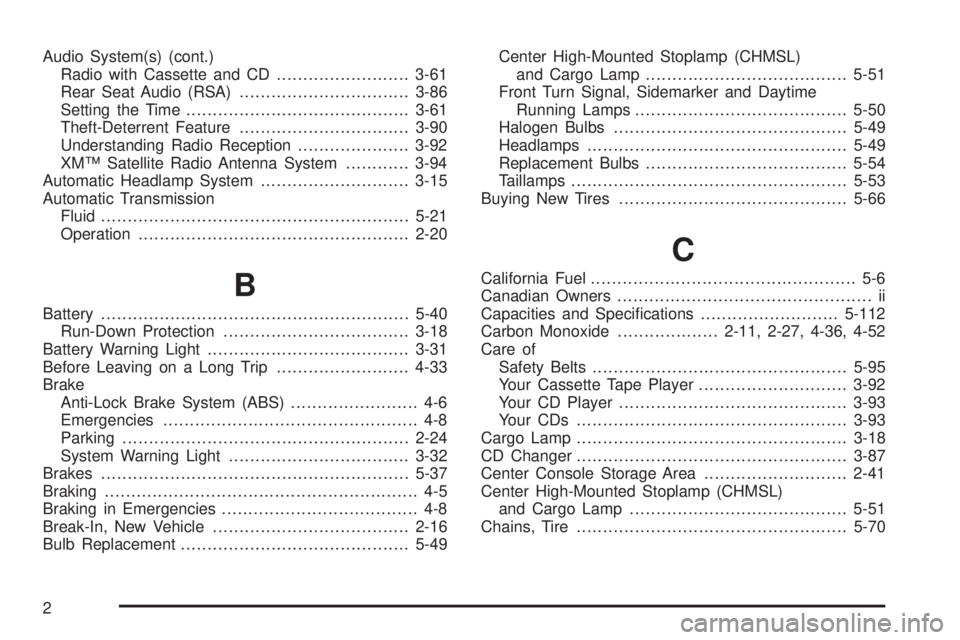
Audio System(s) (cont.)
Radio with Cassette and CD.........................3-61
Rear Seat Audio (RSA)................................3-86
Setting the Time..........................................3-61
Theft-Deterrent Feature................................3-90
Understanding Radio Reception.....................3-92
XM™ Satellite Radio Antenna System............3-94
Automatic Headlamp System............................3-15
Automatic Transmission
Fluid..........................................................5-21
Operation...................................................2-20
B
Battery..........................................................5-40
Run-Down Protection...................................3-18
Battery Warning Light......................................3-31
Before Leaving on a Long Trip.........................4-33
Brake
Anti-Lock Brake System (ABS)........................ 4-6
Emergencies................................................ 4-8
Parking......................................................2-24
System Warning Light..................................3-32
Brakes..........................................................5-37
Braking........................................................... 4-5
Braking in Emergencies..................................... 4-8
Break-In, New Vehicle.....................................2-16
Bulb Replacement...........................................5-49Center High-Mounted Stoplamp (CHMSL)
and Cargo Lamp......................................5-51
Front Turn Signal, Sidemarker and Daytime
Running Lamps........................................5-50
Halogen Bulbs............................................5-49
Headlamps.................................................5-49
Replacement Bulbs......................................5-54
Taillamps....................................................5-53
Buying New Tires...........................................5-66
C
California Fuel.................................................. 5-6
Canadian Owners................................................ ii
Capacities and Specications..........................5-112
Carbon Monoxide...................2-11, 2-27, 4-36, 4-52
Care of
Safety Belts................................................5-95
Your Cassette Tape Player............................3-92
Your CD Player...........................................3-93
Your CDs ...................................................3-93
Cargo Lamp...................................................3-18
CD Changer...................................................3-87
Center Console Storage Area...........................2-41
Center High-Mounted Stoplamp (CHMSL)
and Cargo Lamp.........................................5-51
Chains, Tire...................................................5-70
2
Page 421 of 428
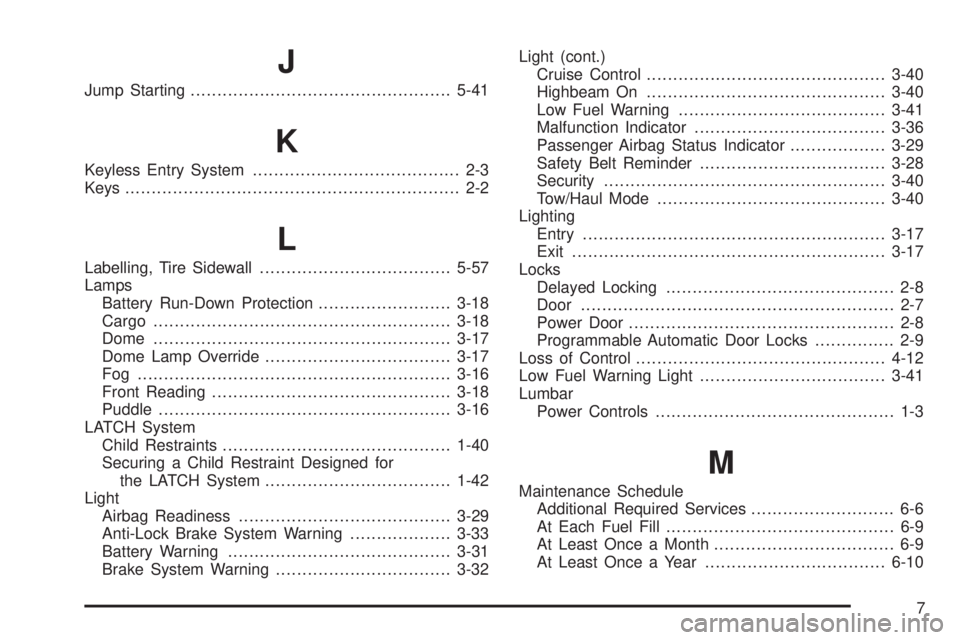
J
Jump Starting.................................................5-41
K
Keyless Entry System....................................... 2-3
Keys............................................................... 2-2
L
Labelling, Tire Sidewall....................................5-57
Lamps
Battery Run-Down Protection.........................3-18
Cargo........................................................3-18
Dome........................................................3-17
Dome Lamp Override...................................3-17
Fog ...........................................................3-16
Front Reading.............................................3-18
Puddle.......................................................3-16
LATCH System
Child Restraints...........................................1-40
Securing a Child Restraint Designed for
the LATCH System...................................1-42
Light
Airbag Readiness........................................3-29
Anti-Lock Brake System Warning...................3-33
Battery Warning..........................................3-31
Brake System Warning.................................3-32Light (cont.)
Cruise Control.............................................3-40
Highbeam On.............................................3-40
Low Fuel Warning.......................................3-41
Malfunction Indicator....................................3-36
Passenger Airbag Status Indicator..................3-29
Safety Belt Reminder...................................3-28
Security.....................................................3-40
Tow/Haul Mode...........................................3-40
Lighting
Entry.........................................................3-17
Exit...........................................................3-17
Locks
Delayed Locking........................................... 2-8
Door........................................................... 2-7
Power Door.................................................. 2-8
Programmable Automatic Door Locks............... 2-9
Loss of Control...............................................4-12
Low Fuel Warning Light...................................3-41
Lumbar
Power Controls............................................. 1-3
M
Maintenance Schedule
Additional Required Services........................... 6-6
At Each Fuel Fill........................................... 6-9
At Least Once a Month.................................. 6-9
At Least Once a Year..................................6-10
7