tires GMC SIERRA DENALI 2005 Owner's Manual
[x] Cancel search | Manufacturer: GMC, Model Year: 2005, Model line: SIERRA DENALI, Model: GMC SIERRA DENALI 2005Pages: 428, PDF Size: 2.5 MB
Page 253 of 428
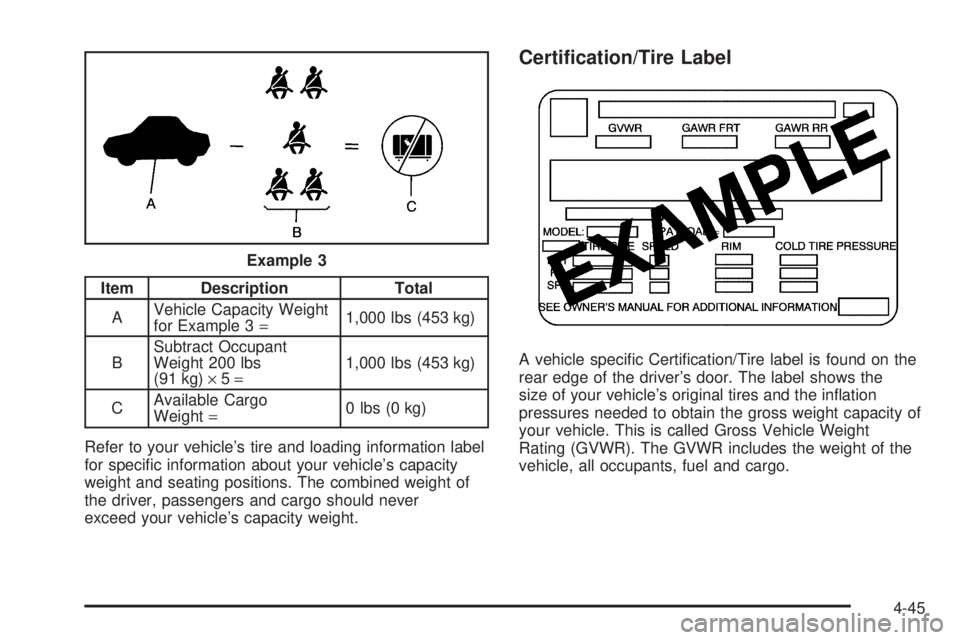
Item Description Total
AVehicle Capacity Weight
for Example 3=1,000 lbs (453 kg)
BSubtract Occupant
Weight 200 lbs
(91 kg)×5=1,000 lbs (453 kg)
CAvailable Cargo
Weight=0 lbs (0 kg)
Refer to your vehicle’s tire and loading information label
for specic information about your vehicle’s capacity
weight and seating positions. The combined weight of
the driver, passengers and cargo should never
exceed your vehicle’s capacity weight.
Certication/Tire Label
A vehicle specic Certication/Tire label is found on the
rear edge of the driver’s door. The label shows the
size of your vehicle’s original tires and the ination
pressures needed to obtain the gross weight capacity of
your vehicle. This is called Gross Vehicle Weight
Rating (GVWR). The GVWR includes the weight of the
vehicle, all occupants, fuel and cargo. Example 3
4-45
Page 261 of 428
If You Do Decide To Pull A Trailer
If you do, here are some important points:
There are many different laws, including speed limit
restrictions, having to do with trailering. Make sure
your rig will be legal, not only where you live
but also where you’ll be driving. A good source for
this information can be state or provincial police.
Consider using a sway control. See “Hitches” later
in this section.
Don’t tow a trailer at all during the rst 500 miles
(800 km) your new vehicle is driven. Your engine,
axle or other parts could be damaged.
Then, during the rst 500 miles (800 km) that you
tow a trailer, don’t drive over 50 mph (80 km/h)
and don’t make starts at full throttle. This helps your
engine and other parts of your vehicle wear in at
the heavier loads.
You can tow in DRIVE (D). You may want to shift the
transmission to THIRD (3) or, if necessary, a lower
gear selection if the transmission shifts too often
(e.g., under heavy loads and/or hilly conditions).
Three important considerations have to do with weight:
the weight of the trailer
the weight of the trailer tongue
and the weight on your vehicle’s tires
Tow/Haul Mode
Tow/Haul is a feature that assists when pulling a heavy
trailer or a large or heavy load. The purpose of the
Tow/Haul mode is to:
Reduce the frequency and improve the predictability
of transmission shifts when pulling a heavy trailer or
a large or heavy load.
Provide the same solid shift feel when pulling a
heavy trailer or a large or heavy load as when
the vehicle is unloaded.
Improve control of vehicle speed while requiring
less throttle pedal activity when pulling a heavy
trailer or a large or heavy load.
Your vehicle may be equipped with a switch at the end
of the shift lever which when pressed enables
Tow/Haul. When the switch is pressed, a light on the
instrument panel will illuminate to indicate that Tow/Haul
has been selected. Tow/Haul may be turned off by
pressing the switch again, at which time the indicator
light on the instrument panel will turn off. The vehicle will
automatically turn off Tow/Haul every time it is started.
4-53
Page 264 of 428
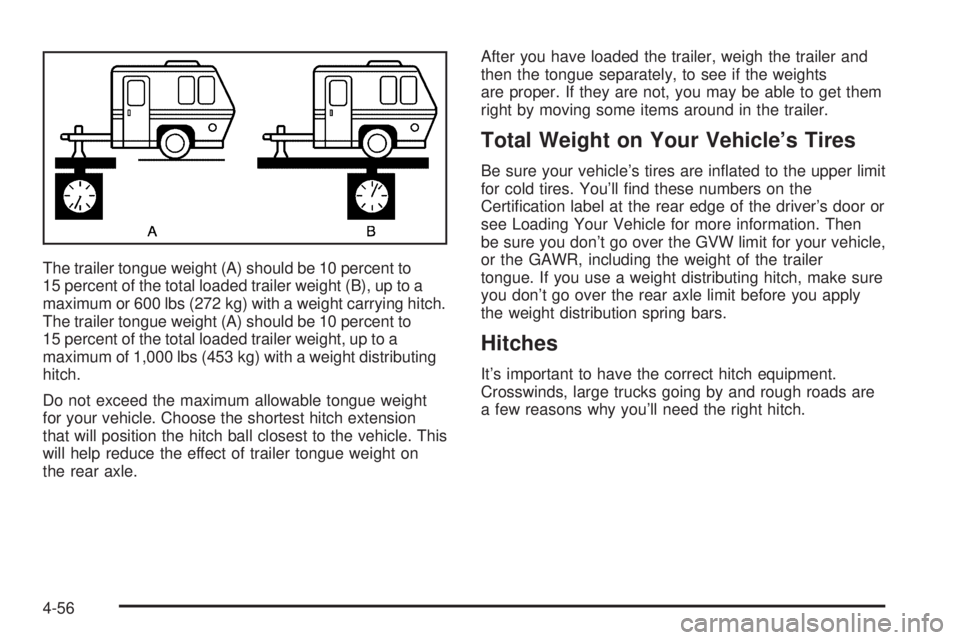
The trailer tongue weight (A) should be 10 percent to
15 percent of the total loaded trailer weight (B), up to a
maximum or 600 lbs (272 kg) with a weight carrying hitch.
The trailer tongue weight (A) should be 10 percent to
15 percent of the total loaded trailer weight, up to a
maximum of 1,000 lbs (453 kg) with a weight distributing
hitch.
Do not exceed the maximum allowable tongue weight
for your vehicle. Choose the shortest hitch extension
that will position the hitch ball closest to the vehicle. This
will help reduce the effect of trailer tongue weight on
the rear axle.After you have loaded the trailer, weigh the trailer and
then the tongue separately, to see if the weights
are proper. If they are not, you may be able to get them
right by moving some items around in the trailer.
Total Weight on Your Vehicle’s Tires
Be sure your vehicle’s tires are inated to the upper limit
for cold tires. You’ll nd these numbers on the
Certication label at the rear edge of the driver’s door or
see Loading Your Vehicle for more information. Then
be sure you don’t go over the GVW limit for your vehicle,
or the GAWR, including the weight of the trailer
tongue. If you use a weight distributing hitch, make sure
you don’t go over the rear axle limit before you apply
the weight distribution spring bars.
Hitches
It’s important to have the correct hitch equipment.
Crosswinds, large trucks going by and rough roads are
a few reasons why you’ll need the right hitch.
4-56
Page 267 of 428
Towing a trailer requires a certain amount of experience.
Before setting out for the open road, you’ll want to get
to know your rig. Acquaint yourself with the feel of
handling and braking with the added weight of the trailer.
And always keep in mind that the vehicle you are
driving is now a good deal longer and not nearly as
responsive as your vehicle is by itself.
Before you start, check all trailer hitch parts and
attachments, safety chains, electrical connector, lamps,
tires and mirror adjustment. If the trailer has electric
brakes, start your vehicle and trailer moving and then
apply the trailer brake controller by hand to be sure
the brakes are working. This lets you check your
electrical connection at the same time.
During your trip, check occasionally to be sure that the
load is secure, and that the lamps and any trailer
brakes are still working.
While towing a trailer or when exposed to long periods
of sunshine, the oor of the truck bed may become
very warm. Avoid putting items in the truck bed
that might be affected by high ambient temperatures.Following Distance
Stay at least twice as far behind the vehicle ahead as
you would when driving your vehicle without a trailer.
This can help you avoid situations that require
heavy braking and sudden turns.
Passing
You’ll need more passing distance up ahead when
you’re towing a trailer. And, because you’re a good deal
longer, you’ll need to go much farther beyond the
passed vehicle before you can return to your lane.
Backing Up
Hold the bottom of the steering wheel with one hand.
Then, to move the trailer to the left, just move that hand
to the left. To move the trailer to the right, move your
hand to the right. Always back up slowly and, if possible,
have someone guide you.
Your vehicle is equipped with four-wheel steering and if
you use it while backing your trailer the same rules
apply. However, with four-wheel steering your rig will
respond more quickly and it may take additional practice
to get used to backing up with four-wheel steering.
4-59
Page 273 of 428
Service............................................................5-3
Doing Your Own Service Work.........................5-4
Adding Equipment to the Outside of Your
Vehicle......................................................5-5
Fuel................................................................5-5
Gasoline Octane............................................5-5
Gasoline Specications....................................5-5
California Fuel...............................................5-6
Additives.......................................................5-6
Fuels in Foreign Countries...............................5-7
Filling Your Tank............................................5-7
Filling a Portable Fuel Container.......................5-9
Checking Things Under the Hood....................5-10
Hood Release..............................................5-10
Engine Compartment Overview.......................5-12
Engine Oil...................................................5-14
Engine Oil Life System..................................5-17
Engine Air Cleaner/Filter................................5-19
Automatic Transmission Fluid.........................5-21
Engine Coolant.............................................5-24
Coolant Surge Tank Pressure Cap..................5-26
Engine Overheating.......................................5-26
Overheated Engine Protection Operating Mode . . .5-28
Cooling System............................................5-29
Engine Fan Noise.........................................5-34
Power Steering Fluid.....................................5-34Windshield Washer Fluid................................5-36
Brakes........................................................5-37
Battery........................................................5-40
Jump Starting...............................................5-41
All-Wheel Drive..............................................5-46
Rear Axle.......................................................5-47
Front Axle......................................................5-48
Bulb Replacement..........................................5-49
Halogen Bulbs..............................................5-49
Headlamps..................................................5-49
Front Turn Signal, Sidemarker and Daytime
Running Lamps.........................................5-50
Center High-Mounted Stoplamp (CHMSL) and
Cargo Lamp.............................................5-51
Taillamps.....................................................5-53
Replacement Bulbs.......................................5-54
Windshield Wiper Blade Replacement..............5-55
Tires..............................................................5-56
Tire Sidewall Labelling...................................5-57
Tire Terminology and Denitions.....................5-60
Ination - Tire Pressure.................................5-62
Tire Inspection and Rotation...........................5-63
When It Is Time for New Tires.......................5-65
Buying New Tires.........................................5-66
Uniform Tire Quality Grading..........................5-67
Section 5 Service and Appearance Care
5-1
Page 274 of 428
Wheel Alignment and Tire Balance..................5-68
Wheel Replacement......................................5-69
Tire Chains..................................................5-70
If a Tire Goes Flat........................................5-71
Changing a Flat Tire.....................................5-72
Removing the Spare Tire and Tools................5-73
Removing the Flat Tire and Installing the
Spare Tire................................................5-76
Secondary Latch System...............................5-83
Storing a Flat or Spare Tire and Tools............5-87
Spare Tire...................................................5-91
Appearance Care............................................5-92
Fabric/Carpet...............................................5-92
Vinyl...........................................................5-94
Leather.......................................................5-94
Instrument Panel..........................................5-94
Interior Plastic Components............................5-95
Wood Panels...............................................5-95
Glass Surfaces.............................................5-95
Care of Safety Belts......................................5-95
Weatherstrips...............................................5-95
Washing Your Vehicle...................................5-96
Cleaning Exterior Lamps/Lenses.....................5-96Finish Care..................................................5-96
Windshield and Wiper Blades.........................5-97
Aluminum or Chrome-Plated Wheels................5-98
Tires...........................................................5-98
Sheet Metal Damage.....................................5-99
Finish Damage.............................................5-99
Underbody Maintenance................................5-99
Chemical Paint Spotting.................................5-99
Vehicle Care/Appearance Materials................5-100
Vehicle Identication.....................................5-101
Vehicle Identication Number (VIN)................5-101
Service Parts Identication Label...................5-101
Electrical System..........................................5-102
Add-On Electrical Equipment.........................5-102
Windshield Wiper Fuses...............................5-102
Power Windows and Other Power Options......5-102
Fuses and Circuit Breakers..........................5-102
Instrument Panel Fuse Block........................5-103
Center Instrument Panel Fuse Block..............5-106
Underhood Fuse Block................................5-107
Capacities and Specications........................5-112
Section 5 Service and Appearance Care
5-2
Page 311 of 428
Brake Wear
Your vehicle has four-wheel disc brakes.
Disc brake pads have built-in wear indicators that make a
high-pitched warning sound when the brake pads are
worn and new pads are needed. The sound may come
and go or be heard all the time your vehicle is moving,
except when you are pushing on the brake pedal rmly.
{CAUTION:
The brake wear warning sound means that soon
your brakes will not work well. That could lead
to an accident. When you hear the brake wear
warning sound, have your vehicle serviced.
Notice:Continuing to drive with worn-out brake
pads could result in costly brake repair.Some driving conditions or climates may cause a brake
squeal when the brakes are rst applied or lightly
applied. This does not mean something is wrong with
your brakes.
Properly torqued wheel nuts are necessary to help
prevent brake pulsation. When tires are rotated, inspect
brake pads for wear and evenly tighten wheel nuts in
the proper sequence to GM torque specications.
Brake linings should always be replaced as complete
axle sets.
Brake Pedal Travel
See your dealer if the brake pedal does not return to
normal height, or if there is a rapid increase in
pedal travel. This could be a sign of brake trouble.
Brake Adjustment
Every time you make a brake stop, your disc brakes
adjust for wear.
5-39
Page 328 of 428

Tires
Your new vehicle comes with high-quality tires made by
a leading tire manufacturer. If you ever have questions
about your tire warranty and where to obtain service,
see your GM Warranty booklet for details. For additional
information refer to the tire manufacturer’s booklet
included with your vehicle’s Owner’s Manual.
{CAUTION:
Poorly maintained and improperly used tires
are dangerous.
Overloading your tires can cause
overheating as a result of too much
friction. You could have an air-out and a
serious accident. SeeLoading Your
Vehicle on page 4-42.
CAUTION: (Continued)
CAUTION: (Continued)
Underinated tires pose the same danger
as overloaded tires. The resulting accident
could cause serious injury. Check all tires
frequently to maintain the recommended
pressure. Tire pressure should be checked
when your tires are cold. SeeInflation - Tire
Pressure on page 5-62.
Overinated tires are more likely to be
cut, punctured or broken by a sudden
impact —such as when you hit a pothole.
Keep tires at the recommended pressure.
Worn, old tires can cause accidents. If your
tread is badly worn, or if your tires have
been damaged, replace them.
20-Inch Tires
If your vehicle has the optional 20-inch P275/55R20
size tires, they are classied as touring tires and
are designed for on road use. The low-prole, wide
tread design is not recommended for “off-road” driving.
SeeOperating Your All-Wheel-Drive Vehicle Off
Paved Roads on page 4-13, for additional information.
5-56
Page 329 of 428

Tire Sidewall Labelling
Useful information about a tire is molded into the
sidewall. The following illustrations are examples of a
typical P-Metric and a LT-Metric tire sidewall.
(A) Tire Size:The tire size code is a combination of
letters and numbers used to dene a particular
tire’s width, height, aspect ratio, construction type and
service description. See the “Tire Size” illustration
later in this section for more detail.(B) TPC Spec (Tire Performance Criteria
Specication):Original equipment tires designed to
GM’s specic tire performance criteria have a TPC
specication code molded onto the sidewall. GM’s TPC
specications meet or exceed all federal safety
guidelines.
(C) DOT (Department of Transportation):The
Department of Transportation (DOT) code indicates that
the tire is in compliance with the U.S. Department of
Transportation Motor Vehicle Safety Standards.
(D) Tire Identication Number (TIN):The letters and
numbers following DOT code are the Tire Identication
Number (TIN). The TIN shows the manufacturer
and plant code, tire size, and date the tire was
manufactured. The TIN is molded onto both sides of the
tire, although only one side may have the date of
manufacture.
(E) Tire Ply Material:The type of cord and number of
plies in the sidewall and under the tread.
(F) Uniform Tire Quality Grading (UTQG):Tire
manufacturers are required to grade tires based on
three performance factors: treadwear, traction and
temperature resistance. For more information, see
Uniform Tire Quality Grading on page 5-67. Passenger (P-Metric) Tire
5-57
Page 330 of 428
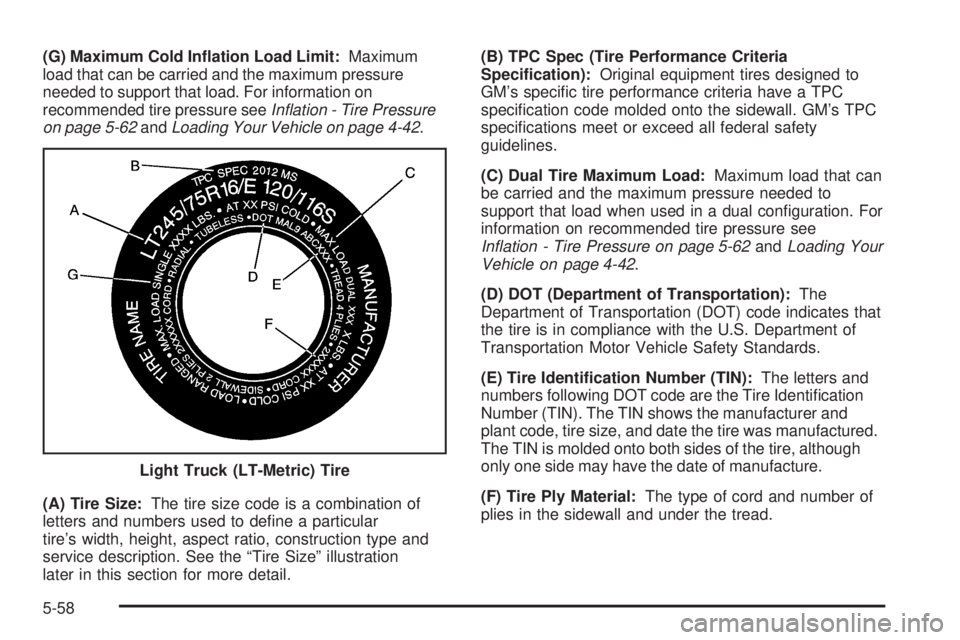
(G) Maximum Cold Ination Load Limit:Maximum
load that can be carried and the maximum pressure
needed to support that load. For information on
recommended tire pressure seeInation - Tire Pressure
on page 5-62andLoading Your Vehicle on page 4-42.
(A) Tire Size:The tire size code is a combination of
letters and numbers used to dene a particular
tire’s width, height, aspect ratio, construction type and
service description. See the “Tire Size” illustration
later in this section for more detail.(B) TPC Spec (Tire Performance Criteria
Specication):Original equipment tires designed to
GM’s specic tire performance criteria have a TPC
specication code molded onto the sidewall. GM’s TPC
specications meet or exceed all federal safety
guidelines.
(C) Dual Tire Maximum Load:Maximum load that can
be carried and the maximum pressure needed to
support that load when used in a dual conguration. For
information on recommended tire pressure see
Ination - Tire Pressure on page 5-62andLoading Your
Vehicle on page 4-42.
(D) DOT (Department of Transportation):The
Department of Transportation (DOT) code indicates that
the tire is in compliance with the U.S. Department of
Transportation Motor Vehicle Safety Standards.
(E) Tire Identication Number (TIN):The letters and
numbers following DOT code are the Tire Identication
Number (TIN). The TIN shows the manufacturer and
plant code, tire size, and date the tire was manufactured.
The TIN is molded onto both sides of the tire, although
only one side may have the date of manufacture.
(F) Tire Ply Material:The type of cord and number of
plies in the sidewall and under the tread. Light Truck (LT-Metric) Tire
5-58