flat tire GMC SIERRA DENALI 2005 Owners Manual
[x] Cancel search | Manufacturer: GMC, Model Year: 2005, Model line: SIERRA DENALI, Model: GMC SIERRA DENALI 2005Pages: 428, PDF Size: 2.5 MB
Page 274 of 428
Wheel Alignment and Tire Balance..................5-68
Wheel Replacement......................................5-69
Tire Chains..................................................5-70
If a Tire Goes Flat........................................5-71
Changing a Flat Tire.....................................5-72
Removing the Spare Tire and Tools................5-73
Removing the Flat Tire and Installing the
Spare Tire................................................5-76
Secondary Latch System...............................5-83
Storing a Flat or Spare Tire and Tools............5-87
Spare Tire...................................................5-91
Appearance Care............................................5-92
Fabric/Carpet...............................................5-92
Vinyl...........................................................5-94
Leather.......................................................5-94
Instrument Panel..........................................5-94
Interior Plastic Components............................5-95
Wood Panels...............................................5-95
Glass Surfaces.............................................5-95
Care of Safety Belts......................................5-95
Weatherstrips...............................................5-95
Washing Your Vehicle...................................5-96
Cleaning Exterior Lamps/Lenses.....................5-96Finish Care..................................................5-96
Windshield and Wiper Blades.........................5-97
Aluminum or Chrome-Plated Wheels................5-98
Tires...........................................................5-98
Sheet Metal Damage.....................................5-99
Finish Damage.............................................5-99
Underbody Maintenance................................5-99
Chemical Paint Spotting.................................5-99
Vehicle Care/Appearance Materials................5-100
Vehicle Identication.....................................5-101
Vehicle Identication Number (VIN)................5-101
Service Parts Identication Label...................5-101
Electrical System..........................................5-102
Add-On Electrical Equipment.........................5-102
Windshield Wiper Fuses...............................5-102
Power Windows and Other Power Options......5-102
Fuses and Circuit Breakers..........................5-102
Instrument Panel Fuse Block........................5-103
Center Instrument Panel Fuse Block..............5-106
Underhood Fuse Block................................5-107
Capacities and Specications........................5-112
Section 5 Service and Appearance Care
5-2
Page 335 of 428
A Tire and Loading Information label is attached to the
vehicle’s center pillar (B-pillar), below the driver’s door
lock post (striker). This label lists your vehicle’s original
equipment tires and their recommended cold tire ination
pressures. The recommended cold tire ination pressure,
shown on the label, is the minimum amount of air
pressure needed to support your vehicle’s maximum load
carrying capacity.
For additional information regarding how much weight
your vehicle can carry, and an example of the tire
and loading information label, seeLoading Your Vehicle
on page 4-42.
When to Check
Check your tires once a month or more. Do not forget to
check the spare tire. For additional information
regarding the spare tire, seeSpare Tire on page 5-91.
How to Check
Use a good quality pocket-type gage to check tire
pressure. You cannot tell if your tires are properly inated
simply by looking at them. Radial tires may look properly
inated even when they’re underinated. Check the tire’s
ination pressure when the tires are cold. Cold means
your vehicle has been sitting for at least three hours or
driven no more than 1 mile (1.6 km).Remove the valve cap from the tire valve stem. Press
the tire gage rmly onto the valve to get a pressure
measurement. If the cold tire ination pressure matches
the recommended pressure on the Tire and Loading
Information label, no further adjustment is necessary. If
the ination pressure is low, add air until you reach
the recommended amount.
If you overll the tire, release air by pushing on the
metal stem in the center of the tire valve. Recheck the
tire pressure with the tire gage.
Be sure to put the valve caps back on the valve stems.
They help prevent leaks by keeping out dirt and moisture.
Tire Inspection and Rotation
Tires should be rotated every 5,000 to 8,000 miles
(8 000 to 13 000 km).
Any time you notice unusual wear, rotate your tires as
soon as possible and check wheel alignment. Also
check for damaged tires or wheels. SeeWhen It Is Time
for New Tires on page 5-65andWheel Replacement
on page 5-69for more information.
Make sure the spare tire is stored securely. Push, pull,
and then try to rotate or turn the tire. If it moves,
use the ratchet/wheel wrench to tighten the cable. See
Changing a Flat Tire on page 5-72.
5-63
Page 336 of 428
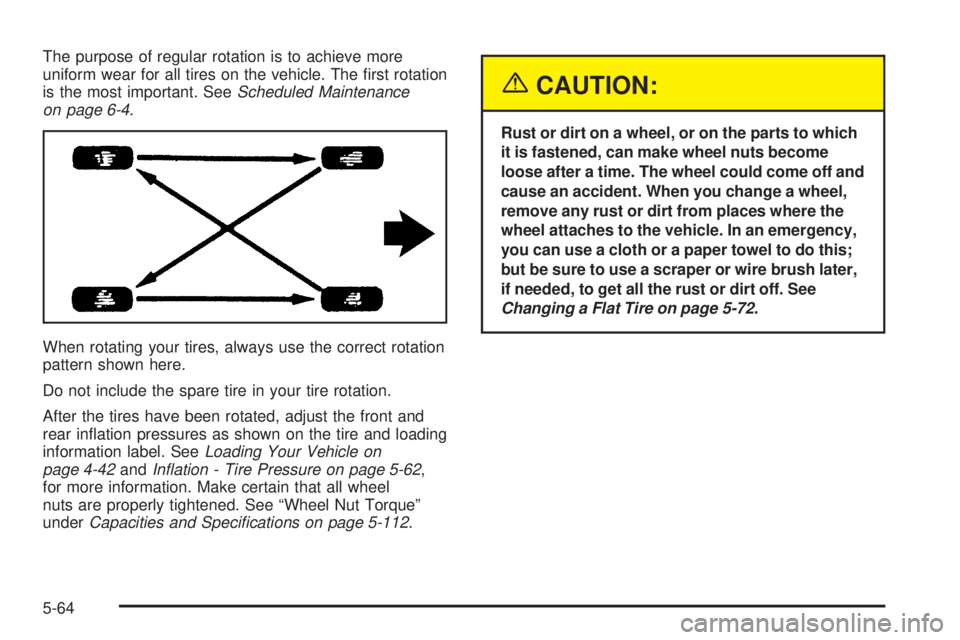
The purpose of regular rotation is to achieve more
uniform wear for all tires on the vehicle. The rst rotation
is the most important. SeeScheduled Maintenance
on page 6-4.
When rotating your tires, always use the correct rotation
pattern shown here.
Do not include the spare tire in your tire rotation.
After the tires have been rotated, adjust the front and
rear ination pressures as shown on the tire and loading
information label. SeeLoading Your Vehicle on
page 4-42andInation - Tire Pressure on page 5-62,
for more information. Make certain that all wheel
nuts are properly tightened. See “Wheel Nut Torque”
underCapacities and Specications on page 5-112.
{CAUTION:
Rust or dirt on a wheel, or on the parts to which
it is fastened, can make wheel nuts become
loose after a time. The wheel could come off and
cause an accident. When you change a wheel,
remove any rust or dirt from places where the
wheel attaches to the vehicle. In an emergency,
you can use a cloth or a paper towel to do this;
but be sure to use a scraper or wire brush later,
if needed, to get all the rust or dirt off. See
Changing a Flat Tire on page 5-72.
5-64
Page 341 of 428
Wheel Replacement
Replace any wheel that is bent, cracked, or badly rusted
or corroded. If wheel nuts keep coming loose, the
wheel, wheel bolts and wheel nuts should be replaced.
If the wheel leaks air, replace it (except some
aluminum wheels, which can sometimes be repaired).
See your dealer if any of these conditions exist.
Your dealer will know the kind of wheel you need.
Each new wheel should have the same load-carrying
capacity, diameter, width, offset and be mounted
the same way as the one it replaces.
If you need to replace any of your wheels, wheel bolts
or wheel nuts, replace them only with new GM
original equipment parts. This way, you will be sure to
have the right wheel, wheel bolts and wheel nuts
for your vehicle.{CAUTION:
Using the wrong replacement wheels, wheel
bolts or wheel nuts on your vehicle can be
dangerous. It could affect the braking and
handling of your vehicle, make your tires lose
air and make you lose control. You could have
a collision in which you or others could be
injured. Always use the correct wheel, wheel
bolts and wheel nuts for replacement.
Notice:The wrong wheel can also cause problems
with bearing life, brake cooling, speedometer or
odometer calibration, headlamp aim, bumper height,
vehicle ground clearance and tire clearance to the
body and chassis.
SeeChanging a Flat Tire on page 5-72for more
information.
5-69
Page 343 of 428
If a Tire Goes Flat
It’s unusual for a tire to “blowout” while you’re driving,
especially if you maintain your tires properly. If air goes
out of a tire, it’s much more likely to leak out slowly.
But if you should ever have a “blowout,” here are a few
tips about what to expect and what to do:
If a front tire fails, the at tire will create a drag that
pulls the vehicle toward that side. Take your foot off the
accelerator pedal and grip the steering wheel rmly.
Steer to maintain lane position, and then gently brake to
a stop well out of the traffic lane.
A rear blowout, particularly on a curve, acts much like a
skid and may require the same correction you’d use
in a skid. In any rear blowout, remove your foot from the
accelerator pedal. Get the vehicle under control by
steering the way you want the vehicle to go. It may be
very bumpy and noisy, but you can still steer. Gently
brake to a stop, well off the road if possible.{CAUTION:
Lifting a vehicle and getting under it to do
maintenance or repairs is dangerous without
the appropriate safety equipment and training.
The jack provided with your vehicle is
designed only for changing a at tire. If it is
used for anything else, you or others could be
badly injured or killed if the vehicle slips off
the jack. Use the jack provided with your
vehicle only for changing a at tire.
If a tire goes at, the next part shows how to use your
jacking equipment to change a at tire safely.
5-71
Page 344 of 428
Changing a Flat Tire
If a tire goes at, avoid further tire and wheel damage
by driving slowly to a level place. Turn on your
hazard warning ashers.
{CAUTION:
Changing a tire can be dangerous. The vehicle
can slip off the jack and roll over or fall on you
or other people. You and they could be badly
injured or even killed. Find a level place to
change your tire. To help prevent the vehicle
from moving:
1. Set the parking brake rmly.
2. Put the shift lever in PARK (P).
CAUTION: (Continued)
CAUTION: (Continued)
3. Turn off the engine and do not restart
while the vehicle is raised.
4. Do not allow passengers to remain in the
vehicle.
To be even more certain the vehicle will not
move, you should put blocks at the front and
rear of the tire farthest away from the one
being changed. That would be the tire, on the
other side, at the opposite end of the vehicle.
5-72
Page 348 of 428
5. Use the wheel wrench
which a hook that
allows you to pull the
hoist cable towards you
to assist in reaching
the spare tire.
6. Tilt the retainer (D) at
the end of the cable
when the tire has been
lowered, so it can
be pulled up through
the wheel opening.
7. Put the spare tire near the at tire.Removing the Flat Tire and
Installing the Spare Tire
Use the following pictures and instructions to remove
the at tire and raise the vehicle.
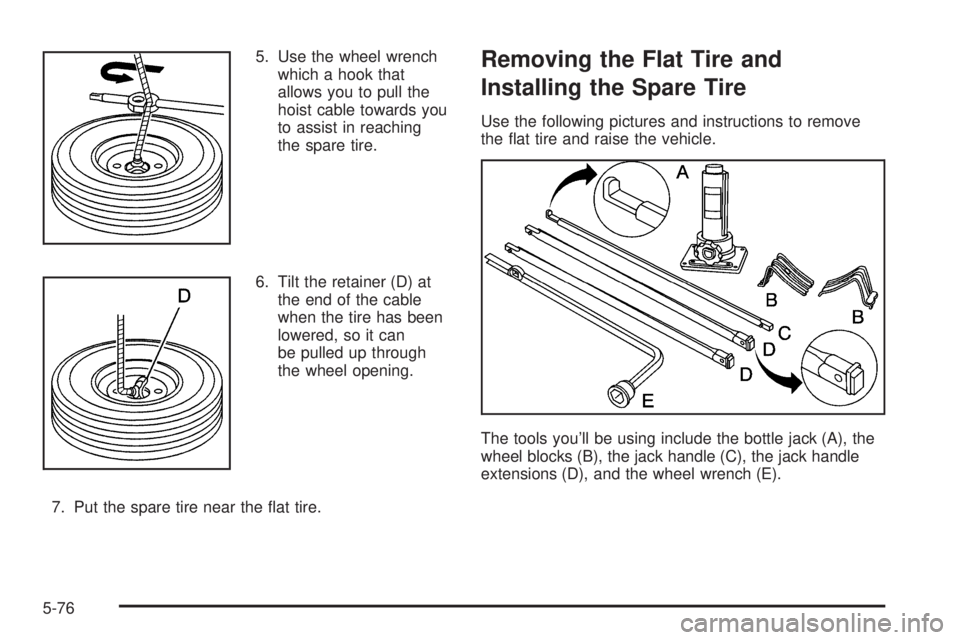
The tools you’ll be using include the bottle jack (A), the
wheel blocks (B), the jack handle (C), the jack handle
extensions (D), and the wheel wrench (E).
5-76
Page 355 of 428
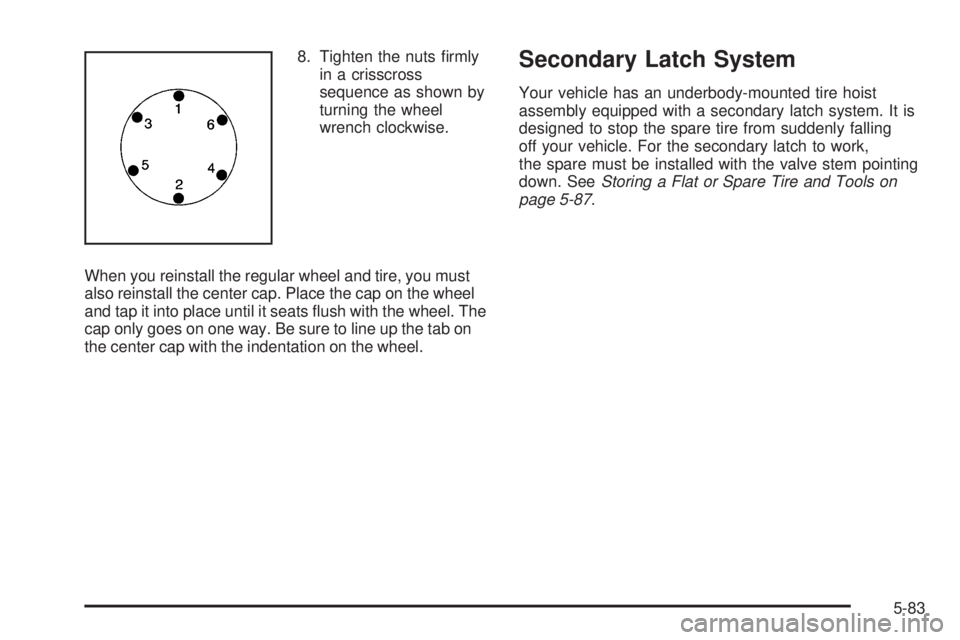
8. Tighten the nuts rmly
in a crisscross
sequence as shown by
turning the wheel
wrench clockwise.
When you reinstall the regular wheel and tire, you must
also reinstall the center cap. Place the cap on the wheel
and tap it into place until it seats ush with the wheel. The
cap only goes on one way. Be sure to line up the tab on
the center cap with the indentation on the wheel.Secondary Latch System
Your vehicle has an underbody-mounted tire hoist
assembly equipped with a secondary latch system. It is
designed to stop the spare tire from suddenly falling
off your vehicle. For the secondary latch to work,
the spare must be installed with the valve stem pointing
down. SeeStoring a Flat or Spare Tire and Tools on
page 5-87.
5-83
Page 359 of 428
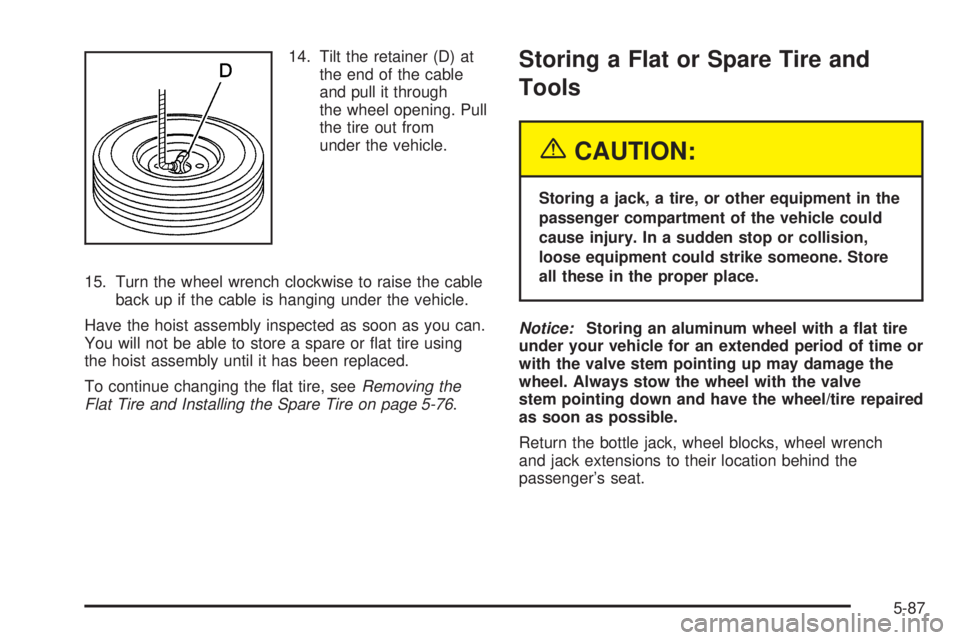
14. Tilt the retainer (D) at
the end of the cable
and pull it through
the wheel opening. Pull
the tire out from
under the vehicle.
15. Turn the wheel wrench clockwise to raise the cable
back up if the cable is hanging under the vehicle.
Have the hoist assembly inspected as soon as you can.
You will not be able to store a spare or at tire using
the hoist assembly until it has been replaced.
To continue changing the at tire, seeRemoving the
Flat Tire and Installing the Spare Tire on page 5-76.Storing a Flat or Spare Tire and
Tools
{CAUTION:
Storing a jack, a tire, or other equipment in the
passenger compartment of the vehicle could
cause injury. In a sudden stop or collision,
loose equipment could strike someone. Store
all these in the proper place.
Notice:Storing an aluminum wheel with a at tire
under your vehicle for an extended period of time or
with the valve stem pointing up may damage the
wheel. Always stow the wheel with the valve
stem pointing down and have the wheel/tire repaired
as soon as possible.
Return the bottle jack, wheel blocks, wheel wrench
and jack extensions to their location behind the
passenger’s seat.
5-87
Page 363 of 428
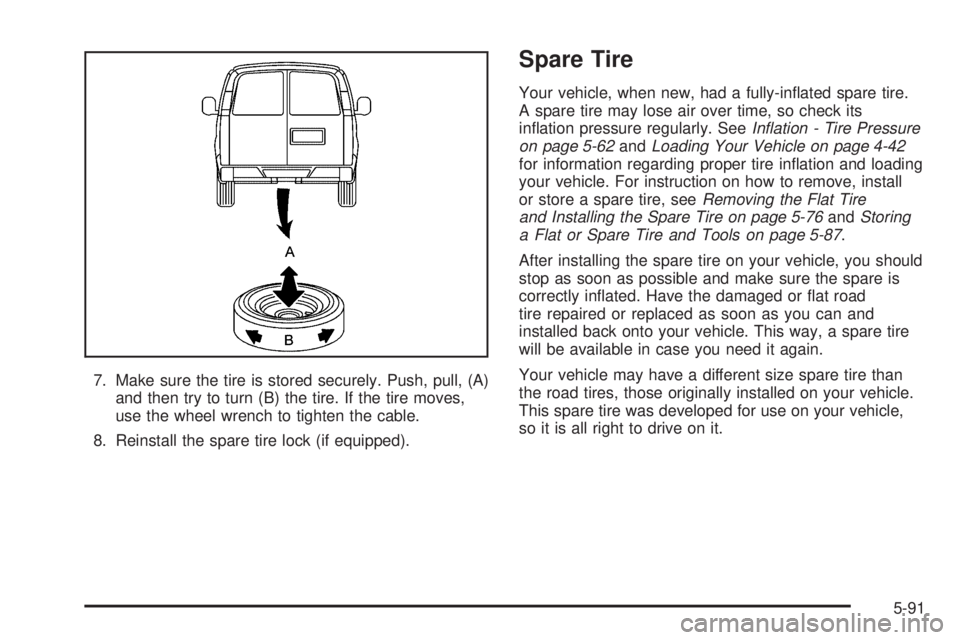
7. Make sure the tire is stored securely. Push, pull, (A)
and then try to turn (B) the tire. If the tire moves,
use the wheel wrench to tighten the cable.
8. Reinstall the spare tire lock (if equipped).
Spare Tire
Your vehicle, when new, had a fully-inated spare tire.
A spare tire may lose air over time, so check its
ination pressure regularly. SeeInation - Tire Pressure
on page 5-62andLoading Your Vehicle on page 4-42
for information regarding proper tire ination and loading
your vehicle. For instruction on how to remove, install
or store a spare tire, seeRemoving the Flat Tire
and Installing the Spare Tire on page 5-76andStoring
a Flat or Spare Tire and Tools on page 5-87.
After installing the spare tire on your vehicle, you should
stop as soon as possible and make sure the spare is
correctly inated. Have the damaged or at road
tire repaired or replaced as soon as you can and
installed back onto your vehicle. This way, a spare tire
will be available in case you need it again.
Your vehicle may have a different size spare tire than
the road tires, those originally installed on your vehicle.
This spare tire was developed for use on your vehicle,
so it is all right to drive on it.
5-91