tires GMC SIERRA DENALI 2017 Owner's Manual
[x] Cancel search | Manufacturer: GMC, Model Year: 2017, Model line: SIERRA DENALI, Model: GMC SIERRA DENALI 2017Pages: 511, PDF Size: 6.88 MB
Page 289 of 511
GMC Sierra/Sierra Denali Owner Manual (GMNA-Localizing-U.S./Canada/
Mexico-9955992) - 2017 - crc - 4/18/17
288 Driving and Operating Low Traction Mode If equipped, Low Traction Mode
assists in vehicle acceleration when
road conditions are slippery, such
as with ice or snow. While the
vehicle is at a stop, select L2 using
Range Selection Mode. This will
limit torque to the wheels and help
to prevent the tires from spinning.
Tow/Haul Mode
Vehicles with an automatic
transmission have a Tow/Haul
Mode. The Tow/Haul Mode adjusts
the transmission shift pattern to
reduce shift cycling. This provides increased performance, vehicle
control, and enhanced transmission
and engine cooling when driving
down steep hills or mountain
grades, when towing, or when
hauling heavy loads.
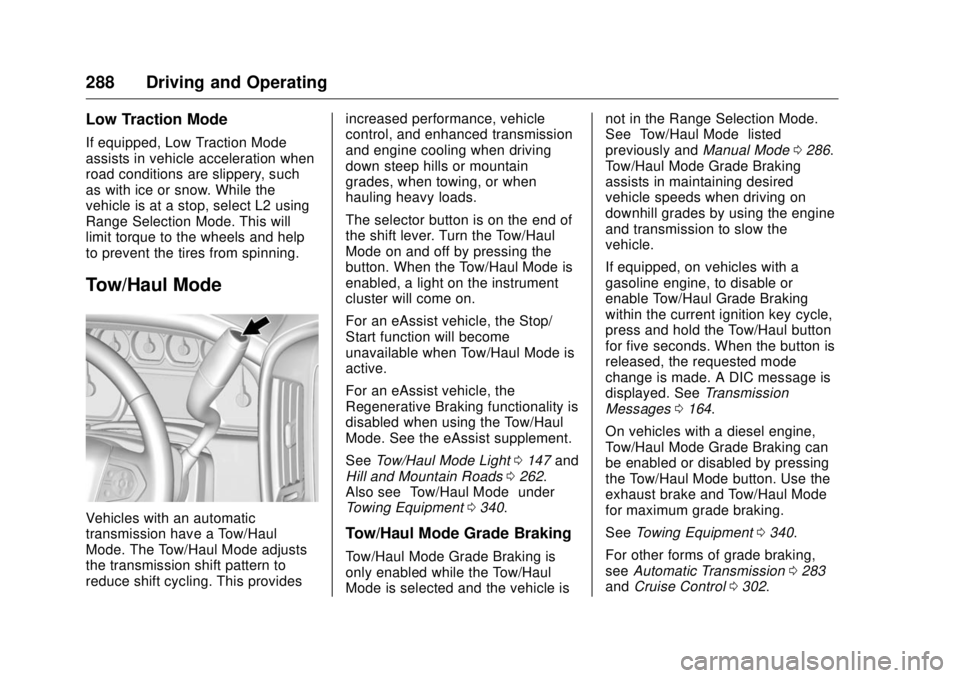
The selector button is on the end of
the shift lever. Turn the Tow/Haul
Mode on and off by pressing the
button. When the Tow/Haul Mode is
enabled, a light on the instrument
cluster will come on.
For an eAssist vehicle, the Stop/
Start function will become
unavailable when Tow/Haul Mode is
active.
For an eAssist vehicle, the
Regenerative Braking functionality is
disabled when using the Tow/Haul
Mode. See the eAssist supplement.
See Tow/Haul Mode Light 0 147 and
Hill and Mountain Roads 0 262 .
Also see “ Tow/Haul Mode ” under
Towing Equipment 0 340 .
Tow/Haul Mode Grade Braking
Tow/Haul Mode Grade Braking is
only enabled while the Tow/Haul
Mode is selected and the vehicle is not in the Range Selection Mode.
See “ Tow/Haul Mode ” listed
previously and Manual Mode 0 286 .
Tow/Haul Mode Grade Braking
assists in maintaining desired
vehicle speeds when driving on
downhill grades by using the engine
and transmission to slow the
vehicle.
If equipped, on vehicles with a
gasoline engine, to disable or
enable Tow/Haul Grade Braking
within the current ignition key cycle,
press and hold the Tow/Haul button
for five seconds. When the button is
released, the requested mode
change is made. A DIC message is
displayed. See Transmission
Messages 0 164 .
On vehicles with a diesel engine,
Tow/Haul Mode Grade Braking can
be enabled or disabled by pressing
the Tow/Haul Mode button. Use the
exhaust brake and Tow/Haul Mode
for maximum grade braking.
See Towing Equipment 0 340 .
For other forms of grade braking,
see Automatic Transmission 0 283
and Cruise Control 0 302 .
Page 290 of 511
GMC Sierra/Sierra Denali Owner Manual (GMNA-Localizing-U.S./Canada/
Mexico-9955992) - 2017 - crc - 4/19/17
Driving and Operating 289
Drive Systems Four-Wheel Drive If equipped, four-wheel drive
engages the front axle for extra
traction. Read the appropriate
section for transfer case operation
before using.
CautionDo not drive on clean, dry
pavement in 4
m and 4
n (if
equipped) for an extended period
of time. These conditions may
cause premature wear on the
vehicle ’ s powertrain.
Driving on clean, dry pavement in
4
m or 4
n may:
.
Cause a vibration to be felt in
the steering system.
.
Cause tires to wear faster.
.
Make the transfer case harder to
shift, and cause it to run noisier. { WarningShifting the transfer case to
N (Neutral) can cause the vehicle
to roll even if the transmission is
in P (Park). You or someone else
could be seriously injured. Be
sure to set the parking brake
before placing the transfer case in
N (Neutral). See Parking Brake
0 297 .
CautionExtended high-speed operation in
4
n may damage or shorten the
life of the drivetrain.
Engagement noise and bump when
shifting between 4
n and 4
m or from
N (Neutral), with the engine running,
is normal.
Shifting into 4
n will turn Traction
Control and StabiliTrak ®
off. See
Traction Control/Electronic Stability
Control 0 299 . Manual Transfer Case
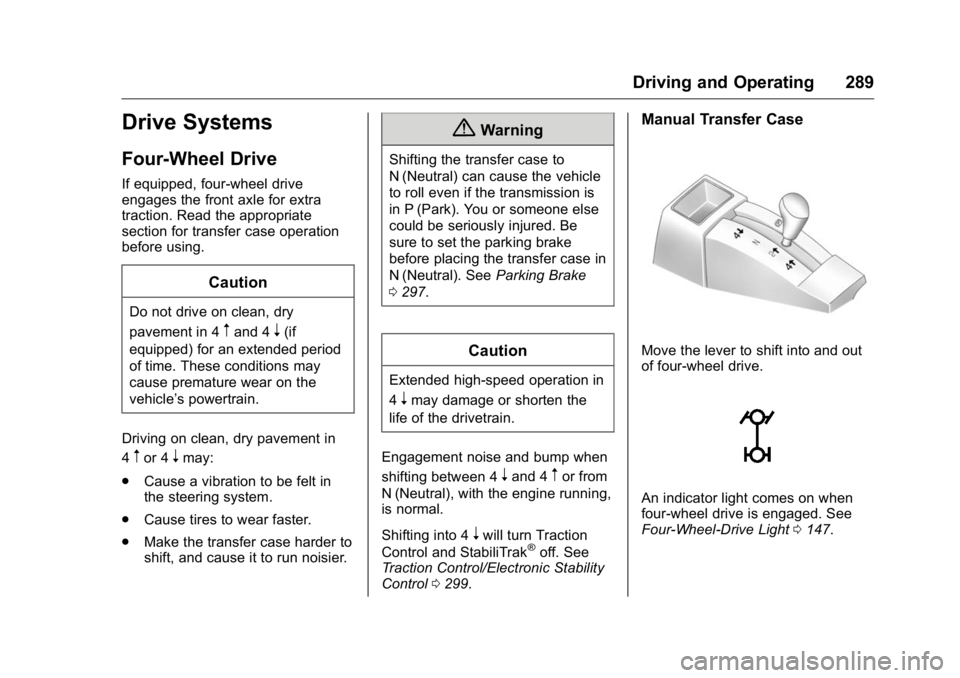
Move the lever to shift into and out
of four-wheel drive.
An indicator light comes on when
four-wheel drive is engaged. See
Four-Wheel-Drive Light 0 147 .
Page 322 of 511
GMC Sierra/Sierra Denali Owner Manual (GMNA-Localizing-U.S./Canada/
Mexico-9955992) - 2017 - crc - 4/18/17
Driving and Operating 321vehicle itself. Get acquainted with
the handling and braking of the rig
before setting out for the open road.
The structure, tires, and brakes of
the trailer must be rated to carry the
load. Inadequate trailer equipment
can cause the combination to
operate in an unexpected or unsafe
manner.
Before starting, check all trailer hitch
parts and attachments, safety
chains, electrical connectors, lamps,
tires, and mirrors. Get familiar with
the handling and braking of the rig.
If the trailer has electric brakes, start
the combination moving and then
apply the trailer brake controller by
hand to be sure the brakes work.
During the trip, check occasionally
to be sure that the load is secure
and the lamps and any trailer
brakes still work.
Following Distance
Stay at least twice as far behind the
vehicle ahead as you would when
driving the vehicle without a trailer.
This can help to avoid heavy
braking and sudden turns. Passing More passing distance is needed
when towing a trailer. The
combination will not accelerate as
quickly and is longer so it is
necessary to go much farther
beyond the passed vehicle before
returning to the lane.
Backing Up Hold the bottom of the steering
wheel with one hand. To move the
trailer to the left, move that hand to
the left. To move the trailer to the
right, move your hand to the right.
Always back up slowly and,
if possible, have someone
guide you.
Making Turns
Caution
Making very sharp turns while
trailering could cause the trailer to
come in contact with the vehicle.
The vehicle could be damaged.
Avoid making very sharp turns
while trailering. When turning with a trailer, make
wider turns than normal. Do this so
the trailer will not strike soft
shoulders, curbs, road signs, trees,
or other objects. Avoid jerky or
sudden maneuvers. Signal well in
advance.
If the trailer turn signal bulbs burn
out, the arrows on the instrument
cluster will still flash for turns. It is
important to check occasionally to
be sure the trailer bulbs are still
working.
Driving on Grades Reduce speed and shift to a lower
gear before starting down a long or
steep downgrade. If the
transmission is not shifted down, the
brakes might get hot and no longer
work well.
Vehicles can tow in D (Drive). Shift
the transmission to a lower gear if
the transmission shifts too often
under heavy loads and/or hilly
conditions.
The Tow/Haul Mode may be used if
the transmission shifts too often.
See Tow/Haul Mode 0 288 .
Page 340 of 511
GMC Sierra/Sierra Denali Owner Manual (GMNA-Localizing-U.S./Canada/
Mexico-9955992) - 2017 - crc - 4/18/17
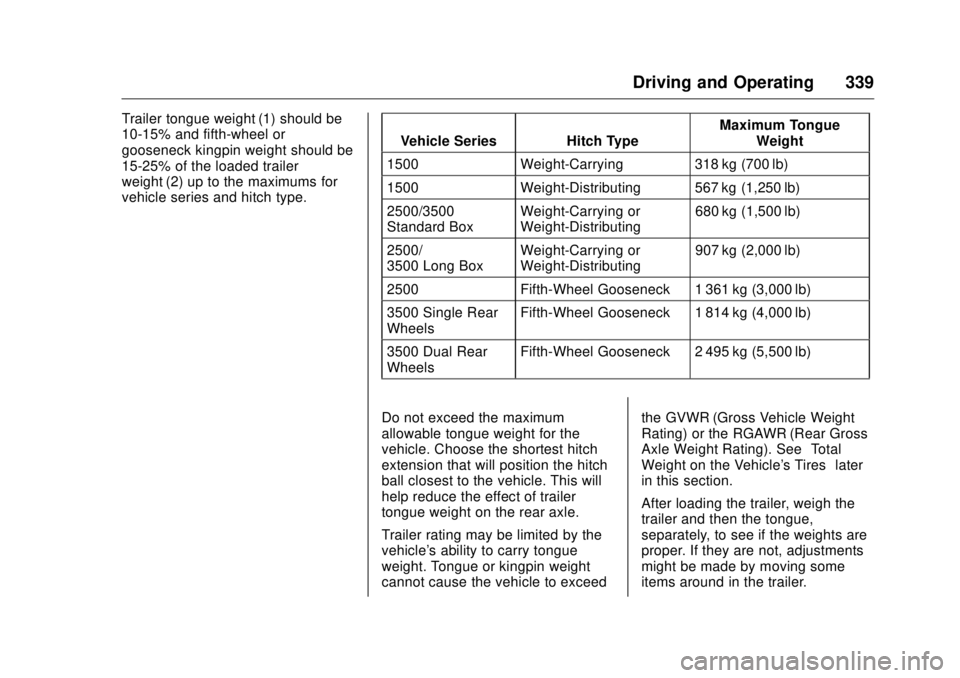
Driving and Operating 339Trailer tongue weight (1) should be
10-15% and fifth-wheel or
gooseneck kingpin weight should be
15-25% of the loaded trailer
weight (2) up to the maximums for
vehicle series and hitch type. Vehicle Series Hitch Type Maximum Tongue
Weight
1500 Weight-Carrying 318 kg (700 lb)
1500 Weight-Distributing 567 kg (1,250 lb)
2500/3500
Standard Box Weight-Carrying or
Weight-Distributing 680 kg (1,500 lb)
2500/
3500 Long Box Weight-Carrying or
Weight-Distributing 907 kg (2,000 lb)
2500 Fifth-Wheel Gooseneck 1 361 kg (3,000 lb)
3500 Single Rear
Wheels Fifth-Wheel Gooseneck 1 814 kg (4,000 lb)
3500 Dual Rear
Wheels Fifth-Wheel Gooseneck 2 495 kg (5,500 lb)
Do not exceed the maximum
allowable tongue weight for the
vehicle. Choose the shortest hitch
extension that will position the hitch
ball closest to the vehicle. This will
help reduce the effect of trailer
tongue weight on the rear axle.
Trailer rating may be limited by the
vehicle's ability to carry tongue
weight. Tongue or kingpin weight
cannot cause the vehicle to exceed the GVWR (Gross Vehicle Weight
Rating) or the RGAWR (Rear Gross
Axle Weight Rating). See “ Total
Weight on the Vehicle's Tires ” later
in this section.
After loading the trailer, weigh the
trailer and then the tongue,
separately, to see if the weights are
proper. If they are not, adjustments
might be made by moving some
items around in the trailer.
Page 341 of 511
GMC Sierra/Sierra Denali Owner Manual (GMNA-Localizing-U.S./Canada/
Mexico-9955992) - 2017 - crc - 4/18/17
340 Driving and Operating If a cargo carrier is used in the
trailer hitch receiver, choose a
carrier that positions the load as
close to the vehicle as possible.
Make sure the total weight,
including the carrier, is no more than
half of the maximum allowable
tongue weight for the vehicle or
227 kg (500 lb), whichever is less.
Total Weight on the Vehicle's
Tires Be sure the vehicle's tires are
inflated to the inflation pressures
found on the Certification/Tire label
on the center pillar or see Vehicle
Load Limits 0 265 . Make sure not to
exceed the GVWR limit for the
vehicle, or the RGAWR, with the tow
vehicle and trailer fully loaded for
the trip including the weight of the
trailer tongue. If using a
weight-distributing hitch, make sure
not to exceed the RGAWR before
applying the weight distribution
spring bars. Weight of the Trailering
Combination It is important that the combination
of the tow vehicle and trailer does
not exceed any of its weight ratings
— GCWR, GVWR, RGAWR, Trailer
Weight Rating, or Tongue Weight.
The only way to be sure it is not
exceeding any of these ratings is to
weigh the tow vehicle and trailer
combination, fully loaded for the trip,
getting individual weights for each of
these items.
Towing Equipment Hitches The correct hitch equipment helps
maintain combination control. Many
trailers can be towed with a
weight-carrying hitch which simply
features a coupler latched to the
hitch ball, or a tow eye latched to a
pintle hook. Other trailers may
require a weight-distributing hitch
that uses spring bars to distribute
the trailer tongue weight among the
tow vehicle and trailer axles. Fifth-wheel and gooseneck hitches
may also be used. See “ Weight of
the Trailer Tongue ” under Trailer
Towing 0 323 for rating limits with
various hitch types.
If a step-bumper hitch will be used,
the bumper could be damaged in
sharp turns. Make sure there
is ample room when turning to avoid
contact between the trailer and the
bumper.
Consider using sway controls with
any trailer. Ask a trailering
professional about sway controls or
refer to the trailer manufacturer's
recommendations and instructions.
Weight-Distributing Hitch and
Adjustment A weight-distributing hitch may be
useful with some trailers. Use the
following guidelines to determine if a
weight-distributing hitch should
be used.
Page 350 of 511
GMC Sierra/Sierra Denali Owner Manual (GMNA-Localizing-U.S./Canada/
Mexico-9955992) - 2017 - crc - 4/18/17
Driving and Operating 349A GM dealer may be able to
diagnose and repair problems with
the trailer. However, any diagnosis
and repair of the trailer is not
covered under the vehicle warranty.
Contact your trailer dealer for
assistance with trailer repairs and
trailer warranty information.
Trailer Sway
Control (TSC) Vehicles with StabiliTrak have a
Trailer Sway Control (TSC) feature.
Trailer sway is unintended
side-to-side motion of a trailer while
being towed. If the vehicle is towing
a trailer and the TSC detects that
sway is increasing, the vehicle
brakes are selectively applied at
each wheel, to help reduce
excessive trailer sway. If the vehicle
is equipped with the Integrated
Trailer Brake Control (ITBC) system,
and the trailer has the electric
actuated brake system, StabiliTrak
may also apply the trailer brakes.
If TSC is enabled, the Traction
Control System (TCS)/StabiliTrak
warning light will flash on the instrument cluster. Vehicle speed
must be reduced. If trailer sway
continues, StabiliTrak can reduce
engine torque to help slow the
vehicle. See Traction Control/
Electronic Stability Control 0 299 .
{ WarningEven if the vehicle is equipped
with TSC, trailer sway could result
in loss of control and the vehicle
could crash. If excessive trailer
sway is detected, slow down to a
safe speed. Check the trailer and
vehicle to help correct possible
causes. These could include an
improperly or overloaded trailer,
unrestrained cargo, improper
trailer hitch configuration,
excessive vehicle-trailer speed,
or improperly inflated or incorrect
vehicle or trailer tires. See Towing
Equipment 0 340 for trailer ratings
and hitch setup
recommendations. Adding non-dealer accessories can
affect the vehicle performance. See
Accessories and Modifications
0 357 .
Page 356 of 511
GMC Sierra/Sierra Denali Owner Manual (GMNA-Localizing-U.S./Canada/
Mexico-9955992) - 2017 - crc - 4/18/17
Vehicle Care 355
Vehicle Care General Information General Information . . . . . . . . . . 356
California Proposition
65 Warning . . . . . . . . . . . . . . . . . 357
California Perchlorate
Materials Requirements . . . . . 357
Accessories and
Modifications . . . . . . . . . . . . . . . . 357
Vehicle Checks Doing Your Own
Service Work . . . . . . . . . . . . . . . 358
Hood . . . . . . . . . . . . . . . . . . . . . . . . . 358
Engine Compartment
Overview . . . . . . . . . . . . . . . . . . . . 359
Engine Oil . . . . . . . . . . . . . . . . . . . . 364
Engine Oil Life System . . . . . . . 367
Automatic Transmission Fluid
(6 Speed Transmission) . . . . . 368
Automatic Transmission Fluid
(8 Speed Transmission) . . . . . 371
Engine Air Cleaner/Filter . . . . . . 371
Cooling System . . . . . . . . . . . . . . 372
Engine Coolant . . . . . . . . . . . . . . . 374
Engine Overheating . . . . . . . . . . 376
Overheated Engine Protection
Operating Mode . . . . . . . . . . . . . 378
Engine Fan . . . . . . . . . . . . . . . . . . . 378 Power Steering Fluid (1500
Series) . . . . . . . . . . . . . . . . . . . . . . 379
Power Steering Fluid (2500/
3500 Series) . . . . . . . . . . . . . . . . 379
Washer Fluid . . . . . . . . . . . . . . . . . 380
Brakes . . . . . . . . . . . . . . . . . . . . . . . 381
Brake Fluid . . . . . . . . . . . . . . . . . . . 381
Battery - North America . . . . . . 383
Four-Wheel Drive . . . . . . . . . . . . . 383
Front Axle . . . . . . . . . . . . . . . . . . . . 384
Rear Axle . . . . . . . . . . . . . . . . . . . . 385
Noise Control System . . . . . . . . 386
Starter Switch Check . . . . . . . . . 387
Automatic Transmission Shift
Lock Control Function
Check . . . . . . . . . . . . . . . . . . . . . . . 387
Ignition Transmission Lock
Check . . . . . . . . . . . . . . . . . . . . . . . 388
Park Brake and P (Park)
Mechanism Check . . . . . . . . . . 388
Wiper Blade Replacement . . . . 388
Glass Replacement . . . . . . . . . . 389
Headlamp Aiming Headlamp Aiming . . . . . . . . . . . . 389
Bulb Replacement
Bulb Replacement . . . . . . . . . . . . 389
Halogen Bulbs . . . . . . . . . . . . . . . . 389
High Intensity Discharge (HID)
Lighting . . . . . . . . . . . . . . . . . . . . . 390 LED Lighting . . . . . . . . . . . . . . . . . 390
Taillamps, Turn Signal,
Stoplamps, and Back-Up
Lamps . . . . . . . . . . . . . . . . . . . . . . 390
Center High-Mounted
Stoplamp (CHMSL) and
Cargo Lamp . . . . . . . . . . . . . . . . . 391
Replacement Bulbs . . . . . . . . . . . 392
Electrical System High Voltage Devices and
Wiring . . . . . . . . . . . . . . . . . . . . . . . 392
Electrical System Overload . . . 392
Fuses . . . . . . . . . . . . . . . . . . . . . . . . 393
Engine Compartment Fuse
Block . . . . . . . . . . . . . . . . . . . . . . . . 393
Instrument Panel Fuse Block
(Right) . . . . . . . . . . . . . . . . . . . . . . 396
Instrument Panel Fuse
Block (Left) . . . . . . . . . . . . . . . . . 398
Wheels and Tires Tires . . . . . . . . . . . . . . . . . . . . . . . . . . 400
All-Season Tires . . . . . . . . . . . . . . 401
Winter Tires . . . . . . . . . . . . . . . . . . 401
Low-Profile Tires . . . . . . . . . . . . . 402
All-Terrain Tires . . . . . . . . . . . . . . . 402
Tire Sidewall Labeling . . . . . . . . 402
Tire Designations . . . . . . . . . . . . . 405
Tire Terminology and
Definitions . . . . . . . . . . . . . . . . . . 406
Page 357 of 511
GMC Sierra/Sierra Denali Owner Manual (GMNA-Localizing-U.S./Canada/
Mexico-9955992) - 2017 - crc - 4/18/17
356 Vehicle Care Tire Pressure . . . . . . . . . . . . . . . . . 408
Tire Pressure for High-Speed
Operation . . . . . . . . . . . . . . . . . . . 410
Tire Pressure Monitor
System . . . . . . . . . . . . . . . . . . . . . . 410
Tire Pressure Monitor
Operation . . . . . . . . . . . . . . . . . . . 411
Tire Inspection . . . . . . . . . . . . . . . . 414
Tire Rotation . . . . . . . . . . . . . . . . . 415
When It Is Time for New
Tires . . . . . . . . . . . . . . . . . . . . . . . . 417
Buying New Tires . . . . . . . . . . . . . 418
Different Size Tires and
Wheels . . . . . . . . . . . . . . . . . . . . . . 419
Uniform Tire Quality
Grading . . . . . . . . . . . . . . . . . . . . . 420
Wheel Alignment and Tire
Balance . . . . . . . . . . . . . . . . . . . . . 421
Wheel Replacement . . . . . . . . . . 421
Tire Chains . . . . . . . . . . . . . . . . . . . 422
If a Tire Goes Flat . . . . . . . . . . . . 423
Tire Changing . . . . . . . . . . . . . . . . 425
Full-Size Spare Tire . . . . . . . . . . 434
Jump Starting Jump Starting - North
America . . . . . . . . . . . . . . . . . . . . . 435
Towing the Vehicle
Towing the Vehicle . . . . . . . . . . . 439 Recreational Vehicle
Towing . . . . . . . . . . . . . . . . . . . . . . 440
Appearance Care Exterior Care . . . . . . . . . . . . . . . . . 444
Interior Care . . . . . . . . . . . . . . . . . . 449
Floor Mats . . . . . . . . . . . . . . . . . . . . 452
General Information For service and parts needs, visit
your dealer. You will receive
genuine GM parts and GM-trained
and supported service people.
Genuine GM parts have one of
these marks:
Page 382 of 511
GMC Sierra/Sierra Denali Owner Manual (GMNA-Localizing-U.S./Canada/
Mexico-9955992) - 2017 - crc - 4/18/17
Vehicle Care 381Caution (Continued) freezing occurs, which could
damage the tank if it is
completely full.
Brakes Disc brake pads have built-in wear
indicators that make a high-pitched
warning sound when the brake pads
are worn and new pads are needed.
The sound can come and go or be
heard all the time the vehicle is
moving, except when applying the
brake pedal firmly.
{ Warning
The brake wear warning sound
means that soon the brakes will
not work well. That could lead to
a crash. When the brake wear
warning sound is heard, have the
vehicle serviced. CautionContinuing to drive with worn-out
brake pads could result in costly
brake repair.
Some driving conditions or climates
can cause a brake squeal when the
brakes are first applied or lightly
applied. This does not mean
something is wrong with the brakes.
Properly torqued wheel nuts are
necessary to help prevent brake
pulsation. When tires are rotated,
inspect brake pads for wear and
evenly tighten wheel nuts in the
proper sequence to torque
specifications in Capacities and
Specifications 0 470 .
Brake linings should always be
replaced as complete axle sets.
Brake Pedal Travel
See your dealer if the brake pedal
does not return to normal height,
or if there is a rapid increase in
pedal travel. This could be a sign
that brake service may be required. Replacing Brake System Parts Always replace brake system parts
with new, approved replacement
parts. If this is not done, the brakes
may not work properly. The braking
performance expected can change
in many other ways if the wrong
replacement brake parts are
installed or parts are improperly
installed.
Brake Fluid
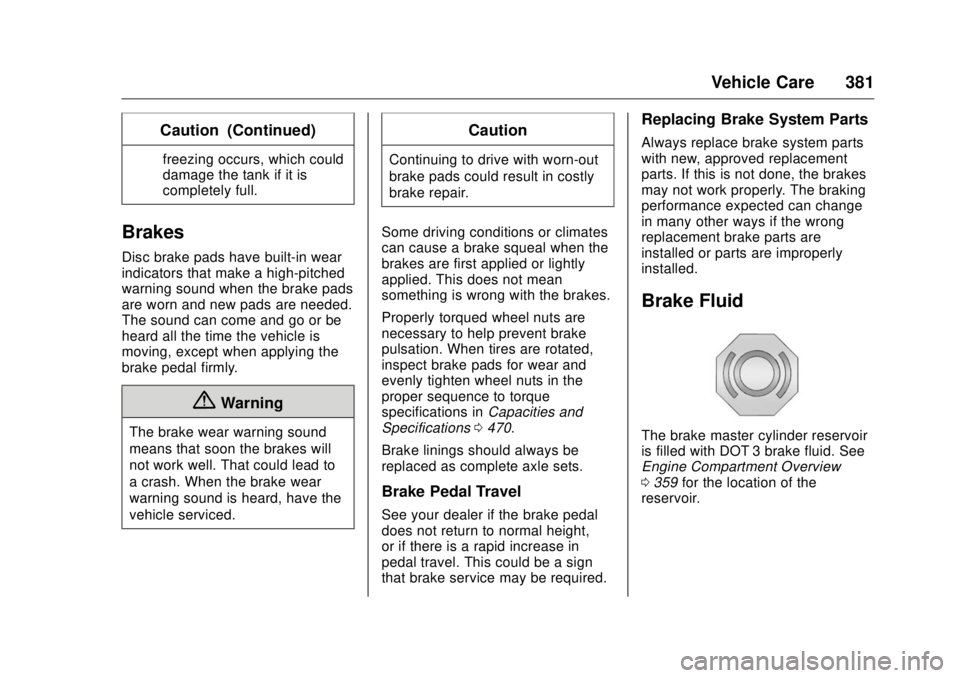
The brake master cylinder reservoir
is filled with DOT 3 brake fluid. See
Engine Compartment Overview
0 359 for the location of the
reservoir.
Page 401 of 511
GMC Sierra/Sierra Denali Owner Manual (GMNA-Localizing-U.S./Canada/
Mexico-9955992) - 2017 - crc - 4/18/17
400 Vehicle Care Number Usage
20 –
22 HVAC/Auxiliary
HVAC/Ignition
23 Instrument cluster/
Ignition sensing
diagnostic module/
Ignition
24 –
25 Data link connector/
Driver seat module
26 Passive entry/Passive
start/HVAC
27 –
28 –
29 Park enable/
Electrically adjustable
pedals
30 SEO
31 Accessory/Run/Crank
32 Heated steering wheel
33 –
34 Instrument cluster
36 – Number Usage
37 –
38 4WD TREC
40 Left doors
41 Driver power seat
43 Left heated, cooled or
ventilated seats (if
equipped)
44 Right heated, cooled
or ventilated seats (if
equipped)
45 –
49 Retained accessory
power
50 Run/Crank Wheels and Tires Tires Every new GM vehicle has
high-quality tires made by a
leading tire manufacturer. See
the warranty manual for
information regarding the tire
warranty and where to get
service. For additional
information refer to the tire
manufacturer.
{ Warning.
Poorly maintained and
improperly used tires are
dangerous. .
Overloading the tires can
cause overheating as a
result of too much
flexing. There could be a
blowout and a serious
crash. See Vehicle Load
Limits 0 265 .
(Continued)