transmission GMC SIERRA DENALI 2019 Workshop Manual
[x] Cancel search | Manufacturer: GMC, Model Year: 2019, Model line: SIERRA DENALI, Model: GMC SIERRA DENALI 2019Pages: 472, PDF Size: 8.98 MB
Page 345 of 472
GMC Sierra/Sierra Denali Owner Manual (GMNA-Localizing-U.S./Canada/
Mexico-1500-11698638) - 2019 - crc - 5/15/18
344 Vehicle Care Park on a fairly steep hill, with the
vehicle facing downhill. Keeping
your foot on the regular brake, set
the parking brake.
.
To check the parking brake's
holding ability: With the engine
running and the transmission in
N (Neutral), slowly remove foot
pressure from the regular brake
pedal. Do this until the vehicle is
held by the parking brake only.
.
To check the P (Park)
mechanism's holding ability:
With the engine running, shift to
P (Park). Then release the
parking brake followed by the
regular brake.
Contact your dealer if service is
required.
Wiper Blade Replacement Windshield wiper blades should be
replaced periodically. See
Maintenance Schedule 0 415 . Replacement blades come in
different types and are removed in
different ways. For proper type and
length, see Maintenance
Replacement Parts 0 427 .
CautionAllowing the wiper arm to touch
the windshield when no wiper
blade is installed could damage
the windshield. Any damage that
occurs would not be covered by
the vehicle warranty. Do not allow
the wiper arm to touch the
windshield.
Front Wiper Blade
Replacement To replace the wiper blade:
1. Pull the wiper assembly away
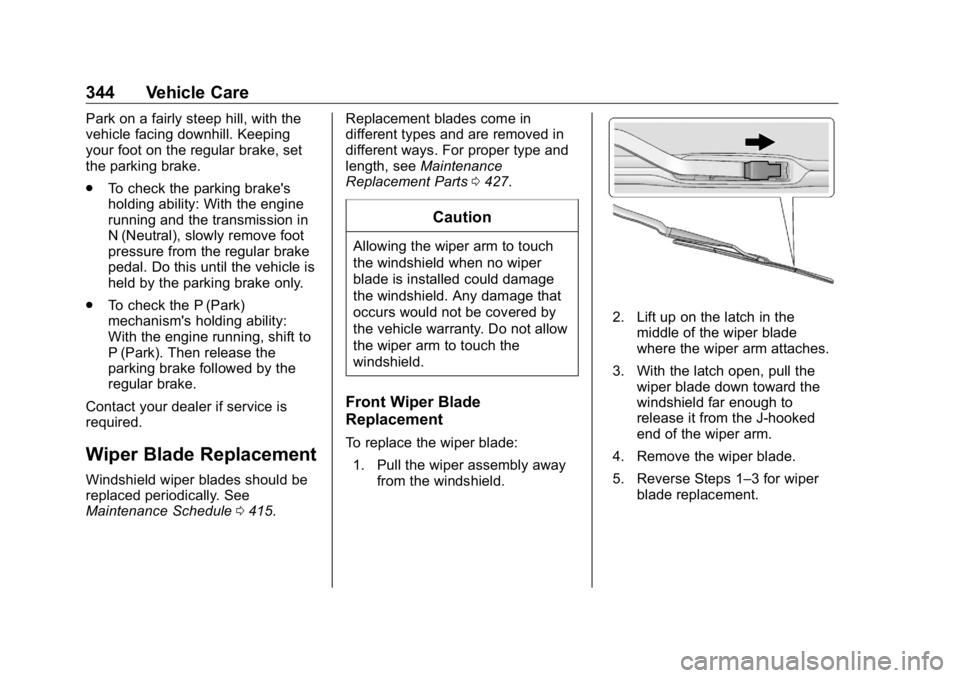
from the windshield. 2. Lift up on the latch in the
middle of the wiper blade
where the wiper arm attaches.
3. With the latch open, pull the
wiper blade down toward the
windshield far enough to
release it from the J-hooked
end of the wiper arm.
4. Remove the wiper blade.
5. Reverse Steps 1 – 3 for wiper
blade replacement.
Page 353 of 472
GMC Sierra/Sierra Denali Owner Manual (GMNA-Localizing-U.S./Canada/
Mexico-1500-11698638) - 2019 - crc - 5/15/18
352 Vehicle Care Fuses Usage
4 Headlamp right
6 TIM
7 –
8 Fog lamp
9 VKM
10 –
11 Police upfitter
12 –
13 Washer front
14 Washer rear
15 MSB driver
16 –
17 IECL 1
19 DC/AC inverter
20 IECR 2
21 MSB pass
22 IECL 2
24 Eboost 1
25 REC
26 – Fuses Usage
27 Horn
28 –
29 –
30 –
31 –
32 Rear window
defogger
33 Heated mirror
34 Parking lamp left
37 Euro trailer
38 TIM
39 –
40 Misc ignition
41 Trailer
parking lamp
42 Park lamp right
44 –
45 Second fuel pump
46 Engine control
module ignition Fuses Usage
47 Transmission
control module
ignition
48 –
49 Transmission
control module
50 A/C clutch
51 Transfer case
control module
52 Front wiper
53 Center
high-mounted
stop lamp
54 Trailer
reverse lamp
55 Trailer
back-up lamp
56 SADS
57 TTPM
58 Starter motor
60 Active fuel
management 1
Page 357 of 472
GMC Sierra/Sierra Denali Owner Manual (GMNA-Localizing-U.S./Canada/
Mexico-1500-11698638) - 2019 - crc - 5/15/18
356 Vehicle Care Fuses Usage
F30 Sensing and
diagnostic module/
Parking brake
F31 Body control module 4
F32 Special equipment
option/Data link
connection
F33 Body control module 8
F34 Cargo lamp
F40 CGM
F41 Infotainment 1
F42 TCP
F43 –
F44 AVM
F45 Body control module 2
F46 Heating, ventilation,
and air conditioning/
Battery 1
F47 Instrument panel
cluster/Battery
F48 Transmission control
module Fuses Usage
F49 Body control module 1
F50 –
F51 Battery 1
F52 Battery 2
F53 –
F54 Sunroof
F55 Driver power seat
F56 DC DC TRANS 1
F57 DC DC TRANS 2
F58 Infotainment 2
Circuit
Breakers Usage
1 Accessory power
outlet 2
2 Accessory power
outlet 1/Cigarette
Lighter
3 Accessory power
outlet 3
4 Accessory power
outlet 4 Relays Usage
1 Run/Crank
2 Retained accessory
power/Accessory 1
4 Retained accessory
power/Accessory 2
5 –
Instrument Panel Fuse
Block (Left)
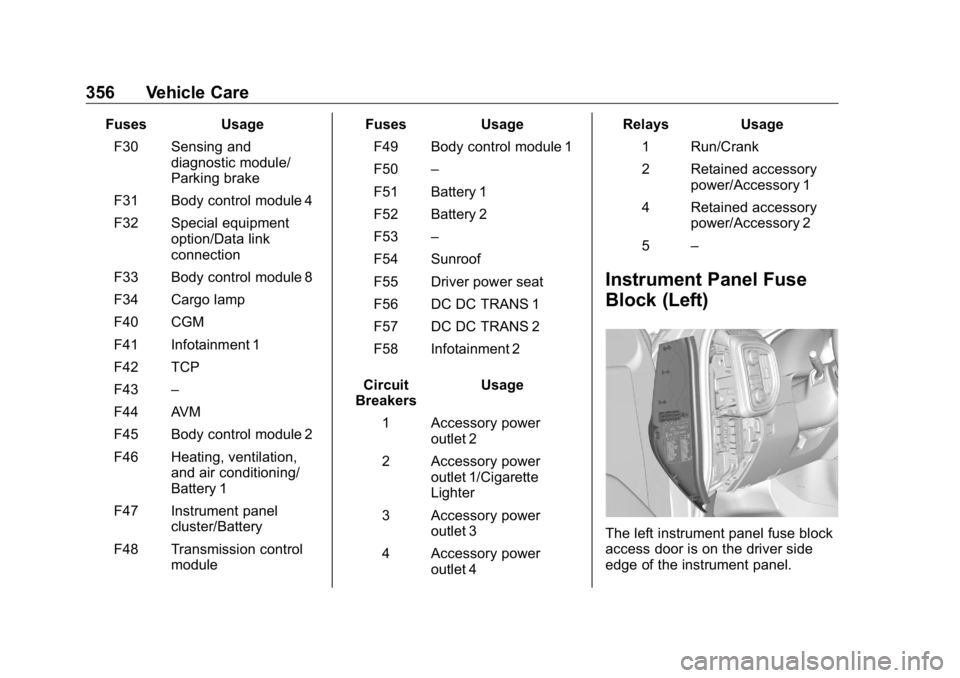
The left instrument panel fuse block
access door is on the driver side
edge of the instrument panel.
Page 365 of 472
GMC Sierra/Sierra Denali Owner Manual (GMNA-Localizing-U.S./Canada/
Mexico-1500-11698638) - 2019 - crc - 5/15/18
364 Vehicle Care (6) Service Description :
These
characters represent the load
index and speed rating of the
tire. The load index represents
the load carrying capacity a tire
is certified to carry. The speed
rating is the maximum speed a
tire is certified to carry a load.
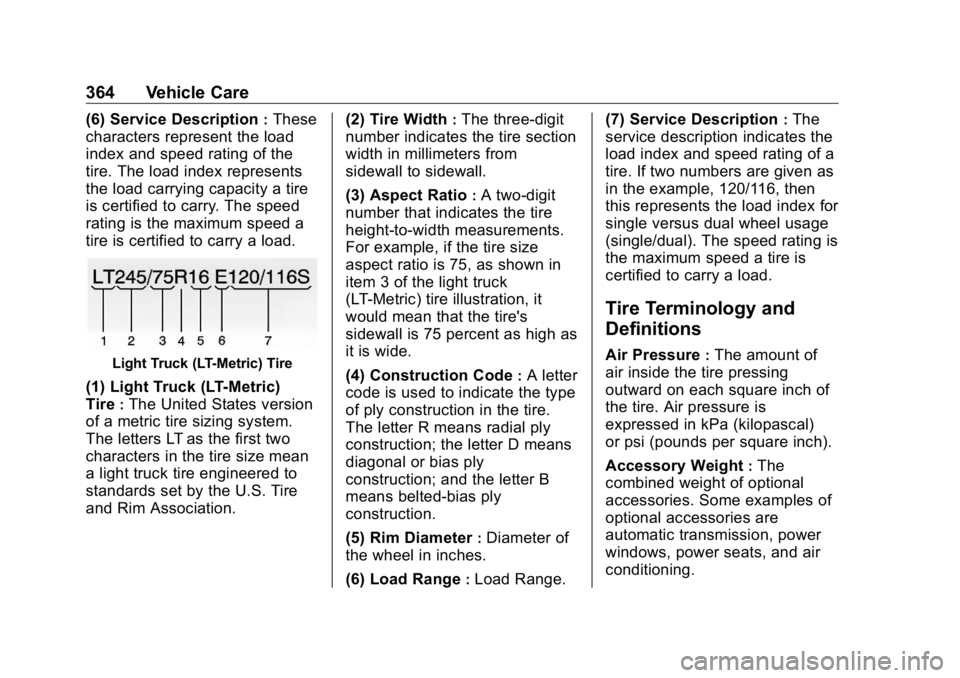
Light Truck (LT-Metric) Tire
(1) Light Truck (LT-Metric)
Tire :
The United States version
of a metric tire sizing system.
The letters LT as the first two
characters in the tire size mean
a light truck tire engineered to
standards set by the U.S. Tire
and Rim Association. (2) Tire Width :
The three-digit
number indicates the tire section
width in millimeters from
sidewall to sidewall.
(3) Aspect Ratio :
A two-digit
number that indicates the tire
height-to-width measurements.
For example, if the tire size
aspect ratio is 75, as shown in
item 3 of the light truck
(LT-Metric) tire illustration, it
would mean that the tire's
sidewall is 75 percent as high as
it is wide.
(4) Construction Code :
A letter
code is used to indicate the type
of ply construction in the tire.
The letter R means radial ply
construction; the letter D means
diagonal or bias ply
construction; and the letter B
means belted-bias ply
construction.
(5) Rim Diameter :
Diameter of
the wheel in inches.
(6) Load Range :
Load Range. (7) Service Description :
The
service description indicates the
load index and speed rating of a
tire. If two numbers are given as
in the example, 120/116, then
this represents the load index for
single versus dual wheel usage
(single/dual). The speed rating is
the maximum speed a tire is
certified to carry a load.
Tire Terminology and
Definitions Air Pressure :
The amount of
air inside the tire pressing
outward on each square inch of
the tire. Air pressure is
expressed in kPa (kilopascal)
or psi (pounds per square inch).
Accessory Weight :
The
combined weight of optional
accessories. Some examples of
optional accessories are
automatic transmission, power
windows, power seats, and air
conditioning.
Page 397 of 472
GMC Sierra/Sierra Denali Owner Manual (GMNA-Localizing-U.S./Canada/
Mexico-1500-11698638) - 2019 - crc - 5/15/18
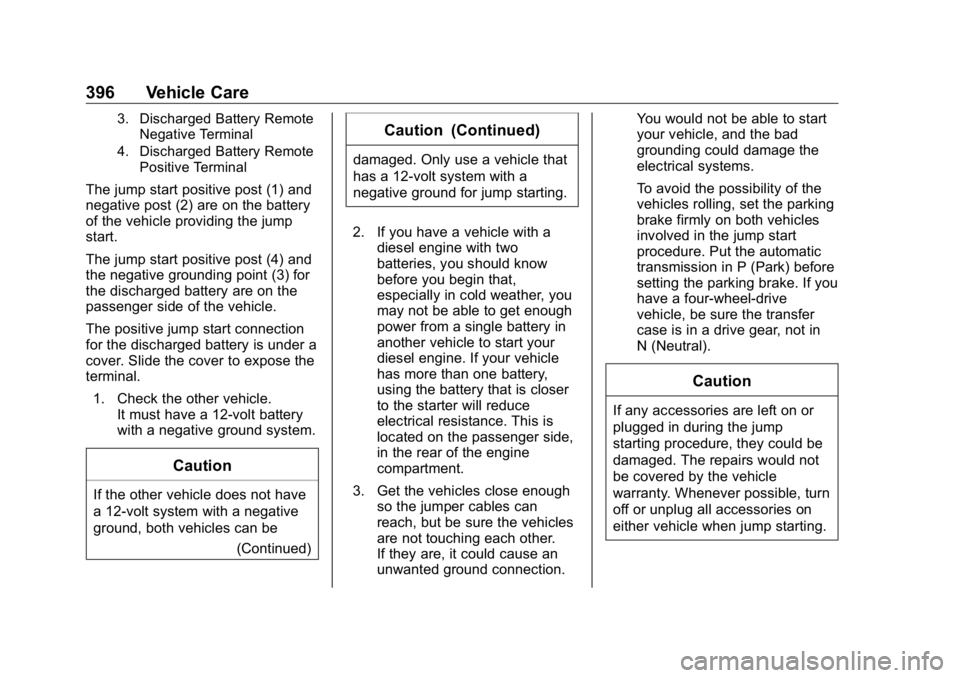
396 Vehicle Care 3. Discharged Battery Remote
Negative Terminal
4. Discharged Battery Remote
Positive Terminal
The jump start positive post (1) and
negative post (2) are on the battery
of the vehicle providing the jump
start.
The jump start positive post (4) and
the negative grounding point (3) for
the discharged battery are on the
passenger side of the vehicle.
The positive jump start connection
for the discharged battery is under a
cover. Slide the cover to expose the
terminal.
1. Check the other vehicle.
It must have a 12-volt battery
with a negative ground system.
Caution
If the other vehicle does not have
a 12-volt system with a negative
ground, both vehicles can be
(Continued) Caution (Continued) damaged. Only use a vehicle that
has a 12-volt system with a
negative ground for jump starting.
2. If you have a vehicle with a
diesel engine with two
batteries, you should know
before you begin that,
especially in cold weather, you
may not be able to get enough
power from a single battery in
another vehicle to start your
diesel engine. If your vehicle
has more than one battery,
using the battery that is closer
to the starter will reduce
electrical resistance. This is
located on the passenger side,
in the rear of the engine
compartment.
3. Get the vehicles close enough
so the jumper cables can
reach, but be sure the vehicles
are not touching each other.
If they are, it could cause an
unwanted ground connection. You would not be able to start
your vehicle, and the bad
grounding could damage the
electrical systems.
To avoid the possibility of the
vehicles rolling, set the parking
brake firmly on both vehicles
involved in the jump start
procedure. Put the automatic
transmission in P (Park) before
setting the parking brake. If you
have a four-wheel-drive
vehicle, be sure the transfer
case is in a drive gear, not in
N (Neutral).
CautionIf any accessories are left on or
plugged in during the jump
starting procedure, they could be
damaged. The repairs would not
be covered by the vehicle
warranty. Whenever possible, turn
off or unplug all accessories on
either vehicle when jump starting.
Page 400 of 472
GMC Sierra/Sierra Denali Owner Manual (GMNA-Localizing-U.S./Canada/
Mexico-1500-11698638) - 2019 - crc - 5/15/18
Vehicle Care 399Front Attachment Points
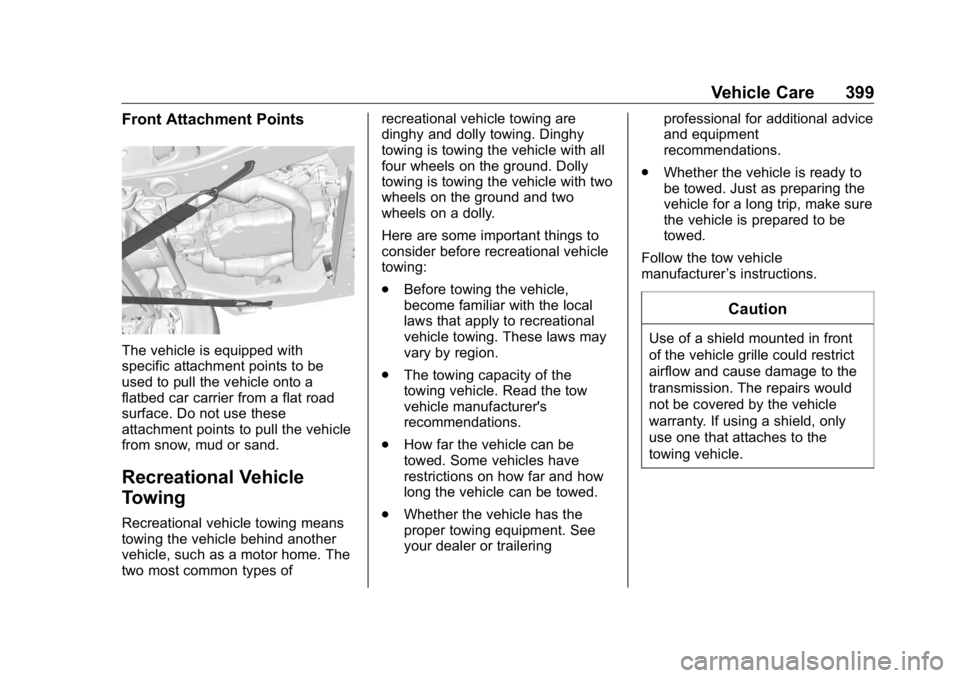
The vehicle is equipped with
specific attachment points to be
used to pull the vehicle onto a
flatbed car carrier from a flat road
surface. Do not use these
attachment points to pull the vehicle
from snow, mud or sand.
Recreational Vehicle
Towing Recreational vehicle towing means
towing the vehicle behind another
vehicle, such as a motor home. The
two most common types of recreational vehicle towing are
dinghy and dolly towing. Dinghy
towing is towing the vehicle with all
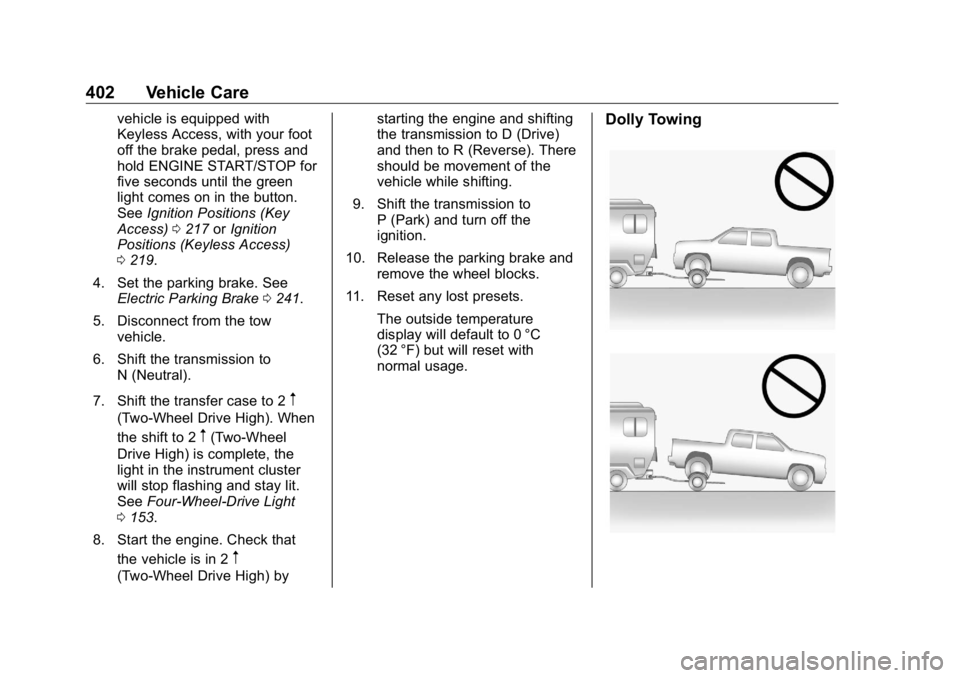
four wheels on the ground. Dolly
towing is towing the vehicle with two
wheels on the ground and two
wheels on a dolly.
Here are some important things to
consider before recreational vehicle
towing:
.
Before towing the vehicle,
become familiar with the local
laws that apply to recreational
vehicle towing. These laws may
vary by region.
.
The towing capacity of the
towing vehicle. Read the tow
vehicle manufacturer's
recommendations.
.
How far the vehicle can be
towed. Some vehicles have
restrictions on how far and how
long the vehicle can be towed.
.
Whether the vehicle has the
proper towing equipment. See
your dealer or trailering professional for additional advice
and equipment
recommendations.
.
Whether the vehicle is ready to
be towed. Just as preparing the
vehicle for a long trip, make sure
the vehicle is prepared to be
towed.
Follow the tow vehicle
manufacturer ’ s instructions.
CautionUse of a shield mounted in front
of the vehicle grille could restrict
airflow and cause damage to the
transmission. The repairs would
not be covered by the vehicle
warranty. If using a shield, only
use one that attaches to the
towing vehicle.
Page 401 of 472
GMC Sierra/Sierra Denali Owner Manual (GMNA-Localizing-U.S./Canada/
Mexico-1500-11698638) - 2019 - crc - 5/15/18
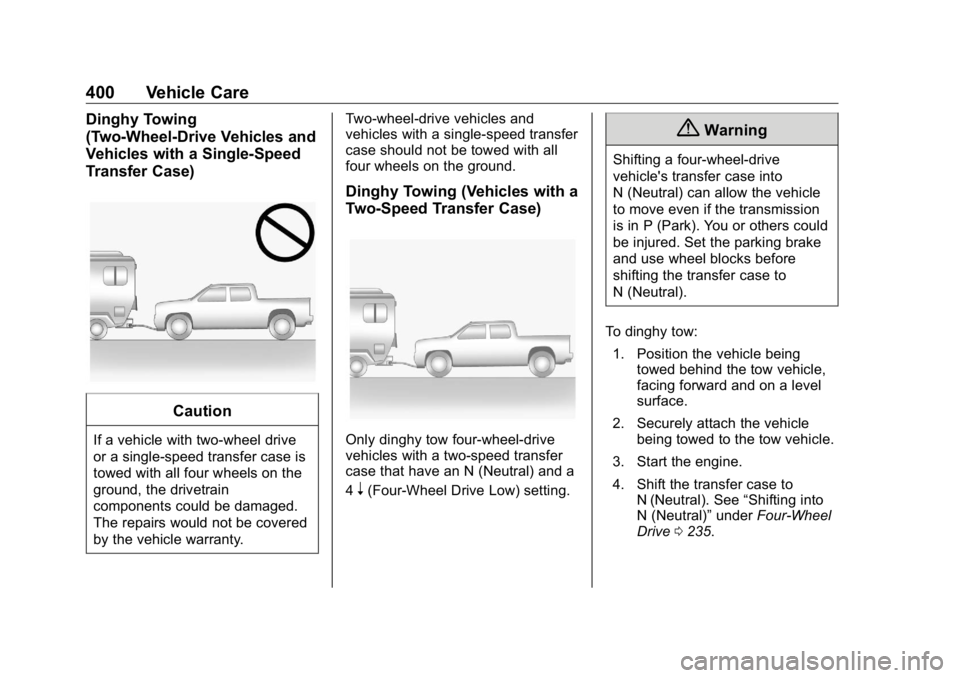
400 Vehicle Care Dinghy Towing
(Two-Wheel-Drive Vehicles and
Vehicles with a Single-Speed
Transfer Case)
Caution
If a vehicle with two-wheel drive
or a single-speed transfer case is
towed with all four wheels on the
ground, the drivetrain
components could be damaged.
The repairs would not be covered
by the vehicle warranty. Two-wheel-drive vehicles and
vehicles with a single-speed transfer
case should not be towed with all
four wheels on the ground.
Dinghy Towing (Vehicles with a
Two-Speed Transfer Case)
Only dinghy tow four-wheel-drive
vehicles with a two-speed transfer
case that have an N (Neutral) and a
4
n (Four-Wheel Drive Low) setting. { WarningShifting a four-wheel-drive
vehicle's transfer case into
N (Neutral) can allow the vehicle
to move even if the transmission
is in P (Park). You or others could
be injured. Set the parking brake
and use wheel blocks before
shifting the transfer case to
N (Neutral).
To dinghy tow:
1. Position the vehicle being
towed behind the tow vehicle,
facing forward and on a level
surface.
2. Securely attach the vehicle
being towed to the tow vehicle.
3. Start the engine.
4. Shift the transfer case to
N (Neutral). See “ Shifting into
N (Neutral) ” under Four-Wheel
Drive 0 235 .
Page 402 of 472
GMC Sierra/Sierra Denali Owner Manual (GMNA-Localizing-U.S./Canada/
Mexico-1500-11698638) - 2019 - crc - 5/15/18
Vehicle Care 4015. With the engine running,
release the parking brake and
verify that the transfer case is
in N (Neutral) by shifting the
transmission to D (Drive) and
then to R (Reverse). There
should be no movement while
shifting the transmission.
6. Shift the transmission to D
(Drive).
7. If equipped with an ignition key,
turn the ignition to ACC/
ACCESSORY. If equipped with
Keyless Access, turn the
engine off. Disregard the Shift
to P (Park) DIC message.
See Ignition Positions (Key
Access) 0 217 or Ignition
Positions (Keyless Access)
0 219 .
{ Warning
To avoid death, serious injury,
or property damage, before
dinghy towing the vehicle, always
disconnect and secure the
(Continued) Warning (Continued) negative battery cable and cover
the negative battery post and
cable with a non-conductive
material. If the battery is left
connected or the battery cable
contacts the post, the Electric
Parking Brake may activate
during towing, which could cause
a crash.
8. Disconnect the negative ( – )
battery cable. See “ Negative
Battery Cable Disconnection ”
in Battery - North America
0 337 .
9. Shift the transmission to
P (Park).
Caution
If the steering column is locked,
vehicle damage may occur. 10. Move the steering wheel to
make sure the steering column
is unlocked.
11. If the vehicle has an ignition
key, keep it in the towed
vehicle in ACC/ACCESSORY
to prevent the steering column
from locking. If the vehicle is
equipped with Keyless Access,
keep the RKE transmitter
outside of the vehicle and
manually lock the doors.
Access the vehicle by using
the key in the door lock. See
Door Locks 0 44 .
Disconnecting the Towed Vehicle
Before disconnecting from the tow
vehicle:
1. Park on a level surface. Secure
the vehicle with wheel blocks.
2. Re-connect the negative ( – )
battery. See Battery - North
America 0 337 .
3. Turn on the ignition with the
engine off. For vehicles with a
key, turn the ignition to ON/
RUN with the engine off. If the
Page 403 of 472
GMC Sierra/Sierra Denali Owner Manual (GMNA-Localizing-U.S./Canada/
Mexico-1500-11698638) - 2019 - crc - 5/15/18
402 Vehicle Care vehicle is equipped with
Keyless Access, with your foot
off the brake pedal, press and
hold ENGINE START/STOP for
five seconds until the green
light comes on in the button.
See Ignition Positions (Key
Access) 0 217 or Ignition
Positions (Keyless Access)
0 219 .
4. Set the parking brake. See
Electric Parking Brake 0 241 .
5. Disconnect from the tow
vehicle.
6. Shift the transmission to
N (Neutral).
7. Shift the transfer case to 2
m(Two-Wheel Drive High). When
the shift to 2
m (Two-Wheel
Drive High) is complete, the
light in the instrument cluster
will stop flashing and stay lit.
See Four-Wheel-Drive Light
0 153 .
8. Start the engine. Check that
the vehicle is in 2
m(Two-Wheel Drive High) by starting the engine and shifting
the transmission to D (Drive)
and then to R (Reverse). There
should be movement of the
vehicle while shifting.
9. Shift the transmission to
P (Park) and turn off the
ignition.
10. Release the parking brake and
remove the wheel blocks.
11. Reset any lost presets.
The outside temperature
display will default to 0 °C
(32 °F) but will reset with
normal usage. Dolly Towing
Page 417 of 472
GMC Sierra/Sierra Denali Owner Manual (GMNA-Localizing-U.S./Canada/
Mexico-1500-11698638) - 2019 - crc - 5/15/18
416 Service and Maintenance Tire Rotation and Required
Services Every 12 000 km/
7,500 mi Rotate the tires, if recommended for
the vehicle, and perform the
following services. See Tire
Rotation 0 376 .
.
Check engine oil level and oil
life percentage. If needed,
change engine oil and filter, and
reset oil life system.
See Engine Oil 0 321 and
Engine Oil Life System 0 323 .
.
Check engine coolant level. See
Cooling System 0 327 .
.
Check windshield washer fluid
level. See Washer Fluid 0 334 .
.
Check tire inflation pressures,
including the spare. See Tire
Pressure 0 367 .
.
Inspect tire wear. See Tire
Inspection 0 375 .
.
Visually check for fluid leaks.
.
Inspect engine air cleaner filter.
See Engine Air Cleaner/Filter
0 326 . .
Inspect brake system. See
Exterior Care 0 403 .
.
Visually inspect steering,
suspension, and chassis
components for damage,
including cracks or tears in the
rubber boots, loose or missing
parts, or signs of wear at least
once a year. See Exterior Care
0 403 . Lubricate the suspension
and steering components at
least every other oil change.
(If equipped with grease fittings)
.
Inspect power steering for
proper attachment, connections,
binding, leaks, cracks,
chafing, etc.
.
Visually inspect drive shafts for
excessive wear, lubricant leaks
or damage including: tube dents,
cracks, constant velocity joint or
universal joint looseness,
cracked or missing boots, loose
or missing boot clamps, center
bearing excessive looseness,
missing or loose fasteners. .
Check restraint system
components. See Safety System
Check 0 84 .
.
Visually inspect fuel system for
damage or leaks.
.
Visually inspect exhaust system
and nearby heat shields for
loose or damaged parts.
.
Lubricate body components. See
Exterior Care 0 403 .
.
Check starter switch. See Starter
Switch Check 0 343 .
.
Check ignition transmission lock.
See Ignition Transmission Lock
Check 0 343 .
.
Check parking brake and
automatic transmission park
mechanism. See Park Brake and
P (Park) Mechanism Check
0 343 .
.
Check accelerator pedal for
damage, high effort, or binding.
Replace if needed.
.
Visually inspect gas strut for
signs of wear, cracks, or other
damage. Check the hold open