lock GMC SONOMA 2002 Owners Manual
[x] Cancel search | Manufacturer: GMC, Model Year: 2002, Model line: SONOMA, Model: GMC SONOMA 2002Pages: 458, PDF Size: 2.83 MB
Page 297 of 458
5-19 Removing the Spare Tire and Tools
The jacking equipment you'll need is stored inside the
plastic jack cover which is behind the front seats, either
on the center of the wall (extended cab) or on the
passenger's side of the wall (regular cab).
The jacking equipment for the crew cab is located
behind the rear seat back on the passenger's side of
the vehicle.
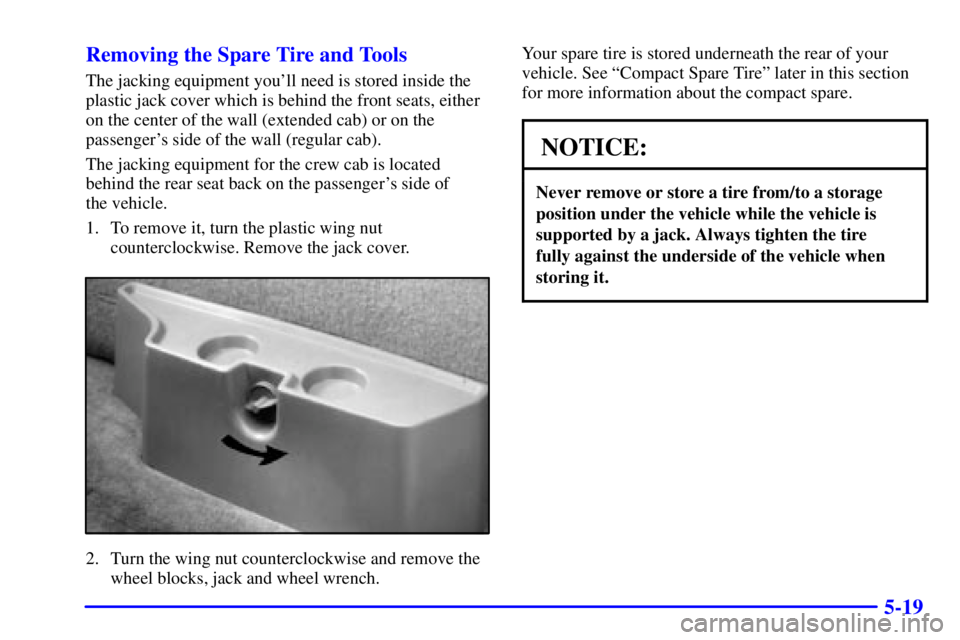
1. To remove it, turn the plastic wing nut
counterclockwise. Remove the jack cover.
2. Turn the wing nut counterclockwise and remove the
wheel blocks, jack and wheel wrench.Your spare tire is stored underneath the rear of your
vehicle. See ªCompact Spare Tireº later in this section
for more information about the compact spare.
NOTICE:
Never remove or store a tire from/to a storage
position under the vehicle while the vehicle is
supported by a jack. Always tighten the tire
fully against the underside of the vehicle when
storing it.
Page 298 of 458
5-20
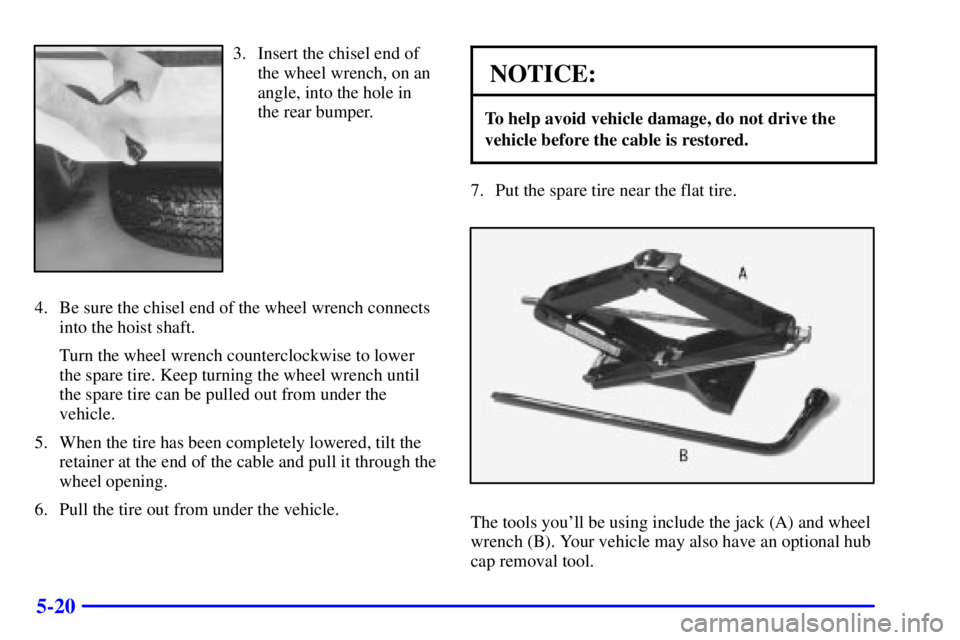
3. Insert the chisel end of
the wheel wrench, on an
angle, into the hole in
the rear bumper.
4. Be sure the chisel end of the wheel wrench connects
into the hoist shaft.
Turn the wheel wrench counterclockwise to lower
the spare tire. Keep turning the wheel wrench until
the spare tire can be pulled out from under the
vehicle.
5. When the tire has been completely lowered, tilt the
retainer at the end of the cable and pull it through the
wheel opening.
6. Pull the tire out from under the vehicle.
NOTICE:
To help avoid vehicle damage, do not drive the
vehicle before the cable is restored.
7. Put the spare tire near the flat tire.
The tools you'll be using include the jack (A) and wheel
wrench (B). Your vehicle may also have an optional hub
cap removal tool.
Page 300 of 458
5-22 Removing the Flat Tire and Installing the
Spare Tire
1. Using the wheel wrench, loosen all the wheel nuts.
Don't remove them yet.
2. Turn the jack handle clockwise slightly to raise the
jack lift head.
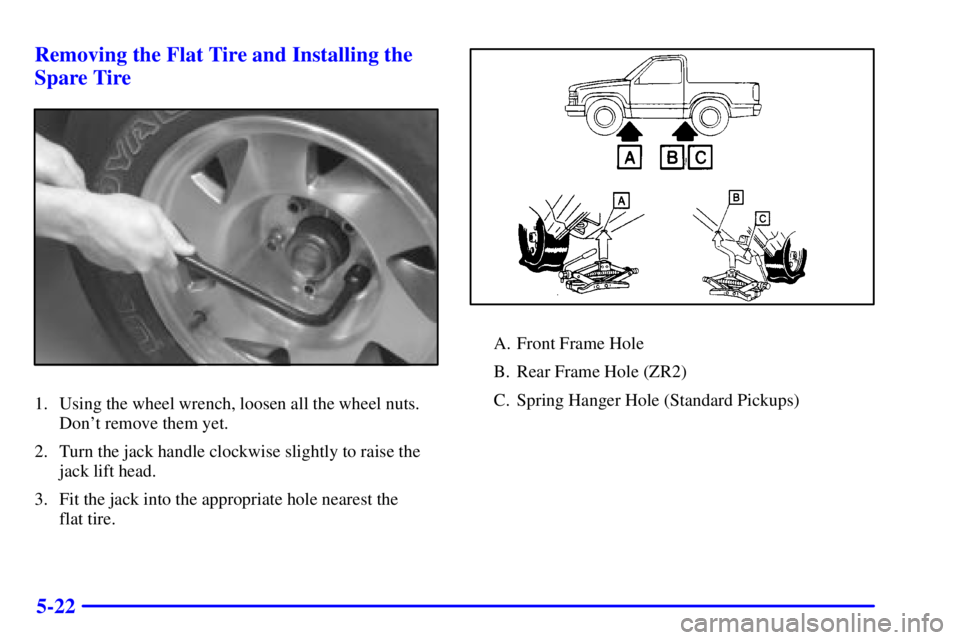
3. Fit the jack into the appropriate hole nearest the
flat tire.
A. Front Frame Hole
B. Rear Frame Hole (ZR2)
C. Spring Hanger Hole (Standard Pickups)
Page 301 of 458
5-23
CAUTION:
Getting under a vehicle when it is jacked up is
dangerous. If the vehicle slips off the jack, you
could be badly injured or killed. Never get under
a vehicle when it is supported only by a jack.
CAUTION:
Raising your vehicle with the jack improperly
positioned can damage the vehicle and even make
the vehicle fall. To help avoid personal injury and
vehicle damage, be sure to fit the jack lift head
into the proper location before raising the
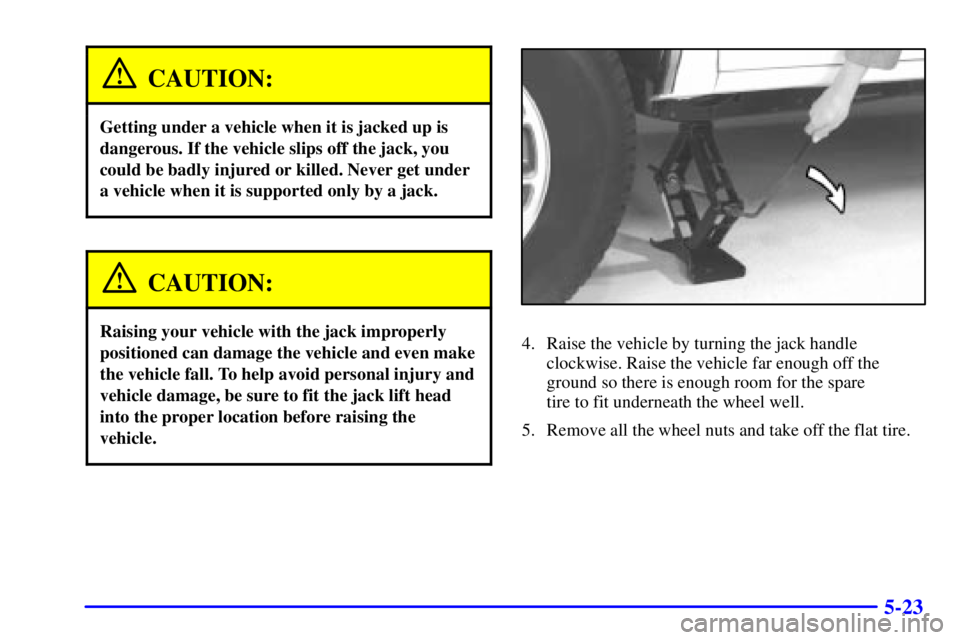
vehicle.4. Raise the vehicle by turning the jack handle
clockwise. Raise the vehicle far enough off the
ground so there is enough room for the spare
tire to fit underneath the wheel well.
5. Remove all the wheel nuts and take off the flat tire.
Page 303 of 458
5-25
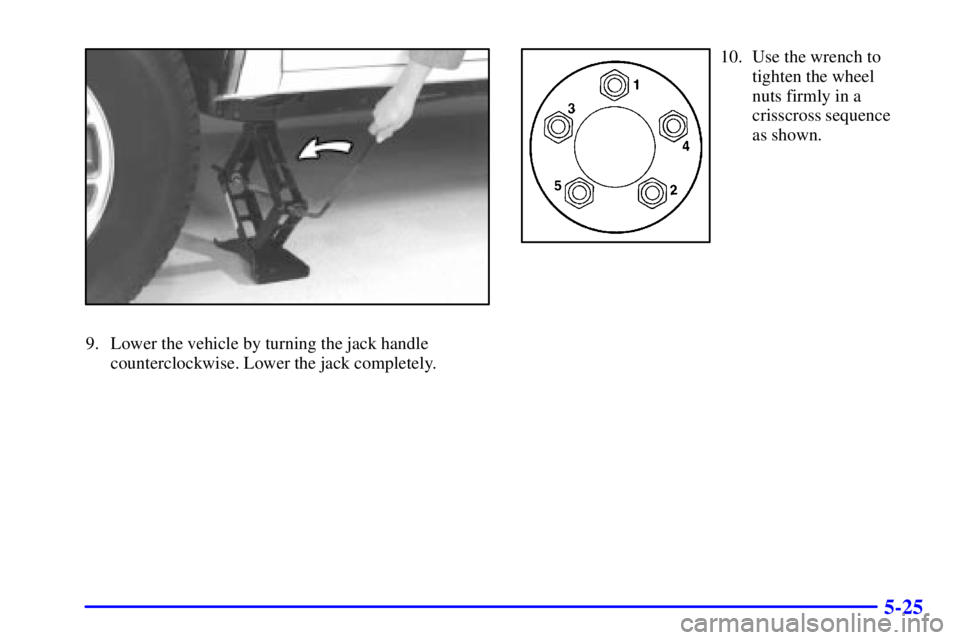
9. Lower the vehicle by turning the jack handle
counterclockwise. Lower the jack completely.
10. Use the wrench to
tighten the wheel
nuts firmly in a
crisscross sequence
as shown.
Page 306 of 458

5-28
5. Make sure the tire is stored securely. Push, pull, and
then try to rotate or turn the tire. If the tire moves,
use the wheel wrench to tighten the cable.
Return the jack, wheel wrench and wheel blocks to the
proper location behind the seat. Secure the items.
A. Wheel Wrench
B. Bracket
C. Jacking Instructions
(Roll and place tag
behind the bracket
after the tools
are installed.)D. Bolt Location
E. Wheel Blocks
F. Nut
G. Rubber Band
H. Jack Position
Put the jack cover back on, if you have one.
Page 318 of 458
6-8
To remove the fuel cap, turn it slowly to the left
(counterclockwise). The fuel cap has a spring in it; if
you let go of the cap too soon, it will spring back to
the right.
CAUTION:
If you get fuel on yourself and then something
ignites it, you could be badly burned. Fuel can
spray out on you if you open the fuel cap too
quickly. This spray can happen if your tank is
nearly full, and is more likely in hot weather.
Open the fuel cap slowly and wait for any ªhissº
noise to stop. Then unscrew the cap all the way.
Be careful not to spill fuel. Clean fuel from painted
surfaces as soon as possible. See ªCleaning the Outside
of Your Vehicleº in the Index.When you put the fuel cap back on, turn it to the right
(clockwise) until you hear a clicking sound. Make sure
you fully install the cap. The diagnostic system can
determine if the fuel cap has been left off or improperly
installed. This would allow fuel to evaporate into the
atmosphere. See ªMalfunction Indicator Lampº in
the Index.
NOTICE:
If you need a new fuel cap, be sure to get the
right type. Your dealer can get one for you. If you
get the wrong type, it may not fit properly. This
may cause your malfunction indicator lamp to
light and may damage your fuel tank and
emissions system. See ªMalfunction Indicator
Lampº in the Index.
Page 321 of 458
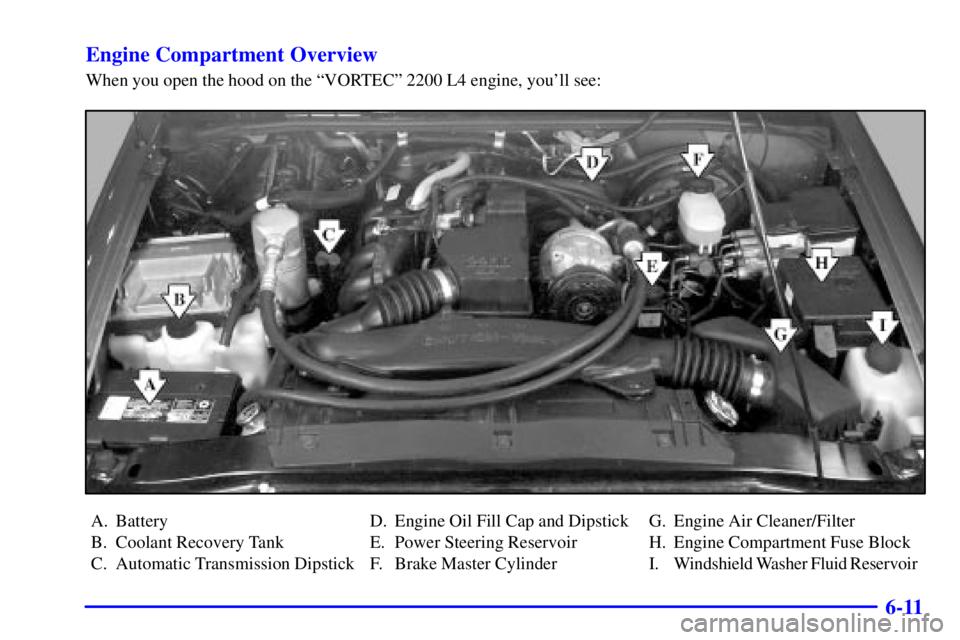
6-11 Engine Compartment Overview
When you open the hood on the ªVORTECº 2200 L4 engine, you'll see:
A. Battery
B. Coolant Recovery Tank
C. Automatic Transmission Dipstick D. Engine Oil Fill Cap and Dipstick
E. Power Steering Reservoir
F. Brake Master CylinderG. Engine Air Cleaner/Filter
H. Engine Compartment Fuse Block
I. Windshield Washer Fluid Reservoir
Page 322 of 458
6-12
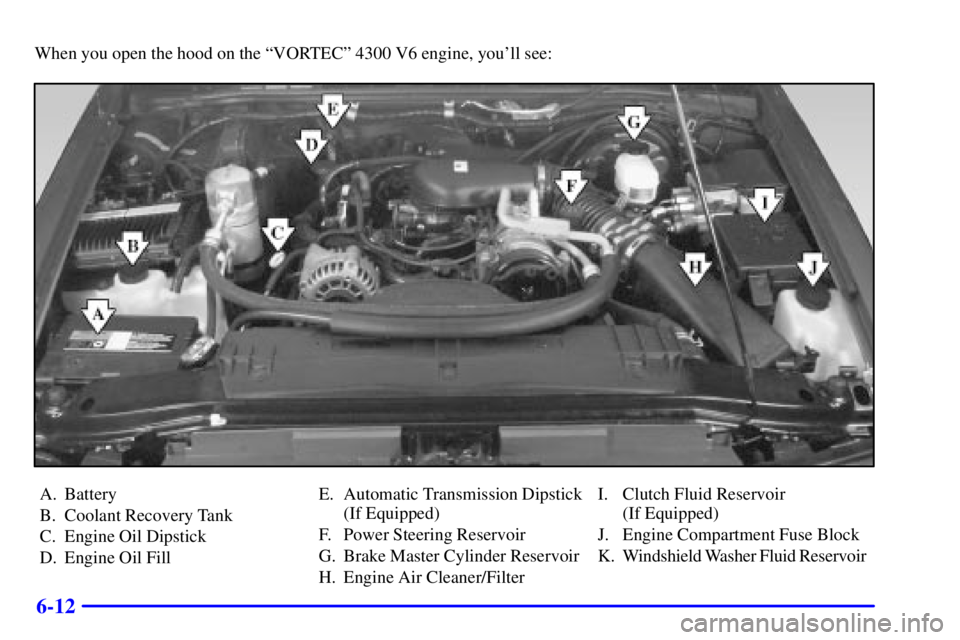
When you open the hood on the ªVORTECº 4300 V6 engine, you'll see:
A. Battery
B. Coolant Recovery Tank
C. Engine Oil Dipstick
D. Engine Oil FillE. Automatic Transmission Dipstick
(If Equipped)
F. Power Steering Reservoir
G. Brake Master Cylinder Reservoir
H. Engine Air Cleaner/FilterI. Clutch Fluid Reservoir
(If Equipped)
J. Engine Compartment Fuse Block
K. Windshield Washer Fluid Reservoir
Page 327 of 458
6-17
Driving under these conditions causes engine oil to
break down sooner. If any one of these is true for your
vehicle, then you need to change your oil and filter
every 3,000 miles (5 000 km) or 3 months
-- whichever
occurs first.
If none of them is true, use the long trip/highway
maintenance schedule. Change the oil and filter every
7,500 miles (12 500 km) or 12 months
-- whichever
occurs first. Driving a vehicle with a fully warmed
engine under highway conditions will cause engine oil
to break down slower.
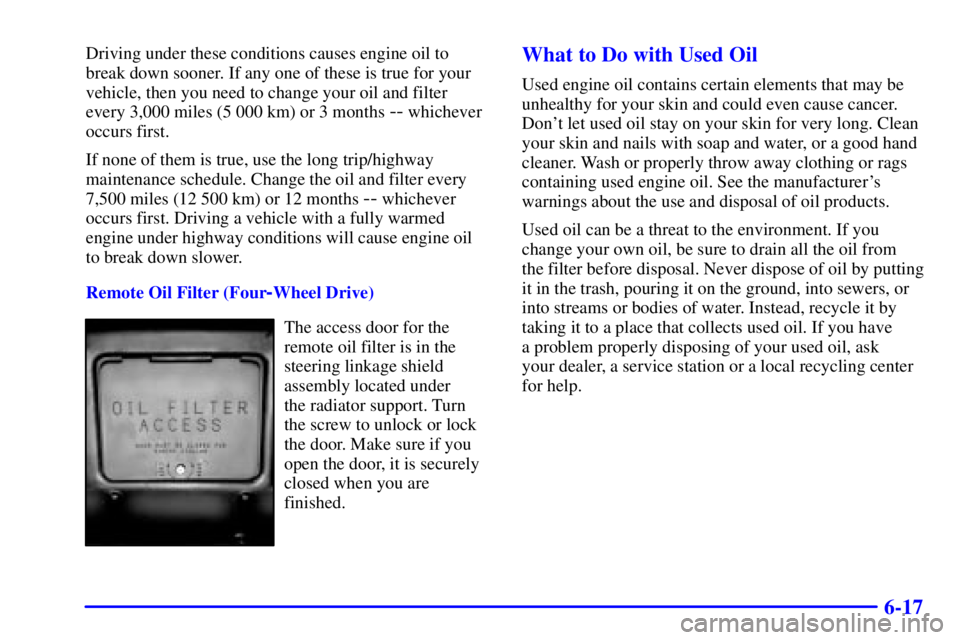
Remote Oil Filter (Four
-Wheel Drive)
The access door for the
remote oil filter is in the
steering linkage shield
assembly located under
the radiator support. Turn
the screw to unlock or lock
the door. Make sure if you
open the door, it is securely
closed when you are
finished.
What to Do with Used Oil
Used engine oil contains certain elements that may be
unhealthy for your skin and could even cause cancer.
Don't let used oil stay on your skin for very long. Clean
your skin and nails with soap and water, or a good hand
cleaner. Wash or properly throw away clothing or rags
containing used engine oil. See the manufacturer's
warnings about the use and disposal of oil products.
Used oil can be a threat to the environment. If you
change your own oil, be sure to drain all the oil from
the filter before disposal. Never dispose of oil by putting
it in the trash, pouring it on the ground, into sewers, or
into streams or bodies of water. Instead, recycle it by
taking it to a place that collects used oil. If you have
a problem properly disposing of your used oil, ask
your dealer, a service station or a local recycling center
for help.