ECU GMC SONOMA 2003 User Guide
[x] Cancel search | Manufacturer: GMC, Model Year: 2003, Model line: SONOMA, Model: GMC SONOMA 2003Pages: 424, PDF Size: 2.45 MB
Page 51 of 424
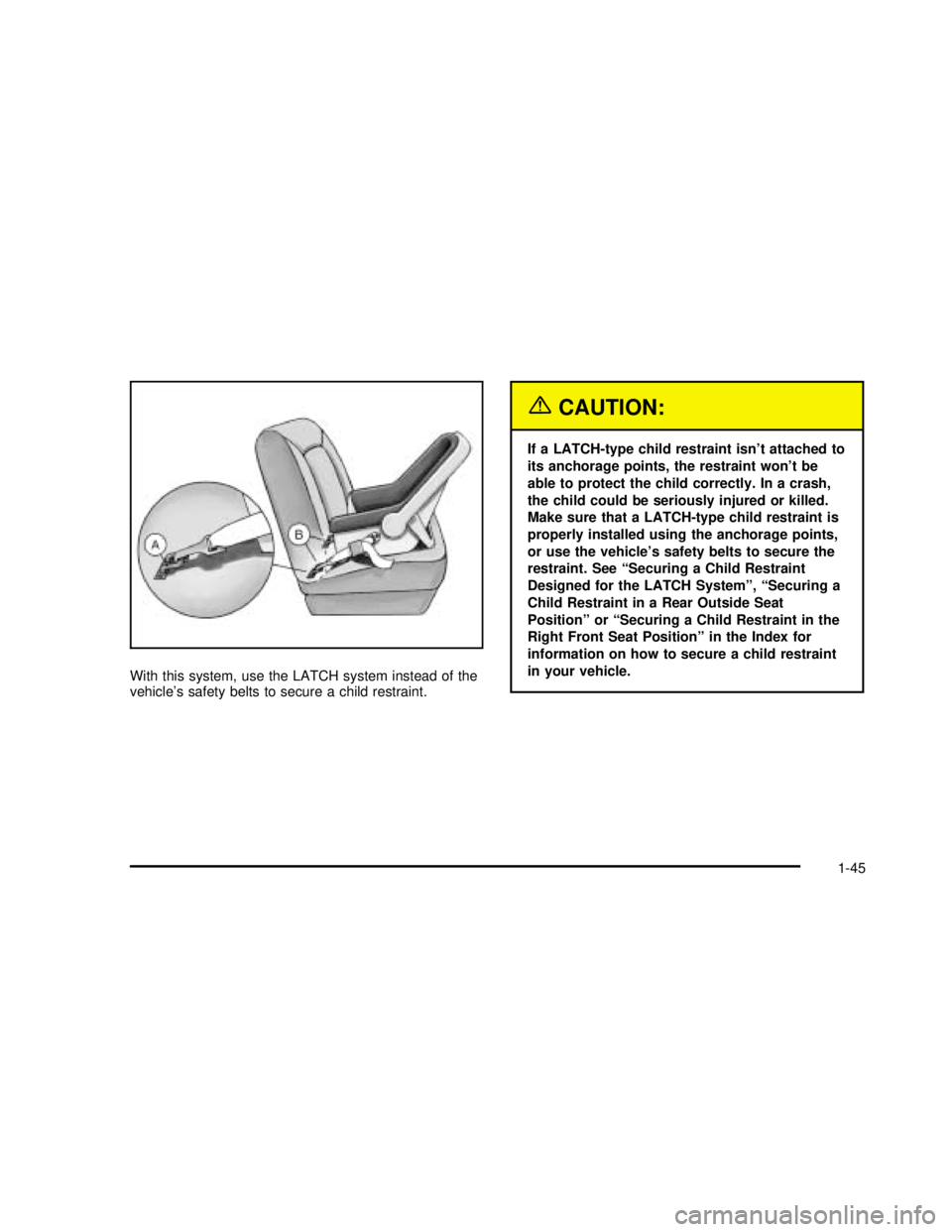
With this system, use the LATCH system instead of the
vehicle’s safety belts to secure a child restraint.
{CAUTION:
If a LATCH-type child restraint isn’t attached to
its anchorage points, the restraint won’t be
able to protect the child correctly. In a crash,
the child could be seriously injured or killed.
Make sure that a LATCH-type child restraint is
properly installed using the anchorage points,
or use the vehicle’s safety belts to secure the
restraint. See “Securing a Child Restraint
Designed for the LATCH System”, “Securing a
Child Restraint in a Rear Outside Seat
Position” or “Securing a Child Restraint in the
Right Front Seat Position” in the Index for
information on howto secure a child restraint
in your vehicle.
1-45
2003 - Sonoma OM
Page 52 of 424
Securing a Child Restraint Designed
for the LATCH System
1. Find the anchors for the seating position you want
to use, where the bottom of the seatback meets the
back of the seat cushion.
2. Put the child restraint on the seat.
3. Attach the anchor points on the child restraint to the
anchors in the vehicle. The child restraint
instructions will show you how.
4. If the child restraint is forward-facing, attach the top
strap to the top strap anchor. SeeTop Strap on
page 1-41. Tighten the top strap according to
the child restraint instructions.
5. Push and pull the child restraint in different
directions to be sure it is secure.
To remove the child restraint, simply unhook the top
strap from the top tether anchor and then disconnect
the anchor points.
Securing a Child Restraint in a Rear
Outside Seat Position
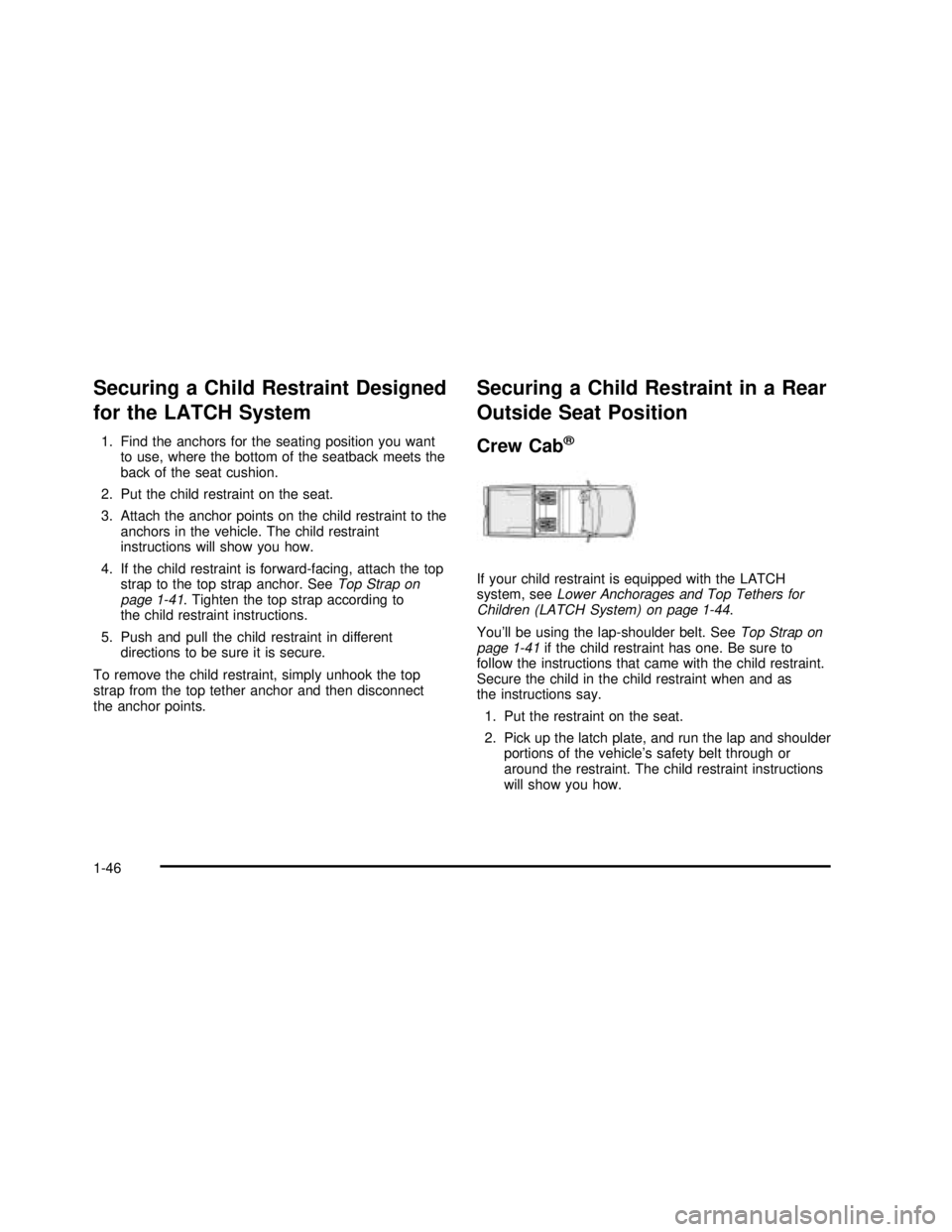
CrewCab®
If your child restraint is equipped with the LATCH
system, seeLower Anchorages and Top Tethers for
Children (LATCH System) on page 1-44.
You’ll be using the lap-shoulder belt. SeeTop Strap on
page 1-41if the child restraint has one. Be sure to
follow the instructions that came with the child restraint.
Secure the child in the child restraint when and as
the instructions say.
1. Put the restraint on the seat.
2. Pick up the latch plate, and run the lap and shoulder
portions of the vehicle’s safety belt through or
around the restraint. The child restraint instructions
will show you how.
1-46
2003 - Sonoma OM
Page 54 of 424
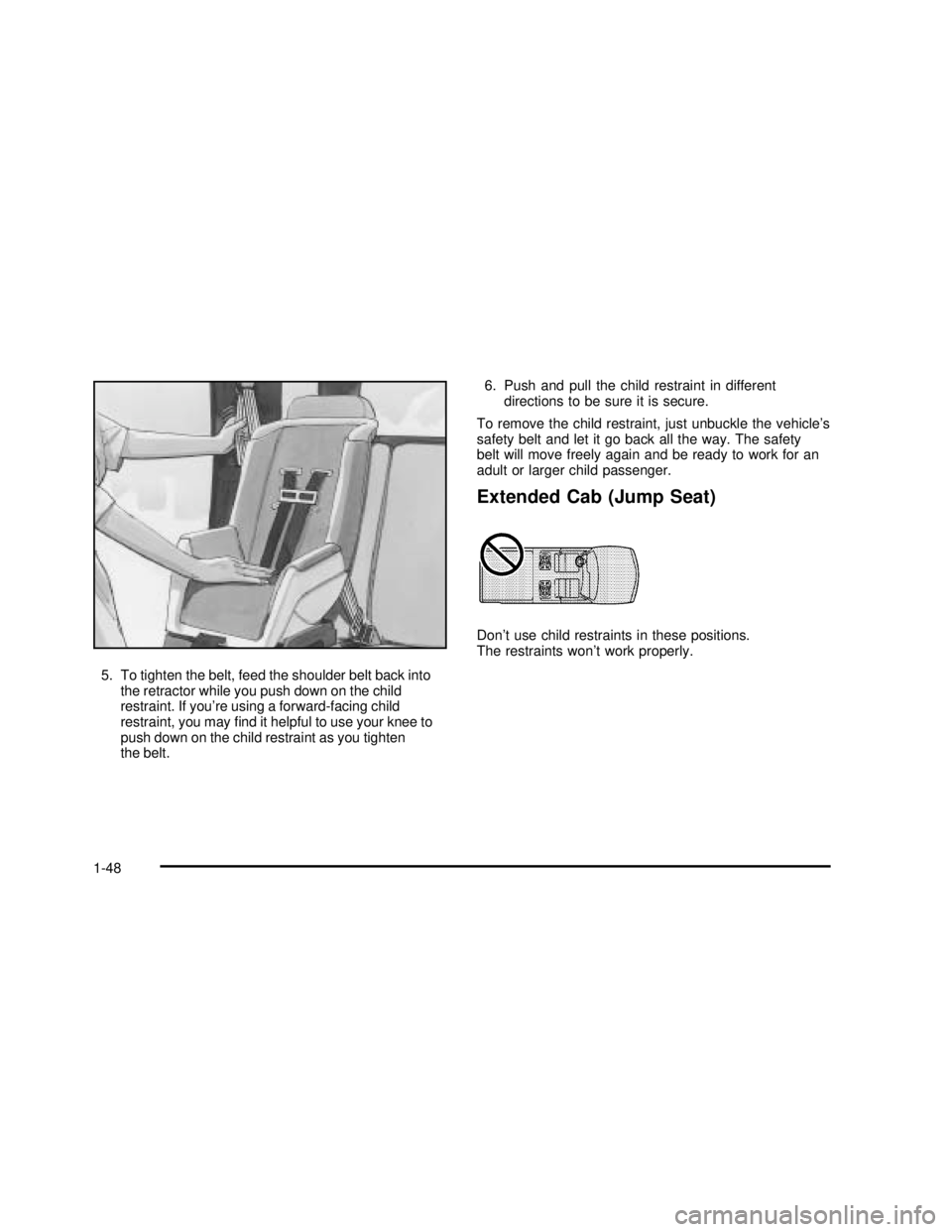
5. To tighten the belt, feed the shoulder belt back into
the retractor while you push down on the child
restraint. If you’re using a forward-facing child
restraint, you mayfind it helpful to use your knee to
push down on the child restraint as you tighten
the belt.6. Push and pull the child restraint in different
directions to be sure it is secure.
To remove the child restraint, just unbuckle the vehicle’s
safety belt and let it go back all the way. The safety
belt will move freely again and be ready to work for an
adult or larger child passenger.
Extended Cab (Jump Seat)
Don’t use child restraints in these positions.
The restraints won’t work properly.
1-48
2003 - Sonoma OM
Page 55 of 424
Securing a Child Restraint in a
Center Seat Position
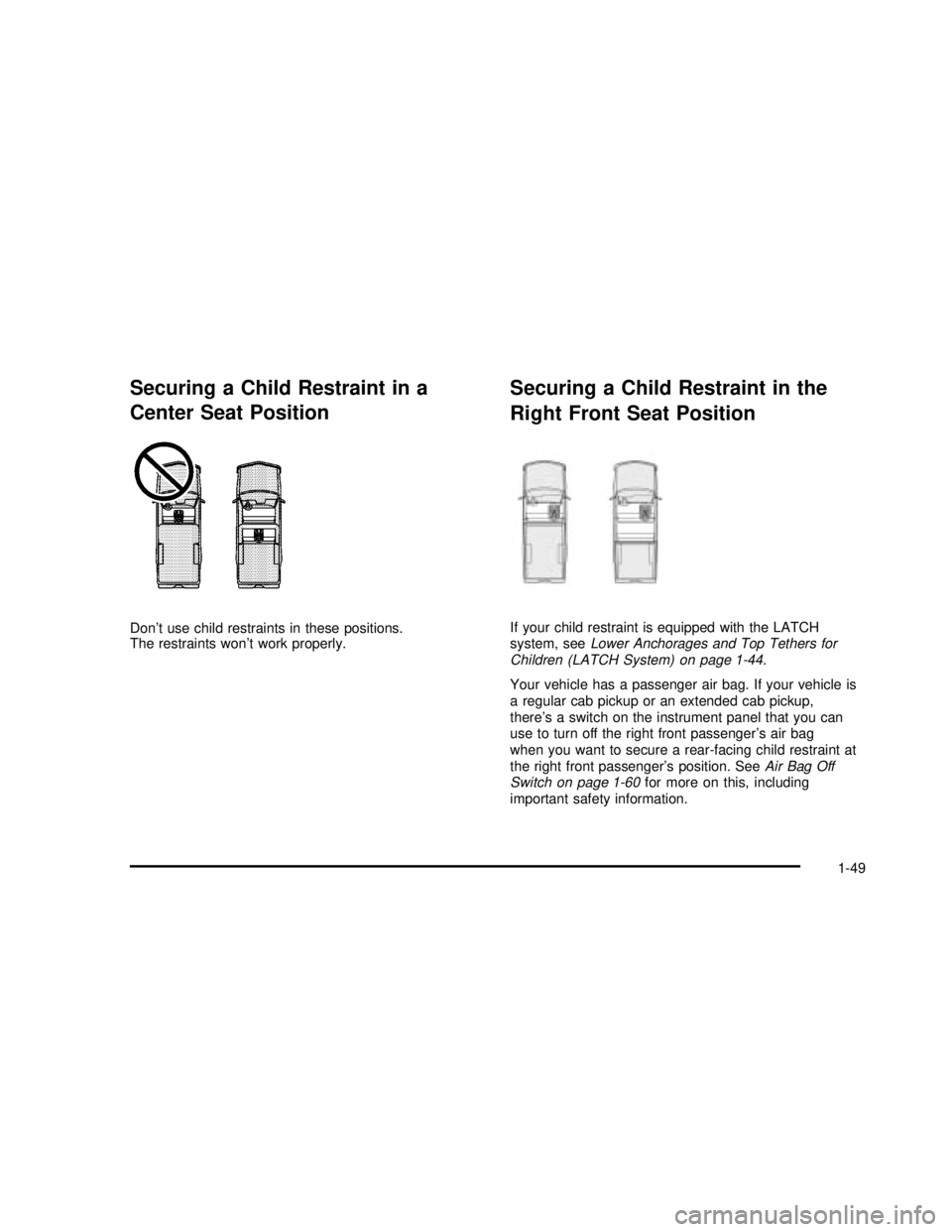
Don’t use child restraints in these positions.
The restraints won’t work properly.
Securing a Child Restraint in the
Right Front Seat Position
If your child restraint is equipped with the LATCH
system, seeLower Anchorages and Top Tethers for
Children (LATCH System) on page 1-44.
Your vehicle has a passenger air bag. If your vehicle is
a regular cab pickup or an extended cab pickup,
there’s a switch on the instrument panel that you can
use to turn off the right front passenger’s air bag
when you want to secure a rear-facing child restraint at
the right front passenger’s position. SeeAir Bag Off
Switch on page 1-60for more on this, including
important safety information.
1-49
2003 - Sonoma OM
Page 57 of 424
CAUTION: (Continued)
Even though the AIR BAG OFF switch is
designed to turn off the passenger’s frontal air
bag, no system is fail-safe, and no one can
guarantee that an air bag will not deploy under
some unusual circumstance, even though it is
turned off. General Motors therefore
recommends that rear-facing child restraints
be transported in vehicles with a rear seat that
will accommodate a rear-facing child restraint,
whenever possible.
If a forward-facing child restraint is suitable for
your child, always move the passenger seat as
far back as it will go.Although a rear seat is a safer place, you can secure a
forward-facing child restraint in the right front seat of
a crew cab.
{CAUTION:
If the air bag readiness light ever comes on
when you have turned off the air bag, it means
that something may be wrong with the air bag
system. The right front passenger’s air bag
could inflate even though the switch is off.
If this ever happens, don’t let anyone whom
the national government has identified as a
member of a passenger air bag risk group
sit in the right front passenger’s position
(for example, don’t secure a rear-facing child
restraint in your vehicle) until you have your
vehicle serviced. See″Air Bag Off Switch″in
the Index.
1-51
2003 - Sonoma OM
Page 58 of 424
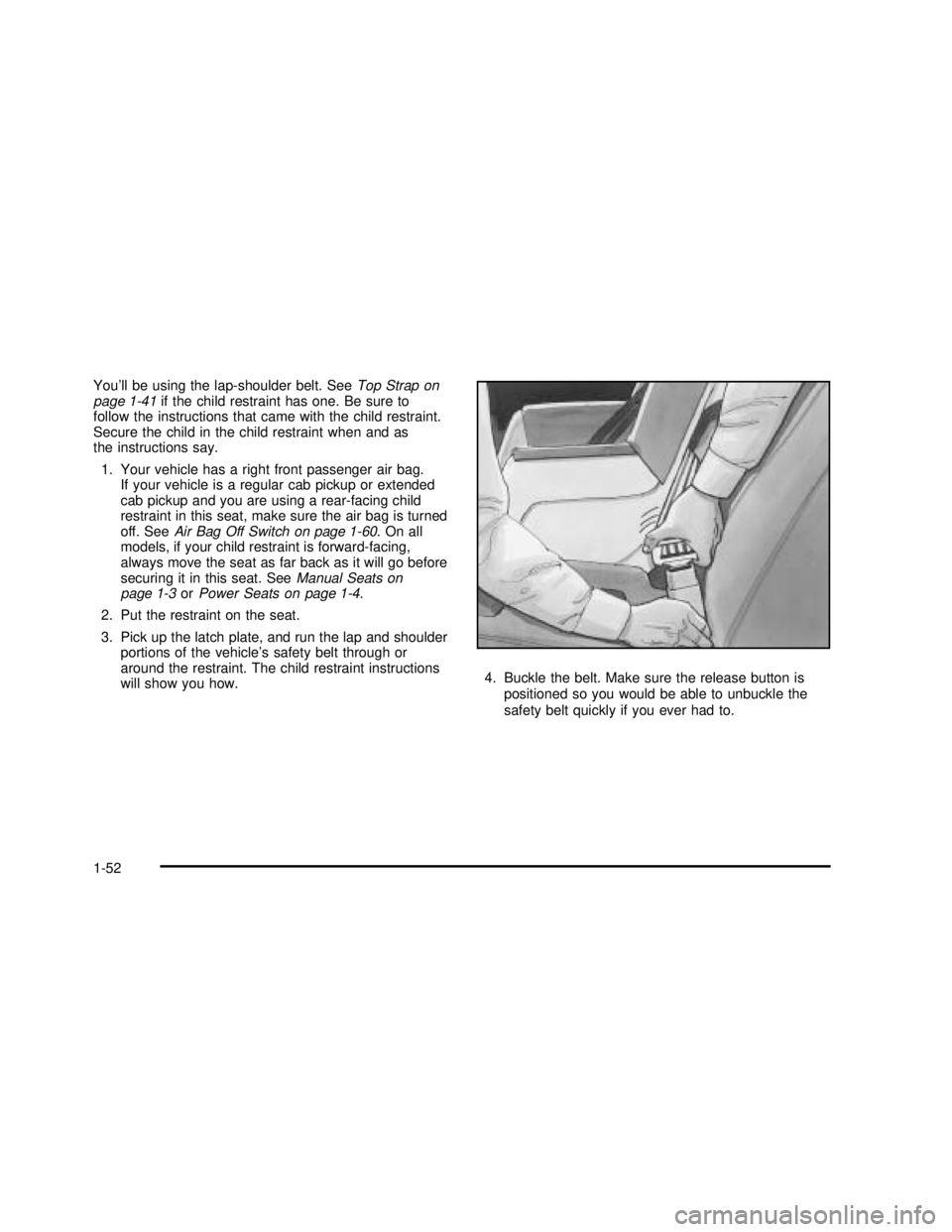
You’ll be using the lap-shoulder belt. SeeTop Strap on
page 1-41if the child restraint has one. Be sure to
follow the instructions that came with the child restraint.
Secure the child in the child restraint when and as
the instructions say.
1. Your vehicle has a right front passenger air bag.
If your vehicle is a regular cab pickup or extended
cab pickup and you are using a rear-facing child
restraint in this seat, make sure the air bag is turned
off. SeeAir Bag Off Switch on page 1-60.Onall
models, if your child restraint is forward-facing,
always move the seat as far back as it will go before
securing it in this seat. SeeManual Seats on
page 1-3orPower Seats on page 1-4.
2. Put the restraint on the seat.
3. Pick up the latch plate, and run the lap and shoulder
portions of the vehicle’s safety belt through or
around the restraint. The child restraint instructions
will show you how.4. Buckle the belt. Make sure the release button is
positioned so you would be able to unbuckle the
safety belt quickly if you ever had to.
1-52
2003 - Sonoma OM
Page 59 of 424
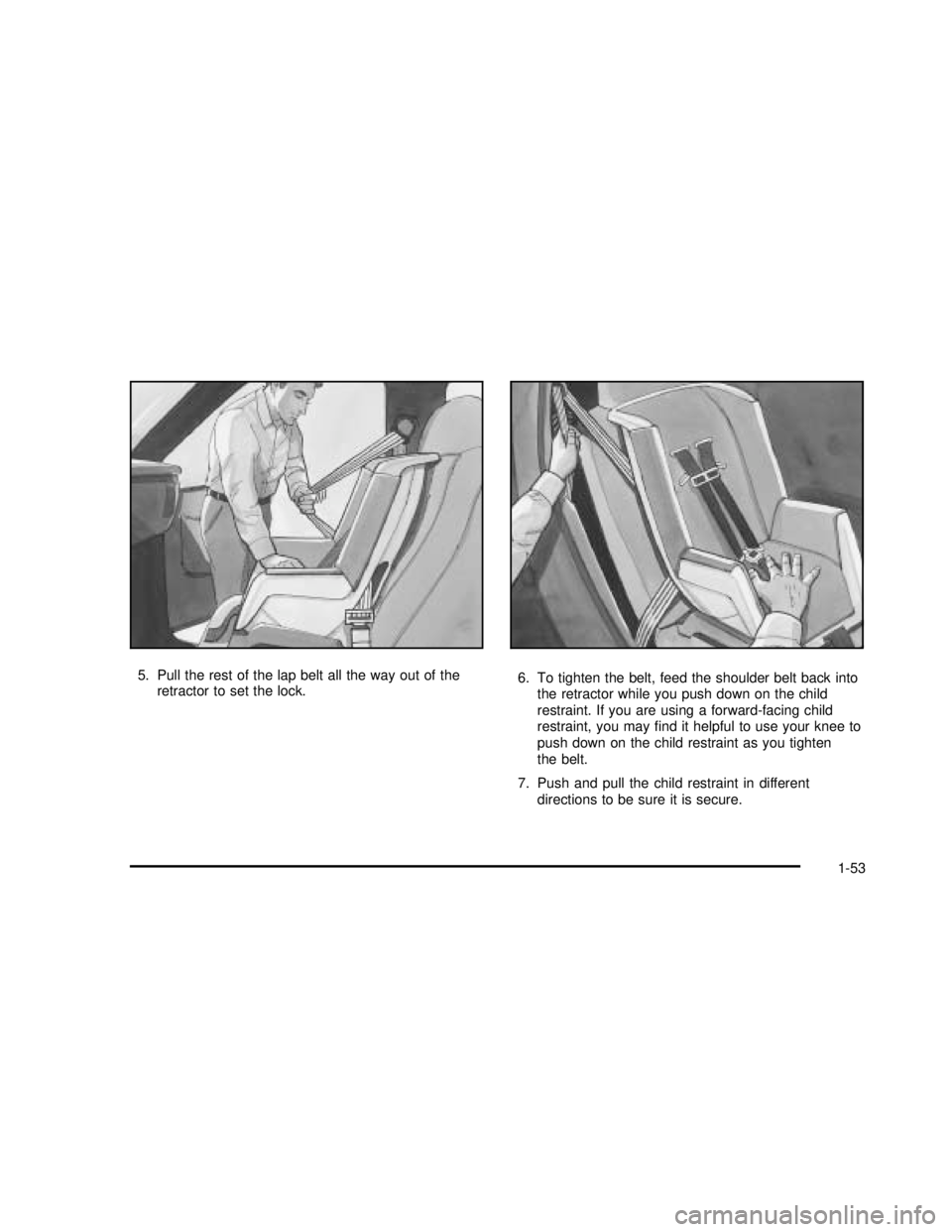
5. Pull the rest of the lap belt all the way out of the
retractor to set the lock.6. To tighten the belt, feed the shoulder belt back into
the retractor while you push down on the child
restraint. If you are using a forward-facing child
restraint, you mayfind it helpful to use your knee to
push down on the child restraint as you tighten
the belt.
7. Push and pull the child restraint in different
directions to be sure it is secure.
1-53
2003 - Sonoma OM
Page 61 of 424
CAUTION: (Continued)
They aren’t designed to inflate at all in rollover,
rear or low-speed frontal crashes, or in many
side crashes. And, for some unrestrained
occupants, air bags may provide less
protection in frontal crashes than more
forceful air bags have provided in the past.
Everyone in your vehicle should wear a safety
belt properly — whether or not there’s an air
bag for that person.
{CAUTION:
Air bags inflate with great force, faster than the
blink of an eye. If you’re too close to an
inflating air bag, as you would be if you were
leaning forward, it could seriously injure you.
Safety belts help keep you in position before
and during a crash. Always wear your safety
belt, even with air bags. The driver should sit
as far back as possible while still maintaining
control of the vehicle.
{CAUTION:
Anyone who is up against, or very close to,
any air bag when it inflates can be seriously
injured or killed. Air bags plus lap-shoulder
belts offer the best protection for adults, but
not for young children and infants. Neither the
vehicle’s safety belt system nor its air bag
system is designed for them. Young children
and infants need the protection that a child
restraint system can provide. Always secure
children properly in your vehicle. To read how,
see the parts of this manual called “Older
Children” and “Infants and Young Children”.
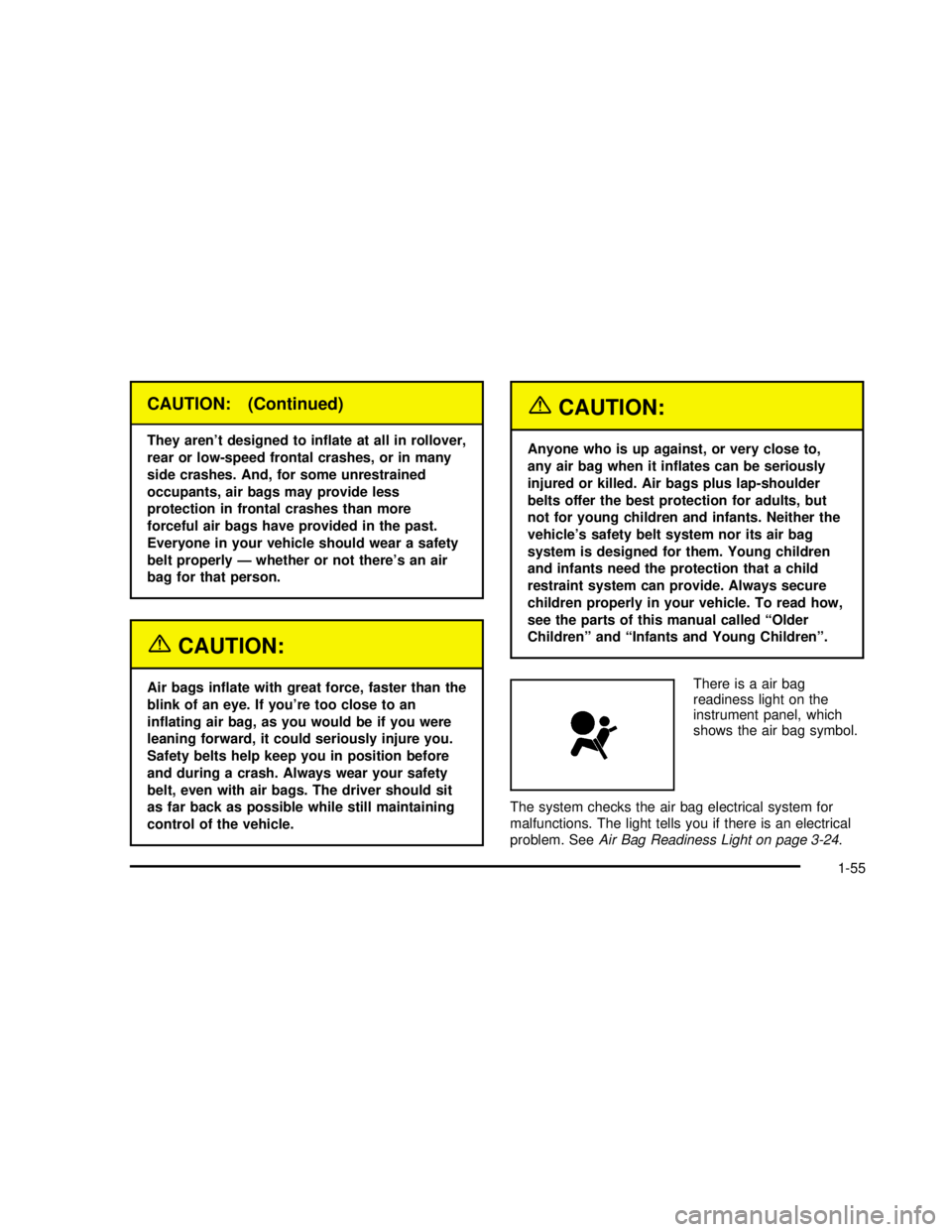
There is a air bag
readiness light on the
instrument panel, which
shows the air bag symbol.
The system checks the air bag electrical system for
malfunctions. The light tells you if there is an electrical
problem. SeeAir Bag Readiness Light on page 3-24.
1-55
2003 - Sonoma OM
Page 68 of 424
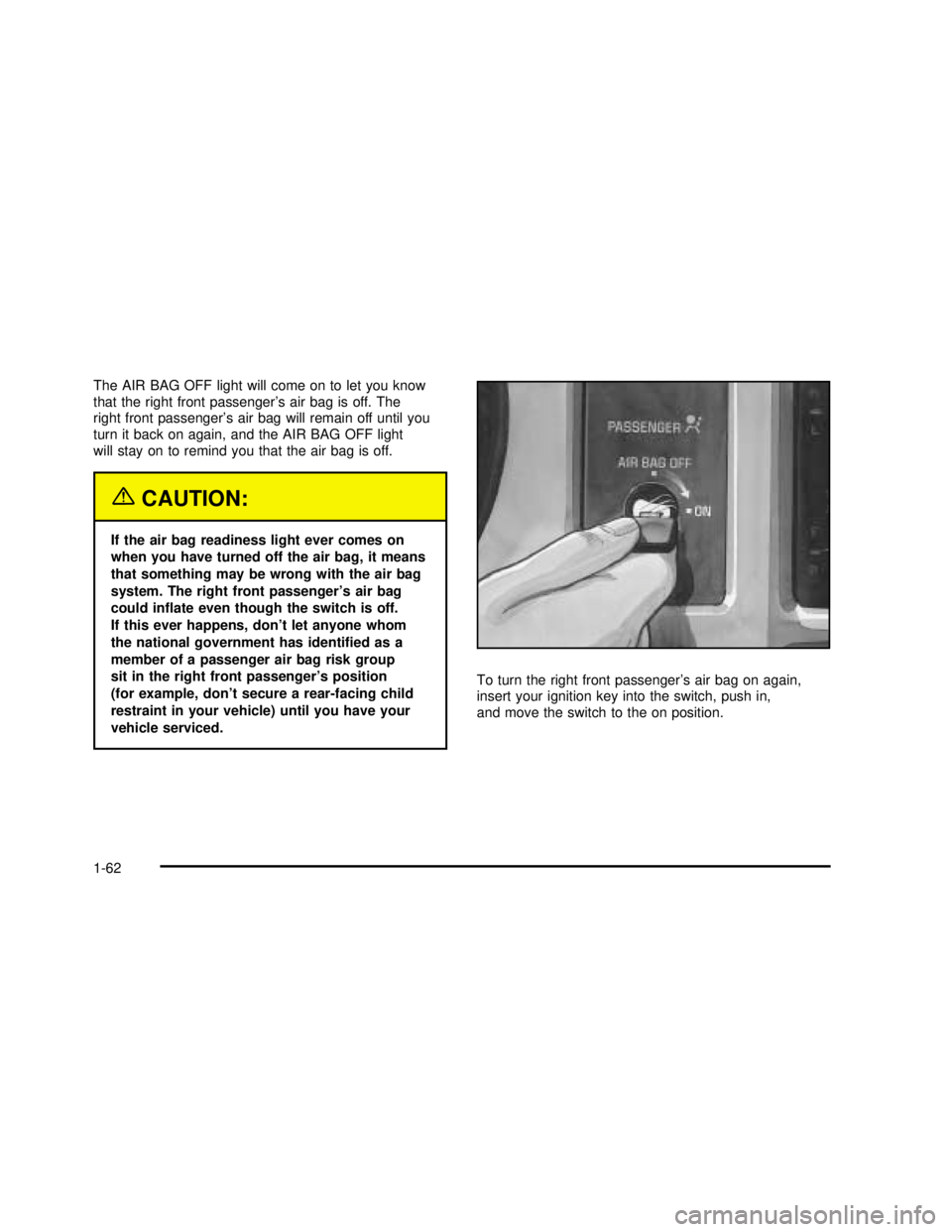
The AIR BAG OFF light will come on to let you know
that the right front passenger’s air bag is off. The
right front passenger’s air bag will remain off until you
turn it back on again, and the AIR BAG OFF light
will stay on to remind you that the air bag is off.
{CAUTION:
If the air bag readiness light ever comes on
when you have turned off the air bag, it means
that something may be wrong with the air bag
system. The right front passenger’s air bag
could inate even though the switch is off.
If this ever happens, don’t let anyone whom
the national government has identied as a
member of a passenger air bag risk group
sit in the right front passenger’s position
(for example, don’t secure a rear-facing child
restraint in your vehicle) until you have your
vehicle serviced.To turn the right front passenger’s air bag on again,
insert your ignition key into the switch, push in,
and move the switch to the on position.
1-62
2003 - Sonoma OM
Page 69 of 424
Servicing Your Air Bag-Equipped
Vehicle
Air bags affect how your vehicle should be serviced.
There are parts of the air bag system in several places
around your vehicle. You don’t want the system to
inflate while someone is working on your vehicle.
Your dealer and the service manual have information
about servicing your vehicle and the air bag system.
To purchase a service manual, seeService Publications
Ordering Information on page 7-9.
{CAUTION:
For up to 10 minutes after the ignition key is
turned off and the battery is disconnected, an
air bag can still inate during improper service.
You can be injured if you are close to an air bag
when it inates. Avoid wires wrapped with
yellow tape or yellow connectors. They are
probably part of the air bag system. Be sure to
follow proper service procedures, and make
sure the person performing work for you is
qualied to do so.
The air bag system does not need regular maintenance.
Adding Equipment to Your Air
Bag-Equipped Vehicle
Q:If I add a push bumper or a bicycle rack to the
front of my vehicle, will it keep the air bags
from working properly?
A:As long as the push bumper or bicycle rack is
attached to your vehicle so that the vehicle’s
basic structure isn’t changed, it’s not likely to keep
the air bags from working properly in a crash.
Q:Is there anything I might add to the front of the
vehicle that could keep the air bags from
working properly?
A:Yes. If you add things that change your vehicle’s
frame, bumper system, front end sheet metal or
height, they may keep the air bag system
from working properly. Also, the air bag system
may not work properly if you relocate any of the air
bag sensors. If you have any questions about
this, you should contact Customer Assistance
before you modify your vehicle. The phone
numbers and addresses for Customer Assistance
are in Step Two of theCustomer Satisfaction
Procedure on page 7-2.
1-63
2003 - Sonoma OM