automatic transmission GMC SONOMA 2003 User Guide
[x] Cancel search | Manufacturer: GMC, Model Year: 2003, Model line: SONOMA, Model: GMC SONOMA 2003Pages: 424, PDF Size: 2.45 MB
Page 242 of 424

When towing your vehicle, turn the ignition to OFF.
To prevent your battery from draining while towing,
remove the RDO BATT and CLSTR fuses from
the instrument panel fuse block. Be sure to replace the
fuse when you reach your destination. SeeFuses
and Circuit Breakers on page 5-89. Be sure to use the
proper towing equipment designed for recreational
vehicle towing. Follow the instructions for the towing
equipment.
{CAUTION:
Shifting a four-wheel-drive vehicle’s transfer
case into NEUTRAL can cause your vehicle to
roll even if the transmission is in Park (P) for
an automatic transmission, or if your vehicle is
in gear, for a manual transmission. You or
others could be injured. Make sure the parking
brake isfirmly set before you shift the transfer
case to NEUTRAL.
If your vehicle has four-wheel-drive it cannot be dinghy
towed. A four-wheel-drive vehicle must be towed by
atbed.
Dolly Towing
Notice:Towing your vehicle with all four wheels on
the ground will damage drivetrain components.
Your two-wheel-drive vehicle should not be towed with
two wheels on the ground. Your transmission has no
provision for internal lubrication while being towed.
To properly tow your vehicle, it should be placed on a
platform trailer with all four wheels off the ground. Towing
with all four wheels on the ground should be avoided.Two-Wheel-Drive Vehicles Only
4-44
2003 - Sonoma OM
Page 243 of 424

In rare cases when it’s unavoidable and your vehicle
must be towed with two wheels on the ground, the
propeller shaft to axle yoke orientation should be marked
and the propeller shaft removed following the applicable
service manual removal/installation procedure. See
Service Publications Ordering Information on page 7-9.
Dust or dirt can enter the back of the transmission
through the opening created by removing the propeller
shaft if proper protection is not provided. Also, check
the transmissionuid level before driving the vehicle.
Use the following steps to dolly tow your vehicle:
1. Put the front wheels on a dolly.
2. Put the vehicle in PARK (P).
3. Set the parking brake and then remove the key.
4. Disconnect the propshaft as described above.
5. Clamp the steering wheel in a straight-ahead
position with a clamping device designed for towing.
6. Release the parking brake.Be sure to use the proper towing equipment designed
for recreational vehicle towing. Follow the instructions for
the towing equipment.
{CAUTION:
Shifting a four-wheel-drive vehicle’s transfer
case into NEUTRAL can cause your vehicle to
roll even if the transmission is in Park (P) for
an automatic transmission, or if your vehicle is
in gear, for a manual transmission. You or
others could be injured. Make sure the parking
brake isfirmly set before you shift the transfer
case to NEUTRAL.
If your vehicle has four-wheel-drive it cannot be dolly
towed. A four-wheel-drive vehicle must be towed
byatbed.
4-45
2003 - Sonoma OM
Page 257 of 424

Driving On Grades
Reduce speed and shift to a lower gear before you start
down a long or steep downgrade. If you don’t shift
down, you might have to use your brakes so much that
they would get hot and no longer work well.
If you have an automatic transmission, you should use
THIRD (3) when towing a trailer. Operating your
vehicle in THIRD (3) when towing a trailer will minimize
heat buildup and extend the life of your transmission.
Or, if you have a manual transmission, it’s better not to
use FIFTH (5). Just drive in FOURTH (4) (or, as you
need to, a lower gear).
When towing at high altitude on steep uphill grades,
consider the following: Engine coolant will boil at a lower
temperature than at normal altitudes. If you turn your
engine off immediately after towing at high altitude
on steep uphill grades, your vehicle may show signs
similar to engine overheating. To avoid this, let the
engine run while parked (preferably on level ground)
with the automatic transmission in PARK (P)
(or the manual transmission out of gear and the parking
brake applied) for a few minutes before turning the
engine off. If you do get the overheat warning,
seeEngine Overheating on page 5-28.
Parking on Hills
{CAUTION:
You really should not park your vehicle, with a
trailer attached, on a hill. If something goes
wrong, your rig could start to move. People
can be injured, and both your vehicle and the
trailer can be damaged.
But if you ever have to park your rig on a hill, here’s
how to do it:
1. Apply your regular brakes, but don’t shift into
PARK (P) yet, or into gear for a manual
transmission. When parking uphill, turn your wheels
away from the curb. When parking downhill, turn
your wheels into the curb.
2. Have someone place chocks under the trailer
wheels.
3. When the wheel chocks are in place, release the
regular brakes until the chocks absorb the load.
4-59
2003 - Sonoma OM
Page 258 of 424

4. Reapply the regular brakes. Then apply your
parking brake, and then shift into PARK (P),
or REVERSE (R) for a manual transmission.
5. If you have a four-wheel-drive vehicle with an
automatic transfer case, be sure the transfer case
is in a drive gear–not in NEUTRAL.
6. Release the regular brakes.
When You Are Ready to Leave After
Parking on a Hill
1. Apply your regular brakes and hold the pedal down
while you:
start your engine,
shift into a gear, and
release the parking brake.
2. Let up on the brake pedal.
3. Drive slowly until the trailer is clear of the chocks.
4. Stop and have someone pick up and store the
chocks.
Maintenance When Trailer Towing
Your vehicle will need service more often when you’re
pulling a trailer. SeePart A: Scheduled Maintenance
Services on page 6-4for more on this. Things that are
especially important in trailer operation are automatic
transmissionuid (don’t overll), engine oil, axle
lubricant, belt, cooling system and brake system.
Each of these is covered in this manual, and the Index
will help yound them quickly. If you’re trailering,
it’s a good idea to review these sections before you
start your trip.
Check periodically to see that all hitch nuts and bolts
are tight.
4-60
2003 - Sonoma OM
Page 259 of 424

Service............................................................5-3
Doing Your Own Service Work.........................5-3
Adding Equipment to the Outside of
Your Vehicle..............................................5-4
Fuel................................................................5-4
Gasoline Octane............................................5-4
Gasoline Specifications....................................5-5
California Fuel...............................................5-5
Additives.......................................................5-5
Fuels in Foreign Countries...............................5-6
Filling Your Tank............................................5-6
Filling a Portable Fuel Container.......................5-8
Checking Things Under
the Hood......................................................5-8
Hood Release................................................5-9
Engine Compartment Overview.......................5-10
Engine Oil...................................................5-13
Engine Air Cleaner/Filter................................5-18
Automatic Transmission Fluid
.........................5-20
Manual Transmission Fluid
.............................5-23
Hydraulic Clutch
...........................................5-24Engine Coolant.............................................5-25
Radiator Pressure Cap..................................5-27
Engine Overheating.......................................5-28
Cooling System............................................5-30
Engine Fan Noise.........................................5-36
Power Steering Fluid.....................................5-37
Windshield Washer Fluid................................5-38
Brakes........................................................5-39
Battery........................................................5-42
Jump Starting...............................................5-43
Rear Axle.......................................................5-47
Four-Wheel Drive............................................5-48
Front Axle......................................................5-49
Bulb Replacement..........................................5-50
Halogen Bulbs..............................................5-50
Headlamps..................................................5-50
One-Piece Front Turn Signal Lamps................5-52
Two-Piece Front Turn Signal Lamps................5-53
Center High-Mounted Stoplamp (CHMSL).........5-54
Taillamps.....................................................5-55
Replacement Bulbs.......................................5-55
Section 5 Service and Appearance Care
5-1
2003 - Sonoma OM
Page 269 of 424

A. Battery
B. Coolant Recovery Tank
C. Automatic Transmission Dipstick (If Equipped)
D. Engine Oil Fill Cap and Dipstick
E. Power Steering ReservoirF. Brake Master Cylinder
G. Engine Air Cleaner/Filter
H. Engine Compartment Fuse Block
I. Windshield Washer Fluid Reservoir
5-11
2003 - Sonoma OM
Page 270 of 424
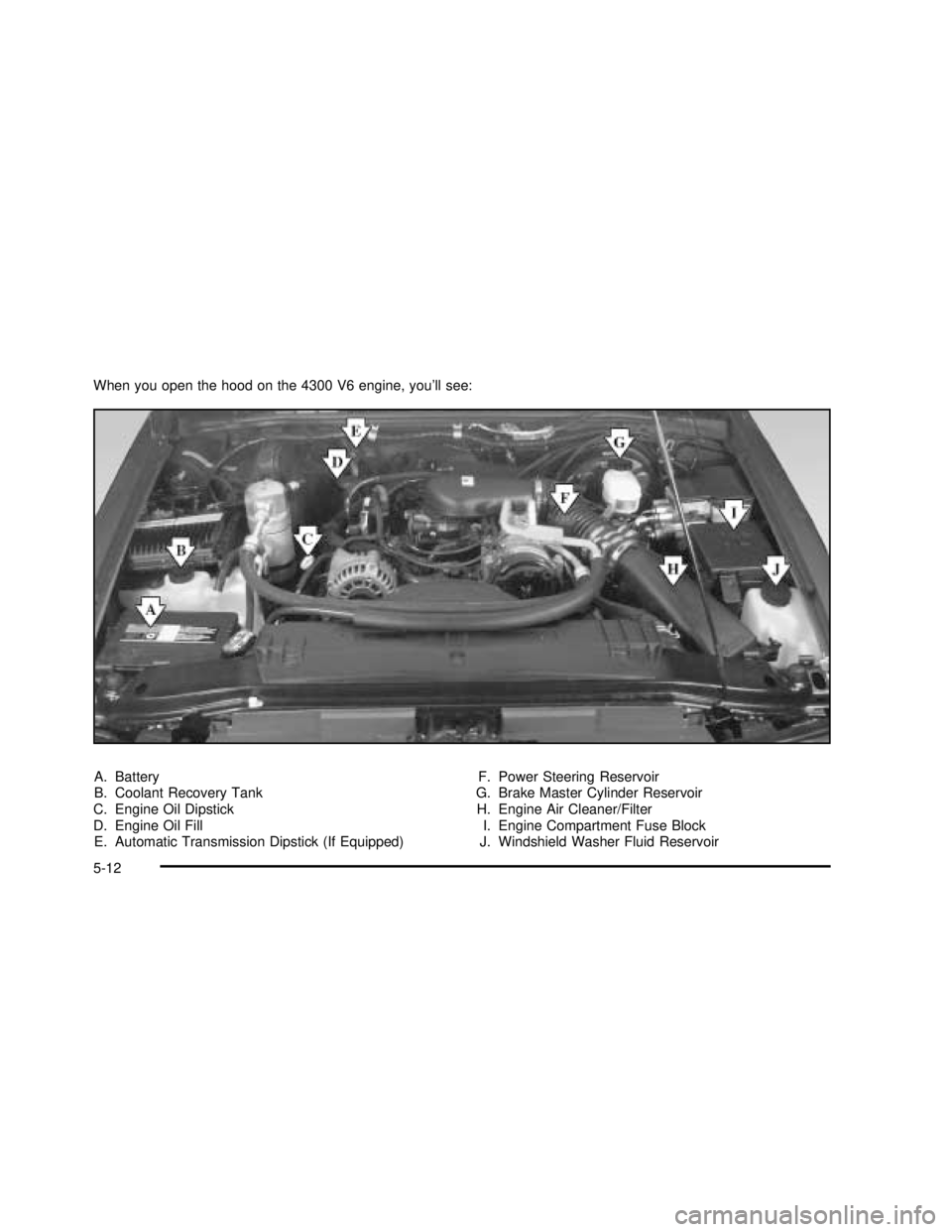
When you open the hood on the 4300 V6 engine, you’ll see:
A. Battery
B. Coolant Recovery Tank
C. Engine Oil Dipstick
D. Engine Oil Fill
E. Automatic Transmission Dipstick (If Equipped)F. Power Steering Reservoir
G. Brake Master Cylinder Reservoir
H. Engine Air Cleaner/Filter
I. Engine Compartment Fuse Block
J. Windshield Washer Fluid Reservoir
5-12
2003 - Sonoma OM
Page 278 of 424

Automatic Transmission Fluid
When to Check and Change
A good time to check your automatic transmissionfluid
level is when the engine oil is changed.
Change both thefluid andfilter every 15,000 miles
(25 000 km) if the vehicle is mainly driven under one
or more of these conditions:
•In heavy city traffic where the outside temperature
regularly reaches 90°F (32°C) or higher.
•In hilly or mountainous terrain.
•When doing frequent trailer towing.
•Uses such as found in taxi, police or delivery
service.
If you do not use your vehicle under any of these
conditions, change thefluid andfilter every
50,000 miles (83 000 km).
SeePart A: Scheduled Maintenance Services
on page 6-4.
How to Check
Because this operation can be a little difficult, you may
choose to have this done at the dealership service
department.
If you do it yourself, be sure to follow all the instructions
here, or you could get a false reading on the dipstick.
Notice:Too much or too littleuid can damage
your transmission. Too much can mean that some
of theuid could come out and fall on hot engine
part or exhaust system parts, starting are.
Too littleuid could cause the transmission to
overheat. Be sure to get an accurate reading if you
check your transmissionuid.
Wait at least 30 minutes before checking the
transmissionfluid level if you have been driving:
•When outside temperatures are above 90°F (32°C).
•At high speed for quite a while.
•In heavy traffic–especially in hot weather.
•While pulling a trailer.
To get the right reading, thefluid should be at normal
operating temperature, which is 180°Fto200°F
(82°Cto93°C)
5-20
2003 - Sonoma OM
Page 280 of 424

3. Check both sides of the dipstick, and read the lower
level. Thefluid level must be in the COLD area,
below the cross-hatched area, for a cold check or in
the HOT area or cross-hatched area for a hot
check.
4. If thefluid level is in the acceptable range, push the
dipstick back in all the way; thenflip the handle
down to lock the dipstick in place.
How to Add Fluid
Refer to the Maintenance Schedule to determine what
kind of transmissionfluid to use. SeePart D:
Recommended Fluids and Lubricants on page 6-33.
Addfluid only after checking the transmissionfluid while
it is hot. (A cold check is used only as a reference.)
If thefluid level is low, add only enough of the proper
fluid to bring the level up to the HOT area for a hot
check. It doesn’t take muchfluid, generally less
than one pint (0.5 L). Don’t overfill.
Notice:We recommend you use onlyuid labeled
DEXRON
®-III, becauseuid with that label is
made especially for your automatic transmission.
Damage caused byuid other than DEXRON
®-III is
not covered by your new vehicle warranty.
•After addingfluid, recheck thefluid level as
described under“How to Check”earlier.
•When the correctfluid level is obtained, push the
dipstick back in all the way; thenflip the handle
down to lock the dipstick in place.
5-22
2003 - Sonoma OM
Page 301 of 424
Jump Starting
If your battery has run down, you may want to use
another vehicle and some jumper cables to start your
vehicle. Be sure to follow the steps below to do it safely.
{CAUTION:
Batteries can hurt you. They can be dangerous
because:
They contain acid that can burn you.
They contain gas that can explode or
ignite.
They contain enough electricity to
burn you.
If you don’t follow these steps exactly, some
or all of these things can hurt you.
Notice:Ignoring these steps could result in costly
damage to your vehicle that wouldn’t be covered
by your warranty.
Trying to start your vehicle by pushing or pulling it
won’t work, and it could damage your vehicle.
1. Check the other vehicle. It must have a 12–volt
battery with a negative ground system.Notice:If the other system isn’t a 12-volt system
with a negative ground, both vehicles can be
damaged.
2. Get the vehicles close enough so the jumper cables
can reach, but be sure the vehicles aren’t touching
each other. If they are, it could cause a ground
connection you don’t want. You wouldn’t be able to
start your vehicle, and the bad grounding could
damage the electrical systems.
To avoid the possibility of the vehicles rolling, set
the parking brakefirmly on both vehicles involved
in the jump start procedure. Put an automatic
transmission in PARK (P) or a manual transmission
in NEUTRAL before setting the parking brake. If
you have a four-wheel-drive vehicle, be sure
the transfer case is not in NEUTRAL (N).
Notice:If you leave your radio on, it could be badly
damaged. The repairs wouldn’t be covered by
your warranty.
3. Turn off the ignition on both vehicles. Unplug
unnecessary accessories plugged into the cigarette
lighter or in the accessory power outlets. Turn off
the radio and all lamps that aren’t needed. This will
avoid sparks and help save both batteries. And it
could save your radio!
5-43
2003 - Sonoma OM