change wheel GMC SONOMA 2003 User Guide
[x] Cancel search | Manufacturer: GMC, Model Year: 2003, Model line: SONOMA, Model: GMC SONOMA 2003Pages: 424, PDF Size: 2.45 MB
Page 256 of 424

Passing
You’ll need more passing distance up ahead when
you’re towing a trailer. And, because you’re a good deal
longer, you’ll need to go much farther beyond the
passed vehicle before you can return to your lane.
Backing Up
Hold the bottom of the steering wheel with one hand.
Then, to move the trailer to the left, just move that hand
to the left. To move the trailer to the right, move your
hand to the right. Always back up slowly and, if possible,
have someone guide you.
Making Turns
Notice:Making very sharp turns while trailering
could cause the trailer to come in contact with the
vehicle. Your vehicle could be damaged. Avoid
making very sharp turns while trailering.
When you’re turning with a trailer, make wider turns
than normal. Do this so your trailer won’t strike
soft shoulders, curbs, road signs, trees or other objects.
Avoid jerky or sudden maneuvers. Signal well in
advance.
Turn Signals When Towing a Trailer
When you tow a trailer, your vehicle has to have extra
wiring and a heavy-duty turn signalasher.
The arrows on your instrument panel willash whenever
you signal a turn or lane change. Properly hooked up,
the trailer lamps will alsoash, telling other drivers
you’re about to turn, change lanes or stop.
When towing a trailer, the arrows on your instrument
panel willash for turns even if the bulbs on the trailer
are burned out. Thus, you may think drivers behind
you are seeing your signal when they are not. It’s
important to check occasionally to be sure the trailer
bulbs are still working.
4-58
2003 - Sonoma OM
Page 275 of 424
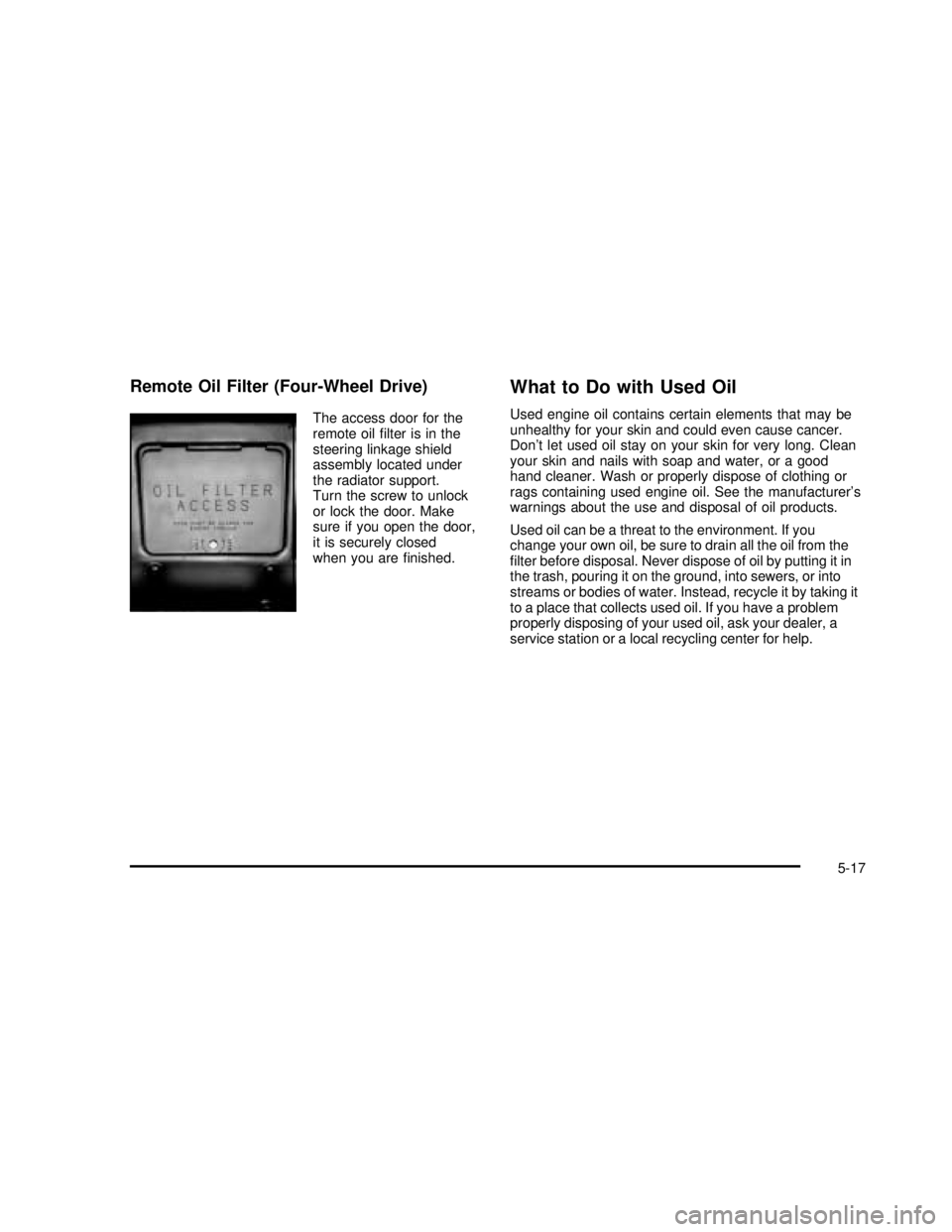
Remote Oil Filter (Four-Wheel Drive)
The access door for the
remote oilfilter is in the
steering linkage shield
assembly located under
the radiator support.
Turn the screw to unlock
or lock the door. Make
sure if you open the door,
it is securely closed
when you arefinished.
What to Do with Used Oil
Used engine oil contains certain elements that may be
unhealthy for your skin and could even cause cancer.
Don’t let used oil stay on your skin for very long. Clean
your skin and nails with soap and water, or a good
hand cleaner. Wash or properly dispose of clothing or
rags containing used engine oil. See the manufacturer’s
warnings about the use and disposal of oil products.
Used oil can be a threat to the environment. If you
change your own oil, be sure to drain all the oil from the
filter before disposal. Never dispose of oil by putting it in
the trash, pouring it on the ground, into sewers, or into
streams or bodies of water. Instead, recycle it by taking it
to a place that collects used oil. If you have a problem
properly disposing of your used oil, ask your dealer, a
service station or a local recycling center for help.
5-17
2003 - Sonoma OM
Page 319 of 424
After the tires have been rotated, adjust the front and
rear inflation pressures as shown on the
Certification/Tire label. Make certain that all wheel nuts
are properly tightened. See“Wheel Nut Torque”
underCapacities and Specifications on page 5-94.
{CAUTION:
Rust or dirt on a wheel, or on the parts to
which it is fastened, can make wheel nuts
become loose after a time. The wheel could
come off and cause an accident. When you
change a wheel, remove any rust or dirt from
places where the wheel attaches to the vehicle.
In an emergency, you can use a cloth or a
paper towel to do this; but be sure to use a
scraper or wire brush later, if you need to,
to get all the rust or dirt off. See“Changing a
Flat Tire”in the Index.
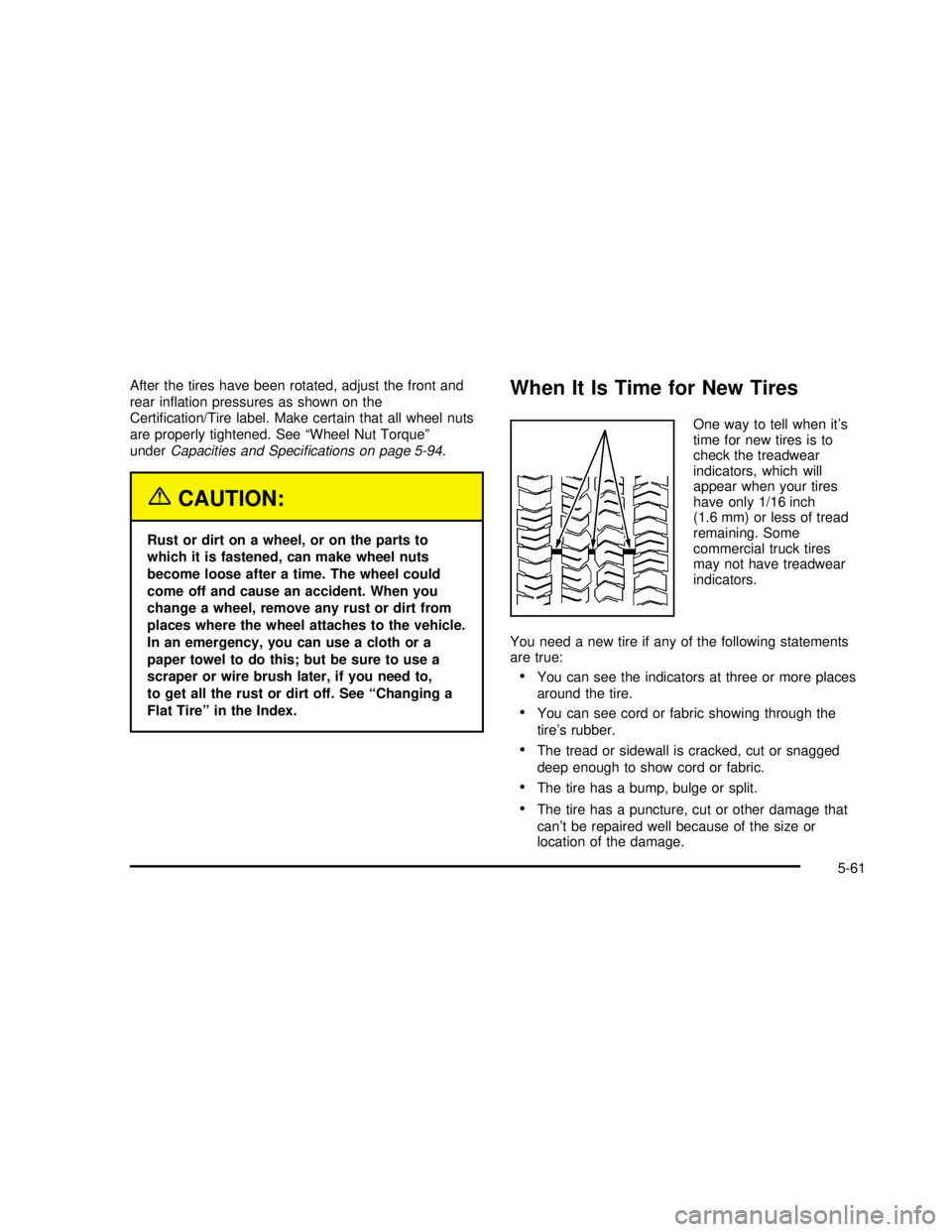
When It Is Time for New Tires
One way to tell when it’s
time for new tires is to
check the treadwear
indicators, which will
appear when your tires
have only 1/16 inch
(1.6 mm) or less of tread
remaining. Some
commercial truck tires
may not have treadwear
indicators.
You need a new tire if any of the following statements
are true:
•You can see the indicators at three or more places
around the tire.
•You can see cord or fabric showing through the
tire’s rubber.
•The tread or sidewall is cracked, cut or snagged
deep enough to show cord or fabric.
•The tire has a bump, bulge or split.
•The tire has a puncture, cut or other damage that
can’t be repaired well because of the size or
location of the damage.
5-61
2003 - Sonoma OM
Page 325 of 424
CAUTION: (Continued)
instructions. To help avoid damage to your
vehicle, drive slowly, readjust or remove the
device if it’s contacting your vehicle, and don’t
spin your wheels.
If you dond traction devices that willt,
install them on the rear tires.
Notice:If your vehicle has a tire size other than
P235/75R15, P235/70R15, P235/55R16 or
31x10.50R15LT/C, use tire chains only where legal
and only when you must. Use only SAE Class″S″
type chains that are the proper size for your tires.
Install them on the drive axle tires (four-wheel-drive
vehicles can use chains on both axles) and tighten
them as tightly as possible with the ends securely
fastened. Drive slowly and follow the chain
manufacturer’s instructions. If you can hear the
chains contacting your vehicle, stop and retighten
them. If the contact continues, slow down until it
stops. Driving too fast or spinning the wheels with
chains on will damage your vehicle.
If a Tire Goes Flat
It’s unusual for a tire to“blowout”while you’re driving,
especially if you maintain your tires properly. If air goes
out of a tire, it’s much more likely to leak out slowly.
But if you should ever have a“blowout”, here are a few
tips about what to expect and what to do:
If a front tire fails, theflat tire will create a drag that
pulls the vehicle toward that side. Take your foot off the
accelerator pedal and grip the steering wheelfirmly.
Steer to maintain lane position, and then gently brake to
a stop well out of the traffic lane.
A rear blowout, particularly on a curve, acts much like a
skid and may require the same correction you’d use
in a skid. In any rear blowout, remove your foot from the
accelerator pedal. Get the vehicle under control by
steering the way you want the vehicle to go. It may be
very bumpy and noisy, but you can still steer. Gently
brake to a stop—well off the road if possible.
If a tire goesflat, the next part shows how to use your
jacking equipment to change aflat tire safely.
5-67
2003 - Sonoma OM
Page 326 of 424
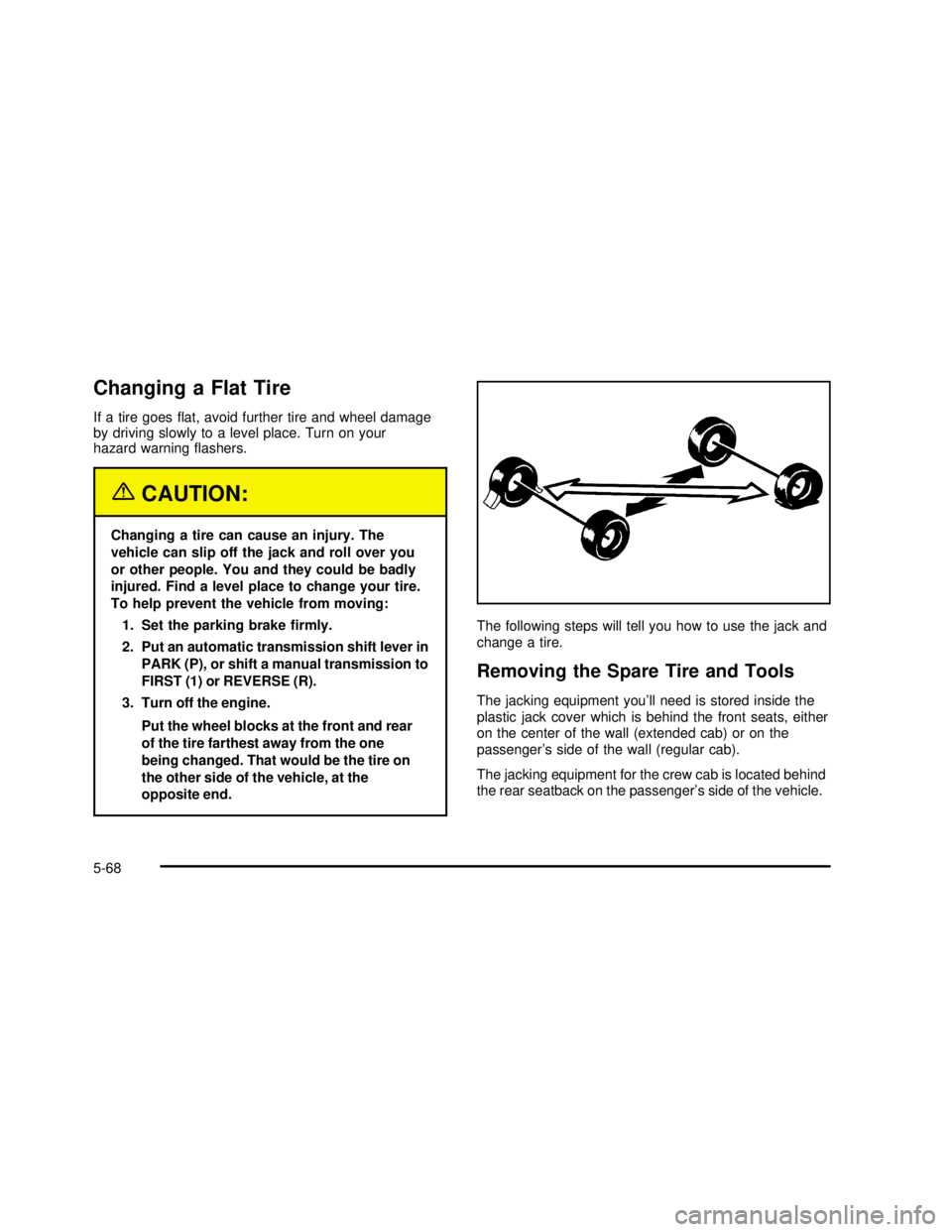
Changing a Flat Tire
If a tire goesflat, avoid further tire and wheel damage
by driving slowly to a level place. Turn on your
hazard warningflashers.
{CAUTION:
Changing a tire can cause an injury. The
vehicle can slip off the jack and roll over you
or other people. You and they could be badly
injured. Find a level place to change your tire.
To help prevent the vehicle from moving:
1. Set the parking brakermly.
2. Put an automatic transmission shift lever in
PARK (P), or shift a manual transmission to
FIRST (1) or REVERSE (R).
3. Turn off the engine.
Put the wheel blocks at the front and rear
of the tire farthest away from the one
being changed. That would be the tire on
the other side of the vehicle, at the
opposite end.The following steps will tell you how to use the jack and
change a tire.
Removing the Spare Tire and Tools
The jacking equipment you’ll need is stored inside the
plastic jack cover which is behind the front seats, either
on the center of the wall (extended cab) or on the
passenger’s side of the wall (regular cab).
The jacking equipment for the crew cab is located behind
the rear seatback on the passenger’s side of the vehicle.
5-68
2003 - Sonoma OM
Page 331 of 424
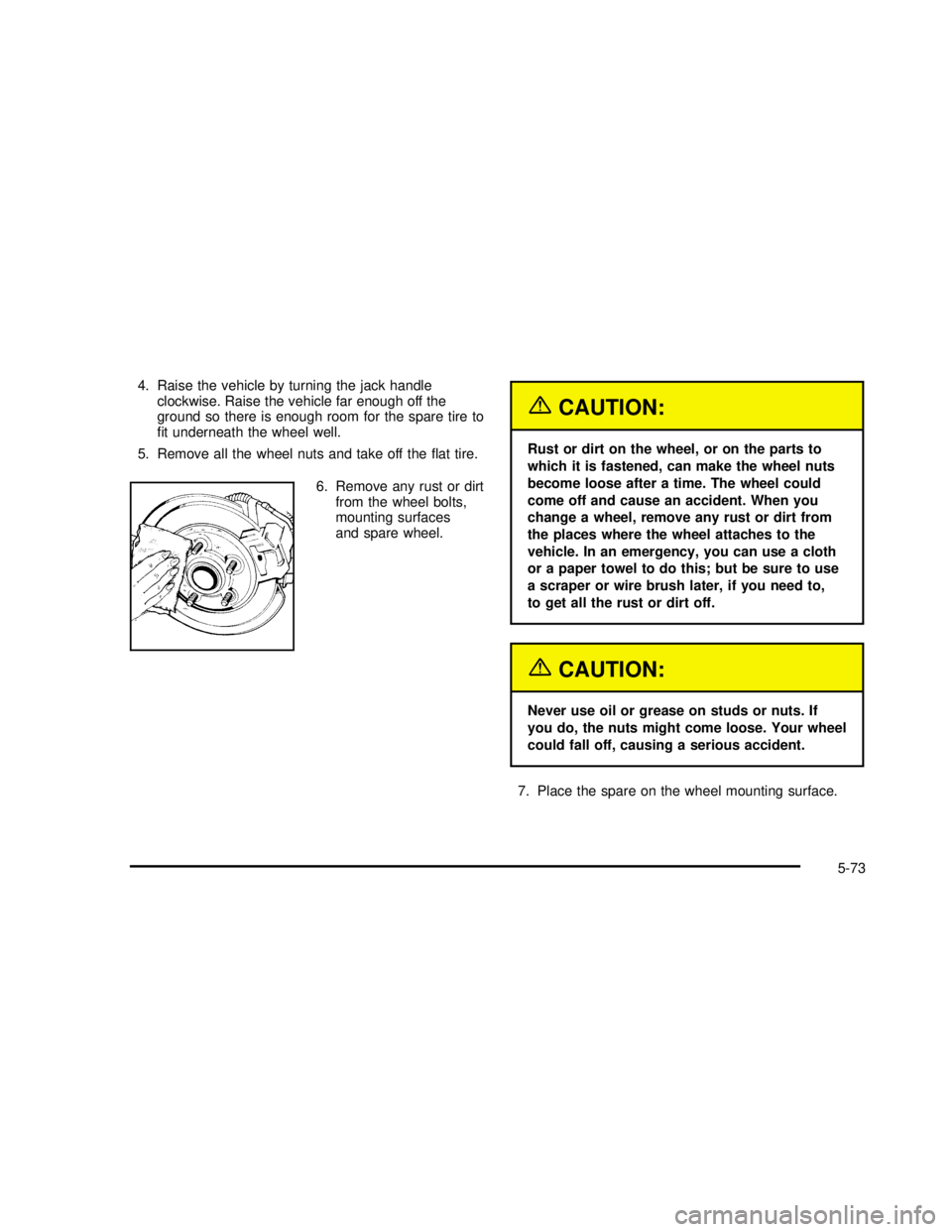
4. Raise the vehicle by turning the jack handle
clockwise. Raise the vehicle far enough off the
ground so there is enough room for the spare tire to
fit underneath the wheel well.
5. Remove all the wheel nuts and take off theflat tire.
6. Remove any rust or dirt
from the wheel bolts,
mounting surfaces
and spare wheel.
{CAUTION:
Rust or dirt on the wheel, or on the parts to
which it is fastened, can make the wheel nuts
become loose after a time. The wheel could
come off and cause an accident. When you
change a wheel, remove any rust or dirt from
the places where the wheel attaches to the
vehicle. In an emergency, you can use a cloth
or a paper towel to do this; but be sure to use
a scraper or wire brush later, if you need to,
to get all the rust or dirt off.
{CAUTION:
Never use oil or grease on studs or nuts. If
you do, the nuts might come loose. Your wheel
could fall off, causing a serious accident.
7. Place the spare on the wheel mounting surface.
5-73
2003 - Sonoma OM
Page 352 of 424

Capacities and Specications
Please refer toPart E: Maintenance Record on page 6-35in the index for more information. See refrigerant change
label under the hood for charge capacity information and requirements.
ApplicationCapacities
English Metric
Wheel Nut Torque 100 lb ft 140Y
Tire PressureSee the Certification/Tire label.
See″Loading Your Vehicle″in the Index.
Cooling System
2.2L Engine
4.3L Engine w/Auto. Trans.
4.3L Engine w/Manual. Trans.9.9 quarts
13.8 quarts
14.1 quarts9.4 L
13.1 L
13.3 L
Engine Oil with Filter*
2.2L Engine
4.3L Engine4.5 quarts
4.5 quarts4.3 L
4.3 L
Fuel Capacity
Reg/Ext. Cab
Crew Cab
®
18.0 gallons
17.5 gallons70.0 L
67.4 L
5-94
2003 - Sonoma OM
Page 359 of 424

Selecting the Right Schedule
First you’ll need to decide which of the two schedules is
right for your vehicle. Here’s how to decide which
schedule to follow:
Short Trip/City Definition
Follow the Short Trip/City Scheduled Maintenance if any
one of these conditions is true for your vehicle:
•Most trips are less than 5 miles (8 km). This is
particularly important when outside temperatures
are below freezing.
•Most trips include extensive idling (such as frequent
driving in stop-and-go traffic).
•You frequently tow a trailer.
If the vehicle is used for delivery service, police,
taxi or other commercial application.
One of the reasons you should follow this schedule if
you operate your vehicle under any of these conditions
is that these conditions cause engine oil to break
down sooner.
Short Trip/City Intervals
Every 3,000 Miles (5 000 km):Engine Oil and Filter
Change (or 3 months, whichever occursfirst). Chassis
Lubrication (or 3 months, whichever occursfirst).
Drive Axle Service.
Every 6,000 Miles (10 000 km):Tire Rotation.
Every 15,000 Miles (25 000 km):Engine Air Cleaner
Filter Inspection. Front Wheel Bearing Repack
(two-wheel drive only) (or at each brake relining,
whichever occursfirst). Automatic Transmission Service
(severe conditions only).
Every 30,000 Miles (50 000 km):Engine Air
Cleaner Filter Replacement. Fuel Filter Replacement
(4.3L V6 engine only).
Every 50,000 Miles (83 000 km):Automatic
Transmission Service (normal conditions).
Every 90,000 Miles (150 000 km):Fuel Filter
Replacement (2200 L4 engine only).
Every 100,000 Miles (166 000 km):Spark Plug Wire
Inspection. Spark Plug Replacement. 4.3L V6 Engine
Only: Positive Crankcase Ventilation (PCV) Valve
Inspection.
6-5
2003 - Sonoma OM
Page 360 of 424

Every 150 000 Miles (240 000 km):Cooling System
Service (or every 60 months, whichever occurs
first). Engine Accessory Drive Belt Inspection.
These intervals only summarize maintenance services.
Be sure to follow the complete scheduled maintenance
on the following pages.
Long Trip/Highway Definition
Follow this scheduled maintenanceonlyif none of the
conditions from the Short Trip/City Scheduled
Maintenance are true. Do not use this schedule if the
vehicle is used for trailer towing, driven in a dusty area
or used off paved roads. Use the Short Trip/City
schedule for these conditions
Driving a vehicle with a fully warmed engine under
highway conditions will cause engine oil to break down
slower.
Long Trip/Highway Intervals
Every 7,500 Miles (12 500 km):Engine Oil and Filter
Change (or every 12 months, whichever occurs
first). Chassis Lubrication (or 12 months, whichever
occursfirst). Drive Axle Service. Tire Rotation.
Every 15,000 Miles (25 000 km):Engine Air Cleaner
Filter Inspection. Automatic Transmission Service
(severe conditions only).Every 30,000 Miles (50 000 km):Fuel Filter
Replacement (4.3L V6 engine only). Engine Air Cleaner
Filter Replacement. Front Wheel Bearing Repack
(two-wheel drive only) (or at each brake relining,
whichever occursfirst).
Every 50,000 Miles (83 000 km):Automatic
Transmission Service (normal conditions).
Every 90,000 Miles (150 000 km):Fuel Filter
Replacement (2200 L4 engine only).
Every 100,000 Miles (166 000 km):Spark Plug Wire
Inspection. Spark Plug Replacement. 4.3L V6 Engine
Only: Positive Crankcase Ventilation (PCV) Valve
Inspection.
Every 150,000 Miles (240 000 km):Cooling System
Service (or every 60 months, whichever occurs
first). Engine Accessory Drive Belt Inspection.
These intervals only summarize maintenance services.
Be sure to follow the complete scheduled maintenance
on the following pages.
6-6
2003 - Sonoma OM
Page 362 of 424

6,000 Miles (10 000 km)
❑Change engine oil andfilter (or every 3 months,
whichever occursfirst).An Emission Control Service.
❑Lubricate chassis components (or every 3 months,
whichever occursfirst).(See footnote #.)
❑Check rear/front axlefluid level and addfluid as
needed. Check constant velocity joints and axle seals
for leaking.(See Footnote **.)
❑Rotate tires. SeeTire Inspection and Rotation on
page 5-60for proper rotation pattern and additional
information.(See footnote +.)
9,000 Miles (15 000 km)
❑Change engine oil andfilter (or every 3 months,
whichever occursfirst).An Emission Control Service.
❑Lubricate chassis components (or every 3 months,
whichever occursfirst).(See footnote #.)
❑Check rear/front axlefluid level and addfluid as
needed. Check constant velocity joints and axle seals
for leaking.(See footnote **.)
12,000 Miles (20 000 km)
❑Change engine oil andfilter (or every 3 months,
whichever occursfirst).An Emission Control Service.
❑Lubricate chassis components (or every 3 months,
whichever occursfirst).(See footnote #.)❑Check rear/front axlefluid level and addfluid as
needed. Check constant velocity joints and axle seals
for leaking.(See footnote **.)
❑Rotate tires. SeeTire Inspection and Rotation on
page 5-60for proper rotation pattern and additional
information.(See footnote +.)
15,000 Miles (25 000 km)
❑Change engine oil andfilter (or every 3 months,
whichever occursfirst).An Emission Control Service.
❑Lubricate chassis components (or every 3 months,
whichever occursfirst).(See footnote #.)
❑Inspect engine air cleanerfilter. If necessary, replace
thefilter. If vehicle is driven in dusty/dirty conditions,
inspectfilter at every engine oil change. See
Engine Air Cleaner/Filter on page 5-18for more
information.An Emission Control Service.
(See footnote†.)
❑Check rear/front axlefluid level and addfluid as
needed. Check constant velocity joints and axle seals
for leaking.(See footnote **.)
❑For Two-Wheel-Drive vehicles only: Clean and
repack the front wheel bearings (or at each
brake relining, whichever occursfirst).
6-8
2003 - Sonoma OM