check oil GMC SONOMA 2003 User Guide
[x] Cancel search | Manufacturer: GMC, Model Year: 2003, Model line: SONOMA, Model: GMC SONOMA 2003Pages: 424, PDF Size: 2.45 MB
Page 271 of 424
Engine Oil
Checking Engine Oil
It’s a good idea to check your engine oil every time you
get fuel. In order to get an accurate reading, the oil
must be warm and the vehicle must be on level ground.
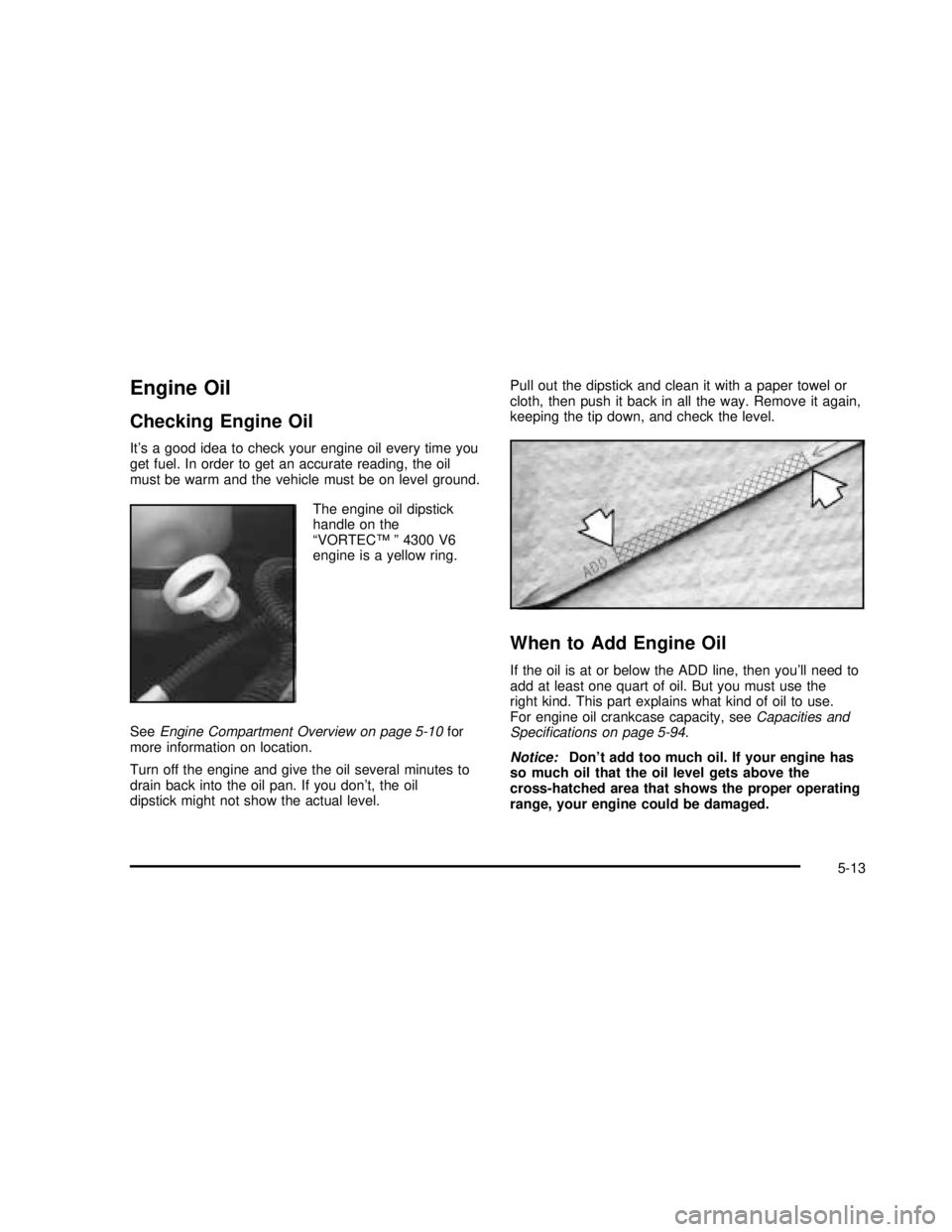
The engine oil dipstick
handle on the
“VORTEC™”4300 V6
engine is a yellow ring.
SeeEngine Compartment Overview on page 5-10for
more information on location.
Turn off the engine and give the oil several minutes to
drain back into the oil pan. If you don’t, the oil
dipstick might not show the actual level.Pull out the dipstick and clean it with a paper towel or
cloth, then push it back in all the way. Remove it again,
keeping the tip down, and check the level.
When to Add Engine Oil
If the oil is at or below the ADD line, then you’ll need to
add at least one quart of oil. But you must use the
right kind. This part explains what kind of oil to use.
For engine oil crankcase capacity, seeCapacities and
Specifications on page 5-94.
Notice:Don’t add too much oil. If your engine has
so much oil that the oil level gets above the
cross-hatched area that shows the proper operating
range, your engine could be damaged.
5-13
2003 - Sonoma OM
Page 278 of 424

Automatic Transmission Fluid
When to Check and Change
A good time to check your automatic transmissionfluid
level is when the engine oil is changed.
Change both thefluid andfilter every 15,000 miles
(25 000 km) if the vehicle is mainly driven under one
or more of these conditions:
•In heavy city traffic where the outside temperature
regularly reaches 90°F (32°C) or higher.
•In hilly or mountainous terrain.
•When doing frequent trailer towing.
•Uses such as found in taxi, police or delivery
service.
If you do not use your vehicle under any of these
conditions, change thefluid andfilter every
50,000 miles (83 000 km).
SeePart A: Scheduled Maintenance Services
on page 6-4.
How to Check
Because this operation can be a little difficult, you may
choose to have this done at the dealership service
department.
If you do it yourself, be sure to follow all the instructions
here, or you could get a false reading on the dipstick.
Notice:Too much or too littleuid can damage
your transmission. Too much can mean that some
of theuid could come out and fall on hot engine
part or exhaust system parts, starting are.
Too littleuid could cause the transmission to
overheat. Be sure to get an accurate reading if you
check your transmissionuid.
Wait at least 30 minutes before checking the
transmissionfluid level if you have been driving:
•When outside temperatures are above 90°F (32°C).
•At high speed for quite a while.
•In heavy traffic–especially in hot weather.
•While pulling a trailer.
To get the right reading, thefluid should be at normal
operating temperature, which is 180°Fto200°F
(82°Cto93°C)
5-20
2003 - Sonoma OM
Page 281 of 424
Manual Transmission Fluid
When to Check
A good time to have it checked is when the engine oil is
changed. However, thefluid in your manual transmission
doesn’t require changing.
How to Check
Because this operation can be a little difficult, you may
choose to have this done at your GM dealership
service department.
If you do it yourself, be sure to follow all the instructions
here, or you could get a false reading.
Notice:Too much or too littleuid can damage
your transmission. Too much can mean that some
of theuid could come out and fall on hot engine
part or exhaust system parts, starting are.
Too littleuid could cause the transmission to
overheat. Be sure to get an accurate reading if
you check your transmissionuid.
Check thefluid level only when your engine is off, the
vehicle is parked on a level place and the transmission
is cool enough for you to rest yourfingers on the
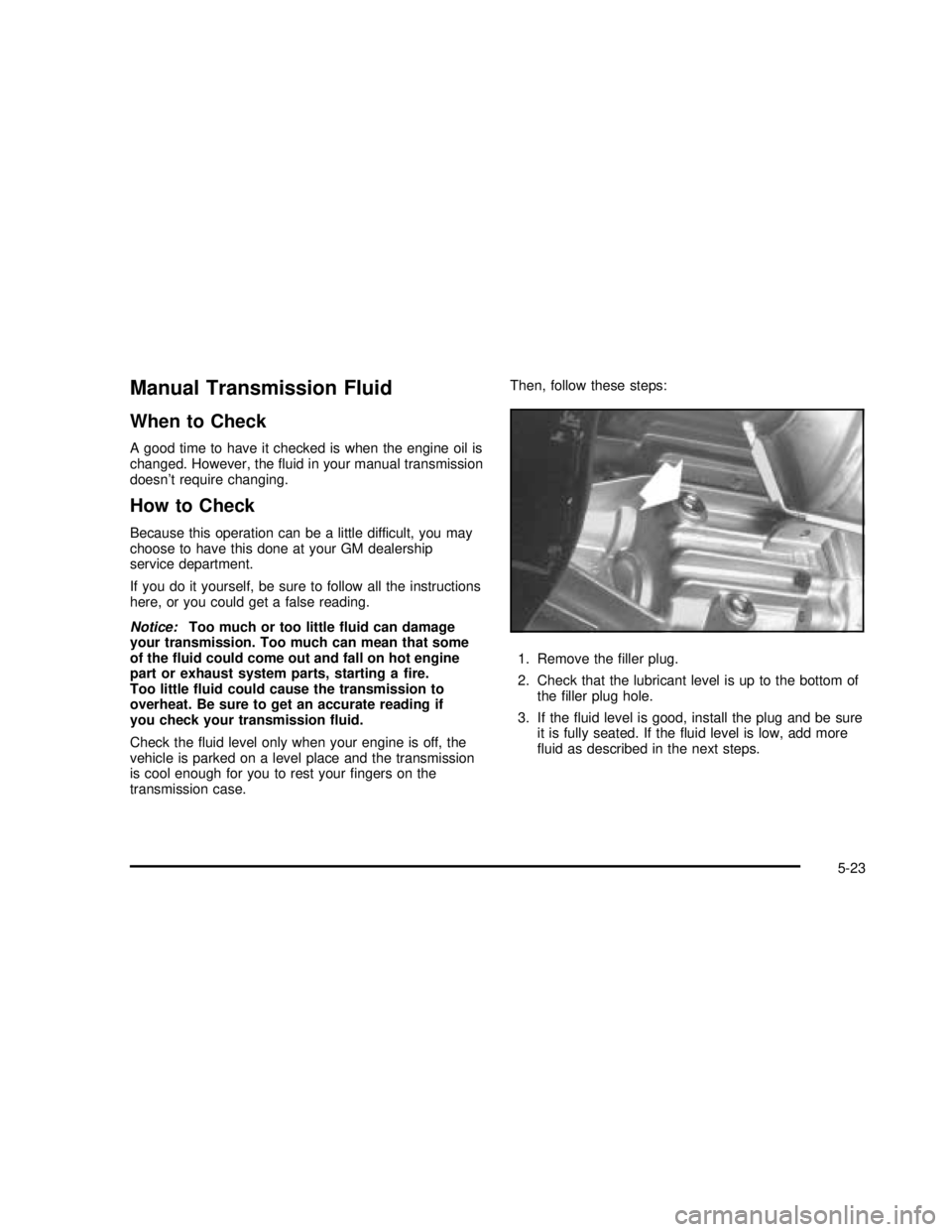
transmission case.Then, follow these steps:
1. Remove thefiller plug.
2. Check that the lubricant level is up to the bottom of
thefiller plug hole.
3. If thefluid level is good, install the plug and be sure
it is fully seated. If thefluid level is low, add more
fluid as described in the next steps.
5-23
2003 - Sonoma OM
Page 283 of 424

How to Check and Add Fluid
The properfluid should be added if the level does not
reach the bottom of the diaphragm when it’s in place
in the reservoir. See the instructions on the
reservoir cap.
Engine Coolant
The cooling system in your vehicle isfilled with
DEX-COOL®engine coolant. This coolant is designed
to remain in your vehicle for 5 years or 150,000 miles
(240 000 km), whichever occursfirst, if you add
only DEX-COOL
®extended life coolant.
The following explains your cooling system and how to
add coolant when it is low. If you have a problem
with engine overheating, seeEngine Overheating
on page 5-28.A 50/50 mixture of clean, drinkable water and
DEX-COOL
®coolant will:
•Give freezing protection down to−34°F(−37°C).
•Give boiling protection up to 265°F (129°C).
•Protect against rust and corrosion.
•Help keep the proper engine temperature.
•Let the warning lights and gages work as
they should.
Notice:When adding coolant, it is important that
you use only DEX-COOL
®(silicate-free) coolant.
If coolant other than DEX-COOL®is added to
the system, premature engine, heater core or
radiator corrosion may result. In addition, the engine
coolant will require change sooner -- at 30,000 miles
(50,000 km) or 24 months, whichever occursrst.
Damage caused by the use of coolant other
than DEX-COOL
®is not covered by your new
vehicle warranty.
5-25
2003 - Sonoma OM
Page 284 of 424
What to Use
Use a mixture of one-halfclean, drinkable waterand
one-half DEX-COOL®coolant which won’t damage
aluminum parts. If you use this coolant mixture,
you don’t need to add anything else.
{CAUTION:
Adding only plain water to your cooling
system can be dangerous. Plain water, or
some other liquid such as alcohol, can boil
before the proper coolant mixture will. Your
vehicle’s coolant warning system is set for the
proper coolant mixture. With plain water or the
wrong mixture, your engine could get too hot
but you wouldn’t get the overheat warning.
Your engine could catchre and you or others
could be burned. Use a 50/50 mixture of clean,
drinkable water and the proper coolant.
Notice:If you use an improper coolant mixture, your
engine could overheat and be badly damaged. The
repair cost wouldn’t be covered by your warranty.
Too much water in the mixture can freeze and crack
the engine, radiator, heater core and other parts.If you have to add coolant more than four times a year,
have your dealer check your cooling system.
Notice:If you use the proper coolant, you don’t
have to add extra inhibitors or additives which claim
to improve the system. These can be harmful.
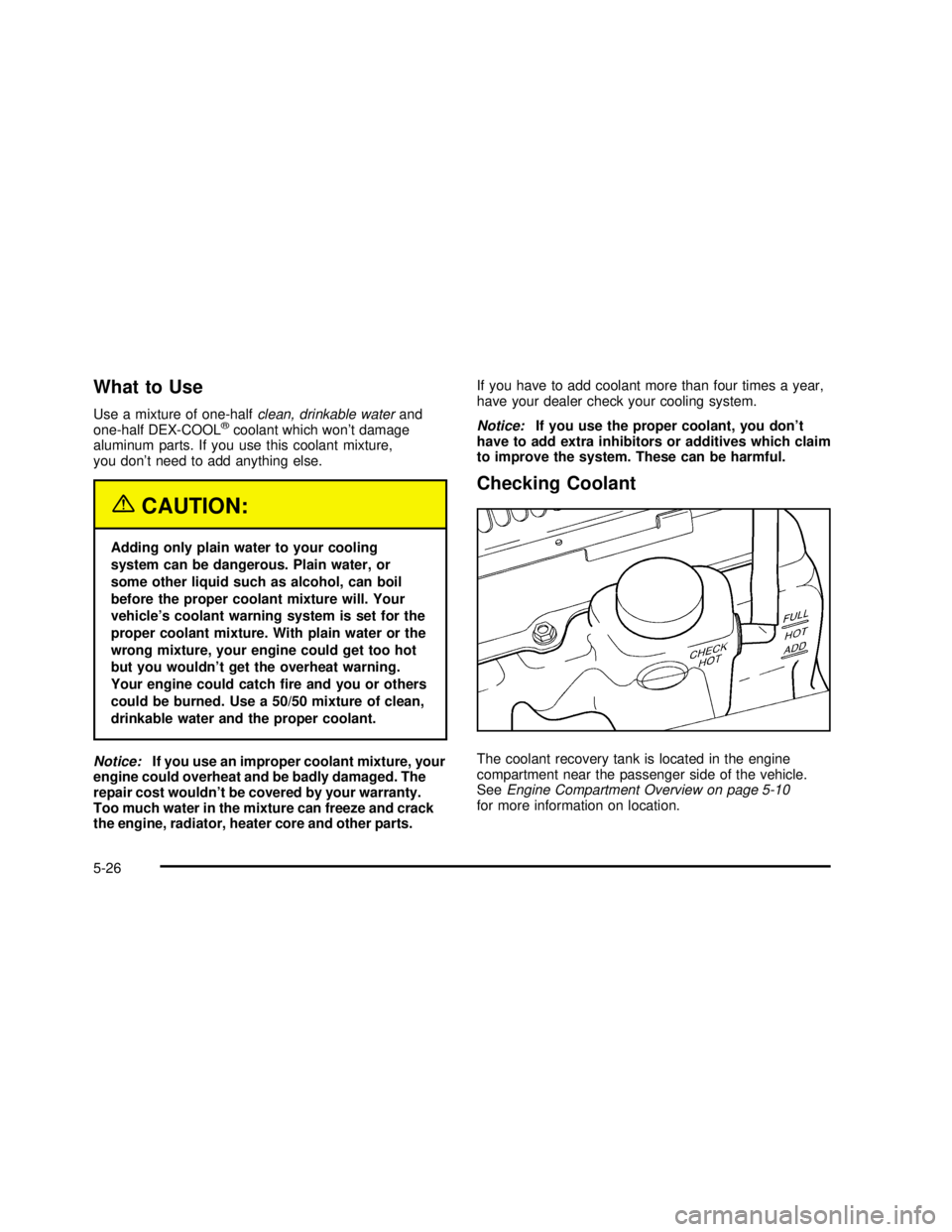
Checking Coolant
The coolant recovery tank is located in the engine
compartment near the passenger side of the vehicle.
SeeEngine Compartment Overview on page 5-10
for more information on location.
5-26
2003 - Sonoma OM
Page 298 of 424

Checking Brake Fluid
You can check the brakefluid without taking off the cap.
Just look at the brakefluid
reservoir. Thefluid level
should be above MIN.
If it isn’t have your brake
system checked to
see if there is a leak.
After work is done on the brake hydraulic system,
make sure the level is above the MIN but not over the
MAX mark.
What to Add
When you do need brakefluid, use only DOT-3 brake
fluid. Use new brakefluid from a sealed container
only. SeePart D: Recommended Fluids and Lubricants
on page 6-33.Always clean the brakefluid reservoir cap and the area
around the cap before removing it. This will help
keep dirt from entering the reservoir.
{CAUTION:
With the wrong kind ofuid in your brake
system, your brakes may not work well, or they
may not even work at all. This could cause a
crash. Always use the proper brakeuid.
Notice:
Using the wronguid can badly damage brake
system parts. For example, just a few drops of
mineral-based oil, such as engine oil, in your
brake system can damage brake system
parts so badly that they’ll have to be replaced.
Don’t let someone put in the wrong kind ofuid.
If you spill brakeuid on your vehicle’s painted
surfaces, the paintnish can be damaged. Be
careful not to spill brakeuid on your vehicle.
If you do, wash it off immediately. See
“Appearance Care”in the Index.
5-40
2003 - Sonoma OM
Page 356 of 424

Maintenance Schedule
Introduction
Important: Keep engine oil at the proper level and
change as recommended.
Have you purchased the GM Protection Plan? The Plan
supplements your new vehicle warranties. See your
Warranty and Owner Assistance booklet or your dealer
for details.
Your Vehicle and the Environment
Proper vehicle maintenance not only helps to keep your
vehicle in good working condition, but also helps the
environment. Improper vehicle maintenance can
even affect the quality of the air we breathe. Improper
fluid levels or the wrong tire inflation can increase
the level of emissions from your vehicle. To help protect
our environment, and to keep your vehicle in good
condition, be sure to maintain your vehicle properly.
Maintenance Requirements
Maintenance intervals, checks, inspections and
recommended fluids and lubricants as prescribed in this
manual are necessary to keep your vehicle in good
working condition. Any damage caused by failure
to follow scheduled maintenance may not be covered
by warranty.
6-2
2003 - Sonoma OM
Page 361 of 424

Short Trip/City Scheduled
Maintenance
The services shown in this schedule up to 100,000 miles
(166 000 km) should be repeated after 100,000 miles
(166 000 km) at the same intervals for the life of
this vehicle. The services shown at 150,000 miles
(240 000 km) should be repeated at the same interval
after 150,000 miles (240 000 km) for the life of this
vehicle.
SeePart B: Owner Checks and Services on page 6-26
andPart C: Periodic Maintenance Inspections on
page 6-31.
Footnotes
†The U.S. Environmental Protection Agency or the
California Air Resources Board has determined that the
failure to perform this maintenance item will not nullify
the emission warranty or limit recall liability prior to
the completion of the vehicle’s useful life. We, however,
urge that all recommended maintenance services be
performed at the indicated intervals and the
maintenance be recorded.#Lubricate the front suspension, ball joints, steering
linkage, parking brake cable guides, propshaft splines,
universal joints, constant velocity joint and brake
pedal springs.
+A good time to check your brakes is during tire
rotation. See Brake System Inspection on page 6-32.
**Drive axle service. See Part D: Recommended Fluids
and Lubricants on page 6-33 for proper lubricant to use:
•Check uid level and add uid as needed. If driving in
dusty areas or when towing a trailer, drain uid and
rell every 15,000 miles (25 000 km).
•If your vehicle has a locking differential, drain uid
and rell at rst engine oil change.
•More frequent lubrication may be required for
heavy-duty or off-road use.
3,000 Miles (5 000 km)
❑Change engine oil andfilter (or every 3 months,
whichever occursfirst).An Emission Control Service.
❑Lubricate chassis components (or every 3 months,
whichever occursfirst).(See footnote #.)
❑Check rear/front axlefluid level and addfluid as
needed. Check constant velocity joints and axle seals
for leaking.(See footnote **.)
6-7
2003 - Sonoma OM
Page 362 of 424

6,000 Miles (10 000 km)
❑Change engine oil andfilter (or every 3 months,
whichever occursfirst).An Emission Control Service.
❑Lubricate chassis components (or every 3 months,
whichever occursfirst).(See footnote #.)
❑Check rear/front axlefluid level and addfluid as
needed. Check constant velocity joints and axle seals
for leaking.(See Footnote **.)
❑Rotate tires. SeeTire Inspection and Rotation on
page 5-60for proper rotation pattern and additional
information.(See footnote +.)
9,000 Miles (15 000 km)
❑Change engine oil andfilter (or every 3 months,
whichever occursfirst).An Emission Control Service.
❑Lubricate chassis components (or every 3 months,
whichever occursfirst).(See footnote #.)
❑Check rear/front axlefluid level and addfluid as
needed. Check constant velocity joints and axle seals
for leaking.(See footnote **.)
12,000 Miles (20 000 km)
❑Change engine oil andfilter (or every 3 months,
whichever occursfirst).An Emission Control Service.
❑Lubricate chassis components (or every 3 months,
whichever occursfirst).(See footnote #.)❑Check rear/front axlefluid level and addfluid as
needed. Check constant velocity joints and axle seals
for leaking.(See footnote **.)
❑Rotate tires. SeeTire Inspection and Rotation on
page 5-60for proper rotation pattern and additional
information.(See footnote +.)
15,000 Miles (25 000 km)
❑Change engine oil andfilter (or every 3 months,
whichever occursfirst).An Emission Control Service.
❑Lubricate chassis components (or every 3 months,
whichever occursfirst).(See footnote #.)
❑Inspect engine air cleanerfilter. If necessary, replace
thefilter. If vehicle is driven in dusty/dirty conditions,
inspectfilter at every engine oil change. See
Engine Air Cleaner/Filter on page 5-18for more
information.An Emission Control Service.
(See footnote†.)
❑Check rear/front axlefluid level and addfluid as
needed. Check constant velocity joints and axle seals
for leaking.(See footnote **.)
❑For Two-Wheel-Drive vehicles only: Clean and
repack the front wheel bearings (or at each
brake relining, whichever occursfirst).
6-8
2003 - Sonoma OM
Page 363 of 424

❑Change automatic transmissionfluid andfilter if the
vehicle is mainly driven under one or more of these
conditions:
In heavy city traffic where the outside
temperature regularly reaches 90°F (32°C)
or higher.
In hilly or mountainous terrain.
When doing frequent trailer towing.
Uses such as found in taxi, police or
delivery service.
If you do not use your vehicle under any of these
conditions, change theuid andlter every 50,000 miles
(83 000 km).
18,000 Miles (30 000 km)
❑Change engine oil and lter (or every 3 months,
whichever occurs rst).An Emission Control Service.
❑Lubricate chassis components (or every 3 months,
whichever occurs rst).(See footnote #.)
❑Check rear/front axle uid level and add uid as
needed. Check constant velocity joints and axle seals
for leaking.(See footnote **.)
❑Rotate tires. SeeTire Inspection and Rotation on
page 5-60for proper rotation pattern and additional
information.(See footnote +.)
21,000 Miles (35 000 km)
❑Change engine oil and lter (or every 3 months,
whichever occurs rst).An Emission Control Service.
❑Lubricate chassis components (or every 3 months,
whichever occurs rst).(See footnote #.)
❑Check rear/front axle uid level and add uid as
needed. Check constant velocity joints and axle seals
for leaking.(See footnote **.)
24,000 Miles (40 000 km)
❑Change engine oil and lter (or every 3 months,
whichever occurs rst).An Emission Control Service.
❑Lubricate chassis components (or every 3 months,
whichever occurs rst).(See footnote #.)
❑Check rear/front axle uid level and add uid as
needed. Check constant velocity joints and axle seals
for leaking.(See footnote **.)
❑Rotate tires. SeeTire Inspection and Rotation on
page 5-60for proper rotation pattern and additional
information.(See footnote +.)
6-9
2003 - Sonoma OM