oil GMC SONOMA 2003 Owner's Guide
[x] Cancel search | Manufacturer: GMC, Model Year: 2003, Model line: SONOMA, Model: GMC SONOMA 2003Pages: 424, PDF Size: 2.45 MB
Page 278 of 424

Automatic Transmission Fluid
When to Check and Change
A good time to check your automatic transmissionfluid
level is when the engine oil is changed.
Change both thefluid andfilter every 15,000 miles
(25 000 km) if the vehicle is mainly driven under one
or more of these conditions:
•In heavy city traffic where the outside temperature
regularly reaches 90°F (32°C) or higher.
•In hilly or mountainous terrain.
•When doing frequent trailer towing.
•Uses such as found in taxi, police or delivery
service.
If you do not use your vehicle under any of these
conditions, change thefluid andfilter every
50,000 miles (83 000 km).
SeePart A: Scheduled Maintenance Services
on page 6-4.
How to Check
Because this operation can be a little difficult, you may
choose to have this done at the dealership service
department.
If you do it yourself, be sure to follow all the instructions
here, or you could get a false reading on the dipstick.
Notice:Too much or too littleuid can damage
your transmission. Too much can mean that some
of theuid could come out and fall on hot engine
part or exhaust system parts, starting are.
Too littleuid could cause the transmission to
overheat. Be sure to get an accurate reading if you
check your transmissionuid.
Wait at least 30 minutes before checking the
transmissionfluid level if you have been driving:
•When outside temperatures are above 90°F (32°C).
•At high speed for quite a while.
•In heavy traffic–especially in hot weather.
•While pulling a trailer.
To get the right reading, thefluid should be at normal
operating temperature, which is 180°Fto200°F
(82°Cto93°C)
5-20
2003 - Sonoma OM
Page 281 of 424
Manual Transmission Fluid
When to Check
A good time to have it checked is when the engine oil is
changed. However, thefluid in your manual transmission
doesn’t require changing.
How to Check
Because this operation can be a little difficult, you may
choose to have this done at your GM dealership
service department.
If you do it yourself, be sure to follow all the instructions
here, or you could get a false reading.
Notice:Too much or too littleuid can damage
your transmission. Too much can mean that some
of theuid could come out and fall on hot engine
part or exhaust system parts, starting are.
Too littleuid could cause the transmission to
overheat. Be sure to get an accurate reading if
you check your transmissionuid.
Check thefluid level only when your engine is off, the
vehicle is parked on a level place and the transmission
is cool enough for you to rest yourfingers on the
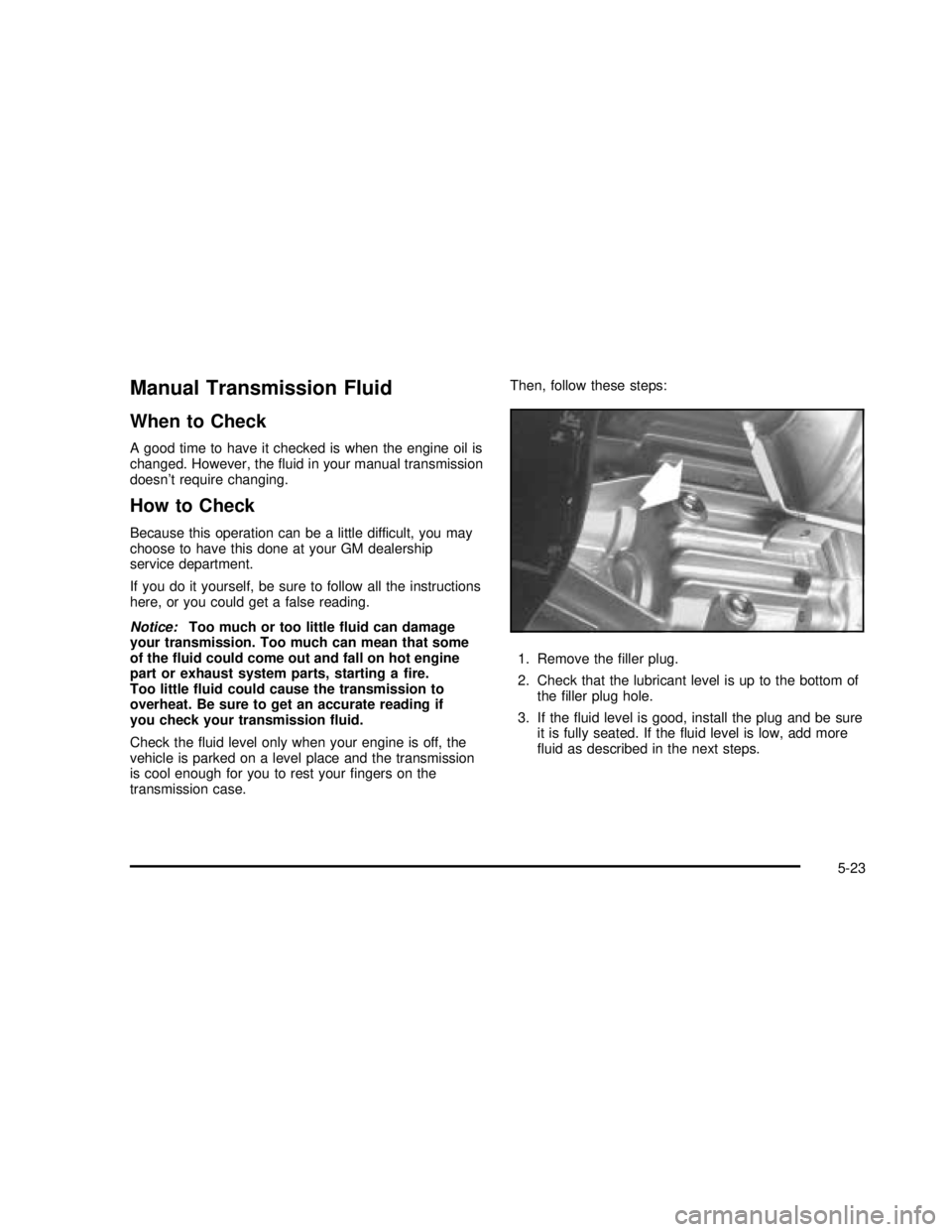
transmission case.Then, follow these steps:
1. Remove thefiller plug.
2. Check that the lubricant level is up to the bottom of
thefiller plug hole.
3. If thefluid level is good, install the plug and be sure
it is fully seated. If thefluid level is low, add more
fluid as described in the next steps.
5-23
2003 - Sonoma OM
Page 283 of 424

How to Check and Add Fluid
The properfluid should be added if the level does not
reach the bottom of the diaphragm when it’s in place
in the reservoir. See the instructions on the
reservoir cap.
Engine Coolant
The cooling system in your vehicle isfilled with
DEX-COOL®engine coolant. This coolant is designed
to remain in your vehicle for 5 years or 150,000 miles
(240 000 km), whichever occursfirst, if you add
only DEX-COOL
®extended life coolant.
The following explains your cooling system and how to
add coolant when it is low. If you have a problem
with engine overheating, seeEngine Overheating
on page 5-28.A 50/50 mixture of clean, drinkable water and
DEX-COOL
®coolant will:
•Give freezing protection down to−34°F(−37°C).
•Give boiling protection up to 265°F (129°C).
•Protect against rust and corrosion.
•Help keep the proper engine temperature.
•Let the warning lights and gages work as
they should.
Notice:When adding coolant, it is important that
you use only DEX-COOL
®(silicate-free) coolant.
If coolant other than DEX-COOL®is added to
the system, premature engine, heater core or
radiator corrosion may result. In addition, the engine
coolant will require change sooner -- at 30,000 miles
(50,000 km) or 24 months, whichever occursrst.
Damage caused by the use of coolant other
than DEX-COOL
®is not covered by your new
vehicle warranty.
5-25
2003 - Sonoma OM
Page 284 of 424

What to Use
Use a mixture of one-halfclean, drinkable waterand
one-half DEX-COOL®coolant which won’t damage
aluminum parts. If you use this coolant mixture,
you don’t need to add anything else.
{CAUTION:
Adding only plain water to your cooling
system can be dangerous. Plain water, or
some other liquid such as alcohol, can boil
before the proper coolant mixture will. Your
vehicle’s coolant warning system is set for the
proper coolant mixture. With plain water or the
wrong mixture, your engine could get too hot
but you wouldn’t get the overheat warning.
Your engine could catchre and you or others
could be burned. Use a 50/50 mixture of clean,
drinkable water and the proper coolant.
Notice:If you use an improper coolant mixture, your
engine could overheat and be badly damaged. The
repair cost wouldn’t be covered by your warranty.
Too much water in the mixture can freeze and crack
the engine, radiator, heater core and other parts.If you have to add coolant more than four times a year,
have your dealer check your cooling system.
Notice:If you use the proper coolant, you don’t
have to add extra inhibitors or additives which claim
to improve the system. These can be harmful.
Checking Coolant
The coolant recovery tank is located in the engine
compartment near the passenger side of the vehicle.
SeeEngine Compartment Overview on page 5-10
for more information on location.
5-26
2003 - Sonoma OM
Page 288 of 424
Cooling System
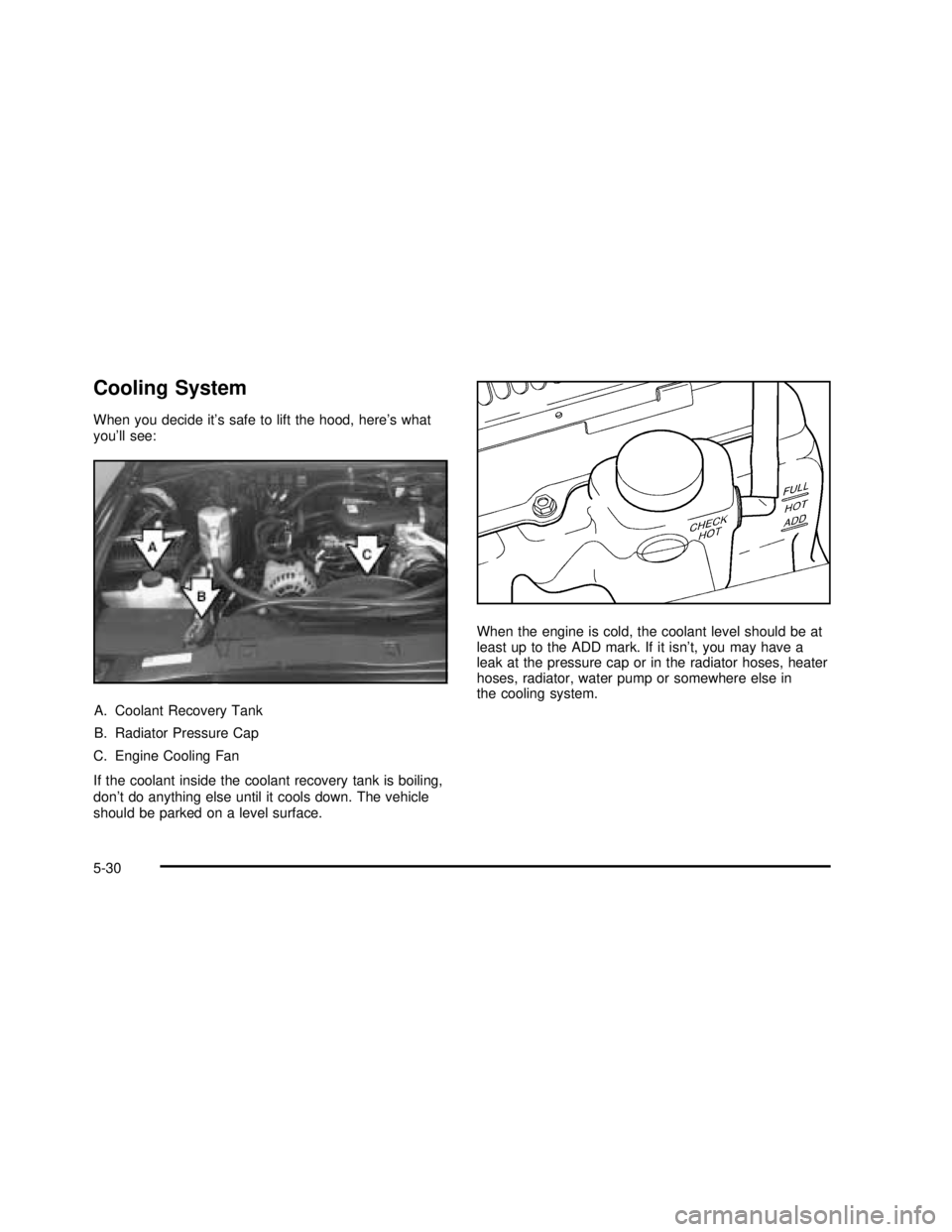
When you decide it’s safe to lift the hood, here’s what
you’ll see:
A. Coolant Recovery Tank
B. Radiator Pressure Cap
C. Engine Cooling Fan
If the coolant inside the coolant recovery tank is boiling,
don’t do anything else until it cools down. The vehicle
should be parked on a level surface.When the engine is cold, the coolant level should be at
least up to the ADD mark. If it isn’t, you may have a
leak at the pressure cap or in the radiator hoses, heater
hoses, radiator, water pump or somewhere else in
the cooling system.
5-30
2003 - Sonoma OM
Page 290 of 424
How to Add Coolant to the Coolant
Recovery Tank
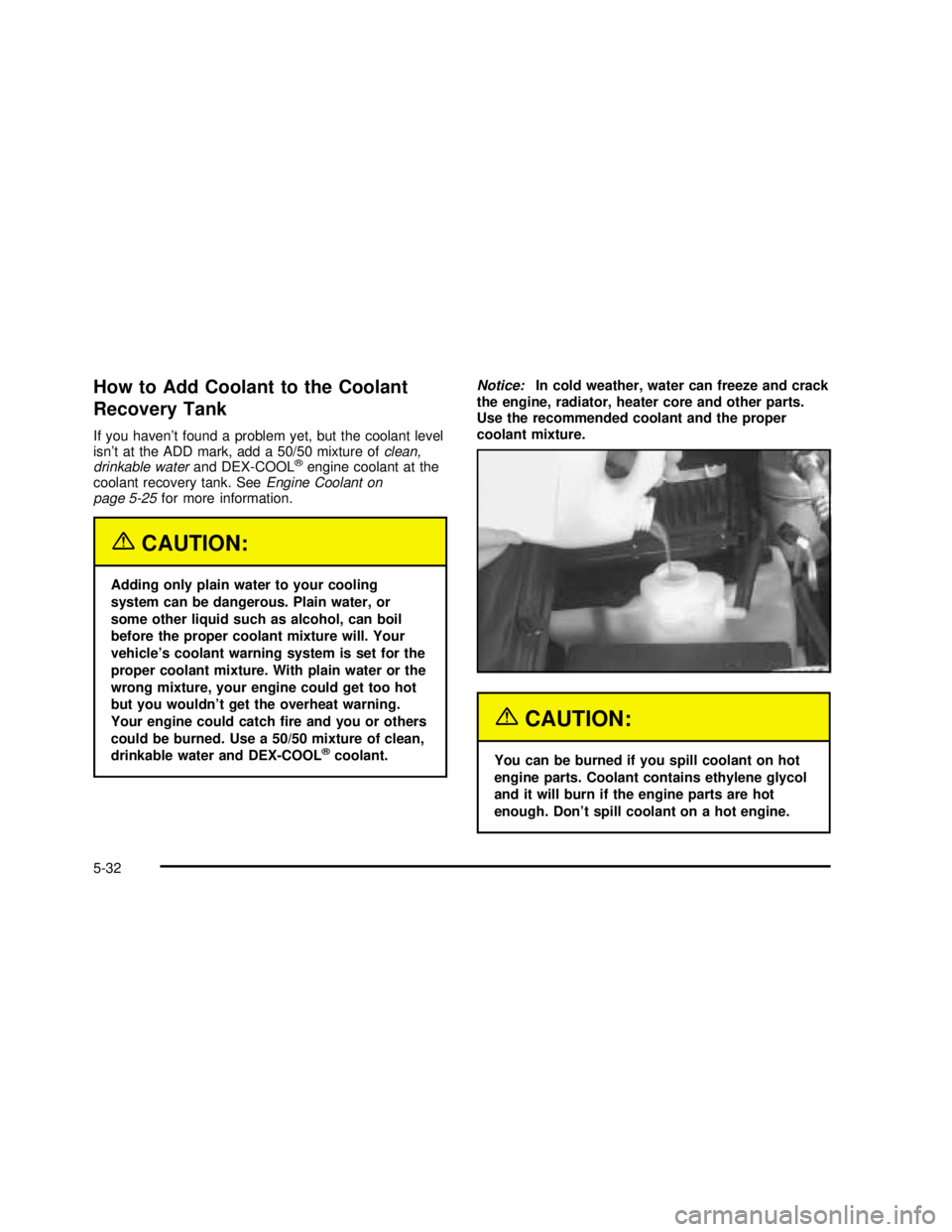
If you haven’t found a problem yet, but the coolant level
isn’t at the ADD mark, add a 50/50 mixture ofclean,
drinkable waterand DEX-COOL
®engine coolant at the
coolant recovery tank. SeeEngine Coolant on
page 5-25for more information.
{CAUTION:
Adding only plain water to your cooling
system can be dangerous. Plain water, or
some other liquid such as alcohol, can boil
before the proper coolant mixture will. Your
vehicle’s coolant warning system is set for the
proper coolant mixture. With plain water or the
wrong mixture, your engine could get too hot
but you wouldn’t get the overheat warning.
Your engine could catchre and you or others
could be burned. Use a 50/50 mixture of clean,
drinkable water and DEX-COOL
®coolant.Notice:In cold weather, water can freeze and crack
the engine, radiator, heater core and other parts.
Use the recommended coolant and the proper
coolant mixture.
{CAUTION:
You can be burned if you spill coolant on hot
engine parts. Coolant contains ethylene glycol
and it will burn if the engine parts are hot
enough. Don’t spill coolant on a hot engine.
5-32
2003 - Sonoma OM
Page 298 of 424

Checking Brake Fluid
You can check the brakefluid without taking off the cap.
Just look at the brakefluid
reservoir. Thefluid level
should be above MIN.
If it isn’t have your brake
system checked to
see if there is a leak.
After work is done on the brake hydraulic system,
make sure the level is above the MIN but not over the
MAX mark.
What to Add
When you do need brakefluid, use only DOT-3 brake
fluid. Use new brakefluid from a sealed container
only. SeePart D: Recommended Fluids and Lubricants
on page 6-33.Always clean the brakefluid reservoir cap and the area
around the cap before removing it. This will help
keep dirt from entering the reservoir.
{CAUTION:
With the wrong kind ofuid in your brake
system, your brakes may not work well, or they
may not even work at all. This could cause a
crash. Always use the proper brakeuid.
Notice:
Using the wronguid can badly damage brake
system parts. For example, just a few drops of
mineral-based oil, such as engine oil, in your
brake system can damage brake system
parts so badly that they’ll have to be replaced.
Don’t let someone put in the wrong kind ofuid.
If you spill brakeuid on your vehicle’s painted
surfaces, the paintnish can be damaged. Be
careful not to spill brakeuid on your vehicle.
If you do, wash it off immediately. See
“Appearance Care”in the Index.
5-40
2003 - Sonoma OM
Page 331 of 424
4. Raise the vehicle by turning the jack handle
clockwise. Raise the vehicle far enough off the
ground so there is enough room for the spare tire to
fit underneath the wheel well.
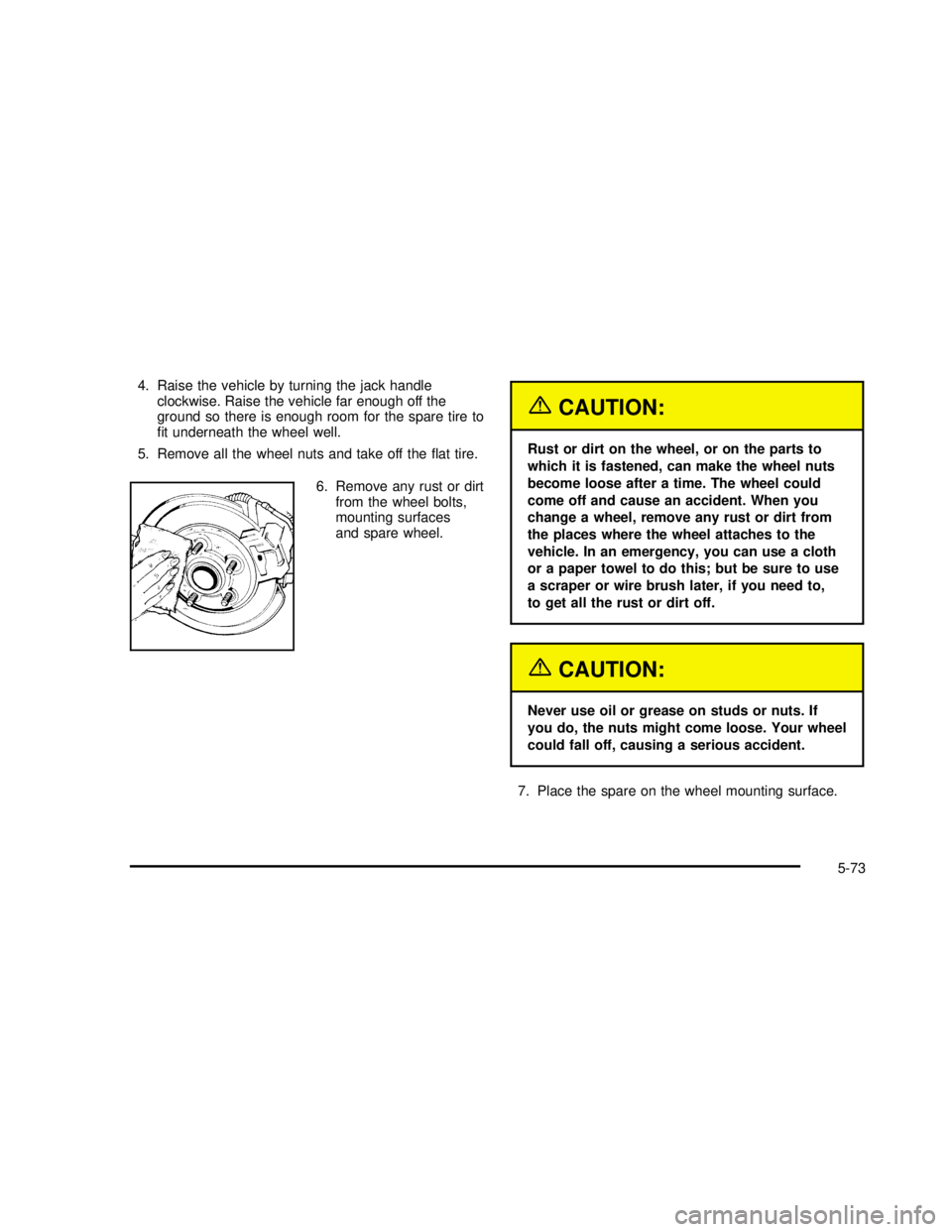
5. Remove all the wheel nuts and take off theflat tire.
6. Remove any rust or dirt
from the wheel bolts,
mounting surfaces
and spare wheel.
{CAUTION:
Rust or dirt on the wheel, or on the parts to
which it is fastened, can make the wheel nuts
become loose after a time. The wheel could
come off and cause an accident. When you
change a wheel, remove any rust or dirt from
the places where the wheel attaches to the
vehicle. In an emergency, you can use a cloth
or a paper towel to do this; but be sure to use
a scraper or wire brush later, if you need to,
to get all the rust or dirt off.
{CAUTION:
Never use oil or grease on studs or nuts. If
you do, the nuts might come loose. Your wheel
could fall off, causing a serious accident.
7. Place the spare on the wheel mounting surface.
5-73
2003 - Sonoma OM
Page 338 of 424

Using Cleaner on Fabric
1. Vacuum and brush the area to remove any
loose dirt.
2. Always clean a whole trim panel or section.
Mask surrounding trim along stitch or welt lines.
3. Follow the directions on the container label.
4. Apply cleaner with a clean sponge. Don’t saturate
the material and don’t rub it roughly.
5. As soon as you’ve cleaned the section, use a
sponge to remove any excess cleaner.
6. Wipe cleaned area with a clean, water-dampened
towel or cloth.
7. Wipe with a clean cloth and let dry.
Special Fabric Cleaning Problems
Stains caused by such things as catsup, coffee (black),
egg, fruit, fruit juice, milk, soft drinks, vomit, urine
and blood can be removed as follows:
1. Carefully scrape off excess stain, then sponge the
soiled area with cool water.
2. If a stain remains, follow the cleaner instructions
described earlier.3. If an odor lingers after cleaning vomit or urine,
treat the area with a water/baking soda solution:
1 teaspoon (5 ml) of baking sold to 1 cup (250 ml)
of lukewarm water.
4. Let dry.
Stains caused by candy, ice cream, mayonnaise, chili
sauce and unknown stains can be removed as follows:
1. Carefully scrape off excess stain.
2. First, clean with cool water and allow to dry
completely.
3. If a stain remains, follow the cleaner instructions
described earlier.
Vinyl
Use warm water and a clean cloth.
•Rub with a clean, damp cloth to remove dirt.
You may have to do this more than once.
•Things like tar, asphalt and shoe polish will stain if
you don’t get them off quickly. Use a clean cloth
and vinyl/leather cleaner. See your dealer for
this product.
5-80
2003 - Sonoma OM
Page 339 of 424

Leather
Use a soft cloth with lukewarm water and a mild soap or
saddle soap and wipe dry with a soft cloth. Then, let
the leather dry naturally. Do not use heat to dry.
•For stubborn stains, use a leather cleaner. See your
dealer for this product.
•Neveruse oils, varnishes, solvent-based or abrasive
cleaners, furniture polish or shoe polish on leather.
•Soiled or stained leather should be cleaned
immediately. If dirt is allowed to work into thefinish,
it can harm the leather.
Top of the Instrument Panel
Use only mild soap and water to clean the top surfaces
of the instrument panel. Sprays containing silicones
or waxes may cause annoying reflections in the
windshield and even make it difficult to see through the
windshield under certain conditions.
Interior Plastic Components
Use only a mild soap and water solution on a soft cloth
or sponge. Commercial cleaners may affect the
surfacefinish.
Wood Panels
Use a clean cloth moistened in warm, soapy water
(use mild dish washing soap). Dry the wood immediately
with a clean cloth.
Glass Surfaces
Glass should be cleaned often. GM Glass Cleaner or a
liquid household glass cleaner will remove normal
tobacco smoke and dustfilms on interior glass. See
GM Vehicle Care/Appearance Materials on page 5-86.
Notice:Don’t use abrasive cleaners on glass,
because they may cause scratches. Avoid placing
decals on the inside rear window, since they
may have to be scraped off later. If abrasive cleaners
are used on the inside of the rear window, an
electric defogger element may be damaged. Any
temporary license should not be attached across
the defogger grid.
5-81
2003 - Sonoma OM