fuel line GMC SONOMA 2004 User Guide
[x] Cancel search | Manufacturer: GMC, Model Year: 2004, Model line: SONOMA, Model: GMC SONOMA 2004Pages: 412, PDF Size: 4.16 MB
Page 336 of 412
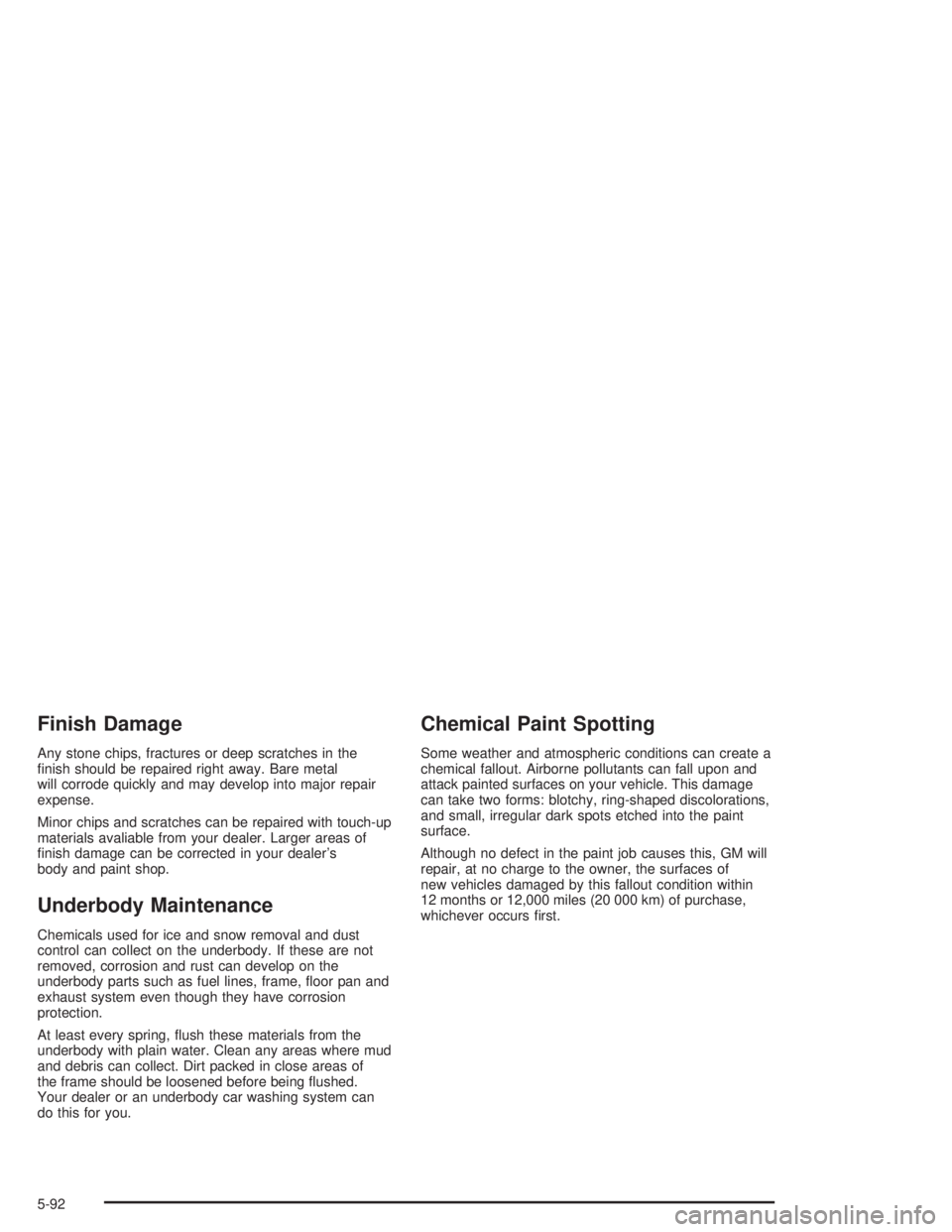
Finish Damage
Any stone chips, fractures or deep scratches in the
finish should be repaired right away. Bare metal
will corrode quickly and may develop into major repair
expense.
Minor chips and scratches can be repaired with touch-up
materials avaliable from your dealer. Larger areas of
finish damage can be corrected in your dealer’s
body and paint shop.
Underbody Maintenance
Chemicals used for ice and snow removal and dust
control can collect on the underbody. If these are not
removed, corrosion and rust can develop on the
underbody parts such as fuel lines, frame, floor pan and
exhaust system even though they have corrosion
protection.
At least every spring, flush these materials from the
underbody with plain water. Clean any areas where mud
and debris can collect. Dirt packed in close areas of
the frame should be loosened before being flushed.
Your dealer or an underbody car washing system can
do this for you.
Chemical Paint Spotting
Some weather and atmospheric conditions can create a
chemical fallout. Airborne pollutants can fall upon and
attack painted surfaces on your vehicle. This damage
can take two forms: blotchy, ring-shaped discolorations,
and small, irregular dark spots etched into the paint
surface.
Although no defect in the paint job causes this, GM will
repair, at no charge to the owner, the surfaces of
new vehicles damaged by this fallout condition within
12 months or 12,000 miles (20 000 km) of purchase,
whichever occurs first.
5-92
Page 350 of 412
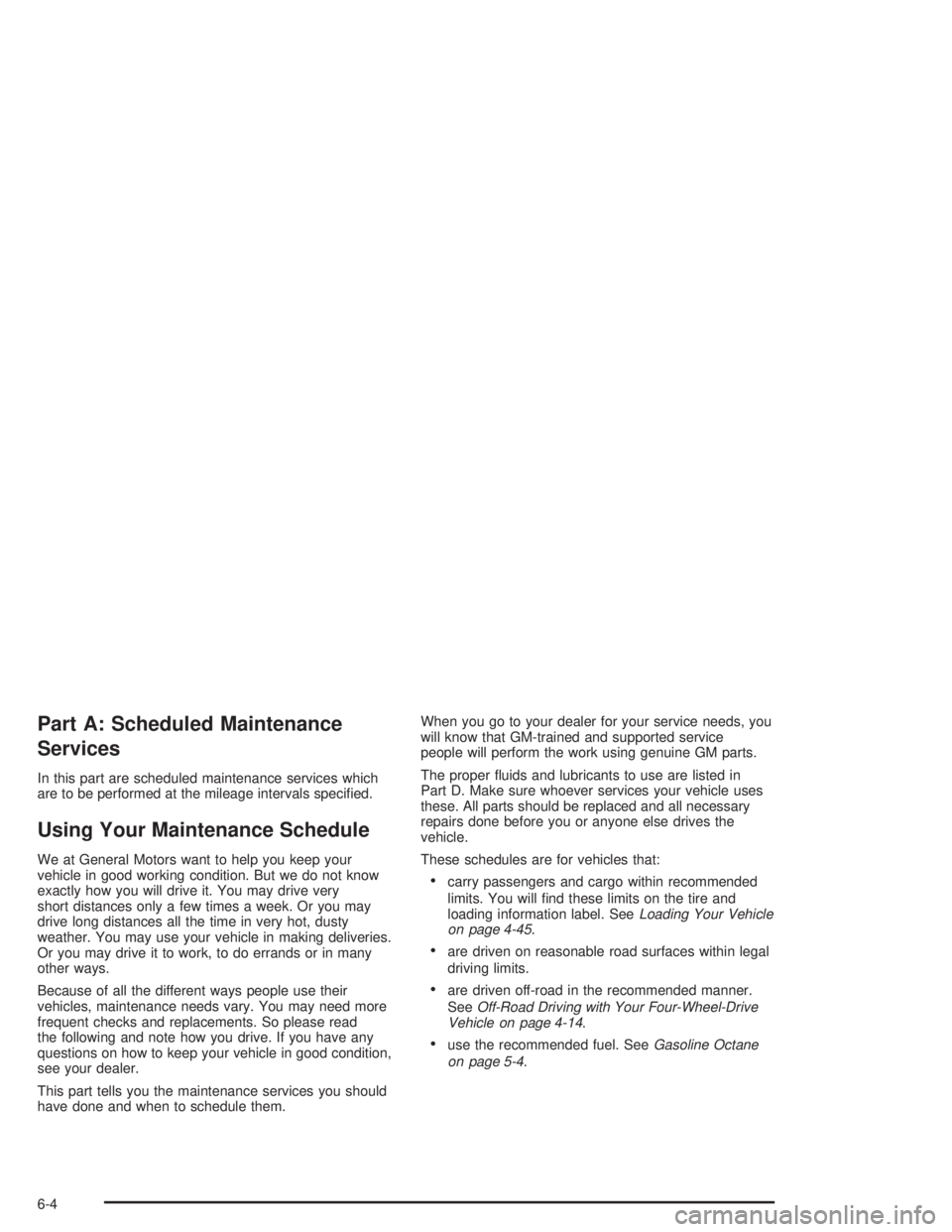
Part A: Scheduled Maintenance
Services
In this part are scheduled maintenance services which
are to be performed at the mileage intervals specified.
Using Your Maintenance Schedule
We at General Motors want to help you keep your
vehicle in good working condition. But we do not know
exactly how you will drive it. You may drive very
short distances only a few times a week. Or you may
drive long distances all the time in very hot, dusty
weather. You may use your vehicle in making deliveries.
Or you may drive it to work, to do errands or in many
other ways.
Because of all the different ways people use their
vehicles, maintenance needs vary. You may need more
frequent checks and replacements. So please read
the following and note how you drive. If you have any
questions on how to keep your vehicle in good condition,
see your dealer.
This part tells you the maintenance services you should
have done and when to schedule them.When you go to your dealer for your service needs, you
will know that GM-trained and supported service
people will perform the work using genuine GM parts.
The proper fluids and lubricants to use are listed in
Part D. Make sure whoever services your vehicle uses
these. All parts should be replaced and all necessary
repairs done before you or anyone else drives the
vehicle.
These schedules are for vehicles that:
•carry passengers and cargo within recommended
limits. You will find these limits on the tire and
loading information label. SeeLoading Your Vehicle
on page 4-45.
•are driven on reasonable road surfaces within legal
driving limits.
•are driven off-road in the recommended manner.
SeeOff-Road Driving with Your Four-Wheel-Drive
Vehicle on page 4-14.
•use the recommended fuel. SeeGasoline Octane
on page 5-4.
6-4
Page 376 of 412
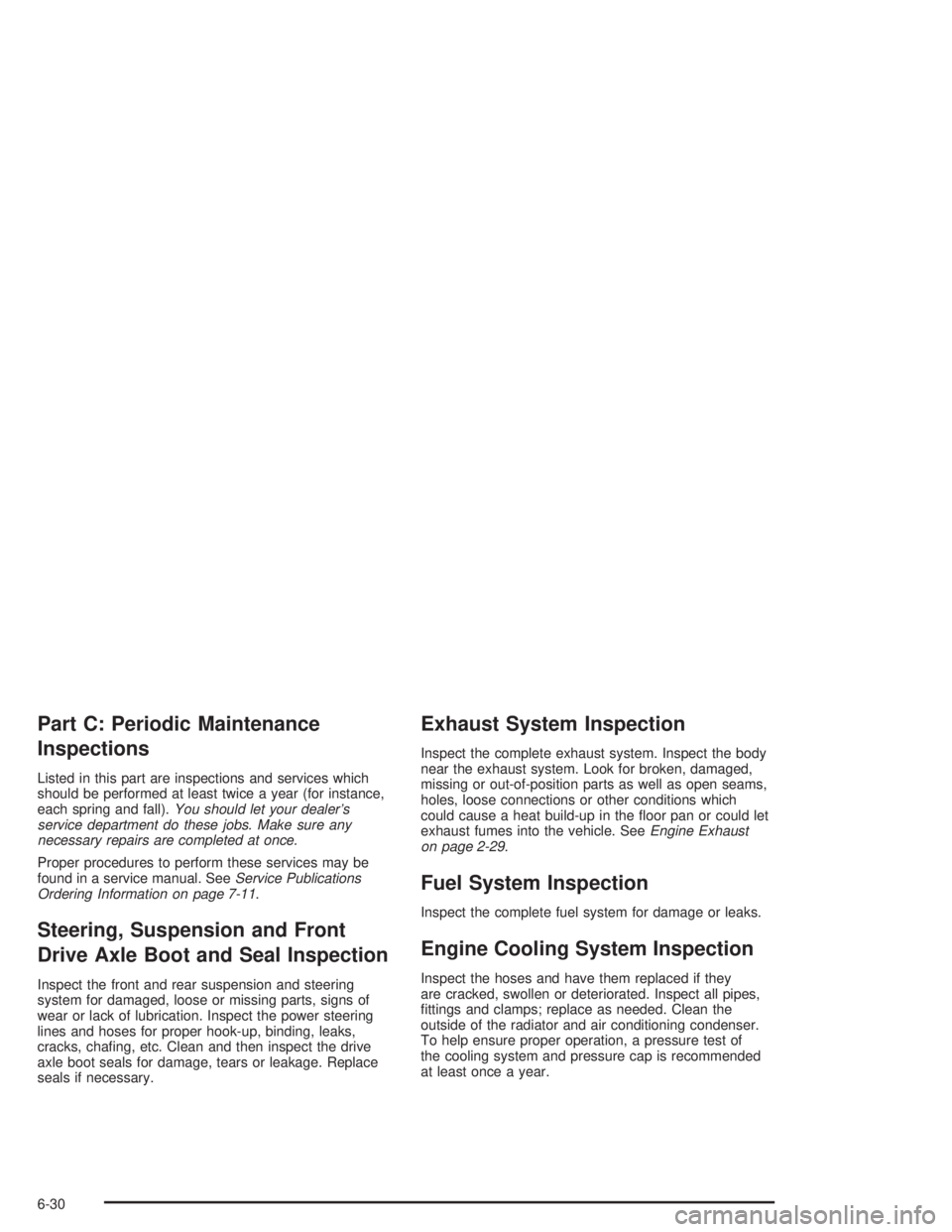
Part C: Periodic Maintenance
Inspections
Listed in this part are inspections and services which
should be performed at least twice a year (for instance,
each spring and fall).You should let your dealer’s
service department do these jobs. Make sure any
necessary repairs are completed at once.
Proper procedures to perform these services may be
found in a service manual. SeeService Publications
Ordering Information on page 7-11.
Steering, Suspension and Front
Drive Axle Boot and Seal Inspection
Inspect the front and rear suspension and steering
system for damaged, loose or missing parts, signs of
wear or lack of lubrication. Inspect the power steering
lines and hoses for proper hook-up, binding, leaks,
cracks, chafing, etc. Clean and then inspect the drive
axle boot seals for damage, tears or leakage. Replace
seals if necessary.
Exhaust System Inspection
Inspect the complete exhaust system. Inspect the body
near the exhaust system. Look for broken, damaged,
missing or out-of-position parts as well as open seams,
holes, loose connections or other conditions which
could cause a heat build-up in the floor pan or could let
exhaust fumes into the vehicle. SeeEngine Exhaust
on page 2-29.
Fuel System Inspection
Inspect the complete fuel system for damage or leaks.
Engine Cooling System Inspection
Inspect the hoses and have them replaced if they
are cracked, swollen or deteriorated. Inspect all pipes,
fittings and clamps; replace as needed. Clean the
outside of the radiator and air conditioning condenser.
To help ensure proper operation, a pressure test of
the cooling system and pressure cap is recommended
at least once a year.
6-30
Page 379 of 412
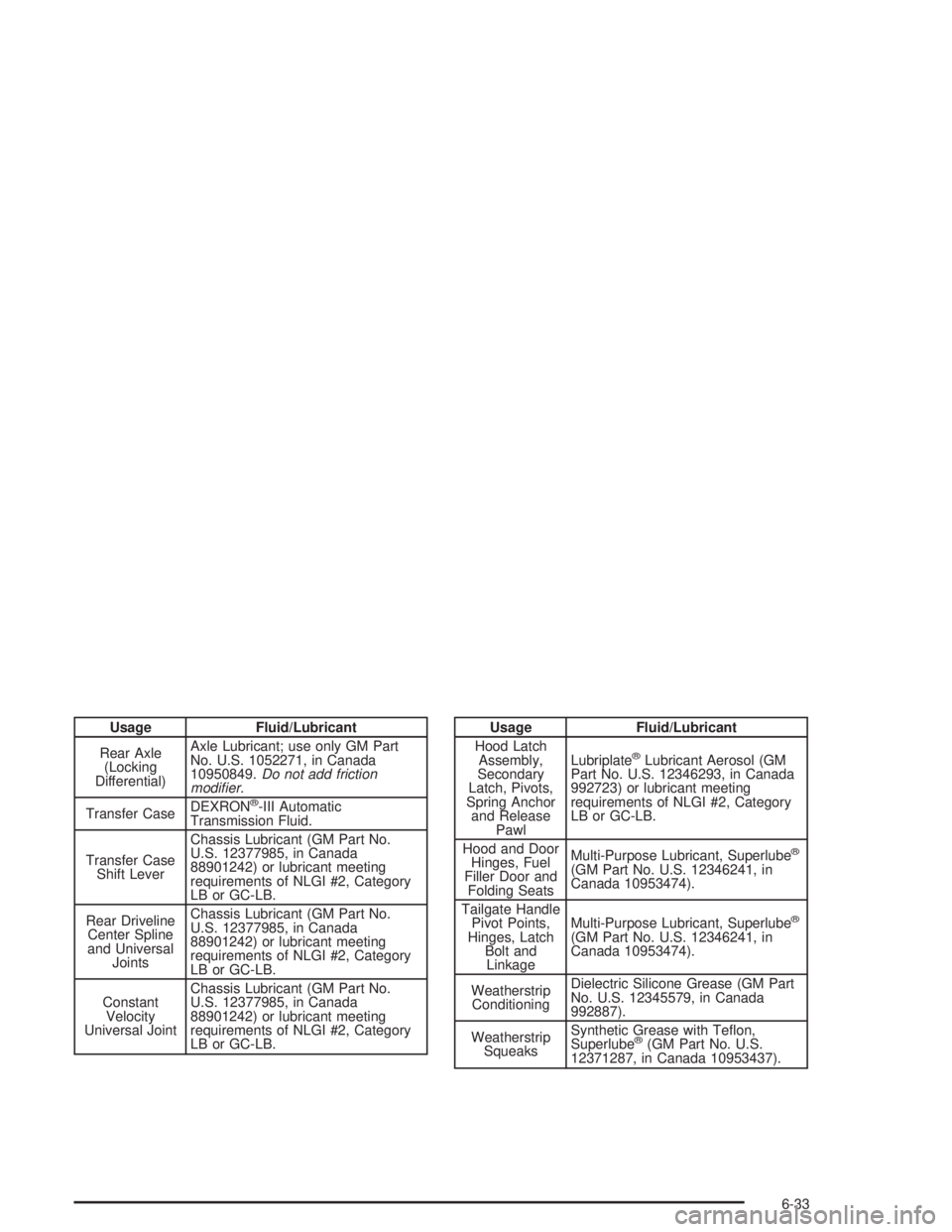
Usage Fluid/Lubricant
Rear Axle
(Locking
Differential)Axle Lubricant; use only GM Part
No. U.S. 1052271, in Canada
10950849.Do not add friction
modier.
Transfer CaseDEXRON
®-III Automatic
Transmission Fluid.
Transfer Case
Shift LeverChassis Lubricant (GM Part No.
U.S. 12377985, in Canada
88901242) or lubricant meeting
requirements of NLGI #2, Category
LB or GC-LB.
Rear Driveline
Center Spline
and Universal
JointsChassis Lubricant (GM Part No.
U.S. 12377985, in Canada
88901242) or lubricant meeting
requirements of NLGI #2, Category
LB or GC-LB.
Constant
Velocity
Universal JointChassis Lubricant (GM Part No.
U.S. 12377985, in Canada
88901242) or lubricant meeting
requirements of NLGI #2, Category
LB or GC-LB.
Usage Fluid/Lubricant
Hood Latch
Assembly,
Secondary
Latch, Pivots,
Spring Anchor
and Release
PawlLubriplate
®Lubricant Aerosol (GM
Part No. U.S. 12346293, in Canada
992723) or lubricant meeting
requirements of NLGI #2, Category
LB or GC-LB.
Hood and Door
Hinges, Fuel
Filler Door and
Folding SeatsMulti-Purpose Lubricant, Superlube
®
(GM Part No. U.S. 12346241, in
Canada 10953474).
Tailgate Handle
Pivot Points,
Hinges, Latch
Bolt and
LinkageMulti-Purpose Lubricant, Superlube
®
(GM Part No. U.S. 12346241, in
Canada 10953474).
Weatherstrip
ConditioningDielectric Silicone Grease (GM Part
No. U.S. 12345579, in Canada
992887).
Weatherstrip
SqueaksSynthetic Grease with Teflon,
Superlube
®(GM Part No. U.S.
12371287, in Canada 10953437).
6-33
Page 402 of 412
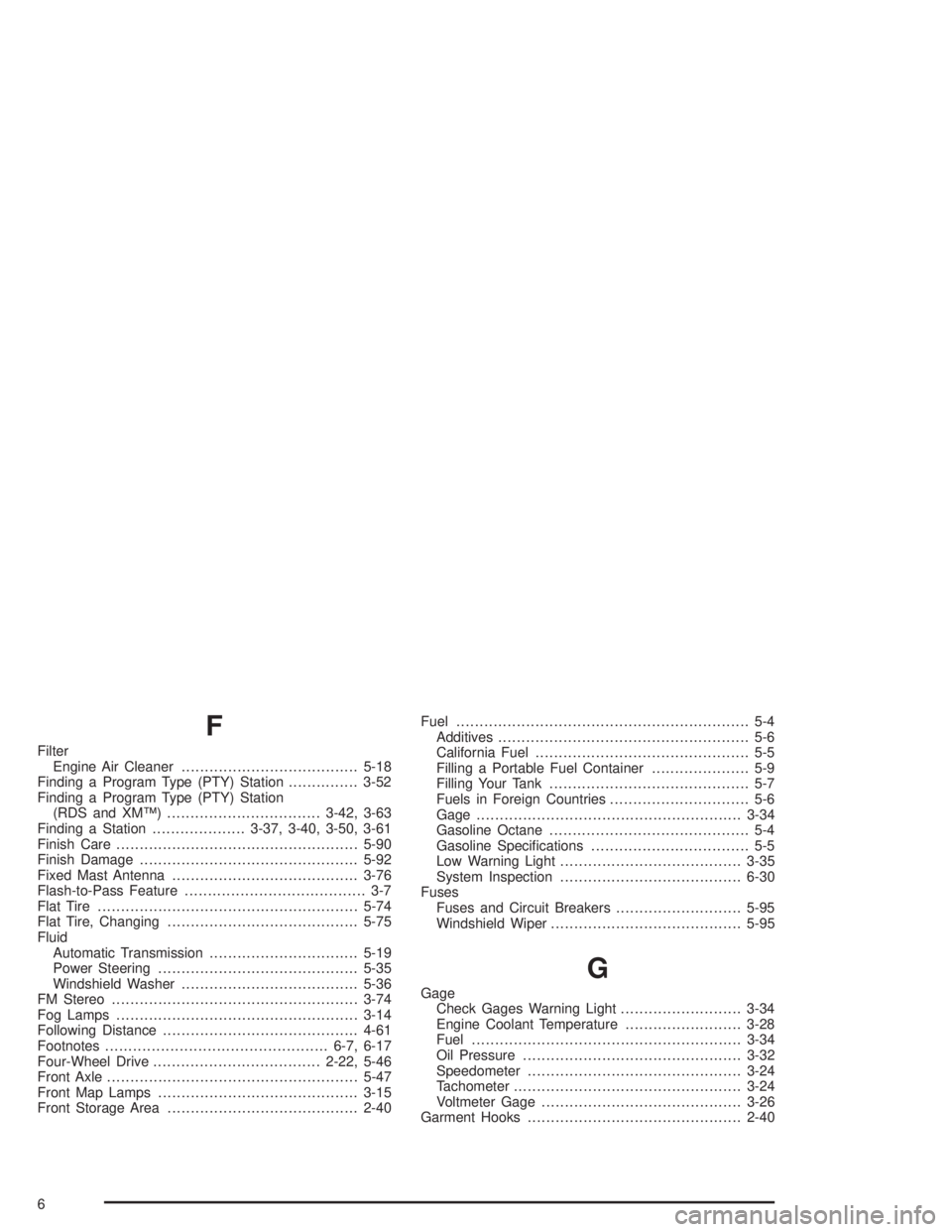
F
Filter
Engine Air Cleaner......................................5-18
Finding a Program Type (PTY) Station...............3-52
Finding a Program Type (PTY) Station
(RDS and XM™).................................3-42, 3-63
Finding a Station....................3-37, 3-40, 3-50, 3-61
Finish Care....................................................5-90
Finish Damage...............................................5-92
Fixed Mast Antenna........................................3-76
Flash-to-Pass Feature....................................... 3-7
Flat Tire........................................................5-74
Flat Tire, Changing.........................................5-75
Fluid
Automatic Transmission................................5-19
Power Steering...........................................5-35
Windshield Washer......................................5-36
FM Stereo.....................................................3-74
Fog Lamps....................................................3-14
Following Distance..........................................4-61
Footnotes................................................6-7, 6-17
Four-Wheel Drive....................................2-22, 5-46
Front Axle......................................................5-47
Front Map Lamps...........................................3-15
Front Storage Area.........................................2-40Fuel............................................................... 5-4
Additives...................................................... 5-6
California Fuel.............................................. 5-5
Filling a Portable Fuel Container..................... 5-9
Filling Your Tank........................................... 5-7
Fuels in Foreign Countries.............................. 5-6
Gage.........................................................3-34
Gasoline Octane........................................... 5-4
Gasoline Specifications.................................. 5-5
Low Warning Light.......................................3-35
System Inspection.......................................6-30
Fuses
Fuses and Circuit Breakers...........................5-95
Windshield Wiper.........................................5-95
G
Gage
Check Gages Warning Light..........................3-34
Engine Coolant Temperature.........................3-28
Fuel..........................................................3-34
Oil Pressure...............................................3-32
Speedometer..............................................3-24
Tachometer.................................................3-24
Voltmeter Gage...........................................3-26
Garment Hooks..............................................2-40
6