brakes GMC SONOMA 2004 Owner's Guide
[x] Cancel search | Manufacturer: GMC, Model Year: 2004, Model line: SONOMA, Model: GMC SONOMA 2004Pages: 412, PDF Size: 4.16 MB
Page 284 of 412
Brake Adjustment
Every time you make a brake stop, your disc brakes
adjust for wear.
If you do not have four-wheel drive and your brake
pedal goes down farther than normal, your rear drum
brakes may need adjustment. Adjust them by backing up
and firmly applying the brakes a few times.
Replacing Brake System Parts
The braking system on a vehicle is complex. Its many
parts have to be of top quality and work well together if
the vehicle is to have really good braking. Your
vehicle was designed and tested with top-quality GM
brake parts. When you replace parts of your braking
system — for example, when your brake linings
wear down and you need new ones put in — be sure
you get new approved GM replacement parts. If you do
not, your brakes may no longer work properly. For
example, if someone puts in brake linings that are wrong
for your vehicle, the balance between your front and
rear brakes can change — for the worse. The braking
performance you have come to expect can change
in many other ways if someone puts in the wrong
replacement brake parts.
Battery
Your new vehicle comes with a maintenance free
ACDelco®battery. When it is time for a new battery, get
one that has the replacement number shown on the
original battery’s label. We recommend an ACDelco
®
battery. SeeEngine Compartment Overview on
page 5-12for battery location.
Warning:Battery posts, terminals and related
accessories contain lead and lead compounds,
chemicals known to the State of California to cause
cancer and reproductive harm. Wash hands after
handling.
5-40
Page 308 of 412
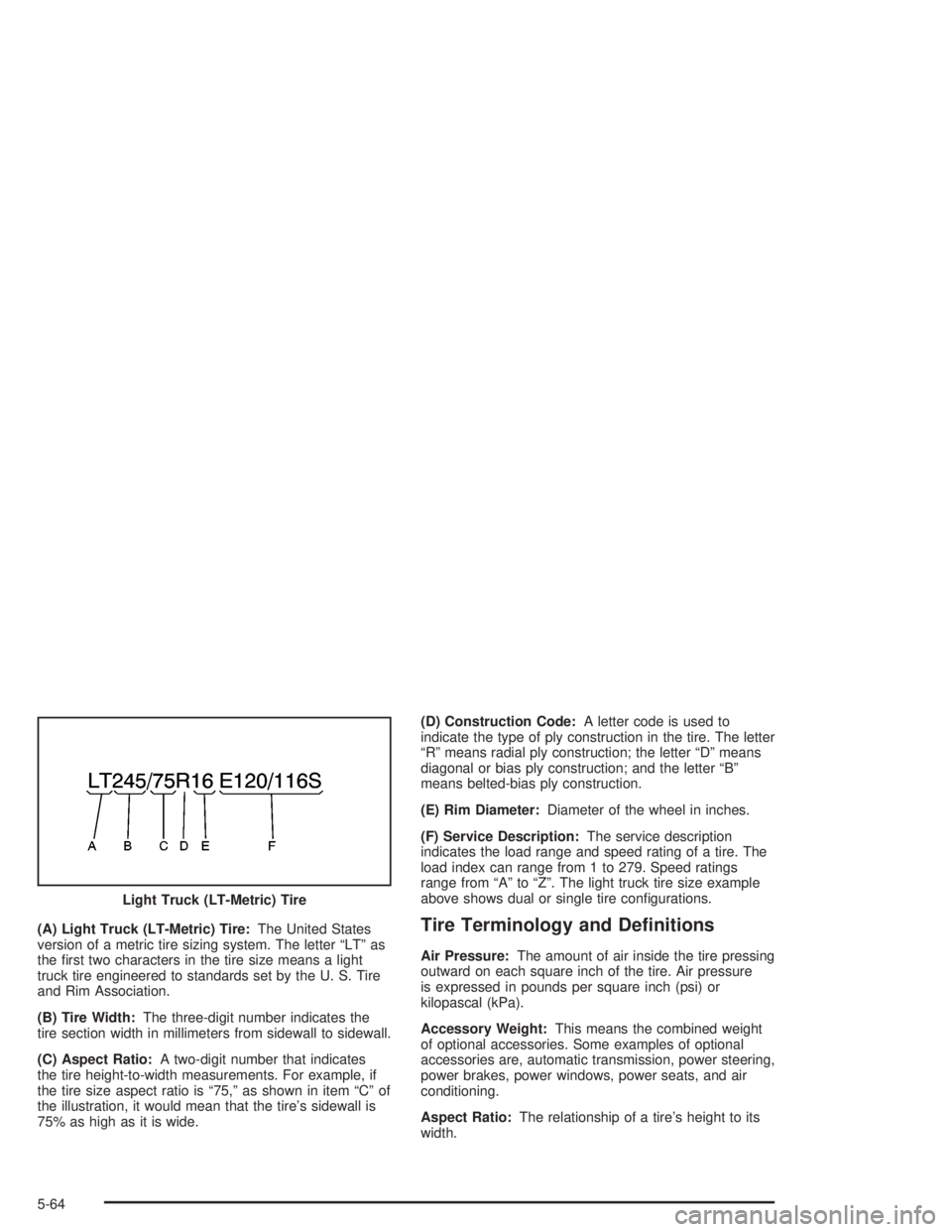
(A) Light Truck (LT-Metric) Tire:The United States
version of a metric tire sizing system. The letter “LT” as
the first two characters in the tire size means a light
truck tire engineered to standards set by the U. S. Tire
and Rim Association.
(B) Tire Width:The three-digit number indicates the
tire section width in millimeters from sidewall to sidewall.
(C) Aspect Ratio:A two-digit number that indicates
the tire height-to-width measurements. For example, if
the tire size aspect ratio is “75,” as shown in item “C” of
the illustration, it would mean that the tire’s sidewall is
75% as high as it is wide.(D) Construction Code:A letter code is used to
indicate the type of ply construction in the tire. The letter
“R” means radial ply construction; the letter “D” means
diagonal or bias ply construction; and the letter “B”
means belted-bias ply construction.
(E) Rim Diameter:Diameter of the wheel in inches.
(F) Service Description:The service description
indicates the load range and speed rating of a tire. The
load index can range from 1 to 279. Speed ratings
range from “A” to “Z”. The light truck tire size example
above shows dual or single tire configurations.Tire Terminology and Denitions
Air Pressure:The amount of air inside the tire pressing
outward on each square inch of the tire. Air pressure
is expressed in pounds per square inch (psi) or
kilopascal (kPa).
Accessory Weight:This means the combined weight
of optional accessories. Some examples of optional
accessories are, automatic transmission, power steering,
power brakes, power windows, power seats, and air
conditioning.
Aspect Ratio:The relationship of a tire’s height to its
width. Light Truck (LT-Metric) Tire
5-64
Page 318 of 412
Tire Chains
{CAUTION:
Don’t use tire chains. There’s not enough
clearance. Tire chains used on a vehicle without
the proper amount of clearance can cause
damage to the brakes, suspension or other
vehicle parts. The area damaged by the tire
chains could cause you to lose control of your
vehicle and you or others may be injured in a
crash. Use another type of traction device only
if its manufacturer recommends it for use on
your vehicle and tire size combination and road
conditions. Follow that manufacturer’s
instructions. To help avoid damage to your
vehicle, drive slowly, readjust or remove the
device if it’s contacting your vehicle, and don’t
spin your wheels. If you do nd traction devices
that will t, install them on the rear tires.
If a Tire Goes Flat
It’s unusual for a tire to “blowout” while you’re driving,
especially if you maintain your tires properly. If air goes
out of a tire, it’s much more likely to leak out slowly.
But if you should ever have a “blowout,” here are a few
tips about what to expect and what to do:
If a front tire fails, the flat tire will create a drag that
pulls the vehicle toward that side. Take your foot off the
accelerator pedal and grip the steering wheel firmly.
Steer to maintain lane position, and then gently brake to
a stop well out of the traffic lane.
A rear blowout, particularly on a curve, acts much like a
skid and may require the same correction you’d use
in a skid. In any rear blowout, remove your foot from the
accelerator pedal. Get the vehicle under control by
steering the way you want the vehicle to go. It may be
very bumpy and noisy, but you can still steer. Gently
brake to a stop, well off the road if possible.
5-74
Page 341 of 412
Fuse Usage
4 Gages, Body Control Module,
Instrument Panel Cluster
5 Parking Lamps, Power Window
Switch, Body Control Module,
Ashtray Lamp
6 Steering Wheel Radio Controls
7 Headlamps Switch, Body Control
Module, Headlamp Relay
8 Courtesy Lamps, Battery Run-Down
Protection
9 Heating, Ventilation, Air Cooling
Control Head (Manual)
10 Turn Signal
11 Cluster, Engine Control Module
12 Interior Lights
13 Auxiliary Power
14 Power Locks MotorFuse Usage
15 4WD Switch, Engine Controls (VCM,
PCM, Transmission)
16 Supplemental Inflatable Restraint
17 Front Wiper
18 Steering Wheel Radio Controls
19 Radio, Battery
20 Amplifier
21 Heating, Ventilation, Air Cooling
(Manual), Heating,Ventilation, Air
Cooling (Automatic), Heating,
Ventilation, Air Cooling Sensors
(Automatic)
22 Anti-Lock Brakes
23 Rear Wiper
24 Radio, Ignition
5-97
Page 353 of 412
Footnotes
†The U.S. Environmental Protection Agency or the
California Air Resources Board has determined that the
failure to perform this maintenance item will not nullify
the emission warranty or limit recall liability prior to
the completion of the vehicle’s useful life. We, however,
urge that all recommended maintenance services be
performed at the indicated intervals and the
maintenance be recorded.
#Lubricate the front suspension, ball joints, steering
linkage, parking brake cable guides, propshaft splines,
universal joints, constant velocity joint and brake
pedal springs.
+A good time to check your brakes is during tire
rotation. See Brake System Inspection on page 6-31.
**Drive axle service. See Part D: Recommended
Fluids and Lubricants on page 6-32 for proper lubricant
to use:
•Check uid level and add uid as needed. If driving
in dusty areas or when towing a trailer, drain uid
and rell every 15,000 miles (25 000 km).
•If your vehicle has a locking differential, drain uid
and rell at rst engine oil change.
•More frequent lubrication may be required for
heavy-duty or off-road use.
3,000 Miles (5 000 km)
❑Change engine oil and filter (or every 3 months,
whichever occurs first).An Emission Control Service.
❑Lubricate chassis components (or every 3 months,
whichever occurs first).(See footnote #.)
❑Check rear/front axle fluid level and add fluid as
needed. Check constant velocity joints and axle seals
for leaking.(See footnote **.)
6,000 Miles (10 000 km)
❑Change engine oil and filter (or every 3 months,
whichever occurs first).An Emission Control Service.
❑Lubricate chassis components (or every 3 months,
whichever occurs first).(See footnote #.)
❑Check rear/front axle fluid level and add fluid as
needed. Check constant velocity joints and axle seals
for leaking.(See Footnote **.)
❑Rotate tires. SeeTire Inspection and Rotation on
page 5-68for proper rotation pattern and additional
information.(See footnote +.)
6-7
Page 364 of 412
+A good time to check your brakes is during tire
rotation. See Brake System Inspection on page 6-31.
**Drive axle service. See Part D: Recommended Fluids
and Lubricants on page 6-32 for proper lubricant to
use:
❑Check uid level and add uid as needed.
❑If your vehicle has a locking differential, drain uid
and rell at rst engine oil change.
7,500 Miles (12 500 km)
❑Change engine oil and filter (or every 12 months,
whichever occurs first).An Emission Control
Service.
❑Lubricate chassis components (or every 12 months,
whichever occurs first).(See footnote #.)
❑Check rear/front axle fluid level and add fluid as
needed. Check constant velocity joints and axle seals
for leaking.(See footnote **.)
❑Rotate tires. SeeTire Inspection and Rotation on
page 5-68for proper rotation pattern and additional
information.(See footnote +.)
15,000 Miles (25 000 km)
❑Change engine oil and filter (or every 12 months,
whichever occurs first).An Emission Control
Service.❑Lubricate chassis components (or every 12 months,
whichever occurs first).(See footnote #.)
❑Inspect engine air cleaner filter. SeeEngine Air
Cleaner/Filter on page 5-18for more information.An
Emission Control Service. (See footnote †.)
❑Check rear/front axle fluid level and add fluid as
needed. Check constant velocity joints and axle seals
for leaking.(See footnote **.)
❑Change automatic transmission fluid and filter if the
vehicle is mainly driven under one or more of these
conditions:
- In heavy city traffic where the outside
temperature regularly reaches 90°F (32°C) or
higher.
- In hilly or mountainous terrain.
- When doing frequent trailer towing.
- Uses such as found in taxi, police or delivery
service.
If you do not use your vehicle under any of these
conditions, change the uid and lter every 50,000 miles
(83 000 km).
❑Rotate tires. SeeTire Inspection and Rotation on
page 5-68for proper rotation pattern and additional
information.(See footnote +.)
6-18
Page 377 of 412
Throttle System Inspection
Inspect the throttle system for interference or binding,
and for damaged or missing parts. Replace parts
as needed. Replace any components that have high
effort or excessive wear. Do not lubricate accelerator
and cruise control cables.
Transfer Case and Front Axle
(Four-Wheel Drive) Inspection
Every 12 months or at engine oil change intervals,
check front axle and transfer case and add lubricant
when necessary. A fluid loss could indicate a problem;
check and have it repaired, if needed. Check vent hose at
transfer case for kinks and proper installation. More
frequent lubrication may be required on off-road use.
Brake System Inspection
Inspect the complete system. Inspect brake lines and
hoses for proper hook-up, binding, leaks, cracks,
chafing, etc. Inspect disc brake pads for wear and rotors
for surface condition. Inspect other brake parts,
including calipers, parking brake, etc. Check parking
brake adjustment. You may need to have your brakes
inspected more often if your driving habits or
conditions result in frequent braking.
6-31
Page 395 of 412
To contact NHTSA, you may either call the Auto Safety
Hotline toll-free at 1-800-424-9393 (or 366-0123 in
the Washington, D.C. area) or write to:
NHTSA, U.S. Department of Transportation
Washington, D.C. 20590
You can also obtain other information about motor
vehicle safety from the hotline.
Reporting Safety Defects to the
Canadian Government
If you live in Canada, and you believe that your vehicle
has a safety defect, you should immediately notify
Transport Canada, in addition to notifying General
Motors of Canada Limited. You may write to:
Transport Canada
330 Sparks Street
Tower C
Ottawa, Ontario K1A 0N5
Reporting Safety Defects to General
Motors
In addition to notifying NHTSA (or Transport Canada) in
a situation like this, we certainly hope you’ll notify us.
Please call us at 1-800-GMC-8782 (1-800-462-8782), or
write:
Pontiac-GMC Customer Assistance Center
P.O. Box 33172
Detroit, MI 48232-5172
In Canada, please call us at 1-800-263-3777 (English)
or 1-800-263-7854 (French). Or, write:
General Motors of Canada Limited
Customer Communication Centre, 163-005
1908 Colonel Sam Drive
Oshawa, Ontario L1H 8P7
Service Publications Ordering
Information
Service Manuals
Service Manuals have the diagnosis and repair
information on engines, transmission, axle, suspension,
brakes, electrical, steering, body, etc.
RETAIL SELL PRICE: $120.00
7-11
Page 398 of 412
Audio System(s) (cont.)
Fixed Mast Antenna.....................................3-76
Radio with Cassette and CD.........................3-49
Radio with CD............................................3-39
Radio with Six-Disc CD................................3-59
Setting the Time for Radios with Radio
Data Systems (RDS)................................3-36
Setting the Time for Radios without Radio
Data Systems (RDS)................................3-35
Theft-Deterrent Feature................................3-73
Understanding Radio Reception.....................3-74
XM™ Satellite Radio Antenna System............3-76
Automatic Headlamp System............................3-12
Automatic Transmission
Fluid..........................................................5-19
Operation...................................................2-20
Automatic Transmission Check..........................6-26
Automatic Transmission Shift Lock Control
System Check.............................................6-28
B
Backing Up....................................................4-61
Battery..........................................................5-40
Battery Replacement......................................... 2-6Battery Rundown Protection.............................3-16
Bed Rails......................................................2-41
Before Leaving on a Long Trip.........................4-34
Before You Go Off-Roading..............................4-14
Body Lubrication Service..................................6-27
Brake
Parking......................................................2-25
System Inspection.......................................6-31
System Warning Light..................................3-27
Brake Adjustment............................................5-40
Brake Fluid....................................................5-37
Brake Pedal Travel.........................................5-39
Brake Wear...................................................5-39
Brakes..........................................................5-37
Braking........................................................... 4-6
Braking in Emergencies..................................... 4-8
Break-In, New Vehicle.....................................2-16
Bulb Replacement...........................................5-48
Center High-Mounted Stoplamp (CHMSL)........5-52
Halogen Bulbs............................................5-48
Headlamps.................................................5-49
One-Piece Front Turn Signal Lamps...............5-51
Replacement Bulbs......................................5-54
Taillamps....................................................5-53
Two-Piece Front Turn Signal Lamps...............5-51
Buying New Tires...........................................5-70
2
Page 411 of 412
Total Weight on Your Vehicle’s Tires..................4-58
Towing
Recreational Vehicle.....................................4-45
Towing a Trailer..........................................4-55
Your Vehicle...............................................4-45
Trailer
Recommendations.......................................4-54
Trailer Brakes.................................................4-60
Transfer Case........................................2-23, 5-46
Transfer Case and Front Axle
(Four-Wheel Drive) Inspection.......................6-31
Transmission
Fluid, Automatic...........................................5-19
Transmission Operation, Automatic....................2-20
Transmission, Transaxle, Transfer Case Unit
Repair Manual............................................7-12
Transportation Options...................................... 7-8
Traveling to Remote Areas...............................4-16
Trip Odometer................................................3-24
Truck-Camper Loading Information....................4-52
Turn and Lane-Change Signals.......................... 3-6
Turn Signal/Multifunction Lever........................... 3-6
Turn Signals When Towing a Trailer..................4-61
Two-Piece Composite Headlamp System............5-50
Two-Tiered Loading.........................................4-51U
Underbody Flushing Service.............................6-29
Understanding Radio Reception........................3-74
Uniform Tire Quality Grading............................5-71
United States................................................... 7-4
Used Replacement Wheels..............................5-73
Using Cleaner on Fabric..................................5-87
Using Song List Mode.....................................3-71
Using the Recovery Hooks...............................4-43
V
Vehicle
Control........................................................ 4-5
Damage Warnings........................................... iv
Loading......................................................4-45
Symbols......................................................... iv
Vehicle Data Collection and Event
Data Records............................................... 7-9
Vehicle Identification
Number (VIN).............................................5-94
Service Parts Identification Label...................5-94
Vehicle Storage..............................................5-41
Ventilation Adjustment......................................3-20
Visors...........................................................2-14
Voltmeter Gage..............................................3-26
15