recommended oil GMC TERRAIN 2010 Owner's Manual
[x] Cancel search | Manufacturer: GMC, Model Year: 2010, Model line: TERRAIN, Model: GMC TERRAIN 2010Pages: 410, PDF Size: 2.55 MB
Page 120 of 410
4-28 Instruments and Controls
Vehicle Information Menu
Items
Press the MENU button until Vehicle
Information Menu is displayed. Then
press
xto scroll through the
following menu items:
.Unit
.Tire Pressure
.Remaining Oil Life
.Blank
Unit
Press
Vor SET/CLR to enter the
unit menu. Then press
worxto
switch between US or Metric
when the Unit display is active.
Press
Vor SET/CLR to confirm
the setting. This will change the
displays on the cluster and DIC to
either metric or English (US)
measurements. Tire Pressure
The display will show a vehicle with
the approximate pressures of all
four tires. Tire pressure is displayed
in either pounds per square
inch (psi) or in kilopascal (kPa).
Any time the tire pressures are
adjusted the system needs to
relearn the new pressures. To
relearn the tire pressures press
Vor
SET/CLR while the Tire Pressure
display is active. The display will
ask for confirmation of a relearn.
Press
worxto select Yes or No.
Then press
Vor SET/CLR to
confirm the selection. See Tire
Pressure Monitor System
on
page 9‑53and Tire Pressure
Monitor Operationon page 9‑55for
more information. Remaining Oil Life
This display shows an estimate of
the oil's remaining useful life.
If
“Remaining Oil Life 99%” is
displayed, that means 99% of the
current oil life remains.
When the remaining oil life is low,
the “Change Engine Oil Soon”
message will appear on the display.
See Engine Oil Messages
on
page 4‑31. The oil should be
changed as soon as possible. See
Engine Oil
on page 9‑10. In
addition to the engine oil life system
monitoring the oil life, additional
maintenance is recommended in the
Maintenance Schedule in this
manual. See Scheduled
Maintenance
on page 10‑2for
more information.
Page 263 of 410
Driving and Operating 8-55
California Fuel
Requirements
If the vehicle is certified to meet
California Emissions Standards, it is
designed to operate on fuels that
meet California specifications. See
the underhood emission control
label. If this fuel is not available in
states adopting California emissions
standards, the vehicle will operate
satisfactorily on fuels meeting
federal specifications, but emission
control system performance might
be affected. The malfunction
indicator lamp could turn on and the
vehicle might fail a smog‐check test.
SeeMalfunction Indicator Lamp
on
page 4‑17. If this occurs, return to
your authorized dealer/retailer for
diagnosis. If it is determined that the
condition is caused by the type of
fuel used, repairs might not be
covered by the vehicle warranty.
Fuels in Foreign
Countries
If you plan on driving in another
country outside the United States or
Canada, the proper fuel might be
hard to find. Never use leaded
gasoline or any other fuel not
recommended in the previous text
on fuel. Costly repairs caused by
use of improper fuel would not be
covered by the vehicle warranty.
To check the fuel availability, ask an
auto club, or contact a major oil
company that does business in the
country where you will be driving.
Fuel Additives
To provide cleaner air, all gasolines
in the United States are now
required to contain additives that
help prevent engine and fuel system
deposits from forming, allowing the
emission control system to work
properly. In most cases, nothing
should have to be added to the fuel.
However, some gasolines contain only the minimum amount of
additive required to meet U.S.
Environmental Protection Agency
regulations. To help keep fuel
injectors and intake valves clean,
or if the vehicle experiences
problems due to dirty injectors or
valves, look for gasoline that is
advertised as TOP TIER Detergent
Gasoline. Look for the TOP TIER
label on the fuel pump to ensure
gasoline meets enhanced
detergency standards developed
by the auto companies. A list of
marketers providing TOP TIER
Detergent Gasoline can be found at
www.toptiergas.com.
For customers who do not use TOP
TIER Detergent Gasoline regularly,
one bottle of GM Fuel System
Treatment PLUS, added to the fuel
tank at every engine oil change,
can help clean deposits from fuel
injectors and intake valves. GM Fuel
System Treatment PLUS is the only
gasoline additive recommended by
General Motors. It is available at
your dealer/retailer.
Page 284 of 410

9-10 Vehicle Care
Engine Oil
Checking Engine Oil
It is a good idea to check the engine
oil level at each fuel fill. In order to
get an accurate reading, the oil
must be warm and the vehicle must
be on level ground.
The engine oil dipstick handle
is a yellow loop. SeeEngine
Compartment Overview
on
page 9‑6for the location of the
engine oil dipstick.
1. Turn off the engine and give the oil several minutes to drain back
into the oil pan. If this is not
done, the oil dipstick might not
show the actual level.
2. Pull out the dipstick and clean it with a paper towel or cloth, then
push it back in all the way.
Remove it again, keeping the tip
down, and check the level.
When to Add Engine Oil
If the oil is below the cross-hatched
area at the tip of the dipstick, add
at least one liter/quart of the
recommended oil. This section
explains what kind of oil to use. For
engine oil crankcase capacity, see
Capacities and Specifications
on
page 11‑2.
Notice: Do not add too much oil.
If the engine has so much oil that
the oil level gets above the
cross-hatched area that shows
the proper operating range, the
engine could be damaged.
See Engine Compartment Overviewon page 9‑6for the location of the
engine oil fill cap.
Add enough oil to put the level
somewhere in the proper operating
range. Push the dipstick all the way
back in when through.
Page 285 of 410

Vehicle Care 9-11
What Kind of Engine Oil to Use
Look for three things:
.GM6094M
Use only an oil that meets GM
Standard GM6094M.
.SAE 5W-30
SAE 5W-30 is best for the
vehicle. These numbers on an
oil container show its viscosity,
or thickness. Do not use other
viscosity oils such as
SAE 20W-50.
.American Petroleum Institute
(API) starburst symbol
Oils meeting these requirements
should have the starburst
symbol on the container. This
symbol indicates that the oil has
been certified by the American
Petroleum Institute (API).
Notice: Use only engine oil
identified as meeting GM
Standard GM6094M and showing
the American Petroleum Institute
Certified For Gasoline Engines
starburst symbol. Failure to use
the recommended oil can result
in engine damage not covered by
the vehicle warranty. Cold Temperature Operation
If in an area of extreme cold, where
the temperature falls below
−29°C
(−20°F), use either an SAE 5W-30
synthetic oil or an SAE 0W-30
engine oil. Both provide easier cold
starting for the engine at extremely
low temperatures. Always use
an oil that meets the required
specification, GM6094M.
Engine Oil Additives / Engine
Oil Flushes
Do not add anything to the oil. The
recommended oils with the starburst
symbol that meet GM standards
are all that is needed for good
performance and engine protection.
Engine oil system flushes are not
recommended and could cause
engine damage not covered by the
vehicle warranty.
Page 287 of 410
Vehicle Care 9-13
What to Do with Used Oil
Used engine oil contains elements
that can be unhealthy for your skin
and could even cause cancer. Do
not let used oil stay on your skin.
Clean your skin and nails with soap
and water, or a good hand cleaner.
Wash or properly dispose of clothing
or rags. See the manufacturer's
warnings about the use and
disposal of oil products.
Used oil can be a threat to the
environment. If you change your
own oil, be sure to drain all the oil
from the filter before disposal. Never
dispose of oil by putting it in the
trash, pouring it on the ground, into
sewers, or into streams or bodies of
water. Recycle it by taking it to a
place that collects used oil.
Automatic Transmission
Fluid
How to Check Automatic
Transmission Fluid
It is not necessary to check
the transmission fluid level.
A transmission fluid leak is the
only reason for fluid loss. If a leak
occurs, take the vehicle to your
dealer/retailer service department
and have it repaired as soon as
possible.
There is a special procedure for
checking and changing the
transmission fluid. Because this
procedure is difficult, this should be
done at your dealer/retailer service
department. Contact your dealer/
retailer for additional information or
the procedure can be found in the
service manual. To purchase a
service manual, seeService
Publications Ordering Information
on
page 12‑12. Change the fluid and filter at the
intervals listed in
Scheduled
Maintenance
on page 10‑2, and be
sure to use the fluid listed in
Recommended Fluids and
Lubricants on page 10‑7.
Engine Air Cleaner/Filter
See Engine Compartment Overviewon page 9‑6
When to Inspect the Engine Air
Cleaner/Filter
Inspect the air cleaner/filter at the
Maintenance IIintervals and replace
it at the first oil change after each
83 000 km (50,000 mile) interval.
See Scheduled Maintenance
on
page 10‑2
Page 359 of 410
Vehicle Care 9-85
Appearance Care
Exterior Care
Cleaning Exterior Lamps/
Lenses
Use only lukewarm or cold water, a
soft cloth and a car washing soap to
clean exterior lamps and lenses.
Follow instructions under“Washing
the Vehicle” later in this section.
Finish Care
Occasional waxing or mild polishing
of the vehicle by hand may be
necessary to remove residue from
the paint finish. Approved cleaning
products can be obtained from your
dealer/retailer. If the vehicle has a basecoat/
clearcoat paint finish, the clearcoat
gives more depth and gloss to the
colored basecoat. Always use
waxes and polishes that are
non-abrasive and made for a
basecoat/clearcoat paint finish.
Notice:
Machine compounding
or aggressive polishing on a
basecoat/clearcoat paint finish
may damage it. Use only
non-abrasive waxes and polishes
that are made for a basecoat/
clearcoat paint finish on the
vehicle.
Foreign materials such as calcium
chloride and other salts, ice melting
agents, road oil and tar, tree sap,
bird droppings, chemicals from
industrial chimneys, etc., can
damage the vehicle's finish if they
remain on painted surfaces. Wash
the vehicle as soon as possible. If necessary, use non-abrasive
cleaners that are marked safe for
painted surfaces to remove foreign
matter.
Exterior painted surfaces are
subject to aging, weather and
chemical fallout that can take their
toll over a period of years. To keep
the paint finish looking new, keep
the vehicle garaged or covered
whenever possible.
Protecting Exterior Bright Metal
Parts
Bright metal parts should be
cleaned regularly to keep their
luster. Wash with water or use
chrome polish on chrome or
stainless steel trim, if necessary.
Use special care with aluminum
trim. To avoid damaging protective
trim, never use auto or chrome
polish, steam or caustic soap to
clean aluminum. A coating of
wax, rubbed to high polish, is
recommended for all bright
metal parts.
Page 368 of 410
10-2 Service and Maintenance
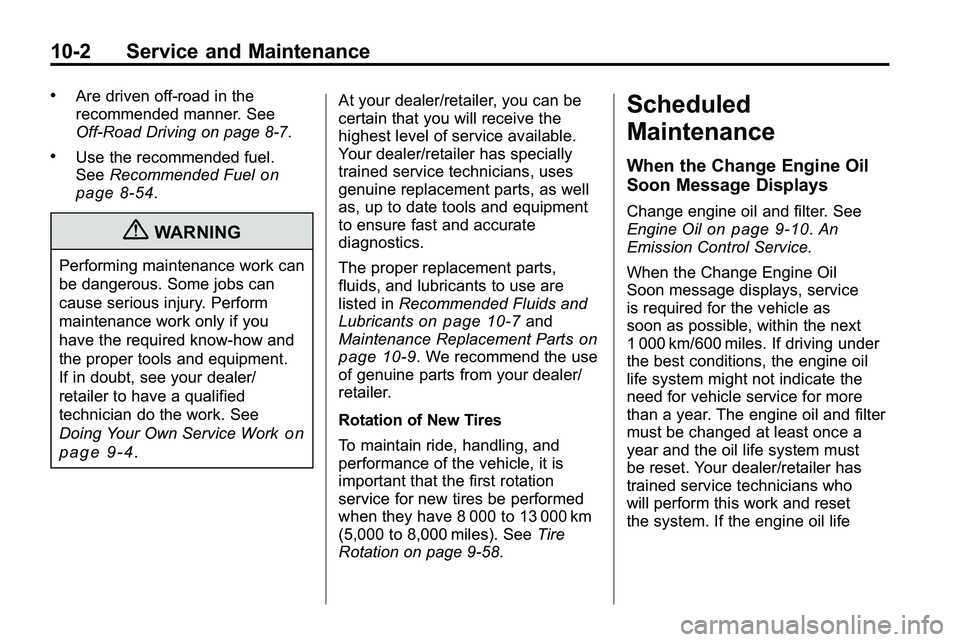
.Are driven off-road in the
recommended manner. See
Off-Road Driving on page 8‑7.
.Use the recommended fuel.
SeeRecommended Fuelon
page 8‑54.
{WARNING
Performing maintenance work can
be dangerous. Some jobs can
cause serious injury. Perform
maintenance work only if you
have the required know-how and
the proper tools and equipment.
If in doubt, see your dealer/
retailer to have a qualified
technician do the work. See
Doing Your Own Service Work
on
page 9‑4
. At your dealer/retailer, you can be
certain that you will receive the
highest level of service available.
Your dealer/retailer has specially
trained service technicians, uses
genuine replacement parts, as well
as, up to date tools and equipment
to ensure fast and accurate
diagnostics.
The proper replacement parts,
fluids, and lubricants to use are
listed in
Recommended Fluids and
Lubricants
on page 10‑7and
Maintenance Replacement Partson
page 10‑9. We recommend the use
of genuine parts from your dealer/
retailer.
Rotation of New Tires
To maintain ride, handling, and
performance of the vehicle, it is
important that the first rotation
service for new tires be performed
when they have 8 000 to 13 000 km
(5,000 to 8,000 miles). See Tire
Rotation on page 9‑58.
Scheduled
Maintenance
When the Change Engine Oil
Soon Message Displays
Change engine oil and filter. See
Engine Oilon page 9‑10. An
Emission Control Service.
When the Change Engine Oil
Soon message displays, service
is required for the vehicle as
soon as possible, within the next
1 000 km/600 miles. If driving under
the best conditions, the engine oil
life system might not indicate the
need for vehicle service for more
than a year. The engine oil and filter
must be changed at least once a
year and the oil life system must
be reset. Your dealer/retailer has
trained service technicians who
will perform this work and reset
the system. If the engine oil life
Page 370 of 410
10-4 Service and Maintenance
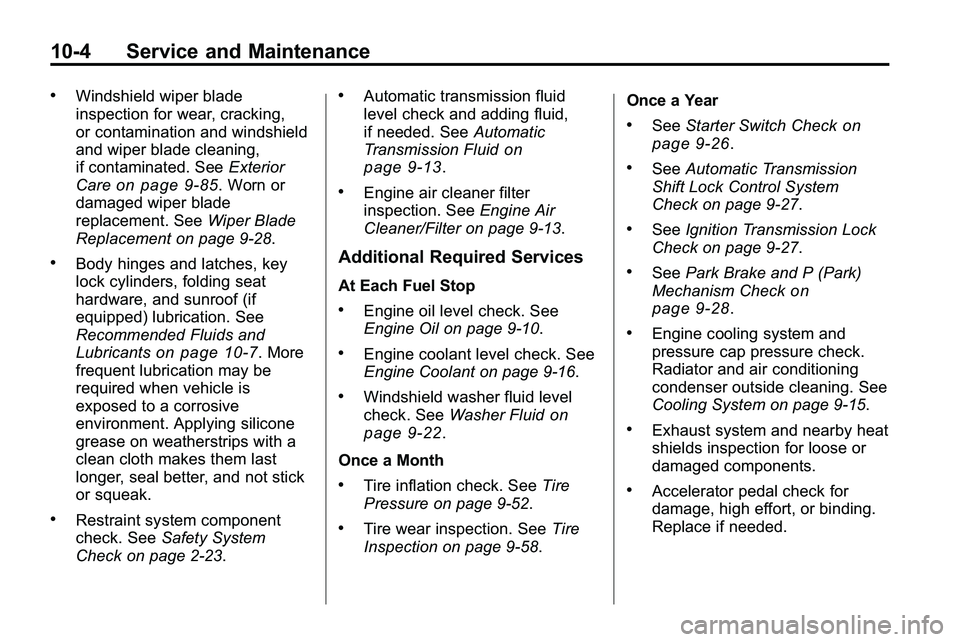
.Windshield wiper blade
inspection for wear, cracking,
or contamination and windshield
and wiper blade cleaning,
if contaminated. SeeExterior
Care
on page 9‑85. Worn or
damaged wiper blade
replacement. See Wiper Blade
Replacement on page 9‑28.
.Body hinges and latches, key
lock cylinders, folding seat
hardware, and sunroof (if
equipped) lubrication. See
Recommended Fluids and
Lubricants
on page 10‑7. More
frequent lubrication may be
required when vehicle is
exposed to a corrosive
environment. Applying silicone
grease on weatherstrips with a
clean cloth makes them last
longer, seal better, and not stick
or squeak.
.Restraint system component
check. See Safety System
Check on page 2‑23.
.Automatic transmission fluid
level check and adding fluid,
if needed. See Automatic
Transmission Fluid
on
page 9‑13.
.Engine air cleaner filter
inspection. See Engine Air
Cleaner/Filter on page 9‑13.
Additional Required Services
At Each Fuel Stop
.Engine oil level check. See
Engine Oil on page 9‑10.
.Engine coolant level check. See
Engine Coolant on page 9‑16.
.Windshield washer fluid level
check. See Washer Fluidon
page 9‑22.
Once a Month
.Tire inflation check. See Tire
Pressure on page 9‑52.
.Tire wear inspection. See Tire
Inspection on page 9‑58. Once a Year
.See
Starter Switch Checkon
page 9‑26.
.See Automatic Transmission
Shift Lock Control System
Check on page 9‑27.
.See Ignition Transmission Lock
Check on page 9‑27.
.See Park Brake and P (Park)
Mechanism Checkon
page 9‑28.
.Engine cooling system and
pressure cap pressure check.
Radiator and air conditioning
condenser outside cleaning. See
Cooling System on page 9‑15.
.Exhaust system and nearby heat
shields inspection for loose or
damaged components.
.Accelerator pedal check for
damage, high effort, or binding.
Replace if needed.
Page 373 of 410
Service and Maintenance 10-7
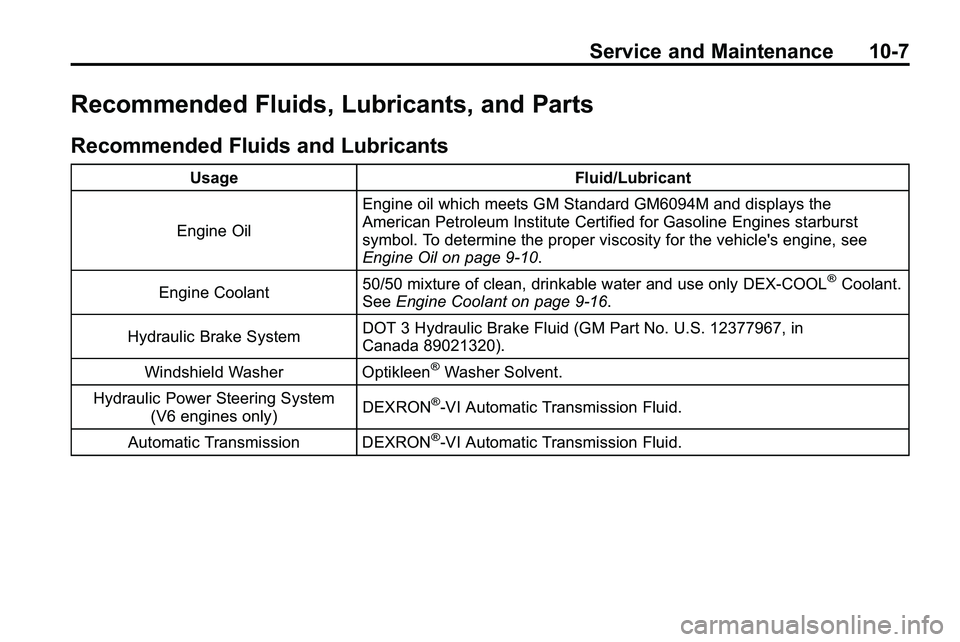
Recommended Fluids, Lubricants, and Parts
Recommended Fluids and Lubricants
UsageFluid/Lubricant
Engine Oil Engine oil which meets GM Standard GM6094M and displays the
American Petroleum Institute Certified for Gasoline Engines starburst
symbol. To determine the proper viscosity for the vehicle's engine, see
Engine Oil on page 9‑10.
Engine Coolant 50/50 mixture of clean, drinkable water and use only DEX-COOL
®Coolant.
See Engine Coolant on page 9‑16.
Hydraulic Brake System DOT 3 Hydraulic Brake Fluid (GM Part No. U.S. 12377967, in
Canada 89021320).
Windshield Washer Optikleen
®Washer Solvent.
Hydraulic Power Steering System (V6 engines only) DEXRON
®-VI Automatic Transmission Fluid.
Automatic Transmission DEXRON
®-VI Automatic Transmission Fluid.
Page 405 of 410
INDEX i-7
Lights (cont.)Fog Lamps . . . . . . . . . . . . . . . . . . . 4-25
Fuel Economy . . . . . . . . . . . . . . . . 4-23
High-Beam On . . . . . . . . . . . . . . . . 4-24
High/Low Beam Changer . . . . . . 5-2
Low Fuel Warning . . . . . . . . . . . . 4-24
Safety Belt Reminders . . . . . . . . 4-14
Security . . . . . . . . . . . . . . . . . . . . . . 4-24
Tire Pressure . . . . . . . . . . . . . . . . . 4-22
Traction Control System
(TCS)/StabiliTrak
®. . . . . . . . . . 4-21
Traction Off . . . . . . . . . . . . . . . . . . . 4-21
Locks Door . . . . . . . . . . . . . . . . . . . . . . . . . . . 1-6
Power Door . . . . . . . . . . . . . . . . . . . . 1-7
Safety . . . . . . . . . . . . . . . . . . . . . . . . . 1-8
Loss of Control . . . . . . . . . . . . . . . . . 8-7
Low Fuel Warning Light . . . . . . . . 4-24
Lower Anchors and Tethers for Children (LATCH
SYSTEM) . . . . . . . . . . . . . . . . . . . . 2-49
Lumbar Adjustment . . . . . . . . . . . . . 2-5 Front Seats . . . . . . . . . . . . . . . . . . . . 2-5
M
Maintenance
Records . . . . . . . . . . . . . . . . . . . . 10-10
Maintenance Schedule Recommended Fluids andLubricants . . . . . . . . . . . . . . . . . . . 10-7
Scheduled Maintenance . . . . . . 10-2
Malfunction Indicator Lamp . . . . 4-17
Manual Mode . . . . . . . . . . . . . . . . . . 8-37
Mass Storage Media (MEM) . . . 6-24
Messages Airbag System . . . . . . . . . . . . . . . . 4-34
Anti-Theft Alarm System . . . . . . 4-34
Battery Voltage andCharging . . . . . . . . . . . . . . . . . . . . 4-29
Brake System . . . . . . . . . . . . . . . . 4-30
Compass . . . . . . . . . . . . . . . . . . . . . 4-30
Door Ajar . . . . . . . . . . . . . . . . . . . . . 4-30
Engine Cooling System . . . . . . . 4-31
Engine Oil . . . . . . . . . . . . . . . . . . . . 4-31
Engine Power . . . . . . . . . . . . . . . . 4-32
Fuel System . . . . . . . . . . . . . . . . . . 4-32 Messages (cont.)
Key and Lock . . . . . . . . . . . . . . . . . 4-33
Object Detection System . . . . . 4-33
Ride Control System . . . . . . . . . . 4-33
Safety Belt . . . . . . . . . . . . . . . . . . . . 4-34
Service Vehicle . . . . . . . . . . . . . . . 4-34
Tire . . . . . . . . . . . . . . . . . . . . . . . . . . . 4-35
Transmission . . . . . . . . . . . . . . . . . 4-35
Vehicle . . . . . . . . . . . . . . . . . . . . . . . 4-29
Vehicle Reminder . . . . . . . . . . . . . 4-36
Washer Fluid . . . . . . . . . . . . . . . . . 4-36
Mirrors Automatic DimmingRearview . . . . . . . . . . . . . . . . . . . . 1-16
Convex . . . . . . . . . . . . . . . . . . . . . . . 1-14
Heated . . . . . . . . . . . . . . . . . . . . . . . 1-15
Park Tilt . . . . . . . . . . . . . . . . . . . . . . 1-15
Power . . . . . . . . . . . . . . . . . . . . . . . . 1-15
Monitor System, Tire Pressure . . . . . . . . . . . . . . . . . . . . . 9-53
Multi-Band Antenna . . . . . . . . . . . . 6-18