washer fluid GMC TERRAIN 2010 Owner's Manual
[x] Cancel search | Manufacturer: GMC, Model Year: 2010, Model line: TERRAIN, Model: GMC TERRAIN 2010Pages: 410, PDF Size: 2.55 MB
Page 5 of 410
Introduction v
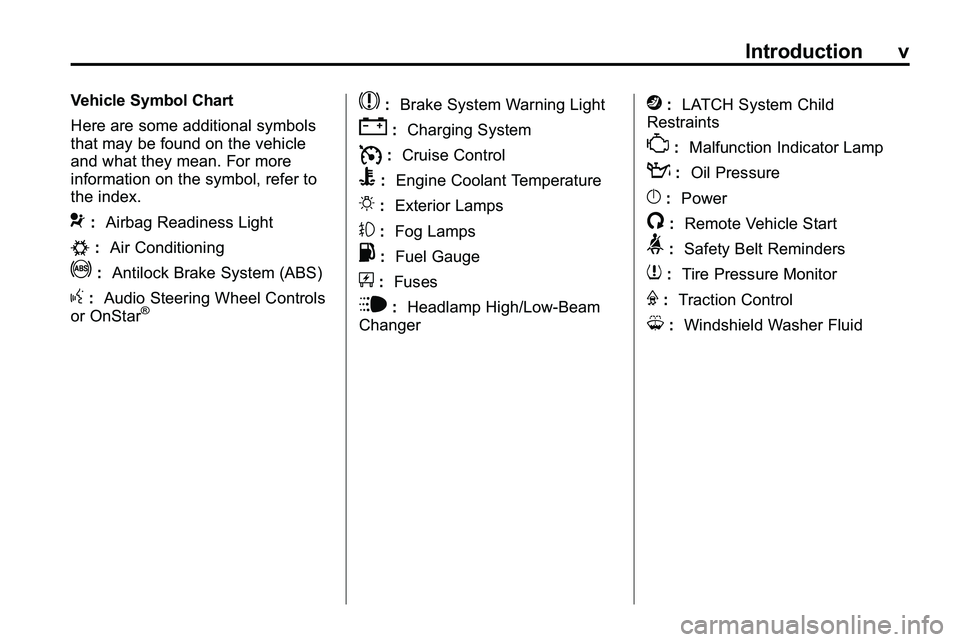
Vehicle Symbol Chart
Here are some additional symbols
that may be found on the vehicle
and what they mean. For more
information on the symbol, refer to
the index.
9:Airbag Readiness Light
#:Air Conditioning
!:Antilock Brake System (ABS)
g:Audio Steering Wheel Controls
or OnStar®
$: Brake System Warning Light
":Charging System
I:Cruise Control
B: Engine Coolant Temperature
O:Exterior Lamps
#:Fog Lamps
.: Fuel Gauge
+:Fuses
i: Headlamp High/Low-Beam
Changer
j: LATCH System Child
Restraints
*: Malfunction Indicator Lamp
::Oil Pressure
}:Power
/:Remote Vehicle Start
>:Safety Belt Reminders
7:Tire Pressure Monitor
F:Traction Control
M:Windshield Washer Fluid
Page 94 of 410

4-2 Instruments and Controls
Vehicle Messages
Vehicle Messages . . . . . . . . . . . 4-29
Battery Voltage and ChargingMessages . . . . . . . . . . . . . . . . . . 4-29
Brake System Messages . . . . 4-30
Compass Messages . . . . . . . . . 4-30
Cruise Control Messages . . . . 4-30
Door Ajar Messages . . . . . . . . . 4-30
Engine Cooling System Messages . . . . . . . . . . . . . . . . . . 4-31
Engine Oil Messages . . . . . . . . 4-31
Engine Power Messages . . . . 4-32
Fuel System Messages . . . . . . 4-32
Key and Lock Messages . . . . . 4-33 Object Detection System
Messages . . . . . . . . . . . . . . . . . . 4-33
Ride Control System Messages . . . . . . . . . . . . . . . . . . 4-33
Airbag System Messages . . . . 4-34
Safety Belt Messages . . . . . . . 4-34
Anti-Theft Alarm System
Messages . . . . . . . . . . . . . . . . . . 4-34
Service Vehicle Messages . . . 4-34
Tire Messages . . . . . . . . . . . . . . . 4-35
Transmission Messages . . . . . 4-35
Vehicle Reminder Messages . . . . . . . . . . . . . . . . . . 4-36
Washer Fluid Messages . . . . . 4-36
Vehicle Personalization
Vehicle Personalization . . . . . . 4-36
OnStar®System
OnStar®System . . . . . . . . . . . . . 4-41
Page 100 of 410
4-8 Instruments and Controls
Windshield Washer
Pull the lever toward you to spray
washer fluid on the windshield. The
spray continues until the lever is
released. The wipers will run a few
times. SeeWasher Fluid
on
page 9‑22for information on filling
the windshield washer fluid
reservoir.
{WARNING
In freezing weather, do not use
your washer until the windshield
is warmed. Otherwise the washer
fluid can form ice on the
windshield, blocking your vision.
Rear Window
Wiper/Washer
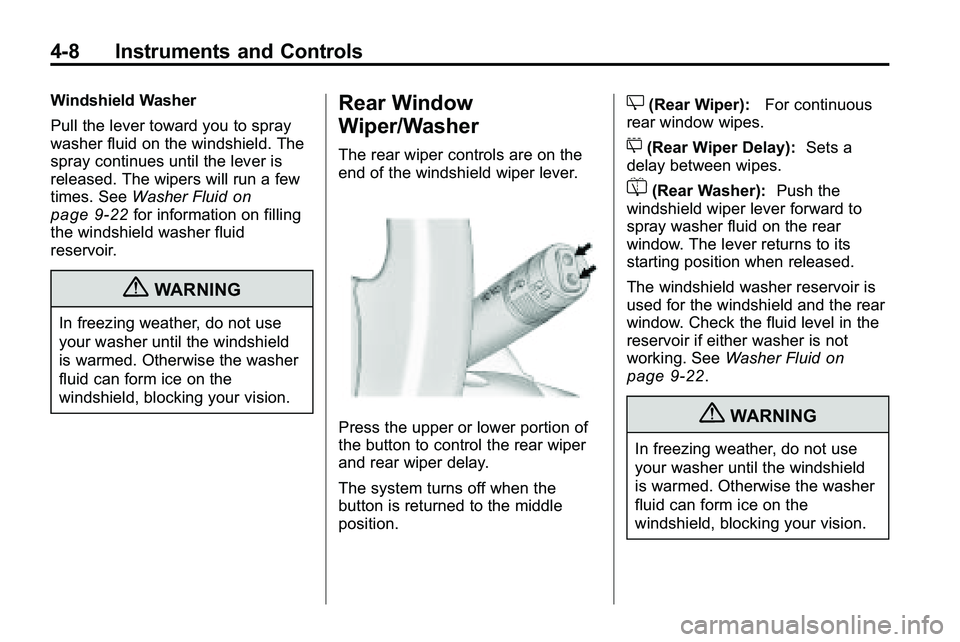
The rear wiper controls are on the
end of the windshield wiper lever.
Press the upper or lower portion of
the button to control the rear wiper
and rear wiper delay.
The system turns off when the
button is returned to the middle
position.
Z(Rear Wiper): For continuous
rear window wipes.
5(Rear Wiper Delay): Sets a
delay between wipes.
=(Rear Washer): Push the
windshield wiper lever forward to
spray washer fluid on the rear
window. The lever returns to its
starting position when released.
The windshield washer reservoir is
used for the windshield and the rear
window. Check the fluid level in the
reservoir if either washer is not
working. See Washer Fluid
on
page 9‑22.
{WARNING
In freezing weather, do not use
your washer until the windshield
is warmed. Otherwise the washer
fluid can form ice on the
windshield, blocking your vision.
Page 226 of 410
8-18 Driving and Operating
Driving on Wet Roads
Rain and wet roads can reduce
vehicle traction and affect your
ability to stop and accelerate.
Always drive slower in these types
of driving conditions and avoid
driving through large puddles and
deep‐standing or flowing water.
{WARNING
Wet brakes can cause crashes.
They might not work as well in a
quick stop and could cause
pulling to one side. You could
lose control of the vehicle.
After driving through a large
puddle of water or a car/vehicle
wash, lightly apply the brake
pedal until the brakes work
normally.(Continued)
WARNING (Continued)
Flowing or rushing water creates
strong forces. Driving through
flowing water could cause your
vehicle to be carried away. If this
happens, you and other vehicle
occupants could drown. Do not
ignore police warnings and be
very cautious about trying to drive
through flowing water.
Hydroplaning
Hydroplaning is dangerous. Water
can build up under your vehicle's
tires so they actually ride on the
water. This can happen if the road is
wet enough and you are going fast
enough. When your vehicle is
hydroplaning, it has little or no
contact with the road.
There is no hard and fast rule about
hydroplaning. The best advice is to
slow down when the road is wet.
Other Rainy Weather Tips
Besides slowing down, other wet
weather driving tips include:
.Allow extra following distance.
.Pass with caution.
.Keep windshield wiping
equipment in good shape.
.Keep the windshield washer fluid
reservoir filled.
.Have good tires with proper
tread depth. SeeTireson
page 9‑45.
.Turn off cruise control.
Highway Hypnosis
Always be alert and pay attention to
your surroundings while driving.
If you become tired or sleepy, find a
safe place to park your vehicle
and rest.
Other driving tips include:
.Keep the vehicle well ventilated.
.Keep interior temperature cool.
Page 275 of 410
Vehicle Care 9-1
Vehicle Care
General Information
General Information . . . . . . . . . . . 9-2
California Proposition65 Warning . . . . . . . . . . . . . . . . . . 9-3
California Perchlorate Materials Requirements . . . . . 9-3
Accessories and Modifications . . . . . . . . . . . . . . . . 9-3
Vehicle Checks
Doing Your OwnService Work . . . . . . . . . . . . . . . . 9-4
Hood . . . . . . . . . . . . . . . . . . . . . . . . . . 9-5
Engine Compartment Overview . . . . . . . . . . . . . . . . . . . . 9-6
Engine Cover . . . . . . . . . . . . . . . . . 9-9
Engine Oil . . . . . . . . . . . . . . . . . . . 9-10
Engine Oil Life System . . . . . . 9-12
Automatic Transmission Fluid . . . . . . . . . . . . . . . . . . . . . . . 9-13 Engine Air Cleaner/Filter . . . . . 9-13
Cooling System . . . . . . . . . . . . . . 9-15
Engine Coolant . . . . . . . . . . . . . . 9-16
Engine Overheating . . . . . . . . . 9-20
Power Steering Fluid
(2.4L L4 Engine) . . . . . . . . . . . 9-21
Power Steering Fluid (3.0L V6 Engine) . . . . . . . . . . . 9-21
Washer Fluid . . . . . . . . . . . . . . . . 9-22
Brakes . . . . . . . . . . . . . . . . . . . . . . . 9-23
Brake Fluid . . . . . . . . . . . . . . . . . . 9-24
Battery . . . . . . . . . . . . . . . . . . . . . . . 9-25
All-Wheel Drive . . . . . . . . . . . . . . 9-26
Starter Switch Check . . . . . . . . 9-26
Automatic Transmission Shift Lock Control
System Check . . . . . . . . . . . . . . 9-27
Ignition Transmission Lock Check . . . . . . . . . . . . . . . . 9-27
Park Brake and P (Park) Mechanism Check . . . . . . . . . 9-28
Wiper Blade Replacement . . . 9-28
Headlamp Aiming
Headlamp Aiming . . . . . . . . . . . . 9-30
Bulb Replacement
Bulb Replacement . . . . . . . . . . . 9-32
Headlamps, Front Turn Signal, Sidemarker, and
Parking Lamps . . . . . . . . . . . . . 9-33
Fog Lamps . . . . . . . . . . . . . . . . . . 9-34
Taillamps, Turn Signal,
Sidemarker, Stoplamps,and Back-Up Lamps . . . . . . . 9-34
License Plate Lamp . . . . . . . . . . 9-37
Replacement Bulbs . . . . . . . . . . 9-38
Electrical System
Fuses . . . . . . . . . . . . . . . . . . . . . . . . 9-38
Engine Compartment Fuse Block . . . . . . . . . . . . . . . . . 9-39
Instrument Panel Fuse Block . . . . . . . . . . . . . . . . 9-42
Wheels and Tires
Tires . . . . . . . . . . . . . . . . . . . . . . . . . 9-45
Tire Sidewall Labeling . . . . . . . 9-46
Tire Designations . . . . . . . . . . . . 9-48
Tire Terminology and
Definitions . . . . . . . . . . . . . . . . . . 9-49
Page 281 of 410
Vehicle Care 9-7
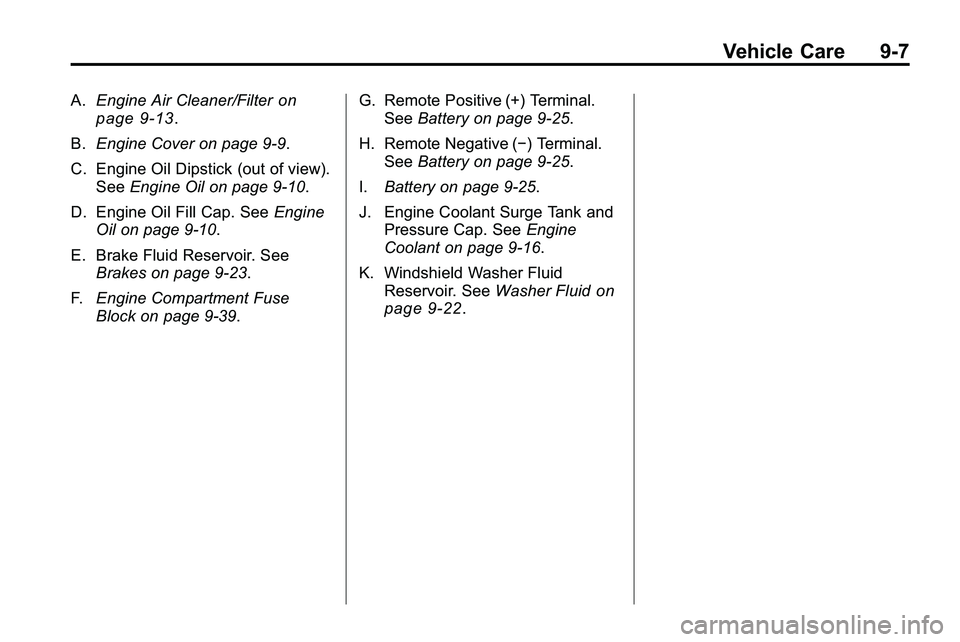
A.Engine Air Cleaner/Filteron
page 9‑13.
B. Engine Cover on page 9‑9.
C. Engine Oil Dipstick (out of view). See Engine Oil on page 9‑10.
D. Engine Oil Fill Cap. See Engine
Oil on page 9‑10.
E. Brake Fluid Reservoir. See Brakes on page 9‑23.
F. Engine Compartment Fuse
Block on page 9‑39. G. Remote Positive (+) Terminal.
See Battery on page 9‑25.
H. Remote Negative (−) Terminal. See Battery on page 9‑25.
I. Battery on page 9‑25.
J. Engine Coolant Surge Tank and Pressure Cap. See Engine
Coolant on page 9‑16.
K. Windshield Washer Fluid Reservoir. See Washer Fluid
on
page 9‑22.
Page 283 of 410
Vehicle Care 9-9
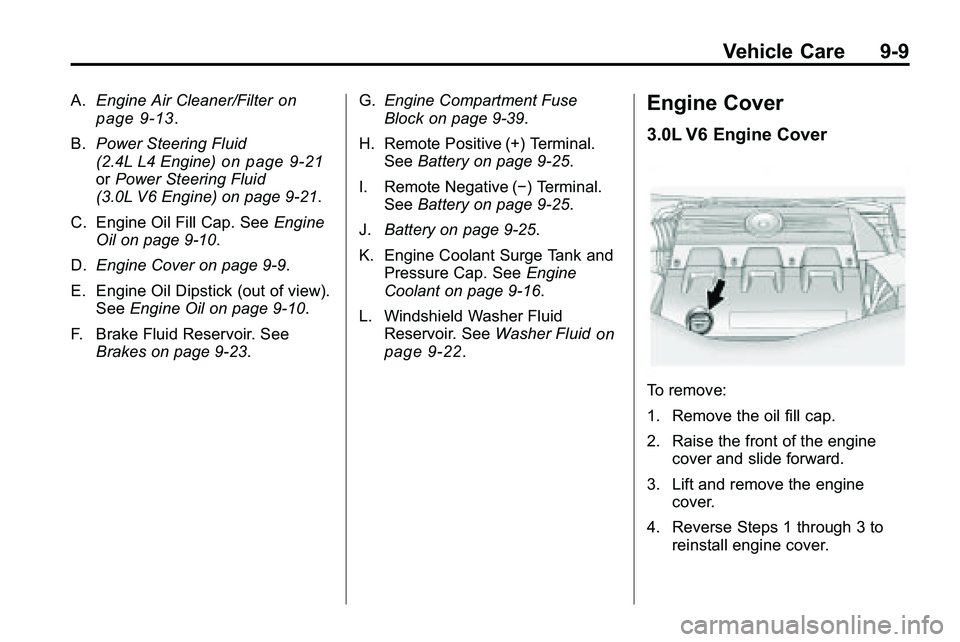
A.Engine Air Cleaner/Filteron
page 9‑13.
B. Power Steering Fluid
(2.4L L4 Engine)
on page 9‑21orPower Steering Fluid
(3.0L V6 Engine) on page 9‑21.
C. Engine Oil Fill Cap. See Engine
Oil on page 9‑10.
D. Engine Cover on page 9‑9.
E. Engine Oil Dipstick (out of view). See Engine Oil on page 9‑10.
F. Brake Fluid Reservoir. See Brakes on page 9‑23. G.
Engine Compartment Fuse
Block on page 9‑39.
H. Remote Positive (+) Terminal. See Battery on page 9‑25.
I. Remote Negative (−) Terminal. See Battery on page 9‑25.
J. Battery on page 9‑25.
K. Engine Coolant Surge Tank and Pressure Cap. See Engine
Coolant on page 9‑16.
L. Windshield Washer Fluid Reservoir. See Washer Fluid
on
page 9‑22.
Engine Cover
3.0L V6 Engine Cover
To remove:
1. Remove the oil fill cap.
2. Raise the front of the engine
cover and slide forward.
3. Lift and remove the engine cover.
4. Reverse Steps 1 through 3 to reinstall engine cover.
Page 296 of 410
9-22Vehicle Care
Washer Fluid
WhattoUse
Rea dthe manufacturer' s
instruction sbefor ere-filin gthe
windshiel dwashe rfluid .If operatin g
th e vehicl ein an are awher ethe
temperatur ema yfal lbelo wfreezing ,
us eaflui dtha tha ssuffi cien t
protectio nagains tfreezing .
Openth eca pwit hth ewashe r
symbo lo n it an dad dwashe rfui d
unti lfull .Se e Engin eCompartmen t
Overvie w
on p a g e9-6fo r
reservoi rlocation . Notice
:
•Whenusin gconcentrate d
washe rfluid ,follo wthe
manufacturer' sinstruction s
fo raddin gwate r.
•D o no tmi xwate rwit h
ready-to-us ewashe rfluid .
W ate rca ncaus eth esolutio n
t o freez ean ddamag eth e
washe rflui dtan kan dothe r
part sof th ewashe rsystem .
Also ,wate rdoe sno tclea nas
wel las washe rfluid .
•Fillth ewashe rflui dtan k
onl ythree-quarter sful l
whe nit is ver ycold .Thi s
allow sfo rflui dexpansio n
i f freezin goccurs ,whic h
coul ddamag eth etan kif it
i s completel yfull .
•Do no tus eengin ecoolan t
(antifreeze )in th ewindshiel d
washe r. It ca ndamag eth e
vehicle' swindshiel dwashe r
syste mandpaint .
Page 360 of 410
9-86 Vehicle Care
Washing the Vehicle
To preserve the vehicle's finish,
keep it clean by washing it often.
Do not wash the vehicle in
direct sunlight and use a car
washing soap.
Notice:Certain cleaners contain
chemicals that can damage the
emblems or nameplates on the
vehicle. Check the cleaning
product label. If it states that it
should not be used on plastic
parts, do not use it on the vehicle
or damage may occur and it
would not be covered by the
warranty.
Do not use cleaning agents that are
petroleum based or that contain
acid or abrasives, as they can
damage the paint, metal or plastic
on the vehicle. Approved cleaning
products can be obtained from your dealer/retailer. Follow all
manufacturer directions regarding
correct product usage, necessary
safety precautions and appropriate
disposal of any vehicle care
product.
Rinse the vehicle well, before
washing and after to remove all
cleaning agents completely. If they
are allowed to dry on the surface,
they could stain.
Dry the finish with a soft, clean
chamois or an all-cotton towel to
avoid surface scratches and water
spotting.
High pressure car washes could
cause water to enter the vehicle.
Avoid using high pressure washes
closer than 30 cm (12 inches) to
the surface of the vehicle. Use of
power washers exceeding
8,274 kPa (1,200 psi) can result
in damage or removal of paint and
decals.
Notice:
Conveyor systems on
some automatic car washes could
damage the vehicle. There may
not be enough clearance for the
undercarriage. Check with the car
wash manager before using the
automatic car wash.
Weatherstrips
Silicone grease on weatherstrips will
make them last longer, seal better,
and not stick or squeak. Apply
silicone grease with a clean cloth.
During very cold, damp weather
frequent application may be
required. See Recommended Fluids
and Lubricants on page 10‑7.
Page 362 of 410
9-88 Vehicle Care
Windshield and Wiper Blades
Clean the outside of the windshield
with glass cleaner.
Clean the rubber blades using a lint
free cloth or paper towel soaked
with windshield washer fluid or a
mild detergent. Wash the windshield
thoroughly when cleaning the
blades. Bugs, road grime, sap, and
a buildup of vehicle wash/wax
treatments may cause wiper
streaking. Replace the wiper blades
if they are worn or damaged.
Wipers can be damaged by:
.Extreme dusty conditions
.Sand and salt
.Heat and sun
.Snow and ice, without proper
removal
Tires
Use a stiff brush with tire cleaner to
clean the tires.
Notice:Using petroleum-based
tire dressing products on the
vehicle may damage the paint
finish and/or tires. When applying
a tire dressing, always wipe off
any overspray from all painted
surfaces on the vehicle.
Sheet Metal Damage
If the vehicle is damaged and
requires sheet metal repair or
replacement, make sure the body
repair shop applies anti-corrosion
material to parts repaired or
replaced to restore corrosion
protection.
Original manufacturer replacement
parts will provide the corrosion
protection while maintaining the
vehicle warranty.
Finish Damage
Any stone chips, fractures or deep
scratches in the finish should be
repaired right away. Bare metal will
corrode quickly and may develop
into major repair expense.
Minor chips and scratches can be
repaired with touch-up materials
available from your dealer/retailer.
Larger areas of finish damage can
be corrected in your dealer's/
retailer's body and paint shop.
Underbody Maintenance
Chemicals used for ice and snow
removal and dust control can collect
on the underbody. If these are not
removed, corrosion and rust can
develop on the underbody parts
such as fuel lines, frame, floor pan,
and exhaust system even though
they have corrosion protection.