electrical GMC TERRAIN 2017 User Guide
[x] Cancel search | Manufacturer: GMC, Model Year: 2017, Model line: TERRAIN, Model: GMC TERRAIN 2017Pages: 330, PDF Size: 4.54 MB
Page 141 of 330

GMC Terrain/Terrain Denali Owner Manual (GMNA-Localizing-U.S./Canada/
Mexico-9919509) - 2017 - crc - 8/16/16
140 Lighting
Normally, these actions occur in
steps or levels, without being
noticeable. In rare cases at the
highest levels of corrective action,
this action may be noticeable to the
driver. If so, a DIC message might
be displayed and it is recommended
that the driver reduce the electrical
loads as much as possible.
Battery Power Protection
The battery saver feature is
designed to protect the vehicle's
battery.
If some interior lamps are left on
and the ignition is turned off, the
battery rundown protection system
automatically turns the lamp off after
some time.
Exterior Lighting Battery
Saver
The exterior lamps turn off about
10 minutes after the ignition is
turned off, if the parking lamps or
headlamps have been manually left
on. This protects against draining
the battery. To restart the 10-minutetimer, turn the exterior lamp control
to the
Oposition and then back to
the
;or2position.
To keep the lamps on for more than
10 minutes, the ignition must be in
the ACC/ACCESSORY or ON/RUN/
START position.
Page 150 of 330
GMC Terrain/Terrain Denali Owner Manual (GMNA-Localizing-U.S./Canada/
Mexico-9919509) - 2017 - crc - 8/16/16
Driving and Operating 149
Driving and
Operating
Driving Information
Distracted Driving . . . . . . . . . . . . 150
Defensive Driving . . . . . . . . . . . . . 150
Drunk Driving . . . . . . . . . . . . . . . . . 151
Control of a Vehicle . . . . . . . . . . . 151
Braking . . . . . . . . . . . . . . . . . . . . . . . 151
Steering . . . . . . . . . . . . . . . . . . . . . . 151
Off-Road Recovery . . . . . . . . . . . 152
Loss of Control . . . . . . . . . . . . . . . 153
Off-Road Driving . . . . . . . . . . . . . 153
Driving on Wet Roads . . . . . . . . 158
Hill and Mountain Roads . . . . . 158
Winter Driving . . . . . . . . . . . . . . . . 159
If the Vehicle Is Stuck . . . . . . . . 160
Vehicle Load Limits . . . . . . . . . . . 161
Starting and Operating
New Vehicle Break-In . . . . . . . . . 165
Ignition Positions . . . . . . . . . . . . . 165
Starting the Engine . . . . . . . . . . . 167
Retained AccessoryPower (RAP) . . . . . . . . . . . . . . . . 168
Engine Coolant Heater . . . . . . . 168
Shifting Into Park . . . . . . . . . . . . . 169
Shifting out of Park . . . . . . . . . . . 170 Parking over Things
That Burn . . . . . . . . . . . . . . . . . . . 171
Engine Exhaust
Engine Exhaust . . . . . . . . . . . . . . 171
Running the Vehicle WhileParked . . . . . . . . . . . . . . . . . . . . . . 172
Automatic Transmission
Automatic Transmission . . . . . . 172
Manual Mode . . . . . . . . . . . . . . . . . 174
Fuel Economy Mode . . . . . . . . . 174
Drive Systems
All-Wheel Drive . . . . . . . . . . . . . . . 175
Brakes
Antilock BrakeSystem (ABS) . . . . . . . . . . . . . . . 175
Parking Brake . . . . . . . . . . . . . . . . 176
Brake Assist . . . . . . . . . . . . . . . . . . 177
Hill Start Assist (HSA) . . . . . . . . 177
Ride Control Systems
Traction Control/Electronic
Stability Control . . . . . . . . . . . . . 177
Cruise Control
Cruise Control . . . . . . . . . . . . . . . . 179
Driver Assistance Systems
Rear Vision Camera (RVC) . . . 182
Parking Assist . . . . . . . . . . . . . . . . 184 Forward Collision Alert (FCA)
System . . . . . . . . . . . . . . . . . . . . . . 185
Side Blind Zone Alert (SBZA) . . . . . . . . . . . . . . . . 187
Lane Departure
Warning (LDW) . . . . . . . . . . . . . 189
Fuel
Fuel . . . . . . . . . . . . . . . . . . . . . . . . . . 191
California FuelRequirements . . . . . . . . . . . . . . . 191
Fuels in Foreign Countries . . . 192
Fuel Additives . . . . . . . . . . . . . . . . 192
E85 or FlexFuel . . . . . . . . . . . . . . 192
Filling the Tank . . . . . . . . . . . . . . . 193
Filling a Portable Fuel Container . . . . . . . . . . . . . . . . . . . 194
Trailer Towing
General Towing
Information . . . . . . . . . . . . . . . . . . 195
Driving Characteristics and Towing Tips . . . . . . . . . . . . . . . . . 195
Trailer Towing . . . . . . . . . . . . . . . . 198
Towing Equipment . . . . . . . . . . . . 200
Trailer Sway Control (TSC) . . . 200
Conversions and Add-Ons
Add-On Electrical Equipment . . . . . . . . . . . . . . . . . . 201
Page 167 of 330
GMC Terrain/Terrain Denali Owner Manual (GMNA-Localizing-U.S./Canada/
Mexico-9919509) - 2017 - crc - 8/16/16
166 Driving and Operating
This is the only position from which
the key can be removed. If the key
cannot be removed, make sure the
shift lever is in P (Park).
The ignition switch can bind in the
LOCK/OFF position with the wheels
turned off center. If this happens,
move the steering wheel from right
to left while turning the key to ACC/
ACCESSORY. If this does not work,
then the vehicle needs service.
Do not turn the engine off when the
vehicle is moving. This will cause a
loss of power assist in the brake
and steering systems and disable
the airbags.
If the vehicle must be shut off in an
emergency:1. Brake using a firm and steady pressure. Do not pump the
brakes repeatedly. This may
deplete power assist, requiring
increased brake pedal force.
2. Shift the vehicle to N (Neutral). This can be done while the
vehicle is moving. After shifting to N (Neutral), firmly apply the
brakes and steer the vehicle to
a safe location.
3. Come to a complete stop, shift to P (Park), and turn the
ignition to LOCK/OFF. On
vehicles with an automatic
transmission, the shift lever
must be in P (Park) to turn the
ignition switch to the LOCK/
OFF position.
4. Set the parking brake. See Parking Brake 0176.
{Warning
Turning off the vehicle while
moving may cause loss of power
assist in the brake and steering
systems and disable the airbags.
While driving, only shut the
vehicle off in an emergency.
If the vehicle cannot be pulled over,
and must be shut off while driving,
turn the ignition to ACC/
ACCESSORY. 1 (ACC/ACCESSORY) :
This
position provides power to some of
the electrical accessories. It unlocks
the steering wheel and ignition. To
move the key from ACC/
ACCESSORY to LOCK/OFF, push
in the key and then turn it to
LOCK/OFF.
2 (ON/RUN) : The ignition switch
stays in this position when the
engine is running. This position can
be used to operate the electrical
accessories, including the
ventilation fan and 12-volt power
outlets, as well as to display some
warning and indicator lights. This
position can also be used for
service and diagnostics, and to
verify the proper operation of the
malfunction indicator lamp as may
be required for emission inspection
purposes. The transmission is also
unlocked in this position on
automatic transmission vehicles.
The battery could be drained if the
key is left in the ACC/ACCESSORY
or ON/RUN position with the engine
off. The vehicle might not start if the
battery is allowed to drain for an
extended period of time.
Page 168 of 330
GMC Terrain/Terrain Denali Owner Manual (GMNA-Localizing-U.S./Canada/
Mexico-9919509) - 2017 - crc - 8/16/16
Driving and Operating 167
3 (START) :This position starts the
engine. When the engine starts,
release the key. The ignition switch
will return to ON/RUN for normal
driving.
A warning tone sounds when the
driver door is opened if the ignition
is still in ACC/ACCESSORY and the
key is in the ignition. If the ignition
becomes difficult to turn, see
Keys 025.
Starting the Engine
Move the shift lever to P (Park) or
N (Neutral). To restart the vehicle
when it is already moving, use
N (Neutral) only.
Caution
Do not try to shift to P (Park) if the
vehicle is moving. If you do, you
could damage the transmission.
Shift to P (Park) only when the
vehicle is stopped.
Caution
If you add electrical parts or
accessories, you could change
the way the engine operates. Any
resulting damage would not be
covered by the vehicle warranty.
See Add-On Electrical
Equipment 0201.
Caution
If the steering wheel is turned
until it reaches the end of its
travel, and is held in that position
while starting the vehicle, damage
may occur to the hydraulic power
steering system and there may be
loss of power steering assist.
Starting Procedure 1. With your foot off the accelerator pedal, turn the
ignition key to START. When
the engine starts, let go of the
key. The idle speed will go
down as the engine warms. Do not race the engine
immediately after starting it.
Operate the engine and
transmission gently to allow the
oil to warm up and lubricate all
moving parts.
Caution
Cranking the engine for long
periods of time, by returning the
ignition to the START position
immediately after cranking has
ended, can overheat and damage
the cranking motor, and drain the
battery. Wait at least 15 seconds
between each try, to let the
cranking motor cool down.
2. If the engine does not start after five to 10 seconds,
especially in very cold weather
(below −18 °C or 0 °F), it could
be flooded with too much
gasoline. Push the accelerator
pedal all the way to the floor
and hold it there as you hold
the key in START for a
maximum of 15 seconds. Wait
at least 15 seconds between
Page 169 of 330
GMC Terrain/Terrain Denali Owner Manual (GMNA-Localizing-U.S./Canada/
Mexico-9919509) - 2017 - crc - 8/16/16
168 Driving and Operating
each try, to allow the cranking
motor to cool. When the engine
starts, let go of the key and
accelerator. If the vehicle starts
briefly but then stops again,
repeat the procedure. This
clears the extra gasoline from
the engine. Do not race the
engine immediately after
starting it. Operate the engine
and transmission gently until
the oil warms up and lubricates
all moving parts.
Retained Accessory
Power (RAP)
These vehicle accessories can be
used for up to 10 minutes after the
engine is turned off:
.Audio system
. Power windows
. Sunroof (if equipped)
Power to the audio system will
continue to operate for up to
10 minutes or until the driver door is
opened. Power to the power windows and
sunroof will continue to operate for
up to 10 minutes or until any door is
opened.
All these features will work when the
key is in ON/RUN or ACC/
ACCESSORY.
Engine Coolant Heater
The engine coolant heater,
if available, can help in cold weather
conditions at or below
−18 °C (0 °F)
for easier starting and better fuel
economy during engine warm-up.
Plug in the coolant heater at least
four hours before starting the
vehicle. An internal thermostat in
the plug end of the cord will prevent
engine coolant heater operation at
temperatures above −18 °C (0 °F).
To Use The Engine Coolant
Heater
1. Turn off the engine.
2. Open the hood and unwrap the
electrical cord. The electrical cord is on the
passenger side of the engine
compartment, in front of the air
cleaner.
Check the heater cord for
damage. If it is damaged, do
not use it. See your dealer for
a replacement. Inspect the
cord for damage yearly.
3. Plug it into a normal, grounded 110-volt AC outlet.
{Warning
Improper use of the heater cord
or an extension cord can damage
the cord and may result in
overheating and fire.
. Plug the cord into a
three-prong electrical utility
receptacle that is protected
by a ground fault detection
(Continued)
Page 196 of 330

GMC Terrain/Terrain Denali Owner Manual (GMNA-Localizing-U.S./Canada/
Mexico-9919509) - 2017 - crc - 8/16/16
Driving and Operating 195
Trailer Towing
General Towing
Information
Only use towing equipment that has
been designed for the vehicle.
Contact your dealer or trailering
dealer for assistance with preparing
the vehicle for towing a trailer. Read
the entire section before towing a
trailer.
For towing a disabled vehicle, see
Towing the Vehicle0266. For
towing the vehicle behind another
vehicle such as a motor home, see
Recreational Vehicle Towing 0266.
Driving Characteristics
and Towing Tips
Driving with a Trailer
When towing a trailer:
.
Become familiar with the state
and local laws that apply
specifically to trailer towing. .
Do not tow a trailer during the
first 800 km (500 miles), to
prevent damage to the engine,
axle or other parts.
. Then, during the first 800 km
(500 miles) trailer towing, do not
drive over 80 km/h (50 mph) and
do not make starts at full throttle.
. The vehicle can tow in D (Drive).
Use a lower gear if the
transmission shifts too often.
. Do not use the Fuel Economy
Mode when towing.
. Turn off Park Assist when
towing.
{Warning
When towing a trailer, exhaust
gases may collect at the rear of
the vehicle and enter if the
liftgate, trunk/hatch, or rear-most
window is open.
When towing a trailer:
(Continued)
Warning (Continued)
.Do not drive with the
liftgate, trunk/hatch,
or rear-most window open.
. Fully open the air outlets on
or under the instrument
panel.
. Also adjust the climate
control system to a setting
that brings in only outside
air. See “Climate Control
Systems” in the Index.
For information about carbon
monoxide, see Engine
Exhaust 0171.
Towing a trailer requires a certain
amount of experience. The
combination you are driving is
longer and not as responsive as the
vehicle itself. Get acquainted with
the handling and braking of the rig
before setting out for the open road.
Before starting, check all trailer hitch
parts and attachments, safety
chains, electrical connectors, lamps,
tires and mirrors. If the trailer has
Page 202 of 330
GMC Terrain/Terrain Denali Owner Manual (GMNA-Localizing-U.S./Canada/
Mexico-9919509) - 2017 - crc - 8/16/16
Driving and Operating 201
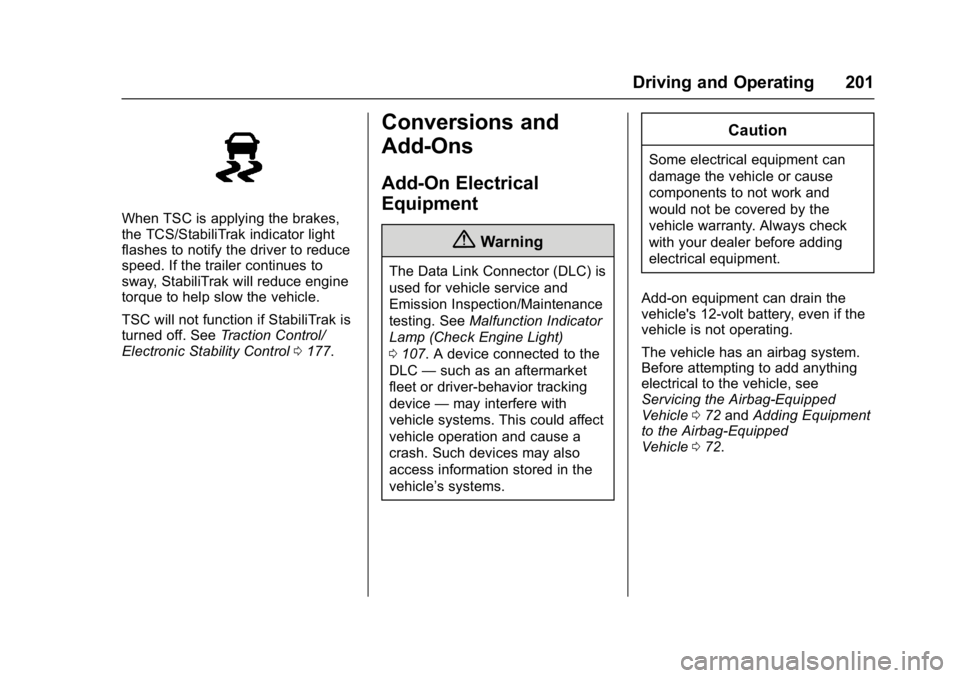
When TSC is applying the brakes,
the TCS/StabiliTrak indicator light
flashes to notify the driver to reduce
speed. If the trailer continues to
sway, StabiliTrak will reduce engine
torque to help slow the vehicle.
TSC will not function if StabiliTrak is
turned off. SeeTraction Control/
Electronic Stability Control 0177.
Conversions and
Add-Ons
Add-On Electrical
Equipment
{Warning
The Data Link Connector (DLC) is
used for vehicle service and
Emission Inspection/Maintenance
testing. See Malfunction Indicator
Lamp (Check Engine Light)
0 107. A device connected to the
DLC —such as an aftermarket
fleet or driver-behavior tracking
device —may interfere with
vehicle systems. This could affect
vehicle operation and cause a
crash. Such devices may also
access information stored in the
vehicle’s systems.
Caution
Some electrical equipment can
damage the vehicle or cause
components to not work and
would not be covered by the
vehicle warranty. Always check
with your dealer before adding
electrical equipment.
Add-on equipment can drain the
vehicle's 12-volt battery, even if the
vehicle is not operating.
The vehicle has an airbag system.
Before attempting to add anything
electrical to the vehicle, see
Servicing the Airbag-Equipped
Vehicle 072 and Adding Equipment
to the Airbag-Equipped
Vehicle 072.
Page 203 of 330
GMC Terrain/Terrain Denali Owner Manual (GMNA-Localizing-U.S./Canada/
Mexico-9919509) - 2017 - crc - 8/16/16
202 Vehicle Care
Vehicle Care
General Information
General Information . . . . . . . . . . 203
California Proposition65 Warning . . . . . . . . . . . . . . . . . 203
California Perchlorate Materials Requirements . . . . . 203
Accessories and Modifications . . . . . . . . . . . . . . . . 204
Vehicle Checks
Doing Your OwnService Work . . . . . . . . . . . . . . . 204
Hood . . . . . . . . . . . . . . . . . . . . . . . . . 205
Engine Compartment Overview . . . . . . . . . . . . . . . . . . . . 206
Engine Cover . . . . . . . . . . . . . . . . . 209
Engine Oil . . . . . . . . . . . . . . . . . . . . 209
Engine Oil Life System . . . . . . . 212
Automatic Transmission Fluid . . . . . . . . . . . . . . . . . . . . . . . . 213
Engine Air Cleaner/Filter . . . . . . 213
Cooling System . . . . . . . . . . . . . . 214
Engine Coolant . . . . . . . . . . . . . . . 215
Engine Overheating . . . . . . . . . . 219
Power Steering Fluid (2.4L L4 Engine) . . . . . . . . . . . . . . . . . . . . . 220
Power Steering Fluid (3.6L V6 Engine) . . . . . . . . . . . . . . . . . . 220 Washer Fluid . . . . . . . . . . . . . . . . . 221
Brakes . . . . . . . . . . . . . . . . . . . . . . . 221
Brake Fluid . . . . . . . . . . . . . . . . . . . 222
Battery - North America . . . . . . 223
All-Wheel Drive . . . . . . . . . . . . . . . 224
Starter Switch Check . . . . . . . . . 224
Automatic Transmission Shift
Lock Control Function
Check . . . . . . . . . . . . . . . . . . . . . . . 224
Ignition Transmission Lock Check . . . . . . . . . . . . . . . . . . . . . . . 225
Park Brake and P (Park) Mechanism Check . . . . . . . . . . 225
Wiper Blade Replacement . . . . 225
Headlamp Aiming
Headlamp Aiming . . . . . . . . . . . . 227
Bulb Replacement
Bulb Replacement . . . . . . . . . . . . 227
Halogen Bulbs . . . . . . . . . . . . . . . . 227
Taillamps, Turn Signal, Sidemarker, Stoplamps, and
Back-Up Lamps . . . . . . . . . . . . . 227
License Plate Lamp . . . . . . . . . . 230
Replacement Bulbs . . . . . . . . . . . 230
Electrical System
Fuses . . . . . . . . . . . . . . . . . . . . . . . . 231
Engine Compartment Fuse Block . . . . . . . . . . . . . . . . . . . . . . . . 231 Instrument Panel Fuse
Block . . . . . . . . . . . . . . . . . . . . . . . . 234
Wheels and Tires
Tires . . . . . . . . . . . . . . . . . . . . . . . . . . 235
All-Season Tires . . . . . . . . . . . . . . 236
Winter Tires . . . . . . . . . . . . . . . . . . 237
Summer Tires . . . . . . . . . . . . . . . . 237
Tire Sidewall Labeling . . . . . . . . 238
Tire Designations . . . . . . . . . . . . . 240
Tire Terminology andDefinitions . . . . . . . . . . . . . . . . . . 240
Tire Pressure . . . . . . . . . . . . . . . . . 243
Tire Pressure Monitor System . . . . . . . . . . . . . . . . . . . . . . 244
Tire Pressure Monitor Operation . . . . . . . . . . . . . . . . . . . 245
Tire Inspection . . . . . . . . . . . . . . . . 248
Tire Rotation . . . . . . . . . . . . . . . . . 248
When It Is Time for New Tires . . . . . . . . . . . . . . . . . . . . . . . . 249
Buying New Tires . . . . . . . . . . . . . 250
Different Size Tires and Wheels . . . . . . . . . . . . . . . . . . . . . . 251
Uniform Tire Quality Grading . . . . . . . . . . . . . . . . . . . . . 252
Wheel Alignment and Tire Balance . . . . . . . . . . . . . . . . . . . . . 253
Wheel Replacement . . . . . . . . . . 254
Tire Chains . . . . . . . . . . . . . . . . . . . 254
If a Tire Goes Flat . . . . . . . . . . . . 255
Page 232 of 330

GMC Terrain/Terrain Denali Owner Manual (GMNA-Localizing-U.S./Canada/
Mexico-9919509) - 2017 - crc - 8/16/16
Vehicle Care 231
Electrical System
Fuses
The wiring circuits in the vehicle are
protected from short circuits by
fuses. This greatly reduces the
chance of damage caused by
electrical problems.
Look at the silver-colored band
inside the fuse. If the band is broken
or melted, replace the fuse. Be sure
to replace a bad fuse with a new
one of the identical size and rating.
Replace a bad fuse with a new one
of the identical size and rating.
If there is a problem on the road and
a fuse needs to be replaced, the
same amperage fuse can be
borrowed. Choose some feature of
the vehicle that is not needed to use
and replace it as soon as possible.
There are two fuse blocks in the
vehicle: one in the engine
compartment and one in the
instrument panel.There is a fuse puller located in the
engine compartment fuse block.
See
Engine Compartment Fuse
Block 0231. It can be used to easily
remove fuses from the fuse block.
Engine Compartment
Fuse Block
To remove the fuse block cover,
squeeze the clips on the cover and
lift it straight up. See Engine
Compartment Overview 0206.
Caution
Spilling liquid on any electrical
component on the vehicle may
damage it. Always keep the
covers on any electrical
component.
Page 265 of 330
GMC Terrain/Terrain Denali Owner Manual (GMNA-Localizing-U.S./Canada/
Mexico-9919509) - 2017 - crc - 8/16/16
264 Vehicle Care
Warning (Continued)
Battery fluid contains acid that
can burn you. Do not get it on
you. If you accidentally get it in
your eyes or on your skin, flush
the place with water and get
medical help immediately.
Be sure to use the following steps to
do it safely. Ignoring these steps
could result in costly damage to the
vehicle that would not be covered
by the warranty.
Trying to start the vehicle by
pushing or pulling it will not work,
and it could damage the vehicle.
Caution
If any accessories are left on or
plugged in during the jump
starting procedure, they could be
damaged. The repairs would not
be covered by the vehicle
warranty. Whenever possible, turn
off or unplug all accessories on
either vehicle when jump starting.
Caution
If the jumper cables are
connected or removed in the
wrong order, electrical shorting
may occur and damage the
vehicle. The repairs would not be
covered by the vehicle warranty.
Always connect and remove the
jumper cables in the correct order,
making sure that the cables do
not touch each other or other
metal.
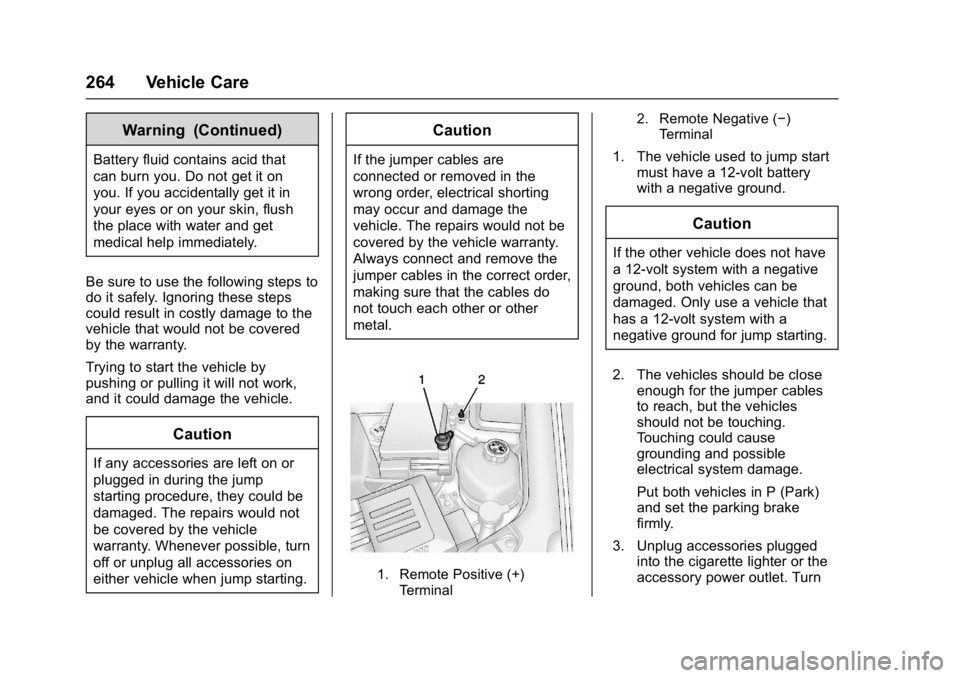
1. Remote Positive (+) Terminal 2. Remote Negative (−)
Terminal
1. The vehicle used to jump start must have a 12-volt battery
with a negative ground.
Caution
If the other vehicle does not have
a 12-volt system with a negative
ground, both vehicles can be
damaged. Only use a vehicle that
has a 12-volt system with a
negative ground for jump starting.
2. The vehicles should be close enough for the jumper cables
to reach, but the vehicles
should not be touching.
Touching could cause
grounding and possible
electrical system damage.
Put both vehicles in P (Park)
and set the parking brake
firmly.
3. Unplug accessories plugged into the cigarette lighter or the
accessory power outlet. Turn