Engine compartment GMC TERRAIN 2020 Owner's Manual
[x] Cancel search | Manufacturer: GMC, Model Year: 2020, Model line: TERRAIN, Model: GMC TERRAIN 2020Pages: 425, PDF Size: 6.59 MB
Page 177 of 425
GMC Terrain/Terrain Denali Owner Manual (GMNA-Localizing-U.S./Canada/
Mexico-13556230) - 2020 - CRC - 9/4/19
174 Driving and Operating
{Warning
Snow can trap engine exhaust
under the vehicle. This may
cause exhaust gases to get
inside. Engine exhaust contains
carbon monoxide (CO), which
cannot be seen or smelled. It can
cause unconsciousness and even
death.
If the vehicle is stuck in snow:. Clear snow from the base of
the vehicle, especially any
blocking the exhaust pipe.
. Open a window about 5 cm
(2 in) on the vehicle side
that is away from the wind,
to bring in fresh air.
. Fully open the air outlets on
or under the instrument
panel.
. Adjust the climate control
system to circulate the air
inside the vehicle and set
(Continued)
Warning (Continued)
the fan speed to the highest
setting. See“Climate
Control Systems.”
For more information about CO,
see Engine Exhaust 0191.
To save fuel, run the engine for
short periods to warm the vehicle
and then shut the engine off and
partially close the window. Moving
about to keep warm also helps.
If it takes time for help to arrive,
when running the engine, push the
accelerator pedal slightly so the
engine runs faster than the idle
speed. This keeps the battery
charged to restart the vehicle and to
signal for help with the headlamps.
Do this as little as possible, to
save fuel.
If the Vehicle Is Stuck
Slowly and cautiously spin the
wheels to free the vehicle when
stuck in sand, mud, ice, or snow. If stuck too severely for the traction
system to free the vehicle, turn the
traction system off and use the
rocking method. See
Traction
Control/Electronic Stability Control
0 209.
{Warning
If the vehicle's tires spin at high
speed, they can explode, and you
or others could be injured. The
vehicle can overheat, causing an
engine compartment fire or other
damage. Spin the wheels as little
as possible and avoid going
above 56 km/h (35 mph).
Rocking the Vehicle to Get
it Out
Turn the steering wheel left and
right to clear the area around the
front wheels. Turn off any traction
system. Shift back and forth
between R (Reverse) and a low
forward gear, spinning the wheels
as little as possible. To prevent
transmission wear, wait until the
Page 188 of 425
GMC Terrain/Terrain Denali Owner Manual (GMNA-Localizing-U.S./Canada/
Mexico-13556230) - 2020 - CRC - 9/4/19
Driving and Operating 185
Winter Cover
If equipped, the winter cover can be
used to enhance heater
performance in extremely cold
conditions below−0 °C (32 °F). The
winter cover installs over the grille
and restricts airflow to the engine
compartment.
Usage Guidelines
The winter cover should only be
used while operating the vehicle in
extremely cold temperatures or in
heavy snow for extended periods. In
these temperatures, the vehicle
does not need a large amount of air
to properly cool the engine. When
more airflow is required to cool the
vehicle, the winter cover should not
be used. The following usage
guidelines will allow adequate
airflow for proper radiator and air
cooler performance:
. Do not use the winter cover if
towing a trailer. The vehicle may
overheat if the radiator is
covered while towing. .
Do not modify the cover. The
winter cover does not cover
some sections of the front of the
vehicle to provide enough
airflow.
. Keep the underside of the winter
cover as clean as possible.
Remove monthly or as
necessary and clean away dust
and debris.
. Do not use the winter cover
above −0 °C (32 °F).
Use only a mild soap to clean. Do
not use harsh soap, strong
detergents, or vinyl protectant/
sealant type products as they may
damage the special finish. Allow the
winter cover to dry completely
before reinstalling.
Installation Instructions
When first trying to fit the cover, it
may appear to be undersized but
will stretch during installation to
ensure a tight fit. The initial
installation of the cover is best
performed when the winter cover
is warm.
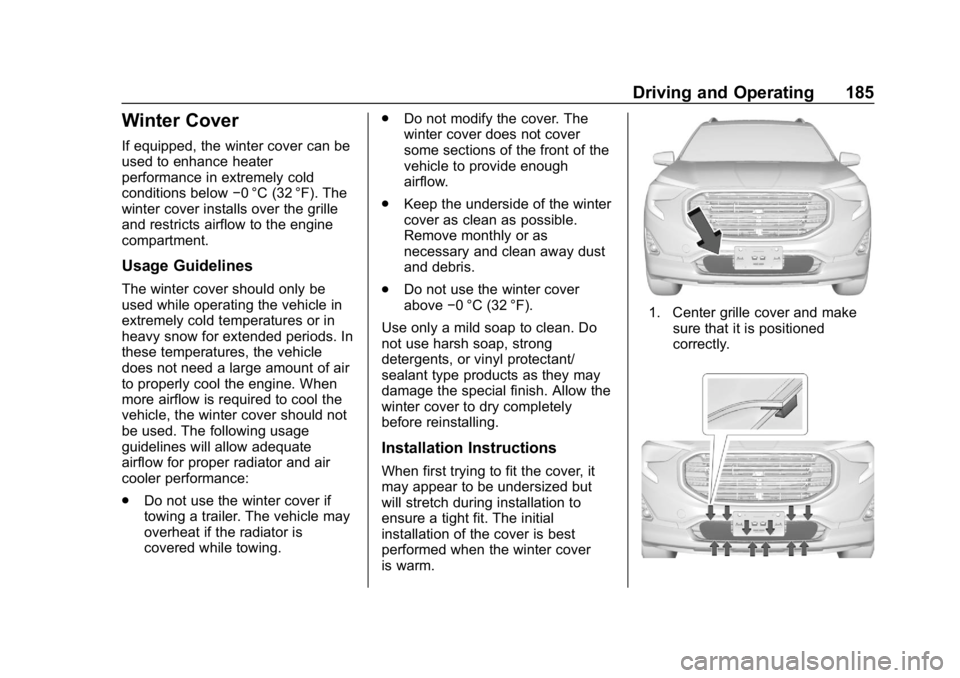
1. Center grille cover and make sure that it is positioned
correctly.
Page 189 of 425

GMC Terrain/Terrain Denali Owner Manual (GMNA-Localizing-U.S./Canada/
Mexico-13556230) - 2020 - CRC - 9/4/19
186 Driving and Operating
2. Push plastic hooks back toengage grille slats.
3. If equipped with license plate bracket pull it toward the front
of the vehicle and install the
cover behind the bottom edge
of the bracket.
4. Repeat for all hooks to fully engage cover to grille.
5. Make sure all clips remain engaged during installation.
Cover should be stretched to a
tight fit when properly installed.
Engine Heater
{Warning
Do not plug in the engine block
heater while the vehicle is parked
in a garage or under a carport.
Property damage or personal
injury may result. Always park the
vehicle in a clear open area away
from buildings or structures.
The engine heater, if available, can
help in cold weather conditions at or
below −18 °C (0 °F) for easier
starting and better fuel economy
during engine warm-up. Plug in the
engine heater at least four hours
before starting the vehicle. An
internal thermostat in the plug end
of the cord will prevent engine
heater operation at temperatures
above −18 °C (0 °F).
To Use the Engine Heater
1. Turn off the engine.
2. Remove the heater cord from
the rear compartment. 3. Check the heater cord for
damage. If it is damaged, do
not use it. See your dealer for
a replacement. Inspect the
cord for damage yearly.
4. Plug the cord into the receptacle in the front fascia.
5. Plug the other end of the cord into a normal, grounded
110-volt AC outlet.
{Warning
Improper use of the heater cord
or an extension cord can damage
the cord and may result in
overheating and fire.
. Plug the cord into a
three-prong electrical utility
receptacle that is protected
by a ground fault detection
function. An ungrounded
outlet could cause an
electric shock.
(Continued)
Page 276 of 425
GMC Terrain/Terrain Denali Owner Manual (GMNA-Localizing-U.S./Canada/
Mexico-13556230) - 2020 - CRC - 9/5/19
Vehicle Care 273
Vehicle Care
General Information
General Information . . . . . . . . . . 274
California Proposition65 Warning . . . . . . . . . . . . . . . . . 274
California Perchlorate Materials Requirements . . . . . 275
Accessories and Modifications . . . . . . . . . . . . . . . . 275
Vehicle Checks
Doing Your OwnService Work . . . . . . . . . . . . . . . 275
Hood . . . . . . . . . . . . . . . . . . . . . . . . . 276
Engine Compartment Overview . . . . . . . . . . . . . . . . . . . . 278
Engine Oil . . . . . . . . . . . . . . . . . . . . 283
Engine Oil Life System . . . . . . . 287
Automatic Transmission Fluid . . . . . . . . . . . . . . . . . . . . . . . . 288
Engine Air Cleaner/Filter . . . . . . 288
Cooling System . . . . . . . . . . . . . . 290
Engine Overheating . . . . . . . . . . 294
Washer Fluid . . . . . . . . . . . . . . . . . 296
Brakes . . . . . . . . . . . . . . . . . . . . . . . 296
Brake Fluid . . . . . . . . . . . . . . . . . . . 297
Battery - North America . . . . . . 298
All-Wheel Drive . . . . . . . . . . . . . . . 299 Starter Switch Check . . . . . . . . . 299
Park Brake and P (Park)
Mechanism Check . . . . . . . . . . 300
Wiper Blade Replacement . . . . 300
Windshield Replacement . . . . . 301
Gas Strut(s) . . . . . . . . . . . . . . . . . . 302
Headlamp Aiming
Front Headlamp Aiming . . . . . . 303
Bulb Replacement
Bulb Replacement . . . . . . . . . . . . 303
Halogen Bulbs . . . . . . . . . . . . . . . . 303
High Intensity Discharge (HID) Lighting . . . . . . . . . . . . . . . . . . . . . 304
LED Lighting . . . . . . . . . . . . . . . . . 304
Front Turn Signal Lamps . . . . . 304
Taillamps . . . . . . . . . . . . . . . . . . . . . 304
License Plate Lamp . . . . . . . . . . 305
Electrical System
Electrical System Overload . . . 306
Fuses and Circuit Breakers . . . 307
Engine Compartment Fuse Block . . . . . . . . . . . . . . . . . . . . . . . . 307
Instrument Panel Fuse Block . . . . . . . . . . . . . . . . . . . . . . . . 310
Rear Compartment Fuse Block . . . . . . . . . . . . . . . . . . . . . . . . 312
Wheels and Tires
Tires . . . . . . . . . . . . . . . . . . . . . . . . . . 314
All-Season Tires . . . . . . . . . . . . . . 315
Winter Tires . . . . . . . . . . . . . . . . . . 315
Summer Tires . . . . . . . . . . . . . . . . 316
Tire Sidewall Labeling . . . . . . . . 316
Tire Designations . . . . . . . . . . . . . 318
Tire Terminology andDefinitions . . . . . . . . . . . . . . . . . . 319
Tire Pressure . . . . . . . . . . . . . . . . . 321
Tire Pressure Monitor System . . . . . . . . . . . . . . . . . . . . . . 323
Tire Pressure Monitor Operation . . . . . . . . . . . . . . . . . . . 324
Tire Inspection . . . . . . . . . . . . . . . . 328
Tire Rotation . . . . . . . . . . . . . . . . . 328
When It Is Time for New Tires . . . . . . . . . . . . . . . . . . . . . . . . 329
Buying New Tires . . . . . . . . . . . . . 330
Different Size Tires and Wheels . . . . . . . . . . . . . . . . . . . . . . 331
Uniform Tire Quality Grading . . . . . . . . . . . . . . . . . . . . . 332
Wheel Alignment and Tire Balance . . . . . . . . . . . . . . . . . . . . . 333
Wheel Replacement . . . . . . . . . . 333
Tire Chains . . . . . . . . . . . . . . . . . . . 334
If a Tire Goes Flat . . . . . . . . . . . . 335
Tire Sealant and Compressor Kit . . . . . . . . . . . . . 336
Page 280 of 425
GMC Terrain/Terrain Denali Owner Manual (GMNA-Localizing-U.S./Canada/
Mexico-13556230) - 2020 - CRC - 9/5/19
Vehicle Care 277
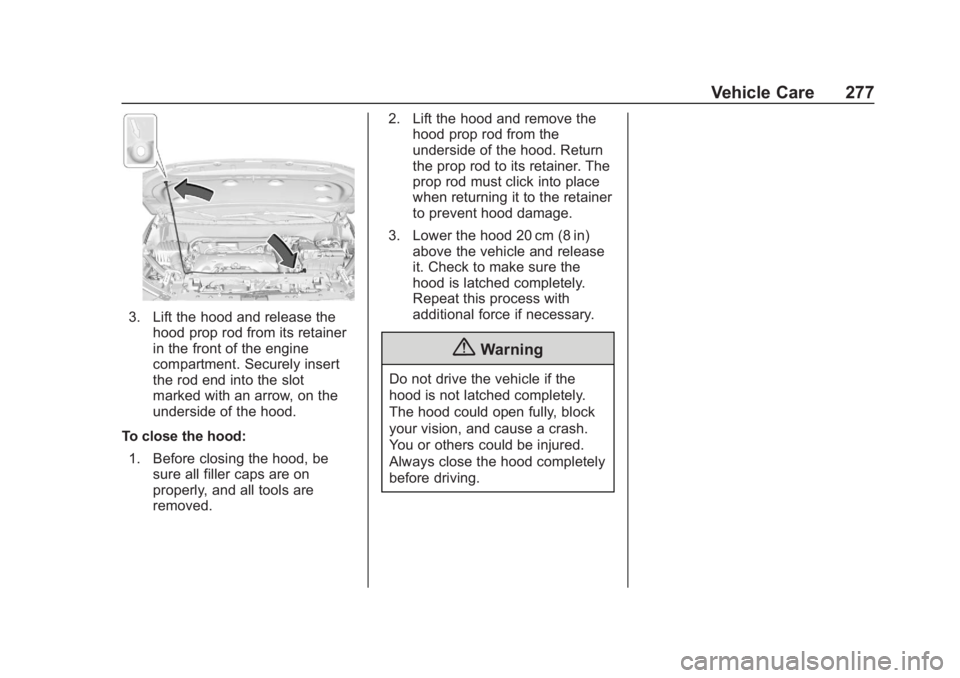
3. Lift the hood and release thehood prop rod from its retainer
in the front of the engine
compartment. Securely insert
the rod end into the slot
marked with an arrow, on the
underside of the hood.
To close the hood: 1. Before closing the hood, be sure all filler caps are on
properly, and all tools are
removed. 2. Lift the hood and remove the
hood prop rod from the
underside of the hood. Return
the prop rod to its retainer. The
prop rod must click into place
when returning it to the retainer
to prevent hood damage.
3. Lower the hood 20 cm (8 in) above the vehicle and release
it. Check to make sure the
hood is latched completely.
Repeat this process with
additional force if necessary.
{Warning
Do not drive the vehicle if the
hood is not latched completely.
The hood could open fully, block
your vision, and cause a crash.
You or others could be injured.
Always close the hood completely
before driving.
Page 281 of 425

GMC Terrain/Terrain Denali Owner Manual (GMNA-Localizing-U.S./Canada/
Mexico-13556230) - 2020 - CRC - 9/5/19
278 Vehicle Care
Engine Compartment Overview
1.5L Gas Engine
Page 282 of 425
GMC Terrain/Terrain Denali Owner Manual (GMNA-Localizing-U.S./Canada/
Mexico-13556230) - 2020 - CRC - 9/5/19
Vehicle Care 279
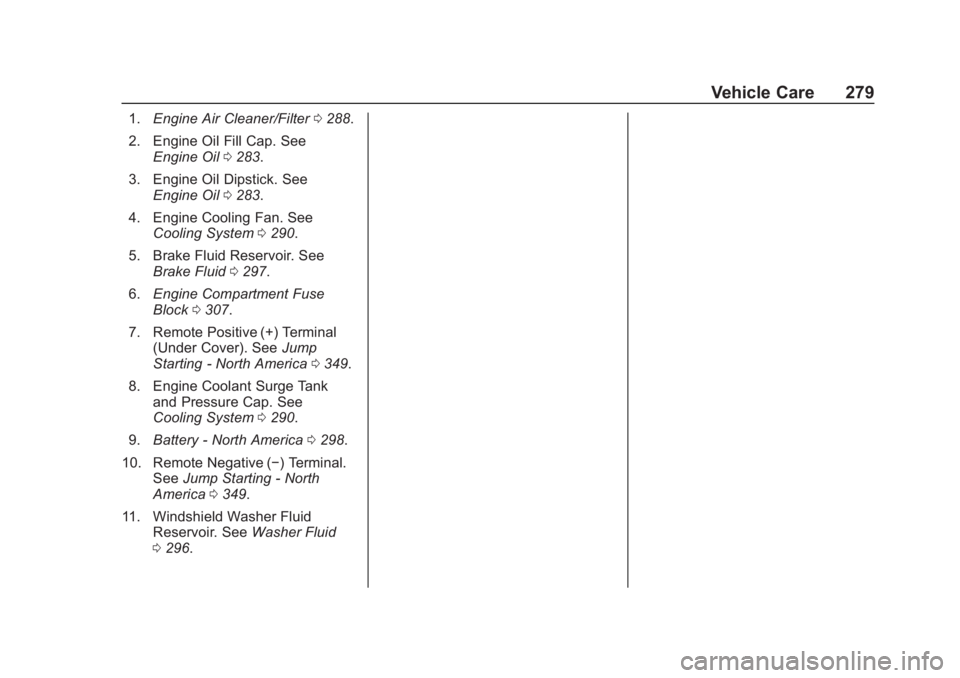
1.Engine Air Cleaner/Filter 0288.
2. Engine Oil Fill Cap. See Engine Oil 0283.
3. Engine Oil Dipstick. See Engine Oil 0283.
4. Engine Cooling Fan. See Cooling System 0290.
5. Brake Fluid Reservoir. See Brake Fluid 0297.
6. Engine Compartment Fuse
Block 0307.
7. Remote Positive (+) Terminal (Under Cover). See Jump
Starting - North America 0349.
8. Engine Coolant Surge Tank and Pressure Cap. See
Cooling System 0290.
9. Battery - North America 0298.
10. Remote Negative (−) Terminal. SeeJump Starting - North
America 0349.
11. Windshield Washer Fluid Reservoir. See Washer Fluid
0 296.
Page 284 of 425
GMC Terrain/Terrain Denali Owner Manual (GMNA-Localizing-U.S./Canada/
Mexico-13556230) - 2020 - CRC - 9/5/19
Vehicle Care 281
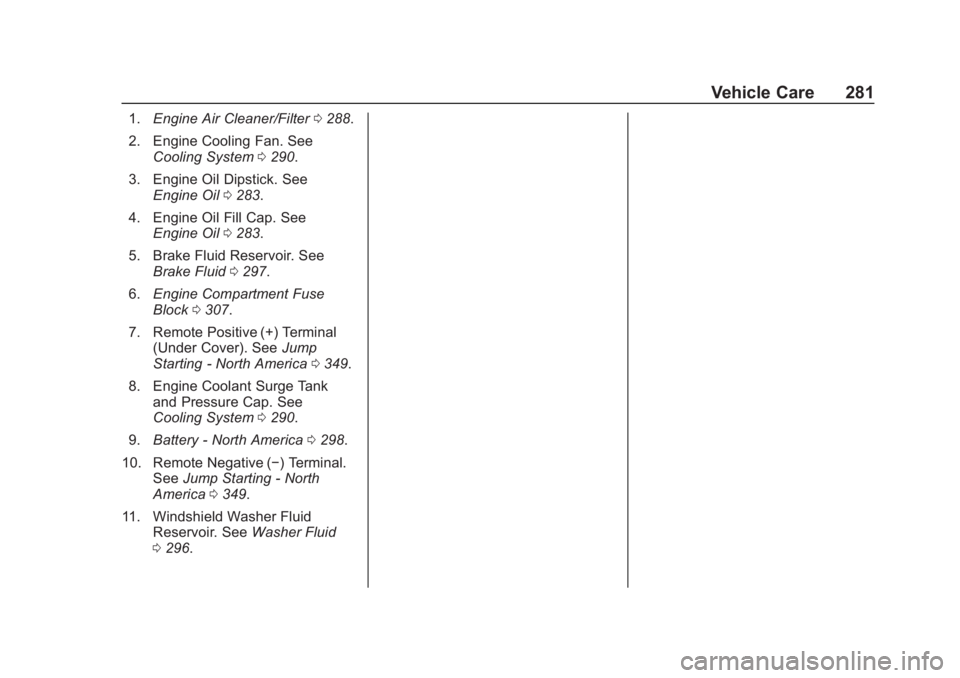
1.Engine Air Cleaner/Filter 0288.
2. Engine Cooling Fan. See Cooling System 0290.
3. Engine Oil Dipstick. See Engine Oil 0283.
4. Engine Oil Fill Cap. See Engine Oil 0283.
5. Brake Fluid Reservoir. See Brake Fluid 0297.
6. Engine Compartment Fuse
Block 0307.
7. Remote Positive (+) Terminal (Under Cover). See Jump
Starting - North America 0349.
8. Engine Coolant Surge Tank and Pressure Cap. See
Cooling System 0290.
9. Battery - North America 0298.
10. Remote Negative (−) Terminal. SeeJump Starting - North
America 0349.
11. Windshield Washer Fluid Reservoir. See Washer Fluid
0 296.
Page 286 of 425
GMC Terrain/Terrain Denali Owner Manual (GMNA-Localizing-U.S./Canada/
Mexico-13556230) - 2020 - CRC - 9/5/19
Vehicle Care 283
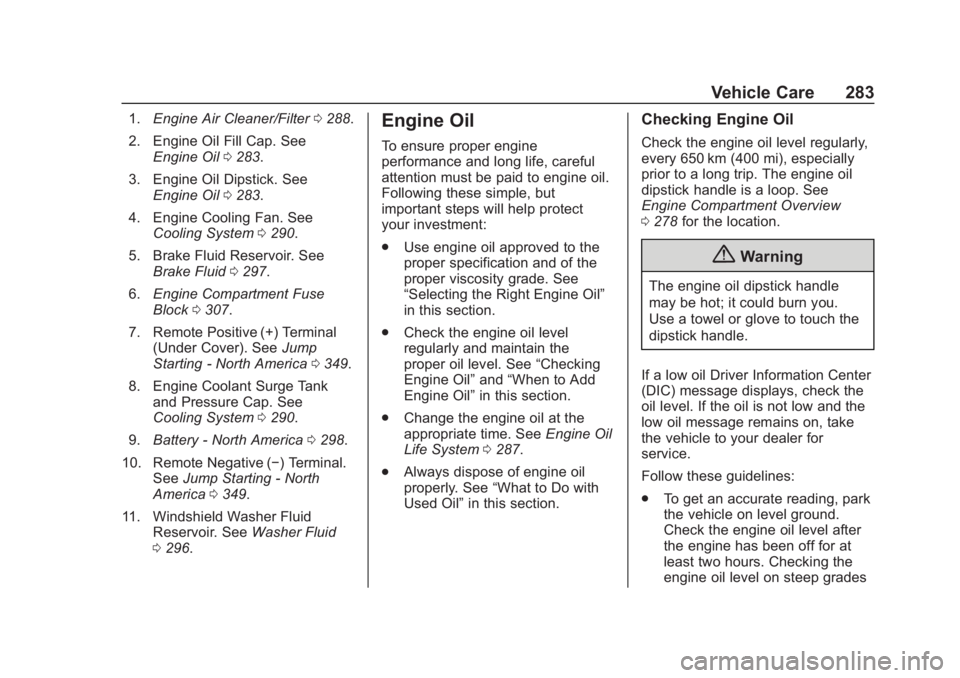
1.Engine Air Cleaner/Filter 0288.
2. Engine Oil Fill Cap. See Engine Oil 0283.
3. Engine Oil Dipstick. See Engine Oil 0283.
4. Engine Cooling Fan. See Cooling System 0290.
5. Brake Fluid Reservoir. See Brake Fluid 0297.
6. Engine Compartment Fuse
Block 0307.
7. Remote Positive (+) Terminal (Under Cover). See Jump
Starting - North America 0349.
8. Engine Coolant Surge Tank and Pressure Cap. See
Cooling System 0290.
9. Battery - North America 0298.
10. Remote Negative (−) Terminal. SeeJump Starting - North
America 0349.
11. Windshield Washer Fluid Reservoir. See Washer Fluid
0 296.Engine Oil
To ensure proper engine
performance and long life, careful
attention must be paid to engine oil.
Following these simple, but
important steps will help protect
your investment:
.
Use engine oil approved to the
proper specification and of the
proper viscosity grade. See
“Selecting the Right Engine Oil”
in this section.
. Check the engine oil level
regularly and maintain the
proper oil level. See “Checking
Engine Oil” and“When to Add
Engine Oil” in this section.
. Change the engine oil at the
appropriate time. See Engine Oil
Life System 0287.
. Always dispose of engine oil
properly. See “What to Do with
Used Oil” in this section.
Checking Engine Oil
Check the engine oil level regularly,
every 650 km (400 mi), especially
prior to a long trip. The engine oil
dipstick handle is a loop. See
Engine Compartment Overview
0278 for the location.
{Warning
The engine oil dipstick handle
may be hot; it could burn you.
Use a towel or glove to touch the
dipstick handle.
If a low oil Driver Information Center
(DIC) message displays, check the
oil level. If the oil is not low and the
low oil message remains on, take
the vehicle to your dealer for
service.
Follow these guidelines:
. To get an accurate reading, park
the vehicle on level ground.
Check the engine oil level after
the engine has been off for at
least two hours. Checking the
engine oil level on steep grades
Page 287 of 425
GMC Terrain/Terrain Denali Owner Manual (GMNA-Localizing-U.S./Canada/
Mexico-13556230) - 2020 - CRC - 9/5/19
284 Vehicle Care
or too soon after engine shutoff
can result in incorrect readings.
Accuracy improves when
checking a cold engine prior to
starting. Remove the dipstick
and check the level.
. If unable to wait two hours, the
engine must be off for at least
15 minutes if the engine is
warm, or at least 30 minutes if
the engine is not warm. Pull out
the dipstick, wipe it with a clean
paper towel or cloth, then push it
back in all the way. Remove it
again, keeping the tip down, and
check the level.
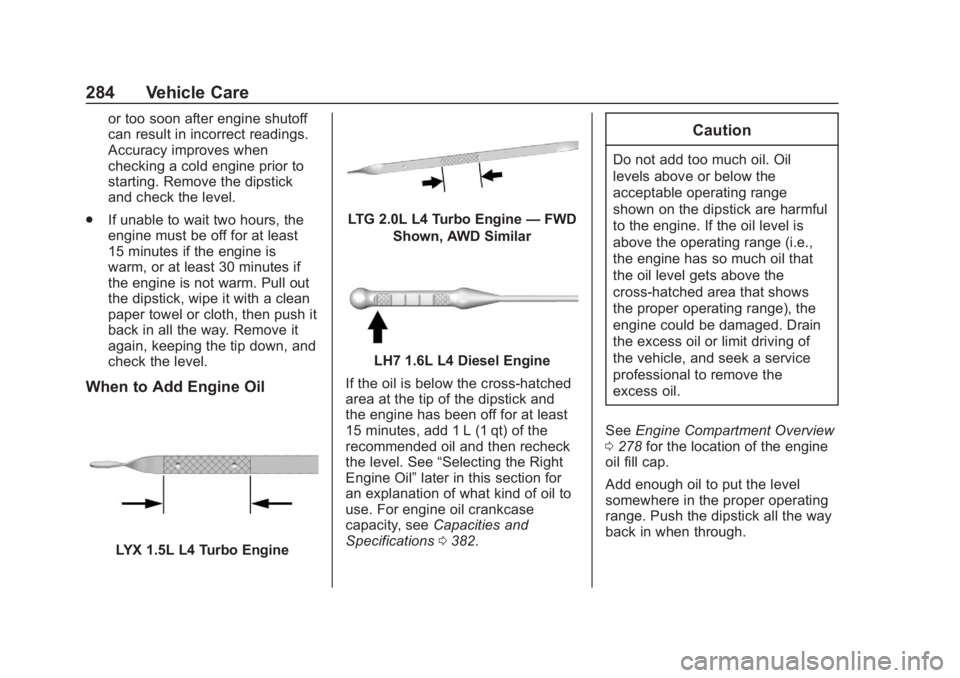
When to Add Engine Oil
LYX 1.5L L4 Turbo Engine
LTG 2.0L L4 Turbo Engine —FWD
Shown, AWD Similar
LH7 1.6L L4 Diesel Engine
If the oil is below the cross-hatched
area at the tip of the dipstick and
the engine has been off for at least
15 minutes, add 1 L (1 qt) of the
recommended oil and then recheck
the level. See “Selecting the Right
Engine Oil” later in this section for
an explanation of what kind of oil to
use. For engine oil crankcase
capacity, see Capacities and
Specifications 0382.
Caution
Do not add too much oil. Oil
levels above or below the
acceptable operating range
shown on the dipstick are harmful
to the engine. If the oil level is
above the operating range (i.e.,
the engine has so much oil that
the oil level gets above the
cross-hatched area that shows
the proper operating range), the
engine could be damaged. Drain
the excess oil or limit driving of
the vehicle, and seek a service
professional to remove the
excess oil.
See Engine Compartment Overview
0 278 for the location of the engine
oil fill cap.
Add enough oil to put the level
somewhere in the proper operating
range. Push the dipstick all the way
back in when through.