wheel GMC YUKON 2001 Repair Manual
[x] Cancel search | Manufacturer: GMC, Model Year: 2001, Model line: YUKON, Model: GMC YUKON 2001Pages: 419, PDF Size: 2.98 MB
Page 285 of 419
5-18
Changing a Flat Tire
If a tire goes flat, avoid further tire and wheel damage
by driving slowly to a level place. Turn on your hazard
warning flashers.
CAUTION:
Changing a tire can cause an injury. The vehicle
can slip off the jack and roll over you or other
people. You and they could be badly injured.
Find a level place to change your tire. To help
prevent the vehicle from moving:
1. Set the parking brake firmly.
2. Put an automatic transmission
shift lever in PARK (P) or shift a
manual transmission to FIRST (1)
or REVERSE (R).
3. Turn off the engine.
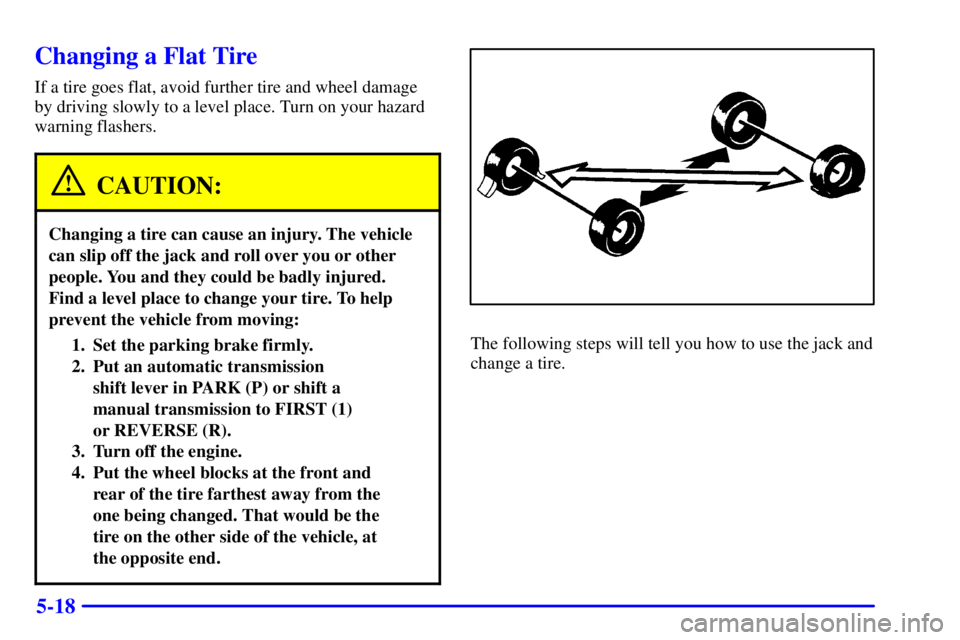
4. Put the wheel blocks at the front and
rear of the tire farthest away from the
one being changed. That would be the
tire on the other side of the vehicle, at
the opposite end.The following steps will tell you how to use the jack and
change a tire.
Page 287 of 419

5-20
Suburban/Yukon XL Models
A. Bottle Jack
B. Wheel Blocks
C. Wing Nut
D. Mounting Bracket
E. Removable TrayF. Retaining Hook
G. Retaining Bracket
and Wing Nut
H. Tool Kit with Jack
Tools and GlovesThe equipment you'll need is under the storage tray in
the left trim panel for Suburban/Yukon XL models.
For utility models, the equipment is located under the
rear seat behind the driver's seat and behind the left trim
panel in the rear of the vehicle. Skip the first step and
follow the last three.
1. Remove the tray to access the tools.
2. There is a wing nut used to retain the tool kit.
To remove it, turn the wing nut counterclockwise.
3. To release the bottle jack from its holder, turn the
knob on the bottle jack counterclockwise to lower
the jack head.
4. The wheel blocks and the wheel block retainer can be
removed by turning the wing nut counterclockwise.
You'll use the jack handle extensions and the wheel
wrench to remove the underbody-mounted spare tire.
Page 288 of 419

5-21
A. Hoist Assembly
B. Wheel Wrench
C. Jack Handle Extensions
D. Hoist Shaft
E. Valve Stem, Pointed Up
F. Spare Tire
G. Tire Retainer
H. Hoist Cable
I. Hoist Lock
J. Hoist Shaft Access Hole
K. Hoist End of Extension Tool
Page 289 of 419

5-22
Follow these instructions to lower the spare tire:
1. If the vehicle is equipped with a hoist lock, open the
spare tire lock cover on the bumper and use the
ignition key to remove the lock.
2. Assemble the wheel wrench and the two jack handle
extensions as shown. Insert the hoist end (open end)
of the extension through the hole in the rear bumper.
Be sure the hoist end of the extension connects into
the hoist shaft (the ribbed square end of the
extension is used to lower the spare tire).
3. Turn the wheel wrench counterclockwise to lower
the spare tire to the ground. Continue to turn the
wheel wrench until the spare tire can be pulled out
from under the vehicle. The wheel wrench has a
hook that allows you to pull the hoist cable towards
you, to assist in reaching the spare tire.
4. When the tire has been lowered, tilt the retainer at
the end of the cable so it can be pulled up through
the wheel opening.
5. Put the spare tire near the flat tire.
The tools you'll be using include the bottle jack (A),
the wheel blocks (B), the jack handle (C), the jack
handle extensions (D), and the wheel wrench (E).
If the flat tire is on the rear of the vehicle, you'll need
to use both jack handle extensions.
Page 290 of 419
5-23
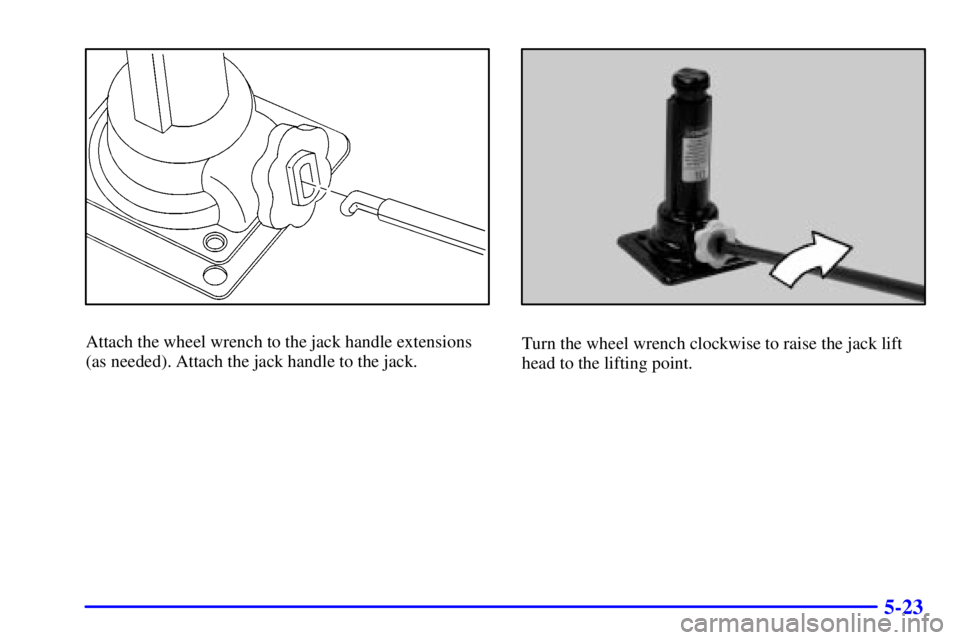
Attach the wheel wrench to the jack handle extensions
(as needed). Attach the jack handle to the jack.Turn the wheel wrench clockwise to raise the jack lift
head to the lifting point.
Page 291 of 419
5-24
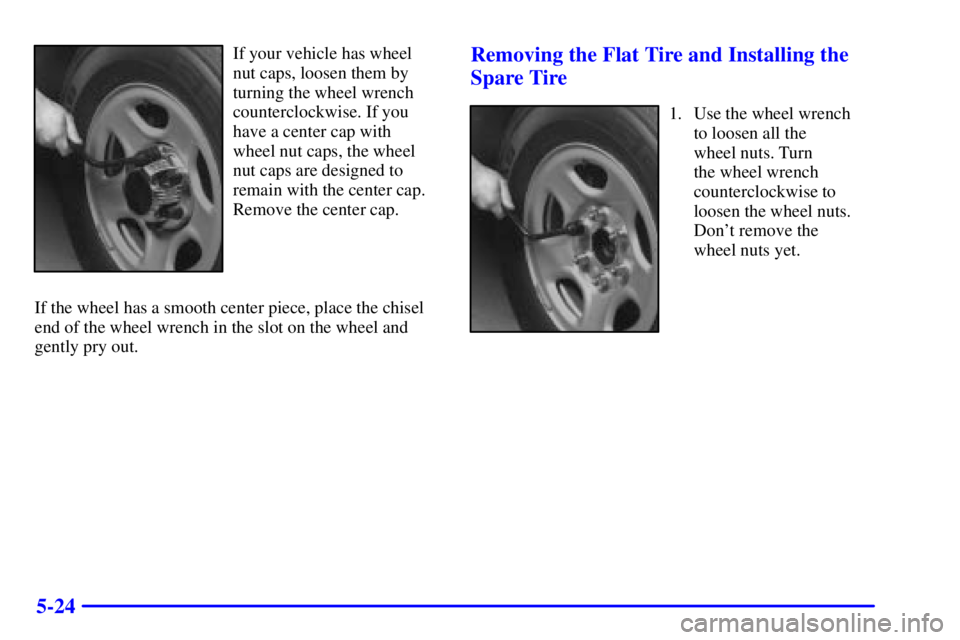
If your vehicle has wheel
nut caps, loosen them by
turning the wheel wrench
counterclockwise. If you
have a center cap with
wheel nut caps, the wheel
nut caps are designed to
remain with the center cap.
Remove the center cap.
If the wheel has a smooth center piece, place the chisel
end of the wheel wrench in the slot on the wheel and
gently pry out.Removing the Flat Tire and Installing the
Spare Tire
1. Use the wheel wrench
to loosen all the
wheel nuts. Turn
the wheel wrench
counterclockwise to
loosen the wheel nuts.
Don't remove the
wheel nuts yet.
Page 293 of 419
5-26
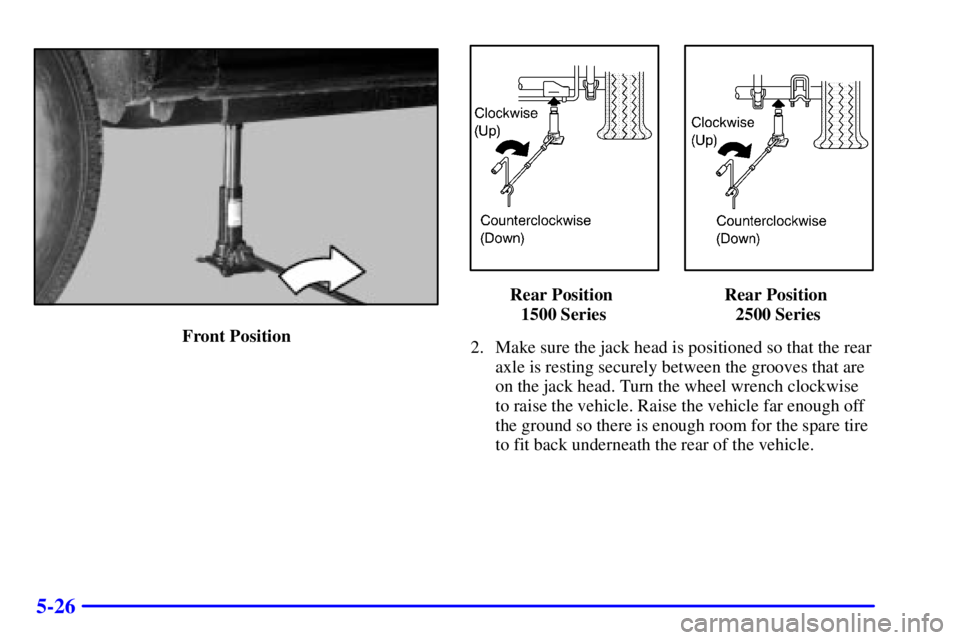
Front Position
Rear Position
1500 SeriesRear Position
2500 Series
2. Make sure the jack head is positioned so that the rear
axle is resting securely between the grooves that are
on the jack head. Turn the wheel wrench clockwise
to raise the vehicle. Raise the vehicle far enough off
the ground so there is enough room for the spare tire
to fit back underneath the rear of the vehicle.
Page 294 of 419
5-27
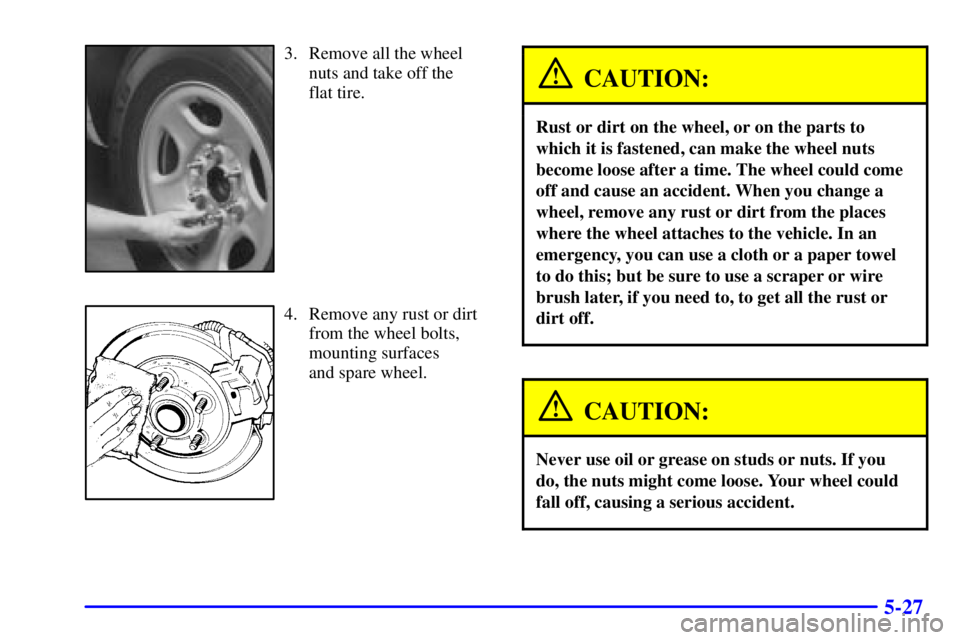
3. Remove all the wheel
nuts and take off the
flat tire.
4. Remove any rust or dirt
from the wheel bolts,
mounting surfaces
and spare wheel.
CAUTION:
Rust or dirt on the wheel, or on the parts to
which it is fastened, can make the wheel nuts
become loose after a time. The wheel could come
off and cause an accident. When you change a
wheel, remove any rust or dirt from the places
where the wheel attaches to the vehicle. In an
emergency, you can use a cloth or a paper towel
to do this; but be sure to use a scraper or wire
brush later, if you need to, to get all the rust or
dirt off.
CAUTION:
Never use oil or grease on studs or nuts. If you
do, the nuts might come loose. Your wheel could
fall off, causing a serious accident.
Page 295 of 419
5-28
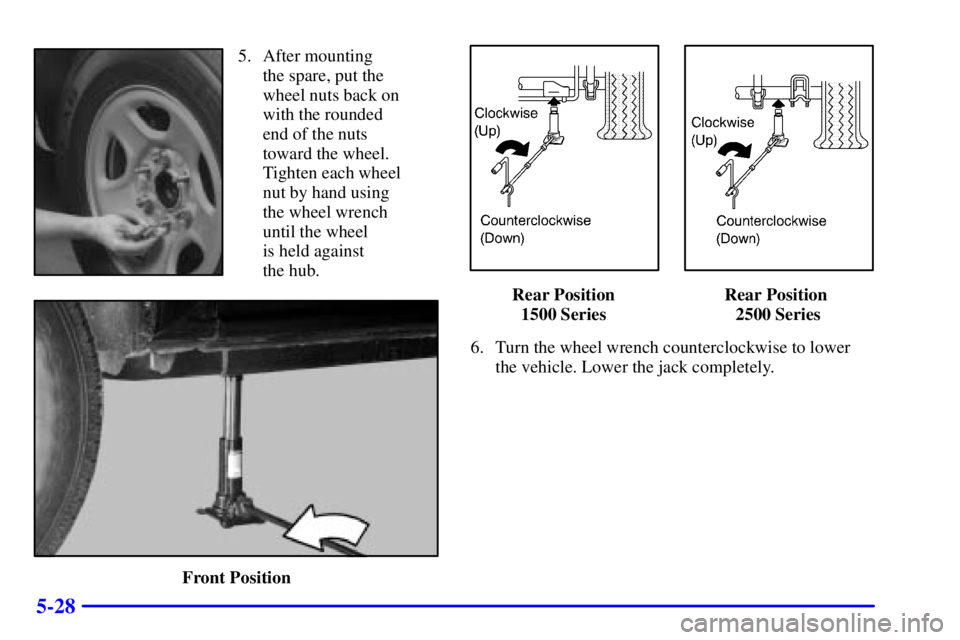
5. After mounting
the spare, put the
wheel nuts back on
with the rounded
end of the nuts
toward the wheel.
Tighten each wheel
nut by hand using
the wheel wrench
until the wheel
is held against
the hub.
Front Position
Rear Position
1500 SeriesRear Position
2500 Series
6. Turn the wheel wrench counterclockwise to lower
the vehicle. Lower the jack completely.
Page 296 of 419
5-29
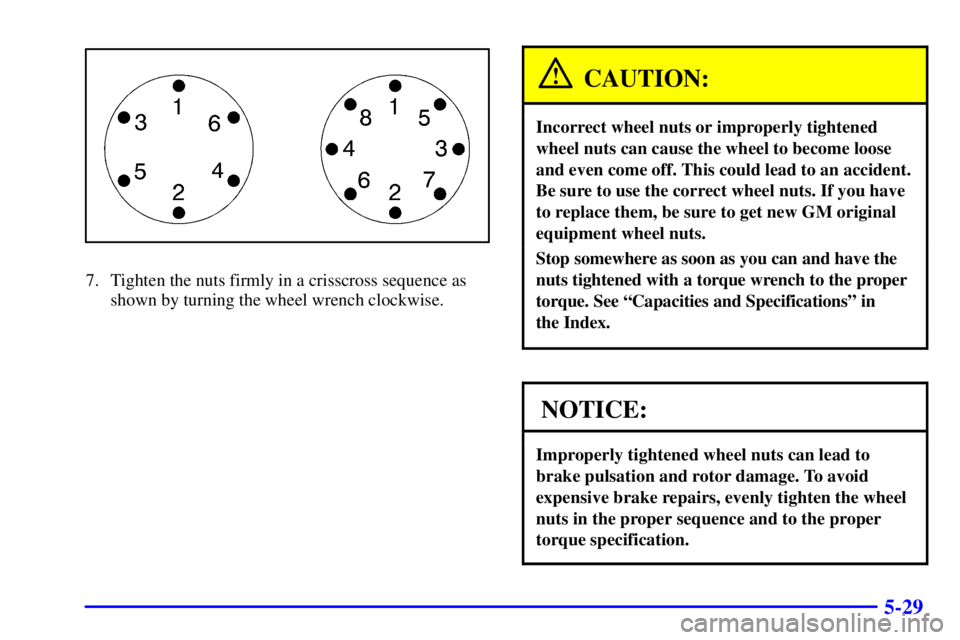
7. Tighten the nuts firmly in a crisscross sequence as
shown by turning the wheel wrench clockwise.
CAUTION:
Incorrect wheel nuts or improperly tightened
wheel nuts can cause the wheel to become loose
and even come off. This could lead to an accident.
Be sure to use the correct wheel nuts. If you have
to replace them, be sure to get new GM original
equipment wheel nuts.
Stop somewhere as soon as you can and have the
nuts tightened with a torque wrench to the proper
torque. See ªCapacities and Specificationsº in
the Index.
NOTICE:
Improperly tightened wheel nuts can lead to
brake pulsation and rotor damage. To avoid
expensive brake repairs, evenly tighten the wheel
nuts in the proper sequence and to the proper
torque specification.