change wheel GMC YUKON 2002 User Guide
[x] Cancel search | Manufacturer: GMC, Model Year: 2002, Model line: YUKON, Model: GMC YUKON 2002Pages: 443, PDF Size: 2.97 MB
Page 302 of 443

5-19
Changing a Flat Tire
If a tire goes flat, avoid further tire and wheel damage
by driving slowly to a level place. Turn on your hazard
warning flashers.
CAUTION:
Changing a tire can cause an injury. The vehicle
can slip off the jack and roll over you or other
people. You and they could be badly injured.
Find a level place to change your tire. To help
prevent the vehicle from moving:
1. Set the parking brake firmly.
2. Put an automatic transmission
shift lever in PARK (P) or shift a
manual transmission to FIRST (1)
or REVERSE (R).
3. Turn off the engine.
4. Put the wheel blocks at the front and
rear of the tire farthest away from the
one being changed. That would be the
tire on the other side of the vehicle, at
the opposite end.The following steps will tell you how to use the jack and
change a tire.
Page 311 of 443

5-28
4. Remove all the wheel
nuts and take off the
flat tire.
5. Remove any rust or dirt
from the wheel bolts,
mounting surfaces and
spare wheel.
CAUTION:
Rust or dirt on the wheel, or on the parts to
which it is fastened, can make the wheel nuts
become loose after a time. The wheel could come
off and cause an accident. When you change a
wheel, remove any rust or dirt from the places
where the wheel attaches to the vehicle. In an
emergency, you can use a cloth or a paper towel
to do this; but be sure to use a scraper or wire
brush later, if you need to, to get all the rust or
dirt off.
CAUTION:
Never use oil or grease on studs or nuts. If you
do, the nuts might come loose. Your wheel could
fall off, causing a serious accident.
Page 372 of 443
6-51 Tire Inspection and Rotation
Tires should be rotated every 6,000 to 8,000 miles
(10 000 to 13 000 km). Any time you notice unusual
wear, rotate your tires as soon as possible and check
wheel alignment. Also check for damaged tires or wheels.
See ªWhen It's Time for New Tiresº and ªWheel
Replacementº later in this section for more information.
Make sure the spare tire is stored securely. Push, pull, and
then try to rotate or turn the tire. If it moves, use the
ratchet/wheel wrench to tighten the cable. See ªStoring a
Flat or Spare Tire and Toolsº in the Index.
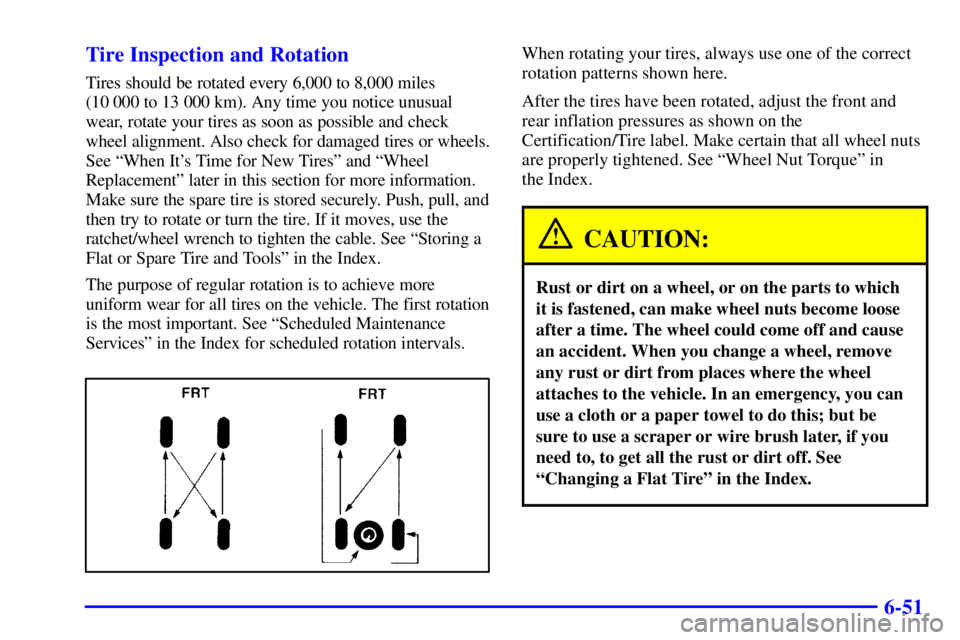
The purpose of regular rotation is to achieve more
uniform wear for all tires on the vehicle. The first rotation
is the most important. See ªScheduled Maintenance
Servicesº in the Index for scheduled rotation intervals.
When rotating your tires, always use one of the correct
rotation patterns shown here.
After the tires have been rotated, adjust the front and
rear inflation pressures as shown on the
Certification/Tire label. Make certain that all wheel nuts
are properly tightened. See ªWheel Nut Torqueº in
the Index.
CAUTION:
Rust or dirt on a wheel, or on the parts to which
it is fastened, can make wheel nuts become loose
after a time. The wheel could come off and cause
an accident. When you change a wheel, remove
any rust or dirt from places where the wheel
attaches to the vehicle. In an emergency, you can
use a cloth or a paper towel to do this; but be
sure to use a scraper or wire brush later, if you
need to, to get all the rust or dirt off. See
ªChanging a Flat Tireº in the Index.
Page 421 of 443

7-18 At Least Twice a Year
Restraint System Check
Make sure the safety belt reminder light and all your
belts, buckles, latch plates, retractors and anchorages are
working properly. Look for any other loose or damaged
safety belt system parts. If you see anything that might
keep a safety belt system from doing its job, have it
repaired. Have any torn or frayed safety belts replaced.
Also look for any opened or broken air bag coverings,
and have them repaired or replaced. (The air bag system
does not need regular maintenance.)
Wiper Blade Check
Inspect wiper blades for wear or cracking. Replace blade
inserts that appear worn or damaged or that streak or
miss areas of the windshield. Also see ªWiper Blades,
Cleaningº in the Index.Spare Tire Check
At least twice a year, after the monthly inflation check
of the spare tire determines that the spare is inflated to
the correct tire inflation pressure, make sure that the
spare tire is stored securely. Push, pull, and then try to
rotate or turn the tire. If it moves, use the wheel
wrench/ratchet to tighten the cable. See ªStoring the
Spare Tire and Toolsº in the Index.
Engine Air Cleaner Filter Restriction
Indicator Check
Your vehicle has an indicator located on the air cleaner
in the engine compartment that lets you know when the
air cleaner filter is dirty and needs to be changed. Check
indicator at least twice a year or when your engine oil is
changed, whichever occurs first. See ªAir Cleanerº in
the Index for more information. Inspect your air cleaner
filter restriction indicator more often if the vehicle is
used in dusty areas or under off road conditions.
Page 426 of 443
7-23 Fuel System Inspection
Inspect the complete fuel system for damage or leaks.
Engine Cooling System Inspection
Inspect the hoses and have them replaced if they are
cracked, swollen or deteriorated. Inspect all pipes,
fittings and clamps; replace as needed. Clean the outside
of the radiator and air conditioning condenser. To help
ensure proper operation, a pressure test of the cooling
system and pressure cap is recommended at least once
a year.
Throttle System Inspection
Inspect the throttle system for interference or binding,
and for damaged or missing parts. Replace parts as
needed. Replace any components that have high effort
or excessive wear. Do not lubricate accelerator and
cruise control cables.
Transfer Case and Front Axle
(Four-Wheel Drive) Inspection
Every 12 months or at engine oil change intervals, check
front axle and transfer case and add lubricant when
necessary. A fluid loss could indicate a problem; check
and have it repaired, if needed. On manual shift transfer
case, oil the control lever pivot point. Check vent hose at
transfer case for kinks and proper installation. More
frequent lubrication may be required on off
-road use.
Brake System Inspection
Inspect the complete system. Inspect brake lines and
hoses for proper hook
-up, binding, leaks, cracks,
chafing, etc. Inspect disc brake pads for wear and rotors
for surface condition. Inspect other brake parts,
including calipers, parking brake, etc. You may need to
have your brakes inspected more often if your driving
habits or conditions result in frequent braking.