ECU GMC YUKON 2003 Owner's Guide
[x] Cancel search | Manufacturer: GMC, Model Year: 2003, Model line: YUKON, Model: GMC YUKON 2003Pages: 520, PDF Size: 2.92 MB
Page 70 of 520

To remove the child restraint, just unbuckle the vehicle’s
safety belt and let it go back all the way. The safety
belt will move freely again and be ready to work for an
adult or larger child passenger.
Securing a Child Restraint in a
Center Rear Seat Position
If your child restraint is equipped with the LATCH
system, seeLower Anchorages and Top Tethers for
Children (LATCH System) on page 1-58. SeeTop Strap
on page 1-54if the child restraint has one.
Second Row
The center seat position in the second row has a
lap-shoulder belt which works the same way as the
safety belt in the rear outside seat positions. For
instructions on how to secure a child restraint using a
lap-shoulder belt seeSecuring a Child Restraint in
a Rear Outside Seat Position on page 1-61.
Third Row
The center seat position in the third row has a lap belt.
Be sure to follow the instructions that came with the
child restraint. Secure the child in the child restraint
when and as the instructions say.
1-64
2003 - Yukon/Yukon XL
Page 71 of 520
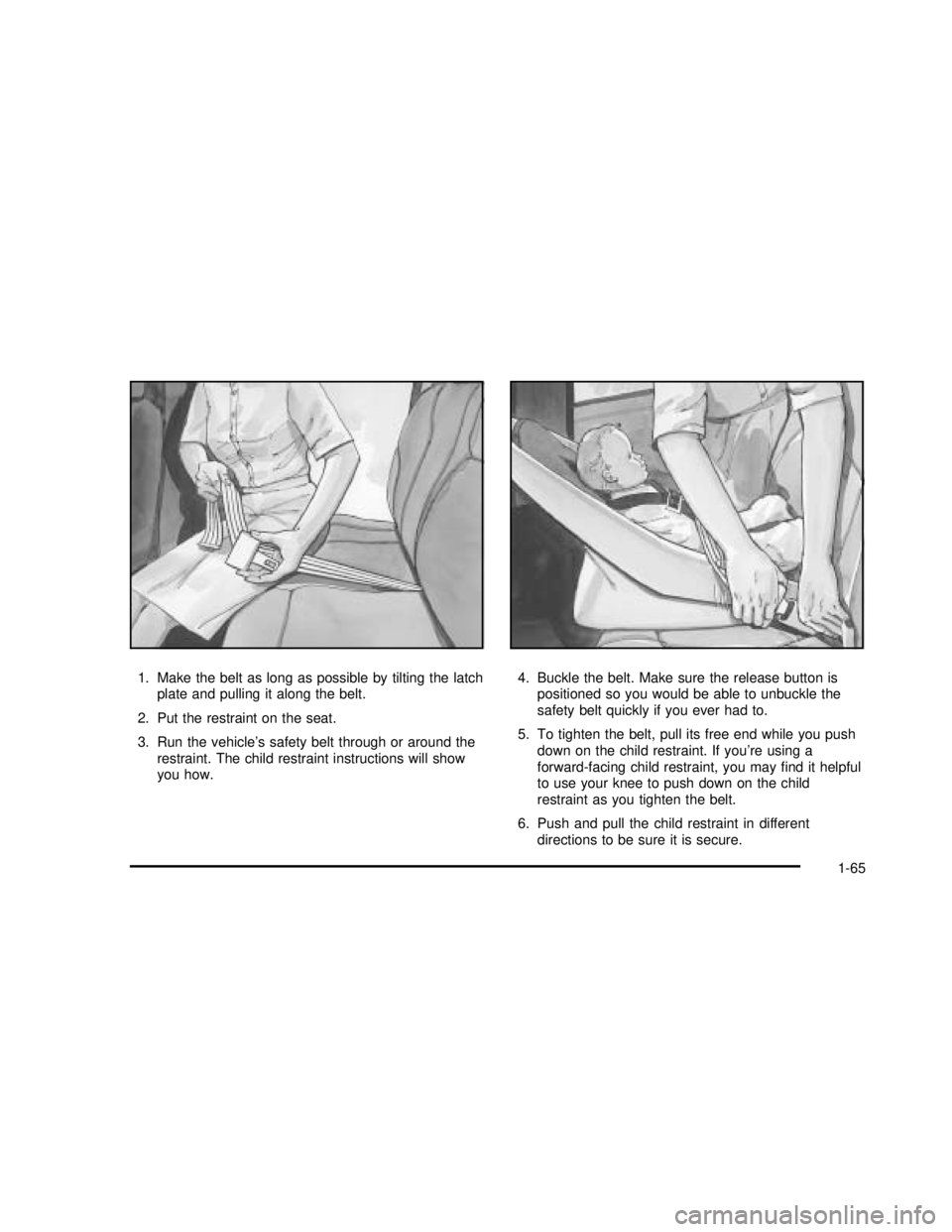
1. Make the belt as long as possible by tilting the latch
plate and pulling it along the belt.
2. Put the restraint on the seat.
3. Run the vehicle’s safety belt through or around the
restraint. The child restraint instructions will show
you how.4. Buckle the belt. Make sure the release button is
positioned so you would be able to unbuckle the
safety belt quickly if you ever had to.
5. To tighten the belt, pull its free end while you push
down on the child restraint. If you’re using a
forward-facing child restraint, you mayfind it helpful
to use your knee to push down on the child
restraint as you tighten the belt.
6. Push and pull the child restraint in different
directions to be sure it is secure.
1-65
2003 - Yukon/Yukon XL
Page 72 of 520

To remove the child restraint, just unbuckle the vehicle’s
safety belt. It will be ready to work for an adult or
larger child passenger.
Securing a Child Restraint in the
Center Front Seat Position
Don’t use child restraints in this position. The restraints
won’t work properly.
Securing a Child Restraint in the
Right Front Seat Position
1-66
2003 - Yukon/Yukon XL
Page 73 of 520
Your vehicle has a right front passenger air bag.
Although a rear seat is a safer place, you can secure a
forward-facing child restraint in the right front seat.
Unless your vehicle has the passenger sensing system,
Neverput a rear-facing child restraint in this seat.
Here’s why:
{CAUTION:
A child in a rear-facing child restraint can be
seriously injured or killed if the right front
passenger’s air bag inflates. This is because
the back of the rear-facing child restraint
would be very close to the inflating air bag.
Always secure a rear-facing child restraint in a
rear seat unless the air bag is off.
If your vehicle has the passenger sensing system and
you need to secure a rear-facing child restraint in
the right front passenger’s seat, the passenger’s air bag
must be off. SeePassenger Sensing System on
page 1-81andPassenger Air Bag Status Indicator on
page 3-40for more information on this including
important safety information.
{CAUTION:
A child in a rear-facing child restraint can be
seriously injured or killed if the right front
passenger’s air bag inflates. This is because the
back of the rear facing child restraint would be
very close to the inflating air bag. Be sure the air
bag is off before using a rear-facing child
restraint in the right front seat position.
Even though the passenger sensing system is
designed to turn off the passenger’s frontal air
bag if the system detects a rear-facing child
restraint, no system is fail-safe, and no one can
guarantee that an air bag will not deploy under
some unusual circumstance, even though it is
turned off. General Motors therefore
recommends that rear-facing child restraints be
secured in the rear seat whenever possible,
even if the air bag is off.
1-67
2003 - Yukon/Yukon XL
Page 74 of 520
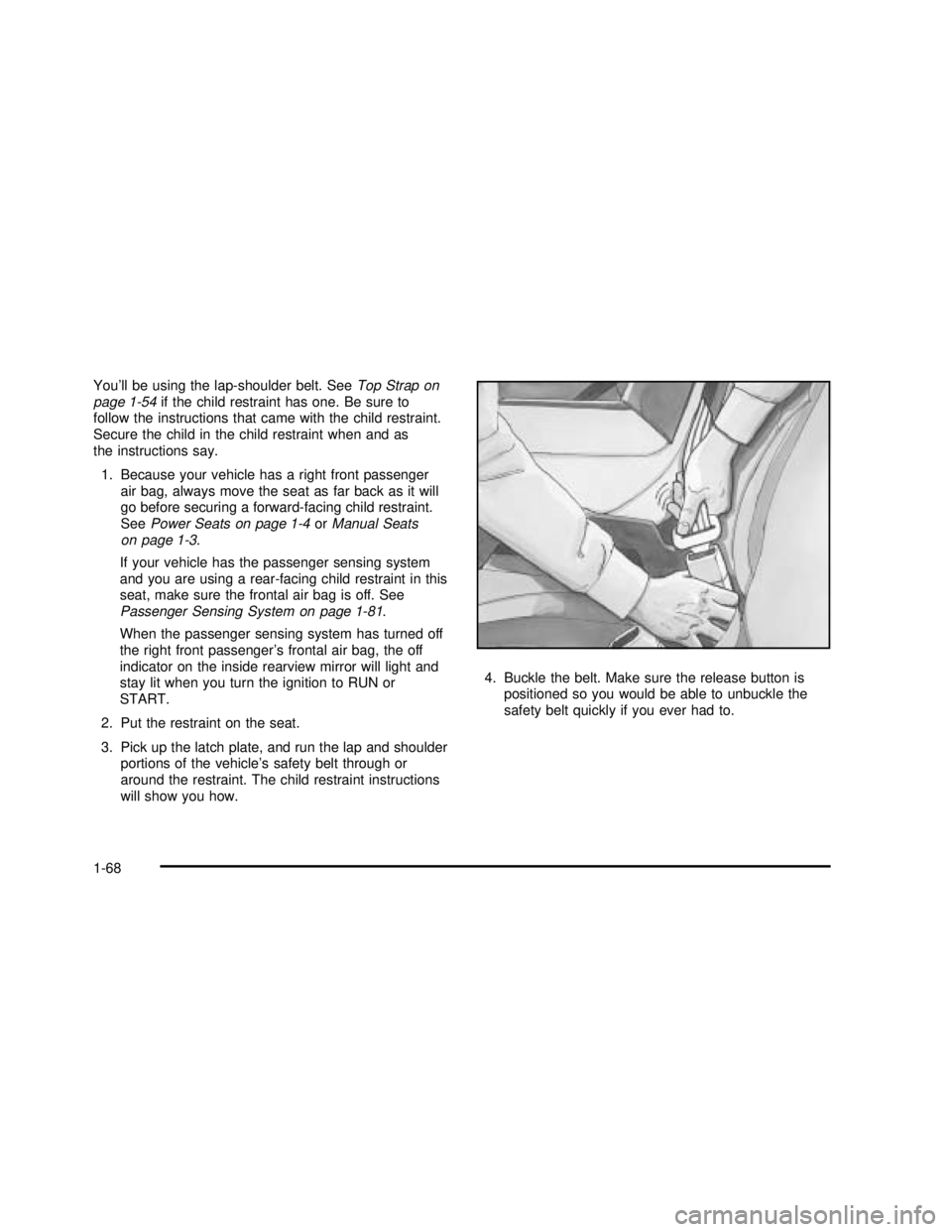
You’ll be using the lap-shoulder belt. SeeTop Strap on
page 1-54if the child restraint has one. Be sure to
follow the instructions that came with the child restraint.
Secure the child in the child restraint when and as
the instructions say.
1. Because your vehicle has a right front passenger
air bag, always move the seat as far back as it will
go before securing a forward-facing child restraint.
SeePower Seats on page 1-4orManual Seats
on page 1-3.
If your vehicle has the passenger sensing system
and you are using a rear-facing child restraint in this
seat, make sure the frontal air bag is off. See
Passenger Sensing System on page 1-81.
When the passenger sensing system has turned off
the right front passenger’s frontal air bag, the off
indicator on the inside rearview mirror will light and
stay lit when you turn the ignition to RUN or
START.
2. Put the restraint on the seat.
3. Pick up the latch plate, and run the lap and shoulder
portions of the vehicle’s safety belt through or
around the restraint. The child restraint instructions
will show you how.4. Buckle the belt. Make sure the release button is
positioned so you would be able to unbuckle the
safety belt quickly if you ever had to.
1-68
2003 - Yukon/Yukon XL
Page 75 of 520
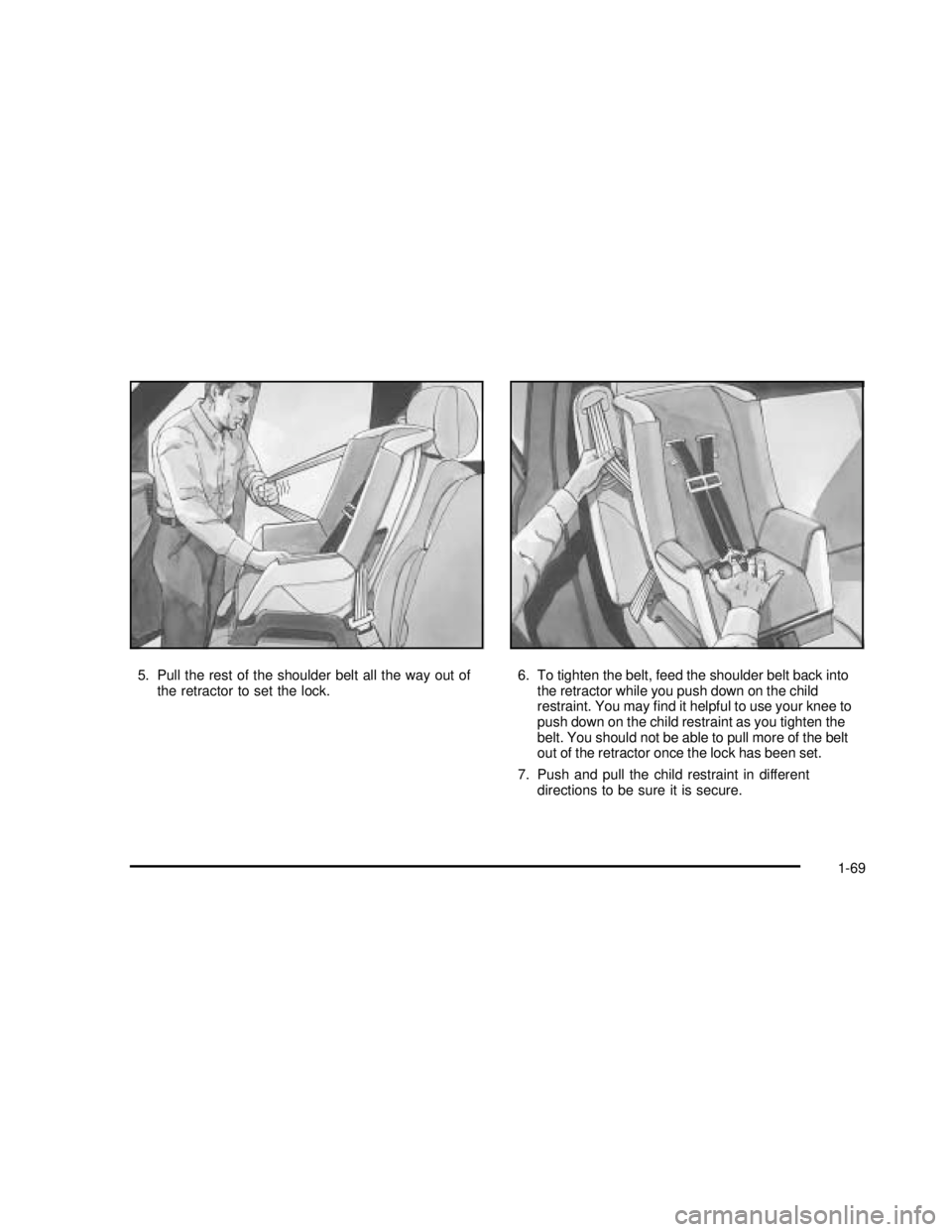
5. Pull the rest of the shoulder belt all the way out of
the retractor to set the lock.6. To tighten the belt, feed the shoulder belt back into
the retractor while you push down on the child
restraint. You mayfind it helpful to use your knee to
push down on the child restraint as you tighten the
belt. You should not be able to pull more of the belt
out of the retractor once the lock has been set.
7. Push and pull the child restraint in different
directions to be sure it is secure.
1-69
2003 - Yukon/Yukon XL
Page 79 of 520
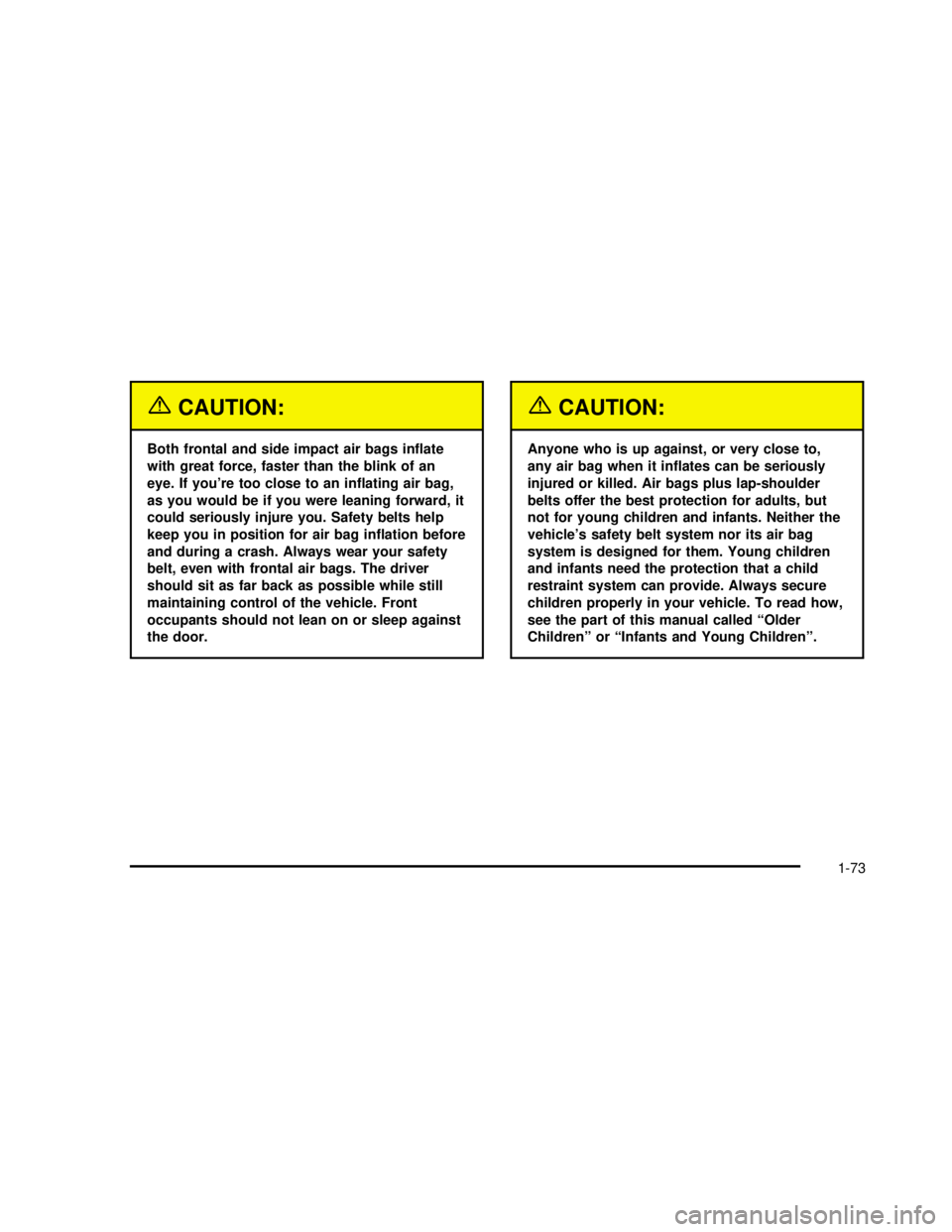
{CAUTION:
Both frontal and side impact air bags inflate
with great force, faster than the blink of an
eye. If you’re too close to an inflating air bag,
as you would be if you were leaning forward, it
could seriously injure you. Safety belts help
keep you in position for air bag inflation before
and during a crash. Always wear your safety
belt, even with frontal air bags. The driver
should sit as far back as possible while still
maintaining control of the vehicle. Front
occupants should not lean on or sleep against
the door.
{CAUTION:
Anyone who is up against, or very close to,
any air bag when it inflates can be seriously
injured or killed. Air bags plus lap-shoulder
belts offer the best protection for adults, but
not for young children and infants. Neither the
vehicle’s safety belt system nor its air bag
system is designed for them. Young children
and infants need the protection that a child
restraint system can provide. Always secure
children properly in your vehicle. To read how,
see the part of this manual called “Older
Children” or “Infants and Young Children”.
1-73
2003 - Yukon/Yukon XL
Page 88 of 520

The passenger sensing system works with sensors that
are part of the right front passenger’s seat and safety
belt. The sensors are designed to detect the presence of
a properly-seated occupant and determine if the
passenger’s frontal air bag should be enabled (may
inflate) or not.
Accident statistics show that children are safer if they
are restrained in the rear rather than the front seat.
General Motors, therefore, recommends that child
restraints be secured in a rear seat, including an infant
riding in a rear-facing infant seat, a child riding in a
forward-facing child seat and an older child riding in a
booster seat. Never put a child in rear-facing child
restraint in the right front passenger seat unless your
vehicle has the passenger sensing system and the
passenger air bag status indicator shows off. Never put
a rear-facing child restraint in the right front passenger
seat unless the air bag is off.
{CAUTION:
A child in a rear-facing child restraint can be
seriously injured or killed if the right front
passenger’s air bag inflates. This is because
the back of the rear-facing child restraint
would be very close to the inflating air bag. Be
sure the air bag is off before using a
rear-facing child restraint in the right front seat
position.
Even though the passenger sensing system is
designed to turn off the passenger’s frontal air
bag if the system detects a rear-facing child
restraint, no system is fail-safe, and no one
can guarantee that an air bag will not deploy
under some unusual circumstance, even
though it is turned off. General Motors,
therefore, recommends that rear-facing child
restraints be secured in the rear seat whenever
possible, even if the air bag is off.
1-82
2003 - Yukon/Yukon XL
Page 89 of 520

The passenger sensing system is designed to turn off
the right front passenger’s frontal air bag if:
•the right front passenger seat is unoccupied
•the system determines that an infant is present in a
rear-facing infant seat
•the system determines that a small child is present
in a forward-facing child restraint
•the system determines that a small child is present
in a booster seat
•a right front passenger takes his/her weight off of
the seat for a period of time
•the right front passenger seat is occupied by a
smaller person, such as a child who has outgrown
child restraints
•or if there is a critical problem with the air bag
system or the passenger sensing system.
When the passenger sensing system has turned off the
passenger’s frontal air bag, the off indicator will light
and stay lit to remind you that the air bag is off.
The passenger sensing system is designed to turn off
the passenger’s frontal air bag when a rear facing infant
seat, a forward-facing child restraint or a booster seatis detected. If the child restraint has been installed and
the on indicator is lit, turn the vehicle off, remove
the child restraint from the vehicle and reinstall the
restraint following the child restraint manufacturer’s
directions and refer toSecuring a Child Restraint in the
Right Front Seat Position on page 1-66of this manual.
If after reinstalling the child restraint and restarting
the vehicle, the on indicator is still lit, secure the child in
the child restraint in a rear seat position in the vehicle
and check with your dealer.
The passenger sensing system is designed to enable
(may inflate) the right front passenger’s frontal air
bag anytime the system senses that a person of adult
size is sitting properly in the right front passenger’s seat.
When the passenger sensing system has allowed the
air bag to be enabled, the on indicator will light and stay
lit to remind you that the air bag is active.
For some children who have outgrown child restraints
and for very small adults, the passenger sensing system
may or may not turn off the right front passenger’s
frontal air bag, depending upon the person’s seating
posture and body build. Everyone in your vehicle
who has outgrown child restraints should wear a safety
belt properly—whether or not there is an air bag
for that person.
1-83
2003 - Yukon/Yukon XL
Page 92 of 520

Adding Equipment to Your Air
Bag-Equipped Vehicle
Q:Is there anything I might add to the front or
sides of the vehicle that could keep the air
bags from working properly?
A:Yes. If you add things that change your vehicle’s
frame, bumper system, front end or side sheet
metal or height, they may keep the air bag system
from working properly. Also, the air bag system
may not work properly if you relocate any of the air
bag sensors. If you have any questions about
this, you should contact Customer Assistance
before you modify your vehicle. The phone
numbers and addresses for Customer Assistance
are in Step Two of the Customer Satisfaction
Procedure in this manual. SeeCustomer
Satisfaction Procedure on page 7-2.
Restraint System Check
Checking Your Restraint Systems
Now and then, make sure the safety belt reminder light
and all your belts, buckles, latch plates, retractors
and anchorages are working properly. Look for any other
loose or damaged safety belt system parts. If you see
anything that might keep a safety belt system from doing
its job, have it repaired.
Torn or frayed safety belts may not protect you in a
crash. They can rip apart under impact forces. If a belt
is torn or frayed, get a new one right away.
Also look for any opened or broken air bag covers, and
have them repaired or replaced. (The air bag system
does not need regular maintenance.)
1-86
2003 - Yukon/Yukon XL