roof GMC YUKON 2006 User Guide
[x] Cancel search | Manufacturer: GMC, Model Year: 2006, Model line: YUKON, Model: GMC YUKON 2006Pages: 540, PDF Size: 3.14 MB
Page 315 of 540

Before You Go Off-Roading
There are some things to do before you go out. For
example, be sure to have all necessary maintenance
and service work done. Check to make sure all
underbody shields (if equipped) are properly attached.
Be sure you read all the information about your
four-wheel-drive or all-wheel-drive vehicle in this manual.
Is there enough fuel? Is the spare tire fully inated?
Are the uid levels up where they should be? What
are the local laws that apply to off-roading where you will
be driving? If you do not know, you should check with
law enforcement people in the area. Will you be on
someone’s private land? If so, be sure to get the
necessary permission.
Loading Your Vehicle for Off-Road
Driving
There are some important things to remember about
how to load your vehicle.
The heaviest things should be on the load oor and
forward of your rear axle. Put heavier items as far
forward as you can.
Be sure the load is secured properly, so driving on
the off-road terrain does not toss things around.
{CAUTION:
Cargo on the load oor piled higher than
the seatbacks can be thrown forward
during a sudden stop. You or your
passengers could be injured. Keep cargo
below the top of the seatbacks.
Unsecured cargo on the load oor can be
tossed about when driving over rough
terrain. You or your passengers can be
struck by ying objects. Secure the cargo
properly.
Heavy loads on the roof raise the vehicle’s
center of gravity, making it more likely to
roll over. You can be seriously or fatally
injured if the vehicle rolls over. Put heavy
loads inside the cargo area, not on the
roof. Keep cargo in the cargo area as far
forward and low as possible.
You will nd other important information in this manual.
SeeLoading Your Vehicle on page 4-46andTires
on page 5-57.
4-19
Page 351 of 540
Q:What is total vehicle reserve capacity?
A:This is the difference between your GVWR and
the weight of your vehicle with full fuel and
passengers. It is the amount of weight you can
add to your vehicle before reaching your GVWR.
Keep in mind that reserve capacity numbers
are intended as a guide when selecting the amount
of equipment or cargo your vehicle can carry.
If you are unsure of your vehicle’s front, rear, or
total weight, go to a weigh station and weigh your
vehicle. Your dealer can also help you with this.
The total vehicle reserve capacity for your
vehicle can be found in the lower right corner of
the Certication/Tire label as shown previously.
See your dealer for additional advice and information
about using a snow plow on your vehicle. Also,
seeLoading Your Vehicle on page 4-46.
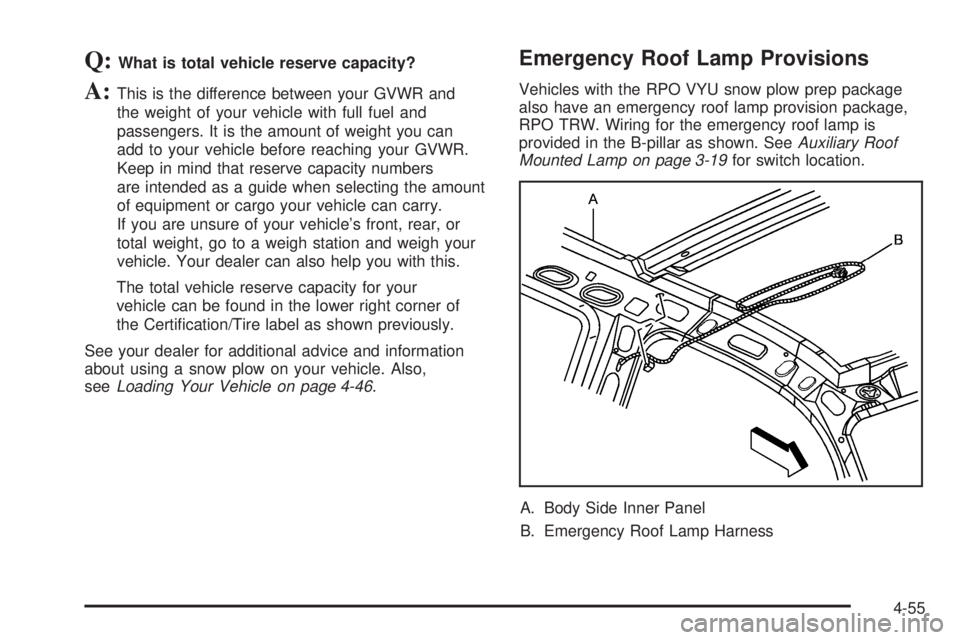
Emergency Roof Lamp Provisions
Vehicles with the RPO VYU snow plow prep package
also have an emergency roof lamp provision package,
RPO TRW. Wiring for the emergency roof lamp is
provided in the B-pillar as shown. SeeAuxiliary Roof
Mounted Lamp on page 3-19for switch location.
A. Body Side Inner Panel
B. Emergency Roof Lamp Harness
4-55
Page 375 of 540
Service............................................................5-3
Accessories and Modications..........................5-3
California Proposition 65 Warning.....................5-3
Doing Your Own Service Work.........................5-4
Adding Equipment to the Outside
of Your Vehicle...........................................5-4
Fuel................................................................5-4
Gasoline Octane............................................5-5
Gasoline Specications....................................5-5
California Fuel...............................................5-5
Additives.......................................................5-5
Fuel E85 (85% Ethanol)..................................5-6
Fuels in Foreign Countries...............................5-7
Filling the Tank..............................................5-8
Filling a Portable Fuel Container.....................5-10
Checking Things Under the Hood....................5-10
Hood Release..............................................5-11
Engine Compartment Overview.......................5-12
Engine Oil...................................................5-15
Engine Oil Life System..................................5-18
Engine Air Cleaner/Filter................................5-20
Automatic Transmission Fluid.........................5-22
Engine Coolant.............................................5-25
Coolant Surge Tank Pressure Cap..................5-27
Engine Overheating.......................................5-28
Overheated Engine Protection Operating Mode . . .5-30Cooling System............................................5-30
Engine Fan Noise.........................................5-35
Power Steering Fluid.....................................5-36
Windshield Washer Fluid................................5-37
Brakes........................................................5-38
Battery........................................................5-41
Jump Starting...............................................5-42
Rear Axle.......................................................5-46
Four-Wheel Drive............................................5-48
Front Axle......................................................5-49
Bulb Replacement..........................................5-50
Halogen Bulbs..............................................5-50
Headlamps..................................................5-50
Front Turn Signal, Sidemarker and Daytime
Running Lamps.........................................5-51
Side Identication Marker Lamps.....................5-52
Roof Marker Lamps......................................5-53
Taillamps, Turn Signal, Stoplamps and
Back-up Lamps.........................................5-54
Replacement Bulbs.......................................5-55
Windshield Wiper Blade Replacement..............5-56
Tires..............................................................5-57
Tire Sidewall Labeling...................................5-58
Tire Terminology and Denitions.....................5-61
Ination - Tire Pressure.................................5-63
Section 5 Service and Appearance Care
5-1
Page 427 of 540
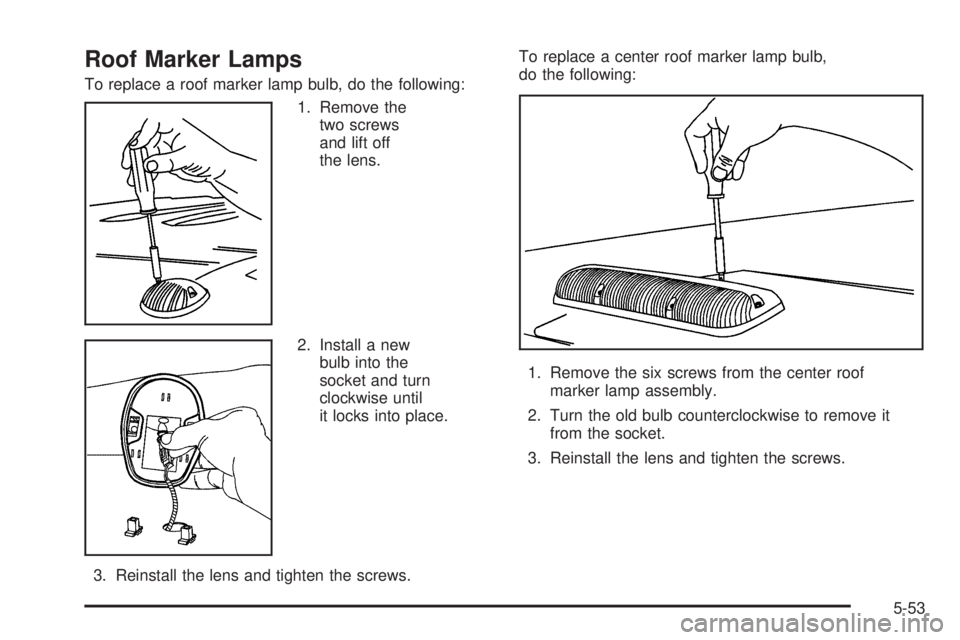
Roof Marker Lamps
To replace a roof marker lamp bulb, do the following:
1. Remove the
two screws
and lift off
the lens.
2. Install a new
bulb into the
socket and turn
clockwise until
it locks into place.
3. Reinstall the lens and tighten the screws.To replace a center roof marker lamp bulb,
do the following:
1. Remove the six screws from the center roof
marker lamp assembly.
2. Turn the old bulb counterclockwise to remove it
from the socket.
3. Reinstall the lens and tighten the screws.
5-53
Page 429 of 540
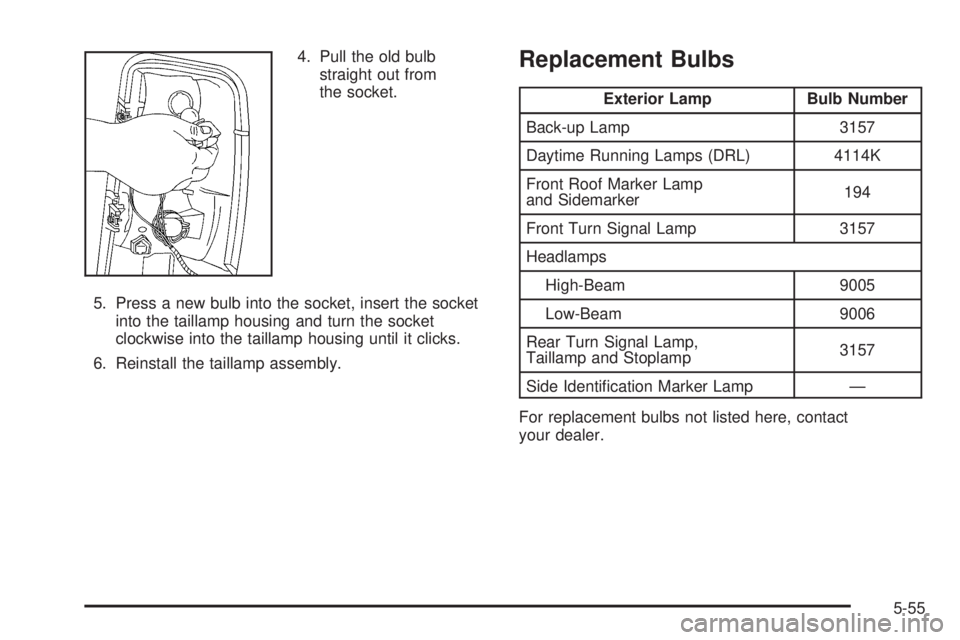
4. Pull the old bulb
straight out from
the socket.
5. Press a new bulb into the socket, insert the socket
into the taillamp housing and turn the socket
clockwise into the taillamp housing until it clicks.
6. Reinstall the taillamp assembly.Replacement Bulbs
Exterior Lamp Bulb Number
Back-up Lamp 3157
Daytime Running Lamps (DRL) 4114K
Front Roof Marker Lamp
and Sidemarker194
Front Turn Signal Lamp 3157
Headlamps
High-Beam 9005
Low-Beam 9006
Rear Turn Signal Lamp,
Taillamp and Stoplamp3157
Side Identication Marker Lamp —
For replacement bulbs not listed here, contact
your dealer.
5-55
Page 485 of 540
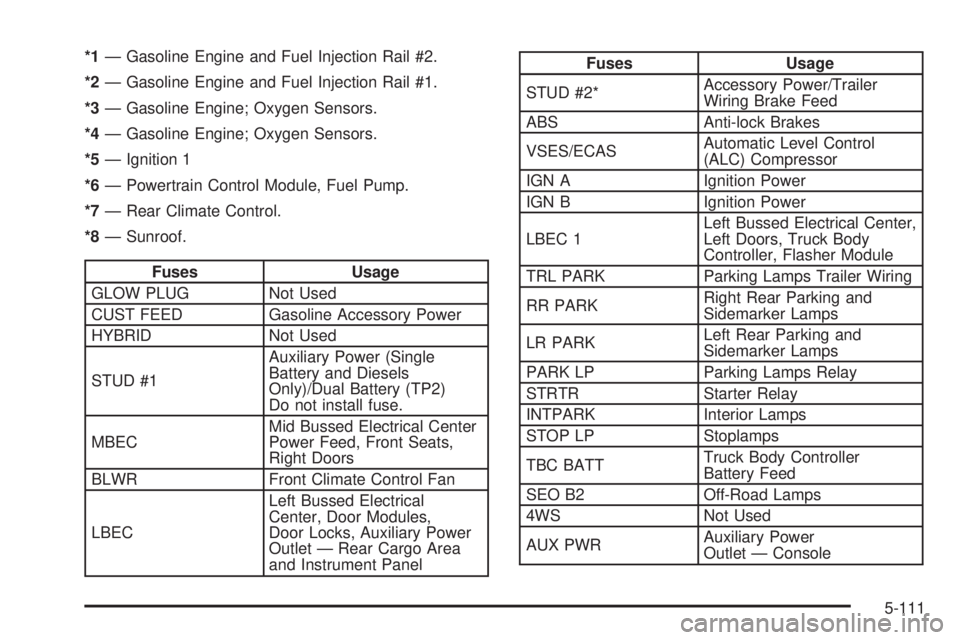
*1— Gasoline Engine and Fuel Injection Rail #2.
*2— Gasoline Engine and Fuel Injection Rail #1.
*3— Gasoline Engine; Oxygen Sensors.
*4— Gasoline Engine; Oxygen Sensors.
*5— Ignition 1
*6— Powertrain Control Module, Fuel Pump.
*7— Rear Climate Control.
*8— Sunroof.
Fuses Usage
GLOW PLUG Not Used
CUST FEED Gasoline Accessory Power
HYBRID Not Used
STUD #1Auxiliary Power (Single
Battery and Diesels
Only)/Dual Battery (TP2)
Do not install fuse.
MBECMid Bussed Electrical Center
Power Feed, Front Seats,
Right Doors
BLWR Front Climate Control Fan
LBECLeft Bussed Electrical
Center, Door Modules,
Door Locks, Auxiliary Power
Outlet — Rear Cargo Area
and Instrument Panel
Fuses Usage
STUD #2*Accessory Power/Trailer
Wiring Brake Feed
ABS Anti-lock Brakes
VSES/ECASAutomatic Level Control
(ALC) Compressor
IGN A Ignition Power
IGN B Ignition Power
LBEC 1Left Bussed Electrical Center,
Left Doors, Truck Body
Controller, Flasher Module
TRL PARK Parking Lamps Trailer Wiring
RR PARKRight Rear Parking and
Sidemarker Lamps
LR PARKLeft Rear Parking and
Sidemarker Lamps
PARK LP Parking Lamps Relay
STRTR Starter Relay
INTPARK Interior Lamps
STOP LP Stoplamps
TBC BATTTruck Body Controller
Battery Feed
SEO B2 Off-Road Lamps
4WS Not Used
AUX PWRAuxiliary Power
Outlet — Console
5-111
Page 528 of 540

Audio System(s) (cont.)
Navigation/Radio System, see Navigation
Manual.................................................3-118
Radio with Cassette and CD.........................3-90
Radio with CD............................................3-79
Radio with Six-Disc CD..............................3-104
Rear Seat Audio (RSA)...............................3-130
Setting the Time for Radios with Radio
Data Systems (RDS)................................3-75
Setting the Time for Radios without Radio
Data Systems (RDS)................................3-75
Theft-Deterrent Feature...............................3-132
Understanding Radio Reception...................3-133
XM™ Satellite Radio Antenna System...........3-136
Automatic Headlamp System............................3-16
Automatic Transmission
Fluid..........................................................5-22
Operation...................................................2-23
Autoride
®.......................................................4-60
Auxiliary Roof Mounted Lamp Switch.................3-19
B
Battery..........................................................5-41
Run-Down Protection...................................3-20
Battery Warning Light......................................3-40
Before Leaving on a Long Trip.........................4-36Bench Seat....................................................1-18
Bench Seat Split (50/50)..................................1-13
Bench Seat, Split (60/40).................................1-10
Brake
Anti-Lock Brake System (ABS)........................ 4-7
Emergencies................................................ 4-8
Parking......................................................2-31
System Warning Light..................................3-42
Brake Pedal, Throttle.......................................2-21
Brakes..........................................................5-38
Braking........................................................... 4-6
Braking in Emergencies..................................... 4-8
Break-In, New Vehicle.....................................2-19
Bucket Seats, Rear.........................................1-23
Bulb Replacement...........................................5-50
Front Turn Signal, Sidemarker and Daytime
Running Lamps........................................5-51
Halogen Bulbs............................................5-50
Headlamps.................................................5-50
Replacement Bulbs......................................5-55
Roof Marker Lamps.....................................5-53
Side Identication Marker Lamps...................5-52
Taillamps, Turn Signal, Stoplamps and
Back-up Lamps........................................5-54
Buying New Tires...........................................5-70
2
Page 532 of 540
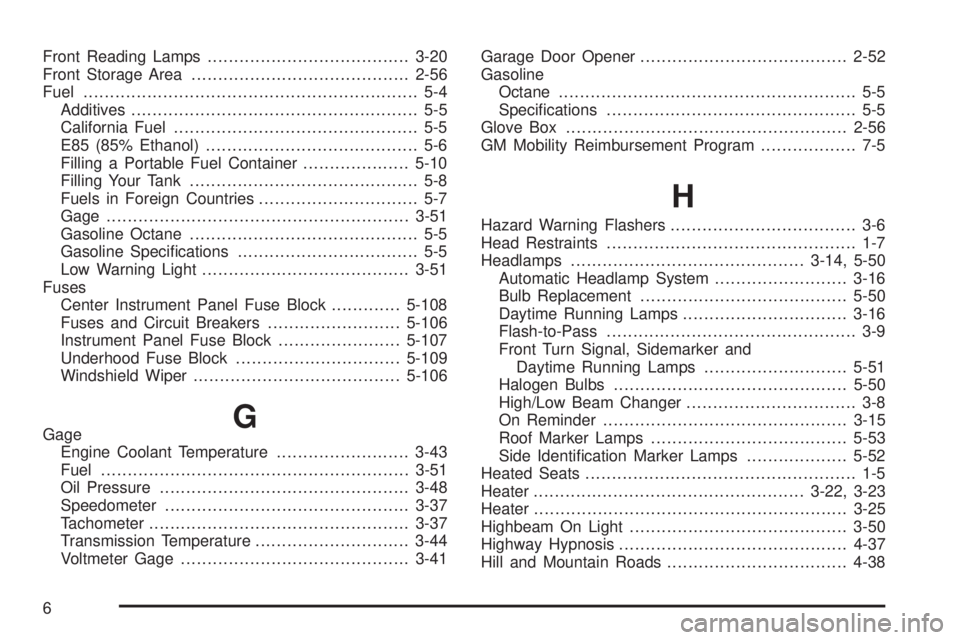
Front Reading Lamps......................................3-20
Front Storage Area.........................................2-56
Fuel............................................................... 5-4
Additives...................................................... 5-5
California Fuel.............................................. 5-5
E85 (85% Ethanol)........................................ 5-6
Filling a Portable Fuel Container....................5-10
Filling Your Tank........................................... 5-8
Fuels in Foreign Countries.............................. 5-7
Gage.........................................................3-51
Gasoline Octane........................................... 5-5
Gasoline Specications.................................. 5-5
Low Warning Light.......................................3-51
Fuses
Center Instrument Panel Fuse Block.............5-108
Fuses and Circuit Breakers.........................5-106
Instrument Panel Fuse Block.......................5-107
Underhood Fuse Block...............................5-109
Windshield Wiper.......................................5-106
GGage
Engine Coolant Temperature.........................3-43
Fuel..........................................................3-51
Oil Pressure...............................................3-48
Speedometer..............................................3-37
Tachometer.................................................3-37
Transmission Temperature.............................3-44
Voltmeter Gage...........................................3-41Garage Door Opener.......................................2-52
Gasoline
Octane........................................................ 5-5
Specications............................................... 5-5
Glove Box.....................................................2-56
GM Mobility Reimbursement Program.................. 7-5
H
Hazard Warning Flashers................................... 3-6
Head Restraints............................................... 1-7
Headlamps............................................3-14, 5-50
Automatic Headlamp System.........................3-16
Bulb Replacement.......................................5-50
Daytime Running Lamps...............................3-16
Flash-to-Pass............................................... 3-9
Front Turn Signal, Sidemarker and
Daytime Running Lamps...........................5-51
Halogen Bulbs............................................5-50
High/Low Beam Changer................................ 3-8
On Reminder..............................................3-15
Roof Marker Lamps.....................................5-53
Side Identication Marker Lamps...................5-52
Heated Seats................................................... 1-5
Heater...................................................3-22, 3-23
Heater...........................................................3-25
Highbeam On Light.........................................3-50
Highway Hypnosis...........................................4-37
Hill and Mountain Roads..................................4-38
6
Page 533 of 540
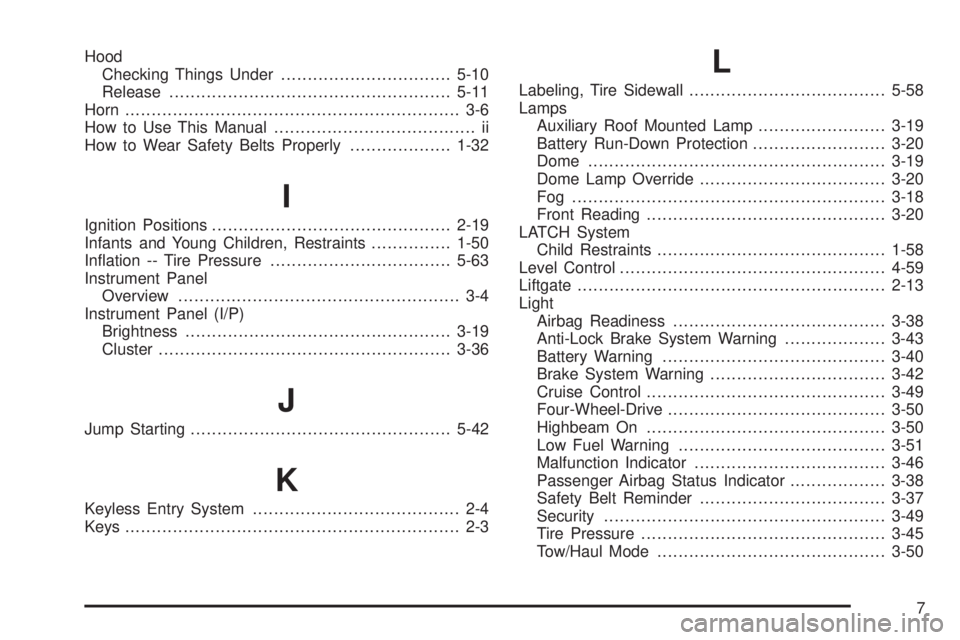
Hood
Checking Things Under................................5-10
Release.....................................................5-11
Horn............................................................... 3-6
How to Use This Manual...................................... ii
How to Wear Safety Belts Properly...................1-32
I
Ignition Positions.............................................2-19
Infants and Young Children, Restraints...............1-50
Ination -- Tire Pressure..................................5-63
Instrument Panel
Overview..................................................... 3-4
Instrument Panel (I/P)
Brightness..................................................3-19
Cluster.......................................................3-36
J
Jump Starting.................................................5-42
K
Keyless Entry System....................................... 2-4
Keys............................................................... 2-3
L
Labeling, Tire Sidewall.....................................5-58
Lamps
Auxiliary Roof Mounted Lamp........................3-19
Battery Run-Down Protection.........................3-20
Dome........................................................3-19
Dome Lamp Override...................................3-20
Fog ...........................................................3-18
Front Reading.............................................3-20
LATCH System
Child Restraints...........................................1-58
Level Control..................................................4-59
Liftgate..........................................................2-13
Light
Airbag Readiness........................................3-38
Anti-Lock Brake System Warning...................3-43
Battery Warning..........................................3-40
Brake System Warning.................................3-42
Cruise Control.............................................3-49
Four-Wheel-Drive.........................................3-50
Highbeam On.............................................3-50
Low Fuel Warning.......................................3-51
Malfunction Indicator....................................3-46
Passenger Airbag Status Indicator..................3-38
Safety Belt Reminder...................................3-37
Security.....................................................3-49
Tire Pressure..............................................3-45
Tow/Haul Mode...........................................3-50
7
Page 538 of 540
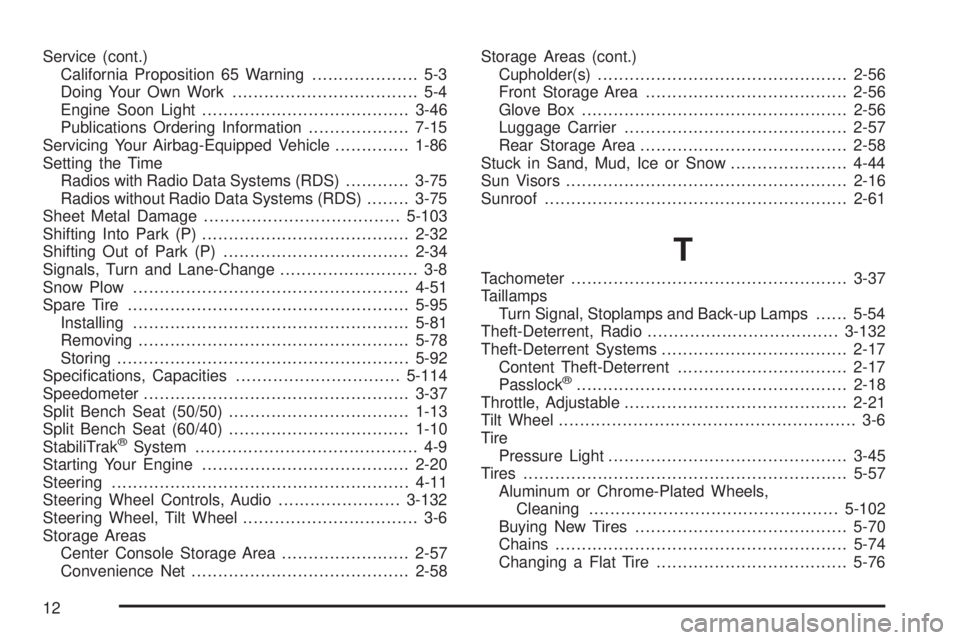
Service (cont.)
California Proposition 65 Warning.................... 5-3
Doing Your Own Work................................... 5-4
Engine Soon Light.......................................3-46
Publications Ordering Information...................7-15
Servicing Your Airbag-Equipped Vehicle..............1-86
Setting the Time
Radios with Radio Data Systems (RDS)............3-75
Radios without Radio Data Systems (RDS)........3-75
Sheet Metal Damage.....................................5-103
Shifting Into Park (P).......................................2-32
Shifting Out of Park (P)...................................2-34
Signals, Turn and Lane-Change.......................... 3-8
Snow Plow....................................................4-51
Spare Tire.....................................................5-95
Installing....................................................5-81
Removing...................................................5-78
Storing.......................................................5-92
Specications, Capacities...............................5-114
Speedometer..................................................3-37
Split Bench Seat (50/50)..................................1-13
Split Bench Seat (60/40)..................................1-10
StabiliTrak
®System.......................................... 4-9
Starting Your Engine.......................................2-20
Steering........................................................4-11
Steering Wheel Controls, Audio.......................3-132
Steering Wheel, Tilt Wheel................................. 3-6
Storage Areas
Center Console Storage Area........................2-57
Convenience Net.........................................2-58Storage Areas (cont.)
Cupholder(s)...............................................2-56
Front Storage Area......................................2-56
Glove Box..................................................2-56
Luggage Carrier..........................................2-57
Rear Storage Area.......................................2-58
Stuck in Sand, Mud, Ice or Snow......................4-44
Sun Visors.....................................................2-16
Sunroof.........................................................2-61
T
Tachometer....................................................3-37
Taillamps
Turn Signal, Stoplamps and Back-up Lamps......5-54
Theft-Deterrent, Radio....................................3-132
Theft-Deterrent Systems...................................2-17
Content Theft-Deterrent................................2-17
Passlock
®...................................................2-18
Throttle, Adjustable..........................................2-21
Tilt Wheel........................................................ 3-6
Tire
Pressure Light.............................................3-45
Tires.............................................................5-57
Aluminum or Chrome-Plated Wheels,
Cleaning...............................................5-102
Buying New Tires........................................5-70
Chains.......................................................5-74
Changing a Flat Tire....................................5-76
12