weight GMC YUKON 2006 Owner's Guide
[x] Cancel search | Manufacturer: GMC, Model Year: 2006, Model line: YUKON, Model: GMC YUKON 2006Pages: 540, PDF Size: 3.14 MB
Page 358 of 540
Your vehicle may be equipped with a button at the
end of the shift lever which, when pressed, enables
tow/haul. Your vehicle may be equipped with Autoride
®
which further improves your vehicle’s ride while
towing. SeeAutoride®on page 4-60for more
information. When the button is pressed, a light on
the instrument panel will illuminate to indicate that
Tow/Haul has been selected. Tow/Haul may be turned
off by pressing the button again, at which time the
indicator light on the instrument panel will turn off.
The vehicle will automatically turn off Tow/Haul every
time it is started.
Tow/Haul is designed to be most effective when the
vehicle and trailer combined weight is at least 75 percent
of the vehicle’s Gross Combined Weight Rating
(GCWR). See Weight of the Trailer later in this section.
Tow/Haul is most useful under the following driving
conditions:
When pulling a heavy trailer or a large or heavy
load through rolling terrain.
When pulling a heavy trailer or a large or heavy
load in stop and go traffic.
When pulling a heavy trailer or a large or heavy
load in busy parking lots where improved low
speed control of the vehicle is desired.Operating the vehicle in tow/haul when lightly loaded or
with no trailer at all will not cause damage. However,
there is no benet to the selection of Tow/Haul when the
vehicle is unloaded. Such a selection when unloaded
may result in unpleasant engine and transmission driving
characteristics and reduced fuel economy. Tow/Haul
is recommended only when pulling a heavy trailer or a
large or heavy load.
Weight of the Trailer
How heavy can a trailer safely be?
It depends on how you plan to use your rig. For
example, speed, altitude, road grades, outside
temperature and how much your vehicle is used to pull
a trailer are all important. It can also depend on any
special equipment that you have on your vehicle,
and the amount of tongue weight the vehicle can carry.
See “Weight of the Trailer Tongue” later in this
section for more information.
Maximum trailer weight is calculated assuming only the
driver is in the tow vehicle and it has all the required
trailering equipment. The weight of additional optional
equipment, passengers and cargo in the tow vehicle
must be subtracted from the maximum trailer weight.
4-62
Page 359 of 540

Use one of the following charts to determine how much your vehicle can weigh, based upon your vehicle model
and options.
Vehicle* Axle Ratio Maximum Trailer Weight GCWR
C-1500 (2WD)*
4800 V83.23
3.735,700 lbs. (2 585 kg)
6,700 lbs. (3 039 kg)11,000 lbs. (4 990 kg)
12,000 lbs. (5 443 kg)
5300 V83.23
3.736,700 lbs. (3 039 kg)
7,700 lbs. (3 492 kg)12,000 lbs. (5 443 kg)
13,000 lbs. (5 897 kg)
5300 V8
(Extended Models)3.42
4.107,500 lbs. (3 402 kg)
8,500 lbs. (3 855 kg)13,000 lbs. (5 897 kg)
14,000 lbs. (6 350 kg)
Vehicle* Axle Ratio Maximum Trailer Weight GCWR
K-1500 (4WD)*
4800 V83.42
4.106,500 lbs. (2 948 kg)
7,500 lbs. (3 402 kg)12,000 lbs. (5 443 kg)
13,000 lbs. (5 897 kg)
5300 V83.42
4.107,500 lbs. (3 402 kg)
7,700 lbs. (3 493 kg)13,000 lbs. (5 897 kg)
14,000 lbs. (6 350 kg)
5300 V8
(Extended Models)3.42
4.107,200 lbs. (3 265 kg)
8,200 lbs. (3 719 kg)13,000 lbs. (5 897 kg)
14,000 lbs. (6 350 kg)
4-63
Page 360 of 540

Vehicle* Axle Ratio Maximum Trailer Weight GCWR
C-2500 (2WD)*
6000 V8
(Extended Models)3.73
4.107,900 lbs. (3 583 kg)
9,900 lbs. (4 490 kg)14,000 lbs. (6 350 kg)
16,000 lbs. (7 257 kg)
8100 V8
(Extended Models)3.73
4.1010,600 lbs. (4 808 kg)
12,000 lbs. (5 443 kg)17,000 lbs. (7 711 kg)
19,000 lbs. (8 618 kg)
Vehicle* Axle Ratio Maximum Trailer Weight GCWR
K-2500 (4WD)*
6000 V8
(Extended Models)3.73
4.107,600 lbs. (3 447 kg)
9,600 lbs. (4 354 kg)14,000 lbs. (6 350 kg)
16,000 lbs. (7 257 kg)
8100 V83.73
4.1010,300 lbs. (4 672 kg)
12,000 lbs. (5 443 kg)17,000 lbs. (7 711 kg)
19,000 lbs. (8 618 kg)
The Gross Combination Weight Rating (GCWR) is
the total allowable weight of the completely loaded
vehicle and trailer including any passengers, cargo,
equipment and conversions. The GCWR for your
vehicle should not be exceeded.
You can ask your dealer for our trailering information
or advice, or you can write us at the address listed
in your Warranty and Owner Assistance Information
Booklet.In Canada, write to:
General Motors of Canada Limited
Customer Communication Centre, 163-005
1908 Colonel Sam Drive
Oshawa, Ontario L1H 8P7
4-64
Page 361 of 540

Weight of the Trailer Tongue
The tongue load (A) of any trailer is an important weight
to measure because it affects the total or gross weight
of your vehicle. The Gross Vehicle Weight (GVW)
includes the curb weight of the vehicle, any cargo you
may carry in it, and the people who will be riding in
the vehicle. If you have a lot of options, equipment,
passengers or cargo in your vehicle, it will reduce the
tongue weight your vehicle can carry, which will
also reduce the trailer weight your vehicle can tow.
And if you will tow a trailer, you must add the tongue
load to the GVW because your vehicle will be carrying
that weight, too. See Loading Your Vehicle for more
information about your vehicle’s maximum load capacity.The trailer tongue weight (A) should be 10 percent to
15 percent of the total loaded trailer weight, up to
a maximum or 600 lbs (272 kg) with a weight carrying
hitch. The trailer tongue weight (A) should be 10 percent
to 15 percent of the total loaded trailer weight, up to a
maximum of 1,000 lbs (453 kg) for the 1500 series
and up to a maximum of 1,500 lbs (680 kg) for the
2500 series with a weight distributing hitch.
4-65
Page 362 of 540

Do not exceed the maximum allowable tongue weight
for your vehicle. Choose the shortest hitch extension
that will position the hitch ball closest to the vehicle.
This will help reduce the effect of trailer tongue weight
on the rear axle.
After you have loaded the trailer, weigh the trailer
and then the tongue separately, to see if the weights
are proper. If they are not, you may be able to get
them right by moving some items around in the trailer.
Trailering may be limited by the vehicle’s ability to
carry tongue weight. Tongue weight cannot cause the
vehicle to exceed the GVWR (Gross Vehicle Weight
Rating) or the RGAWR (Rear Gross Axle Weight
Rating). The effect of additional weight may reduce
your trailering capacity more than the total of the
additional weight.Consider the following example:
A vehicle model base weight is 5,500 lbs (2 495 kg);
2,800 lbs (1 270 kg) at the front axle and 2,700 lbs
(1 225 kg) at the rear axle. It has a GVWR of 7,200 lbs
(3 266 kg), a RGAWR of 4,000 lbs (1 814 kg) and a
GCWR (Gross Combination Weight Rating) of
14,000 lbs (6 350 kg). The trailer rating should be:
You can expect tongue weight to be at least 10 percent of
trailer weight (850 lbs (386 kg)) and because the weight
is applied well behind the rear axle, the effect on the rear
axle will be greater than just the weight itself, as much
as 1.5 times as much. The weight at the rear axle could
be 850 lbs (386 kg) X 1.5 = 1,275 lbs (578 kg). Since
the rear axle already weighs 2,700 lbs (1 225 kg),
adding 1,275 lbs (578 kg) brings the total to 3,975 lbs
(1 803 kg). This is very close to, but within the limit for
RGAWR as well. The vehicle is set to trailer up to
8,500 lbs (3 856 kg).
4-66
Page 363 of 540

But let’s say your specic vehicle is equipped with some
of the latest options and you have a front seat passenger
and two rear seat passengers with some luggage and
gear in the vehicle as well. You may add 300 lbs (136 kg)
to the front axle weight and 400 lbs (181 kg) to the rear
axle weight. Your vehicle now weighs:
Weight is still below 7,200 lbs (3 266 kg) and you
may think that you should subtract 700 additional
pounds (318 kg) from your trailering capacity to stay
within GCWR limits. Your maximum trailer would only
be 7,800 lbs (3 538 kg). You may go further and
think you must limit tongue weight to less than
1,000 lbs (454 kg) to avoid exceeding GVWR.
But, you must still consider the effect on the rear axle.
Because your rear axle now weighs 3,100 lbs (1 406 kg),
you can only put 900 lbs (408 kg) on the rear axle
without exceeding RGAWR. The effect of tongue
weight is about 1.5 times the actual weight. Dividing
the 900 lbs (408 kg) by 1.5 leaves you with being able
to handle only 600 lbs (272 kg) of tongue weight.Since tongue weight is usually at least 10 percent of
total loaded trailer weight, you can expect that the
largest trailer your vehicle can properly handle is
6,000 lbs (2 721 kg).
It is important that you make sure your vehicle does not
exceed any of its ratings — GCWR, GVWR, RGAWR,
Maximum Trailer Rating or Tongue Weight. The only way
to be sure you are not exceeding any of these ratings is
to weigh your vehicle and trailer.
Total Weight on Your Vehicle’s Tires
Be sure your vehicle’s tires are inated to the upper
limit for cold tires. You’ll nd these numbers on the
Certication label at the rear edge of the driver’s door
or seeLoading Your Vehicle on page 4-46for more
information. Then be sure you don’t go over the GVW
limit for your vehicle, or the GAWR, including the weight
of the trailer tongue. If you use a weight distributing hitch,
make sure you don’t go over the rear axle limit before
you apply the weight distribution spring bars.
Hitches
It’s important to have the correct hitch equipment.
Crosswinds, large trucks going by and rough roads
are a few reasons why you will need the right hitch.
4-67
Page 364 of 540
Weight-Distributing Hitches and Weight
Carrying Hitches
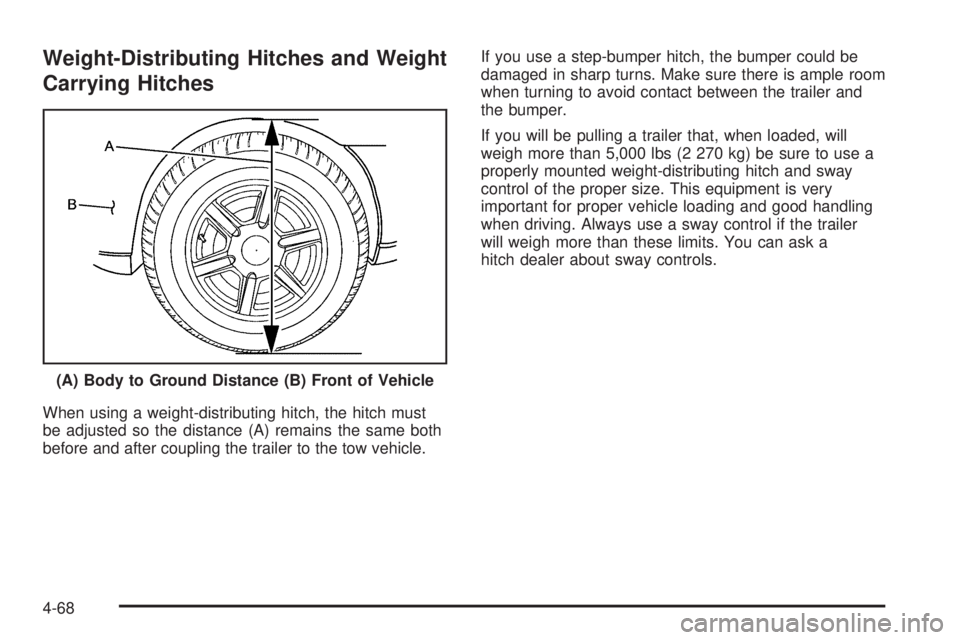
When using a weight-distributing hitch, the hitch must
be adjusted so the distance (A) remains the same both
before and after coupling the trailer to the tow vehicle.If you use a step-bumper hitch, the bumper could be
damaged in sharp turns. Make sure there is ample room
when turning to avoid contact between the trailer and
the bumper.
If you will be pulling a trailer that, when loaded, will
weigh more than 5,000 lbs (2 270 kg) be sure to use a
properly mounted weight-distributing hitch and sway
control of the proper size. This equipment is very
important for proper vehicle loading and good handling
when driving. Always use a sway control if the trailer
will weigh more than these limits. You can ask a
hitch dealer about sway controls.
(A) Body to Ground Distance (B) Front of Vehicle
4-68
Page 366 of 540
Driving with a Trailer
{CAUTION:
If you have a rear-most window open and
you pull a trailer with your vehicle, carbon
monoxide (CO) could come into your vehicle.
You cannot see or smell CO. It can cause
unconsciousness or death. SeeEngine
Exhaust on page 2-35. To maximize your safety
when towing a trailer:
Have your exhaust system inspected
for leaks, and make necessary repairs
before starting on your trip.
Keep the rear-most windows closed.
If exhaust does come into your vehicle
through a window in the rear or another
opening, drive with your front, main
heating or cooling system on and with
the fan on any speed. This will bring fresh,
outside air into your vehicle. Do not use
the climate control setting for maximum
air because it only recirculates the air
inside your vehicle. SeeClimate Control
System on page 3-22.Towing a trailer requires a certain amount of experience.
Before setting out for the open road, you’ll want to get
to know your rig. Acquaint yourself with the feel of
handling and braking with the added weight of the trailer.
And always keep in mind that the vehicle you are
driving is now a good deal longer and not nearly as
responsive as your vehicle is by itself.
Before you start, check all trailer hitch parts and
attachments, safety chains, electrical connector, lamps,
tires and mirror adjustment. If the trailer has electric
brakes, start your vehicle and trailer moving and then
apply the trailer brake controller by hand to be sure
the brakes are working. This lets you check your
electrical connection at the same time.
During your trip, check occasionally to be sure that
the load is secure, and that the lamps and any trailer
brakes are still working.
4-70
Page 373 of 540
Step-Bumper Pad
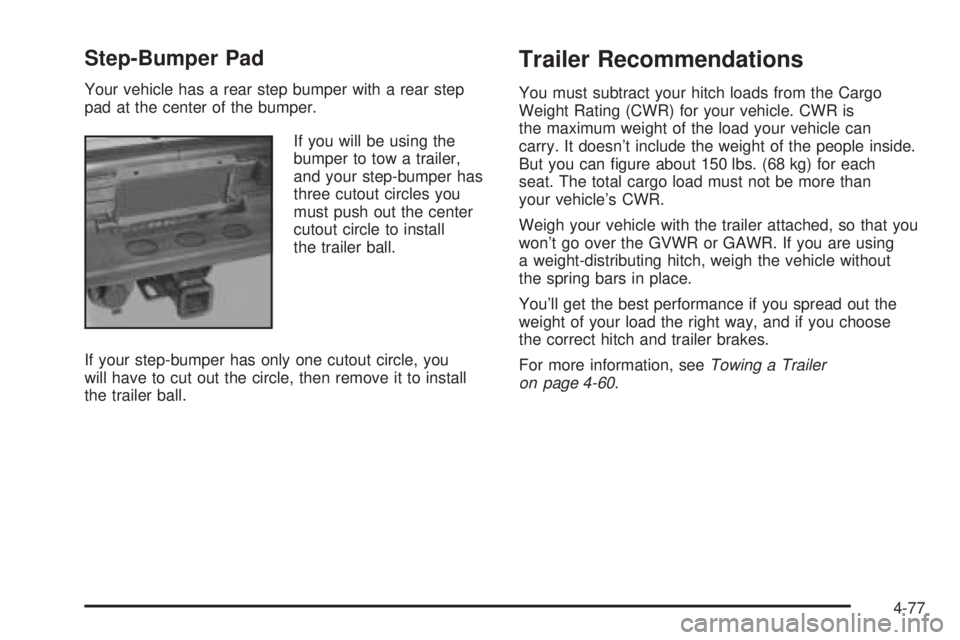
Your vehicle has a rear step bumper with a rear step
pad at the center of the bumper.
If you will be using the
bumper to tow a trailer,
and your step-bumper has
three cutout circles you
must push out the center
cutout circle to install
the trailer ball.
If your step-bumper has only one cutout circle, you
will have to cut out the circle, then remove it to install
the trailer ball.
Trailer Recommendations
You must subtract your hitch loads from the Cargo
Weight Rating (CWR) for your vehicle. CWR is
the maximum weight of the load your vehicle can
carry. It doesn’t include the weight of the people inside.
But you can gure about 150 lbs. (68 kg) for each
seat. The total cargo load must not be more than
your vehicle’s CWR.
Weigh your vehicle with the trailer attached, so that you
won’t go over the GVWR or GAWR. If you are using
a weight-distributing hitch, weigh the vehicle without
the spring bars in place.
You’ll get the best performance if you spread out the
weight of your load the right way, and if you choose
the correct hitch and trailer brakes.
For more information, seeTowing a Trailer
on page 4-60.
4-77
Page 435 of 540
Tire Terminology and Denitions
Air Pressure:The amount of air inside the tire pressing
outward on each square inch of the tire. Air pressure
is expressed in pounds per square inch (psi) or
kilopascal (kPa).
Accessory Weight:This means the combined weight
of optional accessories. Some examples of optional
accessories are, automatic transmission, power steering,
power brakes, power windows, power seats, and
air conditioning.
Aspect Ratio:The relationship of a tire’s height to
its width.
Belt:A rubber coated layer of cords that is located
between the plies and the tread. Cords may be made
from steel or other reinforcing materials.
Bead:The tire bead contains steel wires wrapped by
steel cords that hold the tire onto the rim.
Bias Ply Tire:A pneumatic tire in which the plies are
laid at alternate angles less than 90 degrees to the
centerline of the tread.
Cold Ination Pressure:The amount of air pressure
in a tire, measured in pounds per square inch (psi)
or kilopascals (kPa) before a tire has built up heat from
driving. SeeInation - Tire Pressure on page 5-63.Curb Weight:This means the weight of a motor
vehicle with standard and optional equipment including
the maximum capacity of fuel, oil and coolant, but
without passengers and cargo.
DOT Markings:A code molded into the sidewall of a
tire signifying that the tire is in compliance with the
U.S. Department of Transportation (DOT) motor vehicle
safety standards. The DOT code includes the Tire
Identication Number (TIN), an alphanumeric designator
which can also identify the tire manufacturer, production
plant, brand and date of production.
GVWR:Gross Vehicle Weight Rating, seeLoading
Your Vehicle on page 4-46.
GAWR FRT:Gross Axle Weight Rating for the front
axle, seeLoading Your Vehicle on page 4-46.
GAWR RR:Gross Axle Weight Rating for the rear axle,
seeLoading Your Vehicle on page 4-46.
Intended Outboard Sidewall:The side of an
asymmetrical tire, that must always face outward when
mounted on a vehicle.
Kilopascal (kPa):The metric unit for air pressure.
Light Truck (LT-Metric) Tire:A tire used on light duty
trucks and some multipurpose passenger vehicles.
Load Index:An assigned number ranging from 1 to 279
that corresponds to the load carrying capacity of a tire.
5-61