ignition GMC YUKON 2007 Owner's Guide
[x] Cancel search | Manufacturer: GMC, Model Year: 2007, Model line: YUKON, Model: GMC YUKON 2007Pages: 608, PDF Size: 3.06 MB
Page 142 of 608

If the ignition key is turned to the START, and
then released when the engine begins cranking,
the engine will continue cranking until the
vehicle starts or until it exceeds the maximum
cranking time allowed, approximately
15 seconds to prevent cranking motor damage.
To prevent gear damage, this system also
prevents cranking if the engine is already
running. The engine cranking can be stopped
by turning the ignition switch to the
ACCESSORY or LOCK.
Notice:Cranking the engine for long periods
of time, by returning the key to the START
position immediately after cranking has ended,
can overheat and damage the cranking
motor and drain the battery. Waiting about
15 seconds between each try, to allow
the cranking motor to cool down, will prevent
damage due to overheating.
2. If the engine does not start within 10 seconds,
push the accelerator pedal all the way to the
oor, while you hold the ignition key in
START. When the engine starts, let go of the
key and let up on the accelerator pedal.
Wait about 15 seconds between each try.When starting your engine in very cold weather
(below 0°F or−18°C), do this:
1. With your foot off the accelerator pedal, turn
the ignition key to START and hold it there up
to 15 seconds. When the engine starts, let
go of the key.
2. If your engine still will not start, or starts but
then stops, it could be ooded with too much
gasoline. Try pushing your accelerator
pedal all the way to the oor and holding it
there as you hold the key in START for about
three seconds. When the engine starts, let
go of the key and accelerator. If the vehicle
starts briey but then stops again, do the
same thing, but this time keep the pedal down
for ve or six seconds. This clears the extra
gasoline from the engine.
Notice:Your engine is designed to work with
the electronics in your vehicle. If you add
electrical parts or accessories, you could
change the way the engine operates. Before
adding electrical equipment, check with
your dealer. If you do not, your engine might
not perform properly. Any resulting damage
would not be covered by your vehicle’s
warranty.
142
Page 152 of 608
Parking Brake
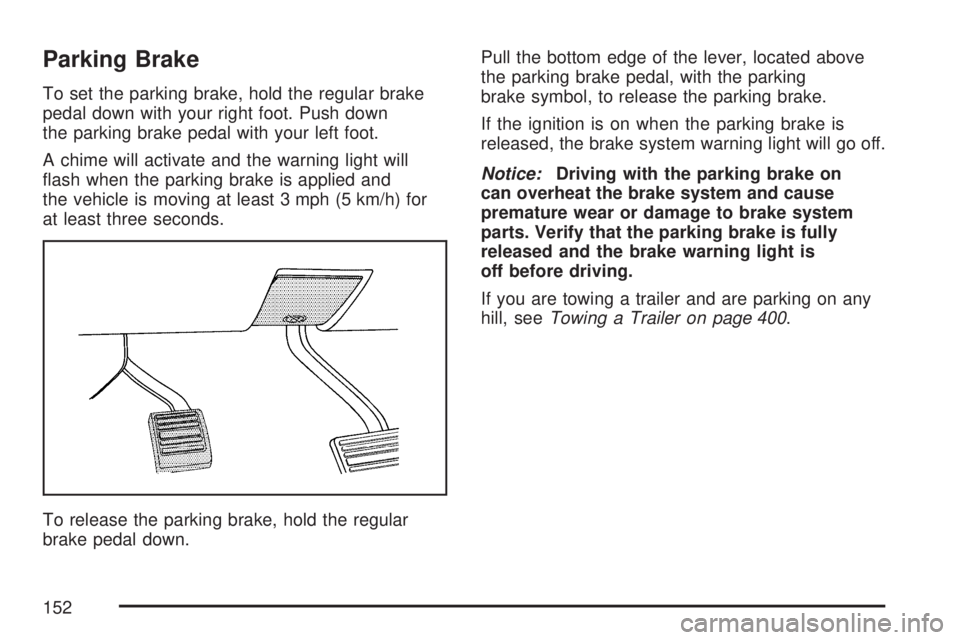
To set the parking brake, hold the regular brake
pedal down with your right foot. Push down
the parking brake pedal with your left foot.
A chime will activate and the warning light will
ash when the parking brake is applied and
the vehicle is moving at least 3 mph (5 km/h) for
at least three seconds.
To release the parking brake, hold the regular
brake pedal down.Pull the bottom edge of the lever, located above
the parking brake pedal, with the parking
brake symbol, to release the parking brake.
If the ignition is on when the parking brake is
released, the brake system warning light will go off.
Notice:Driving with the parking brake on
can overheat the brake system and cause
premature wear or damage to brake system
parts. Verify that the parking brake is fully
released and the brake warning light is
off before driving.
If you are towing a trailer and are parking on any
hill, seeTowing a Trailer on page 400.
152
Page 153 of 608

Shifting Into Park (P)
{CAUTION:
It can be dangerous to get out of your
vehicle if the shift lever is not fully in
PARK (P) with the parking brake rmly
set. Your vehicle can roll. If you have left
the engine running, the vehicle can move
suddenly. You or others could be injured.
To be sure your vehicle will not move,
even when you are on fairly level ground,
use the steps that follow. If you are
pulling a trailer, seeTowing a Trailer on
page 400.
1. Hold the brake pedal down with your right
foot and set the parking brake.
2. Move the shift lever into the PARK (P)
position by pulling the shift lever toward
you and moving it up as far as it will go.
3. Turn the ignition key to LOCK.
4. Remove the key and take it with you. If you
can leave your vehicle with the ignition key in
your hand, your vehicle is in PARK (P).
Leaving Your Vehicle With the
Engine Running
{CAUTION:
It can be dangerous to leave your vehicle
with the engine running. Your vehicle
could move suddenly if the shift lever is
not fully in PARK (P) with the parking
brake rmly set. And, if you leave the
vehicle with the engine running, it could
overheat and even catch re. You or
others could be injured. Do not leave your
vehicle with the engine running.
If you have to leave your vehicle with the engine
running, be sure your vehicle is in PARK (P)
and the parking brake is rmly set before
you leave it. After you move the shift lever into
PARK (P), hold the regular brake pedal down.
Then, see if you can move the shift lever away
from PARK (P) without rst pulling it toward you.
If you can, it means that the shift lever was
not fully locked into PARK (P).
153
Page 154 of 608
Torque Lock
If you are parking on a hill and you do not shift
your transmission into PARK (P) properly,
the weight of the vehicle may put too much force
on the parking pawl in the transmission. You
may nd it difficult to pull the shift lever out
of PARK (P). This is called torque lock. To prevent
torque lock, set the parking brake and then shift
into PARK (P) properly before you leave the
driver’s seat. To nd out how, seeShifting Into
Park (P) on page 153.
When you are ready to drive, move the shift lever
out of PARK (P) before you release the parking
brake.
If torque lock does occur, you may need to have
another vehicle push yours a little uphill to
take some of the pressure from the parking pawl
in the transmission, then you will be able to
pull the shift lever out of PARK (P).
Shifting Out of Park (P)
Your vehicle has an automatic transmission shift
lock control system which locks the shift lever
in PARK (P) when the ignition is in the LOCK.
You have to fully apply your regular brakes before
you can shift from PARK (P) when the ignition
is in RUN. SeeAutomatic Transmission Operation
on page 145.
If you cannot shift out of PARK (P), ease pressure
on the shift lever and push the shift lever all the
way up into PARK (P) as you maintain brake
application. Then, move the shift lever into
the desired gear.
154
Page 159 of 608
Automatic Dimming Mirror Operation
The automatic dimming mirror function is turned on
automatically each time the ignition is started.
To operate the automatic dimming mirror, do the
following:
1. Make sure the green indicator light, located to
the left of the on/off button, is lit. If it’s not, press
and hold the on/off button for approximately
six seconds until the green light comes on,
indicating that the mirror is in automatic
dimming mode.
2. Turn off the automatic dimming mirror function
by pressing and holding the on/off button for
approximately six seconds, until the green
indicator light turns off.
Compass Variance
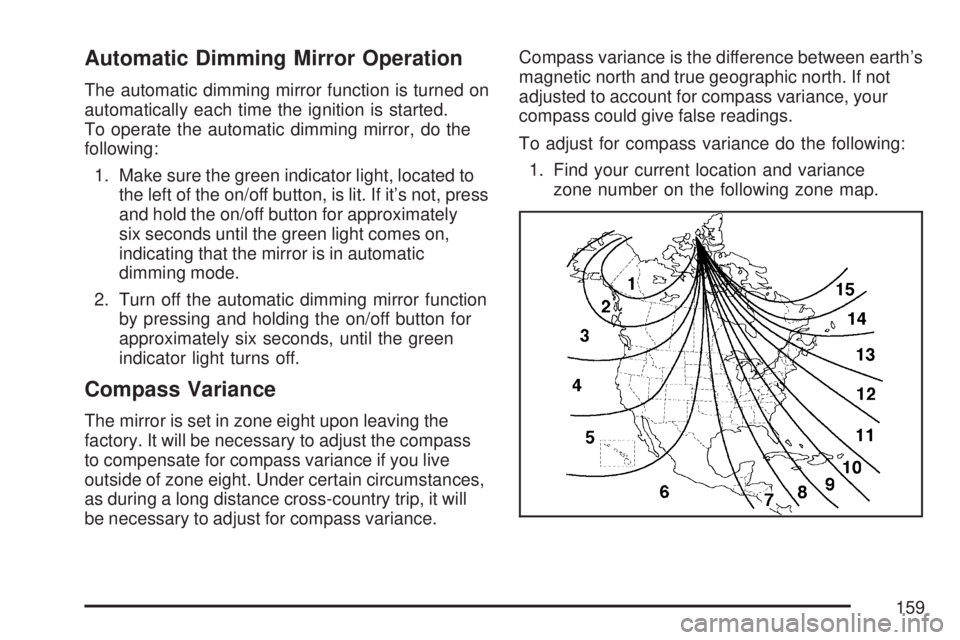
The mirror is set in zone eight upon leaving the
factory. It will be necessary to adjust the compass
to compensate for compass variance if you live
outside of zone eight. Under certain circumstances,
as during a long distance cross-country trip, it will
be necessary to adjust for compass variance.Compass variance is the difference between earth’s
magnetic north and true geographic north. If not
adjusted to account for compass variance, your
compass could give false readings.
To adjust for compass variance do the following:
1. Find your current location and variance
zone number on the following zone map.
159
Page 162 of 608

Resetting the Power Foldaway Mirrors
You will need to reset the power foldaway mirrors
if the following occurs:
The mirrors are accidentally obstructed while
folding.
They are accidentally manually
folded/unfolded.
The mirrors will not stay in the unfolded
position.
The mirrors shake and utter at normal driving
speeds.
To reset the power foldaway mirrors, fold and
unfold them one time using the mirror controls.
This will reset them to their normal position.
This mirror has the following features.
Automatic Dimming
The driver’s outside mirror will adjust for the glare
of the headlamps behind you. SeeAutomatic
Dimming Rearview Mirror with OnStar
®, Compass
and Temperature Display on page 158.
Curb View Assist
If your vehicle has the memory package, the
outside mirrors are able to perform the curb view
assist mirror function. This feature may be
useful in allowing the driver to view the curb when
parallel parking. This feature will cause the
passenger’s and/or driver’s mirror to tilt to a
preselected position when the vehicle is in
REVERSE (R).
The passenger’s and/or driver’s mirror will return
to its original position when the vehicle is
shifted out of REVERSE (R), or the ignition is
turned off or to LOCK.
This feature can be turned on or off through the
Driver Information Center (DIC). SeeDriver
Information Center (DIC) on page 244.
162
Page 185 of 608
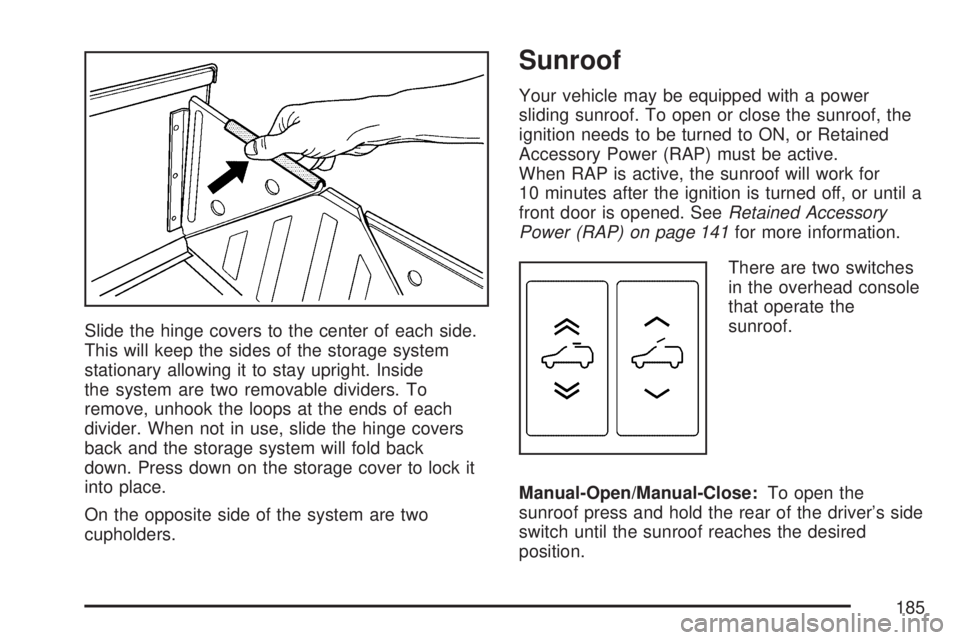
Slide the hinge covers to the center of each side.
This will keep the sides of the storage system
stationary allowing it to stay upright. Inside
the system are two removable dividers. To
remove, unhook the loops at the ends of each
divider. When not in use, slide the hinge covers
back and the storage system will fold back
down. Press down on the storage cover to lock it
into place.
On the opposite side of the system are two
cupholders.
Sunroof
Your vehicle may be equipped with a power
sliding sunroof. To open or close the sunroof, the
ignition needs to be turned to ON, or Retained
Accessory Power (RAP) must be active.
When RAP is active, the sunroof will work for
10 minutes after the ignition is turned off, or until a
front door is opened. SeeRetained Accessory
Power (RAP) on page 141for more information.
There are two switches
in the overhead console
that operate the
sunroof.
Manual-Open/Manual-Close:To open the
sunroof press and hold the rear of the driver’s side
switch until the sunroof reaches the desired
position.
185
Page 192 of 608
Hazard Warning Flashers
The hazard warning ashers warn others.
They also let police know you have a problem.
Your front and rear turn signal lamps will ash on
and off.
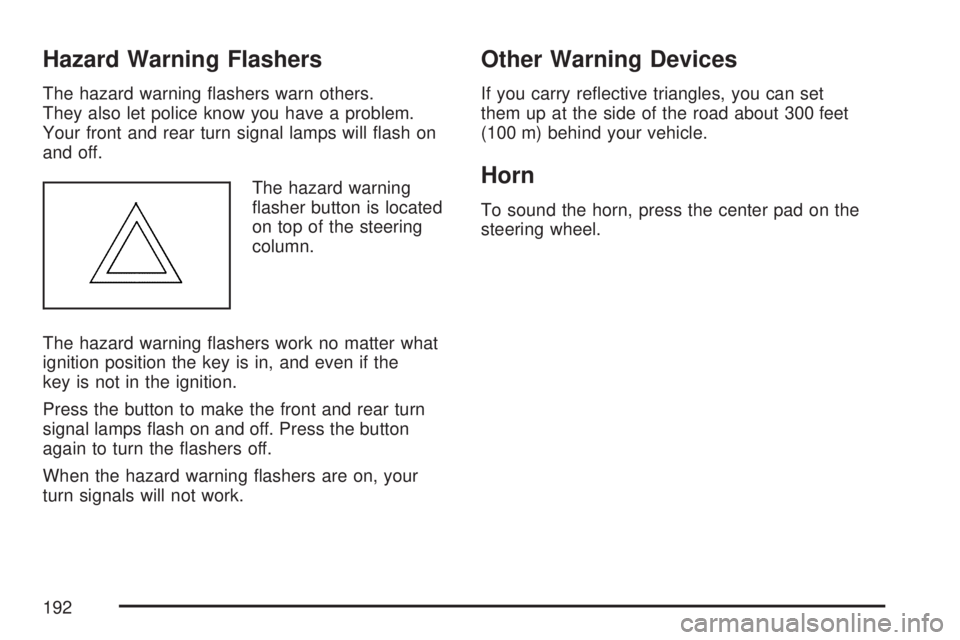
The hazard warning
asher button is located
on top of the steering
column.
The hazard warning ashers work no matter what
ignition position the key is in, and even if the
key is not in the ignition.
Press the button to make the front and rear turn
signal lamps ash on and off. Press the button
again to turn the ashers off.
When the hazard warning ashers are on, your
turn signals will not work.
Other Warning Devices
If you carry reective triangles, you can set
them up at the side of the road about 300 feet
(100 m) behind your vehicle.
Horn
To sound the horn, press the center pad on the
steering wheel.
192
Page 203 of 608

Using Cruise Control on Hills
How well your cruise control will work on hills
depends upon your speed, load, and the
steepness of the hills. When going up steep hills,
you may have to step on the accelerator pedal
to maintain the vehicle’s speed. When going
downhill, you may have to brake or shift to a
lower gear to keep the vehicle’s speed down.
Of course, applying the brake takes you out
of cruise control. Many drivers nd this to be too
much trouble and do not use cruise control on
steep hills.
Ending Cruise Control
There are three ways to end cruise control:
Step lightly on the brake pedal.
Press the cancel button on the steering wheel.
Press the On/Off button on the steering
wheel.
Erasing Speed Memory
When you turn off the cruise control or the ignition,
your cruise control set speed memory is erased.
Exterior Lamps
The exterior lamps
control is located on the
instrument panel to
the left of the steering
wheel.
It controls the following systems:
Headlamps
Taillamps
Parking Lamps
License Plate Lamps
Instrument Panel Lights
203
Page 204 of 608
The exterior lamps control has four positions:
9(Off):Turn the control to this position to
turn off the automatic headlamps and daytime
running lamps (DRL). Turning the headlamp
control to the off position again will turn the
automatic headlamps or DRL back on.
For vehicles rst sold in Canada, the off position
will only work for vehicles that are shifted into
the PARK (P) position.
AUTO (Automatic):Turn the control to this
position to automatically turn on the headlamps at
normal brightness, together with the following:
Parking Lamps
Instrument Panel Lights
Taillamps
License Plate Lamps
;(Parking Lamps):Turn the control to this
position to turn on the parking lamps together with
the following:
Instrument Panel Lights
Taillamps
License Plate Lamps
2(Headlamps):Turn the control to this position
to turn on the headlamps together with the
following lamps listed below. A warning chime will
sound if you open the driver’s door when the
ignition switch is off and the headlamps are on.
Parking Lamps
Instrument Panel Lights
Taillamps
License Plate Lamps
204