steering wheel GMC YUKON 2008 Owner's Guide
[x] Cancel search | Manufacturer: GMC, Model Year: 2008, Model line: YUKON, Model: GMC YUKON 2008Pages: 546, PDF Size: 6.4 MB
Page 338 of 546
Rocking Your Vehicle to Get It Out
First, turn the steering wheel left and right to clear
the area around the front wheels. For four-wheel-drive
vehicles, shift into Four-Wheel High or Four-Wheel Low.
For vehicles with StabiliTrak
®, turn the traction control
part of the system off. SeeStabiliTrak®System on
page 4-6. Then shift back and forth between
REVERSE (R) and a forward gear, spinning the wheels
as little as possible. To prevent transmission wear,
wait until the wheels stop spinning before shifting gears.
Release the accelerator pedal while you shift, and
press lightly on the accelerator pedal when the
transmission is in gear. By slowly spinning the wheels in
the forward and reverse directions, you will cause a
rocking motion that could free your vehicle. If that does
not get your vehicle out after a few tries, it might
need to be towed out. Or, you can use recovery hooks,
if your vehicle has them. If your vehicle does need to
be towed out, seeTowing Your Vehicle on page 4-45.
Recovery Hooks
{CAUTION:
These hooks, when used, are under a lot of
force. Always pull the vehicle straight out.
Never pull on the hooks at a sideways angle.
The hooks could break off and you or others
could be injured from the chain or cable
snapping back.
4-34
Page 353 of 546
Autoride®
If equipped, the Autoride®feature will provide a superior
vehicle ride and handling under a variety of passenger
and loading conditions.
The system is fully automatic and uses a computer
controller to continuously monitor vehicle speed, wheel
to body position, lift/dive and steering position of the
vehicle. The controller then sends signals to each shock
absorber to independently adjust the damping level to
provide the optimum vehicle ride.
Autoride
®also interacts with the tow/haul switch that,
when engaged, will provide additional control of the
shock absorbers. This additional control results in better
ride and handling characteristics when the vehicle is
loaded or towing a trailer. SeeTow/Haul Mode Light on
page 3-53for more information.
Towing a Trailer
If your vehicle is a Two-mode Hybrid, see the Two-mode
Hybrid manual for more information.
Do not tow a trailer during break-in. SeeNew Vehicle
Break-In on page 2-26for more information.
{CAUTION:
If you do not use the correct equipment and
drive properly, you can lose control when you
pull a trailer. For example, if the trailer is too
heavy, the brakes may not work well — or even
at all. You and your passengers could be
seriously injured. You may also damage your
vehicle; the resulting repairs would not be
covered by your warranty. Pull a trailer only if
you have followed all the steps in this section.
Ask your dealer/retailer for advice and
information about towing a trailer with your
vehicle.
Notice:Pulling a trailer improperly can damage
your vehicle and result in costly repairs that would
not be covered by your warranty. Always follow
the instructions in this section and check with your
dealer/retailer for more information about towing
a trailer with your vehicle.
To identify the trailering capacity of your vehicle, you
should read the information in “Weight of the Trailer” that
appears later in this section.
4-49
Page 363 of 546

Passing
You’ll need more passing distance up ahead when
you’re towing a trailer. And, because you’re a good deal
longer, you’ll need to go much farther beyond the
passed vehicle before you can return to your lane.
Backing Up
Hold the bottom of the steering wheel with one hand.
Then, to move the trailer to the left, just move that hand
to the left. To move the trailer to the right, move your
hand to the right. Always back up slowly and, if possible,
have someone guide you.
Making Turns
Notice:Making very sharp turns while trailering
could cause the trailer to come in contact with the
vehicle. Your vehicle could be damaged. Avoid
making very sharp turns while trailering.
When you’re turning with a trailer, make wider turns
than normal. Do this so your trailer won’t strike
soft shoulders, curbs, road signs, trees or other objects.
Avoid jerky or sudden maneuvers. Signal well in
advance.
Turn Signals When Towing a Trailer
The arrows on your instrument panel will ash whenever
you signal a turn or lane change. Properly hooked up,
the trailer lamps will also ash, telling other drivers
you’re about to turn, change lanes or stop.
When towing a trailer, the arrows on your instrument
panel will ash for turns even if the bulbs on the trailer
are burned out. Thus, you may think drivers behind
you are seeing your signal when they are not. It’s
important to check occasionally to be sure the trailer
bulbs are still working.
Driving On Grades
Reduce speed and shift to a lower gearbeforeyou start
down a long or steep downgrade. If you don’t shift
down, you might have to use your brakes so much that
they would get hot and no longer work well.
You can tow in DRIVE (D). You may want to shift the
transmission to THIRD (3) or, if necessary, a lower gear
selection if the transmission shifts too often (e.g.,
under heavy loads and/or hilly conditions).
You may also want to activate the tow/haul mode if the
transmission shifts too often. See “Tow/Haul Mode”
earlier in this section for more information.
4-59
Page 369 of 546
Service............................................................5-3
Accessories and Modications..........................5-3
California Proposition 65 Warning.....................5-4
California Perchlorate Materials Requirements.....5-4
Doing Your Own Service Work.........................5-4
Adding Equipment to the Outside of Your
Vehicle......................................................5-5
Fuel................................................................5-5
Gasoline Octane............................................5-5
Gasoline Specications....................................5-6
California Fuel...............................................5-6
Additives.......................................................5-6
Fuel E85 (85% Ethanol)..................................5-7
Fuels in Foreign Countries...............................5-8
Filling the Tank..............................................5-9
Filling a Portable Fuel Container.....................5-11
Checking Things Under the Hood....................5-12
Hood Release..............................................5-13
Engine Compartment Overview.......................5-14
Engine Oil...................................................5-15
Engine Oil Life System..................................5-18
Engine Air Cleaner/Filter................................5-19
Automatic Transmission Fluid
(4-Speed Transmission)..............................5-22
Automatic Transmission Fluid
(6-Speed Transmission)..............................5-24
Engine Coolant.............................................5-28Coolant Surge Tank Pressure Cap..................5-31
Engine Overheating.......................................5-31
Overheated Engine Protection
Operating Mode........................................5-33
Cooling System............................................5-34
Engine Fan Noise.........................................5-39
Power Steering Fluid.....................................5-39
Windshield Washer Fluid................................5-40
Brakes........................................................5-41
Battery
........................................................5-45
Jump Starting...............................................5-46
Rear Axle.......................................................5-52
Four-Wheel Drive............................................5-54
Front Axle......................................................5-55
Headlamp Aiming...........................................5-56
Bulb Replacement..........................................5-59
Halogen Bulbs..............................................5-59
Taillamps, Turn Signal, Stoplamps and
Back-up Lamps.........................................5-60
License Plate Lamp......................................5-61
Replacement Bulbs.......................................5-61
Windshield Wiper Blade Replacement..............5-62
Tires..............................................................5-64
Tire Sidewall Labeling...................................5-65
Tire Terminology and Denitions.....................5-69
Ination - Tire Pressure.................................5-72
Section 5 Service and Appearance Care
5-1
Page 381 of 546
Hood Release
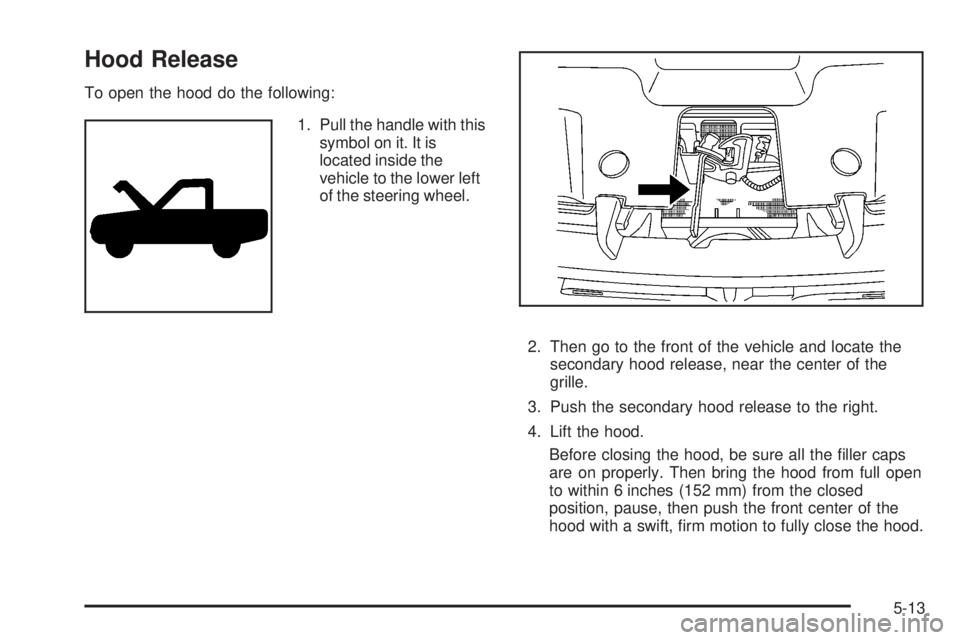
To open the hood do the following:
1. Pull the handle with this
symbol on it. It is
located inside the
vehicle to the lower left
of the steering wheel.
2. Then go to the front of the vehicle and locate the
secondary hood release, near the center of the
grille.
3. Push the secondary hood release to the right.
4. Lift the hood.
Before closing the hood, be sure all the ller caps
are on properly. Then bring the hood from full open
to within 6 inches (152 mm) from the closed
position, pause, then push the front center of the
hood with a swift, rm motion to fully close the hood.
5-13
Page 455 of 546
Notice:If your vehicle has P265/70R17 size tires,
use tire chains only where legal and only when you
must. Use chains that are the proper size for your
vehicle’s tires. Install them on the rear tires only.
Do not use chains on the front tires.
Tighten them as tightly as possible with the ends
securely fastened. Drive slowly and follow the chain
manufacturer’s instructions. If you can hear the
chains contacting your vehicle, stop and retighten
them. If the contact continues, slow down until
it stops. Driving too fast or spinning the wheels with
chains on will damage your vehicle.If a Tire Goes Flat
It is unusual for a tire to blowout while you are driving,
especially if you maintain your vehicle’s tires properly.
If air goes out of a tire, it is much more likely to leak out
slowly. But if you should ever have a blowout, here
are a few tips about what to expect and what to do:
If a front tire fails, the at tire creates a drag that pulls
the vehicle toward that side. Take your foot off the
accelerator pedal and grip the steering wheel rmly.
Steer to maintain lane position, and then gently brake to
a stop well out of the traffic lane.
A rear blowout, particularly on a curve, acts much like a
skid and may require the same correction you would
use in a skid. In any rear blowout remove your foot from
the accelerator pedal. Get the vehicle under control
by steering the way you want the vehicle to go. It may
be very bumpy and noisy, but you can still steer. Gently
brake to a stop, well off the road if possible.
5-87
Page 486 of 546
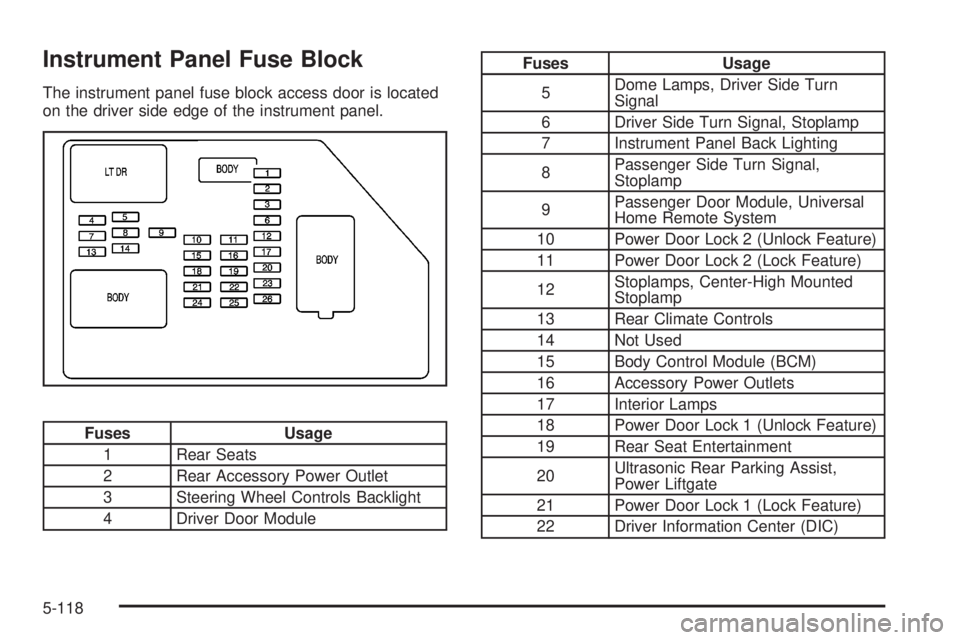
Instrument Panel Fuse Block
The instrument panel fuse block access door is located
on the driver side edge of the instrument panel.
Fuses Usage
1 Rear Seats
2 Rear Accessory Power Outlet
3 Steering Wheel Controls Backlight
4 Driver Door Module
Fuses Usage
5Dome Lamps, Driver Side Turn
Signal
6 Driver Side Turn Signal, Stoplamp
7 Instrument Panel Back Lighting
8Passenger Side Turn Signal,
Stoplamp
9Passenger Door Module, Universal
Home Remote System
10 Power Door Lock 2 (Unlock Feature)
11 Power Door Lock 2 (Lock Feature)
12Stoplamps, Center-High Mounted
Stoplamp
13 Rear Climate Controls
14 Not Used
15 Body Control Module (BCM)
16 Accessory Power Outlets
17 Interior Lamps
18 Power Door Lock 1 (Unlock Feature)
19 Rear Seat Entertainment
20Ultrasonic Rear Parking Assist,
Power Liftgate
21 Power Door Lock 1 (Lock Feature)
22 Driver Information Center (DIC)
5-118
Page 507 of 546

Recommended Fluids and
Lubricants
Fluids and lubricants identied below by name, part
number, or specication can be obtained from your
dealer/retailer.
Usage Fluid/Lubricant
Engine OilEngine oil which meets GM
Standard GM6094M and displays
the American Petroleum Institute
Certied for Gasoline Engines
starburst symbol. To determine the
proper viscosity for your vehicle’s
engine, seeEngine Oil on
page 5-15.
Engine Coolant50/50 mixture of clean, drinkable
water and use only DEX-COOL
®
Coolant. SeeEngine Coolant on
page 5-28.
Hydraulic Brake
SystemDelco
®Supreme 11 Brake Fluid or
equivalent DOT-3 brake uid.
Usage Fluid/Lubricant
Windshield
WasherOptikleen
®Washer Solvent.
Power Steering
SystemGM Power Steering Fluid
(GM Part No. U.S. 89021184, in
Canada 89021186).
Automatic
TransmissionDEXRON
®-VI Automatic
Transmission Fluid.
Key Lock
CylindersMulti-Purpose Lubricant, Superlube
(GM Part No. U.S. 12346241, in
Canada 10953474).
Chassis
LubricationChassis Lubricant
(GM Part No. U.S. 12377985, in
Canada 88901242) or lubricant
meeting requirements of NLGI #2,
Category LB or GC-LB.
Front Axle
(1500 Series
Vehicles with
Four-Wheel
Drive)SAE 80W-90 Axle Lubricant
(GM Part No. U.S. 89021671, in
Canada 89021672).
Front Axle
(2500 Series
Vehicles with
Four-Wheel
Drive)SAE 75W-90
Synthetic Axle Lubricant
(GM Part No. U.S. 89021677,
in Canada 89021678) meeting
GM Specication 9986115.
6-13
Page 533 of 546

A
Accessories and Modications............................ 5-3
Adding a Snow Plow or Similar Equipment.........4-41
Adding Equipment to Your Airbag-Equipped
Vehicle.......................................................1-90
Additives, Fuel................................................. 5-6
Add-On Electrical Equipment...........................5-117
Adjustable Throttle and Brake Pedal..................2-29
Air Cleaner/Filter, Engine.................................5-19
Air Conditioning......................................3-23, 3-26
Airbag
Passenger Status Indicator...........................3-41
Readiness Light..........................................3-40
Airbag System................................................1-76
What Will You See After an Airbag Inates?....1-84
When Should an Airbag Inate?....................1-81
Where Are the Airbags?...............................1-78
Airbag Systems
Adding Equipment to Your Airbag-Equipped
Vehicle...................................................1-90
How Does an Airbag Restrain?......................1-83
Passenger Sensing System...........................1-85
Servicing Your Airbag-Equipped Vehicle..........1-90
What Makes an Airbag Inate?......................1-83
Antenna, Rear Side Window...........................3-130
Antenna, XM™ Satellite Radio Antenna
System.....................................................3-130Antilock Brake System (ABS)............................. 4-5
Antilock Brake, System Warning Light................3-46
Appearance Care
Aluminum or Chrome-Plated Wheels.............5-113
Care of Safety Belts...................................5-111
Chemical Paint Spotting..............................5-115
Cleaning Exterior Lamps/Lenses..................5-112
Fabric/Carpet............................................5-109
Finish Care...............................................5-112
Finish Damage..........................................5-114
Instrument Panel, Vinyl, and Other Plastic
Surfaces...............................................5-110
Interior Cleaning........................................5-108
Leather
....................................................5-110
Sheet Metal Damage..................................5-114
Tires........................................................5-114
Underbody Maintenance.............................5-114
Vehicle Care/Appearance Materials...............5-115
Washing Your Vehicle.................................5-111
Weatherstrips............................................5-111
Windshield, Backglass, and Wiper Blades......5-113
Appointments, Scheduling Service....................... 7-9
Ashtray.........................................................3-23
Audio System.................................................3-81
Audio Steering Wheel Controls....................3-128
Navigation/Radio System, see Navigation
Manual.................................................3-114
Radio Reception........................................3-129
1
Page 537 of 546

Engine
Air Cleaner/Filter.........................................5-19
Check and Service Engine Soon Light............3-48
Coolant......................................................5-28
Coolant Heater............................................2-30
Coolant Temperature Gage...........................3-47
Drive Belt Routing.......................................6-16
Engine Compartment Overview......................5-14
Exhaust.....................................................2-47
Fan Noise..................................................5-39
Oil .............................................................5-15
Oil Life System...........................................5-18
Overheated Protection Operating Mode...........5-33
Overheating................................................5-31
Running While Parked..................................2-48
Starting......................................................2-28
Entry Lighting.................................................3-20
Event Data Recorders.....................................7-16
Exit Lighting...................................................3-20
Extender, Safety Belt.......................................1-50
Exterior Lamps...............................................3-16
F
Filter
Engine Air Cleaner......................................5-19
Finish Damage.............................................5-114
Flashers, Hazard Warning.................................. 3-6
Flash-to-Pass................................................... 3-9Flat Tire........................................................5-87
Flat Tire, Changing.........................................5-88
Flat Tire, Storing...........................................5-103
Fluid.....................................................5-22, 5-24
Power Steering...........................................5-39
Windshield Washer......................................5-40
Fog Lamp
Fog ...........................................................3-19
Fog Lamp Light..............................................3-53
Four-Wheel Drive....................................2-38, 5-54
Front Axle......................................................5-55
Fuel............................................................... 5-5
Additives...................................................... 5-6
California Fuel.............................................. 5-6
E85 (85% Ethanol)........................................ 5-7
Filling a Portable Fuel Container....................5-11
Filling the Tank............................................. 5-9
Fuels in Foreign Countries.............................. 5-8
Gage.........................................................3-54
Gasoline Octane........................................... 5-5
Gasoline Specications.................................. 5-6
Low Warning Light.......................................3-55
Fuses
Center Instrument Panel Fuse Block.............5-119
Fuses and Circuit Breakers.........................5-117
Instrument Panel Fuse Block.......................5-118
Underhood Fuse Block...............................5-120
Windshield Wiper.......................................5-117
5