fuel cap GMC YUKON 2009 User Guide
[x] Cancel search | Manufacturer: GMC, Model Year: 2009, Model line: YUKON, Model: GMC YUKON 2009Pages: 576, PDF Size: 3.06 MB
Page 413 of 576
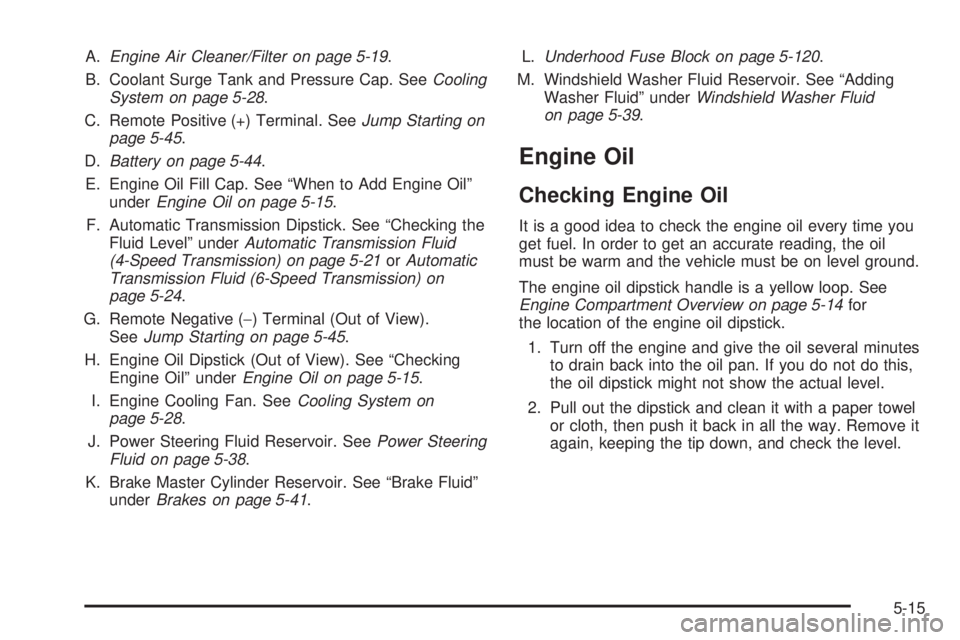
A.Engine Air Cleaner/Filter on page 5-19.
B. Coolant Surge Tank and Pressure Cap. SeeCooling
System on page 5-28.
C. Remote Positive (+) Terminal. SeeJump Starting on
page 5-45.
D.Battery on page 5-44.
E. Engine Oil Fill Cap. See “When to Add Engine Oil”
underEngine Oil on page 5-15.
F. Automatic Transmission Dipstick. See “Checking the
Fluid Level” underAutomatic Transmission Fluid
(4-Speed Transmission) on page 5-21orAutomatic
Transmission Fluid (6-Speed Transmission) on
page 5-24.
G. Remote Negative (−) Terminal (Out of View).
SeeJump Starting on page 5-45.
H. Engine Oil Dipstick (Out of View). See “Checking
Engine Oil” underEngine Oil on page 5-15.
I. Engine Cooling Fan. SeeCooling System on
page 5-28.
J. Power Steering Fluid Reservoir. SeePower Steering
Fluid on page 5-38.
K. Brake Master Cylinder Reservoir. See “Brake Fluid”
underBrakes on page 5-41.L.Underhood Fuse Block on page 5-120.
M. Windshield Washer Fluid Reservoir. See “Adding
Washer Fluid” underWindshield Washer Fluid
on page 5-39.
Engine Oil
Checking Engine Oil
It is a good idea to check the engine oil every time you
get fuel. In order to get an accurate reading, the oil
must be warm and the vehicle must be on level ground.
The engine oil dipstick handle is a yellow loop. See
Engine Compartment Overview on page 5-14for
the location of the engine oil dipstick.
1. Turn off the engine and give the oil several minutes
to drain back into the oil pan. If you do not do this,
the oil dipstick might not show the actual level.
2. Pull out the dipstick and clean it with a paper towel
or cloth, then push it back in all the way. Remove it
again, keeping the tip down, and check the level.
5-15
Page 466 of 576
Aspect Ratio:The relationship of a tire’s height
to its width.
Belt
:A rubber coated layer of cords that is located
between the plies and the tread. Cords may be
made from steel or other reinforcing materials.
Bead
:The tire bead contains steel wires wrapped
by steel cords that hold the tire onto the rim.
Bias Ply Tire
:A pneumatic tire in which the plies
are laid at alternate angles less than 90 degrees
to the centerline of the tread.
Cold Tire Pressure
:The amount of air pressure
in a tire, measured in pounds per square inch
(psi) or kilopascals (kPa) before a tire has built up
heat from driving. SeeInflation - Tire Pressure
on page 5-70.
Curb Weight
:The weight of a motor vehicle with
standard and optional equipment including the
maximum capacity of fuel, oil, and coolant,
but without passengers and cargo.DOT Markings
:A code molded into the sidewall
of a tire signifying that the tire is in compliance
with the U.S. Department of Transportation (DOT)
motor vehicle safety standards. The DOT code
includes the Tire Identication Number (TIN),
an alphanumeric designator which can also identify
the tire manufacturer, production plant, brand,
and date of production.
GVWR
:Gross Vehicle Weight Rating. See
Loading the Vehicle on page 4-33.
GAWR FRT
:Gross Axle Weight Rating for the
front axle. SeeLoading the Vehicle on page 4-33.
GAWR RR
:Gross Axle Weight Rating for the
rear axle. SeeLoading the Vehicle on page 4-33.
Intended Outboard Sidewall
:The side of an
asymmetrical tire, that must always face outward
when mounted on a vehicle.
Kilopascal (kPa)
:The metric unit for air pressure.
Light Truck (LT-Metric) Tire
:A tire used on light
duty trucks and some multipurpose passenger
vehicles.
5-68
Page 468 of 576
Treadwear Indicators:Narrow bands, sometimes
called wear bars, that show across the tread of
a tire when only 1/16 inch (1.6 mm) of tread
remains. SeeWhen It Is Time for New Tires on
page 5-79.
UTQGS (Uniform Tire Quality Grading
Standards)
:A tire information system that
provides consumers with ratings for a tire’s
traction, temperature, and treadwear. Ratings
are determined by tire manufacturers using
government testing procedures. The ratings are
molded into the sidewall of the tire. SeeUniform
Tire Quality Grading on page 5-82.
Vehicle Capacity Weight
:The number of
designated seating positions multiplied by 150 lbs
(68 kg) plus the rated cargo load. SeeLoading
the Vehicle on page 4-33.
Vehicle Maximum Load on the Tire
:Load on an
individual tire due to curb weight, accessory
weight, occupant weight, and cargo weight.
Vehicle Placard
:A label permanently attached to
a vehicle showing the vehicle’s capacity weight
and the original equipment tire size and
recommended ination pressure. See “Tire and
Loading Information Label” underLoading
the Vehicle on page 4-33.
Ination - Tire Pressure
If your vehicle is a Two-mode Hybrid, see the
Two-mode Hybrid manual for more information.
Tires need the correct amount of air pressure
to operate effectively.
Notice:Do not let anyone tell you that
under-ination or over-ination is all right. It is
not. If your tires do not have enough air
(under-ination), you can get the following:
Too much exing
Too much heat
Tire overloading
Premature or irregular wear
Poor handling
Reduced fuel economy
If your tires have too much air (over-ination),
you can get the following:
Unusual wear
Poor handling
Rough ride
Needless damage from road hazards
5-70
Page 522 of 576
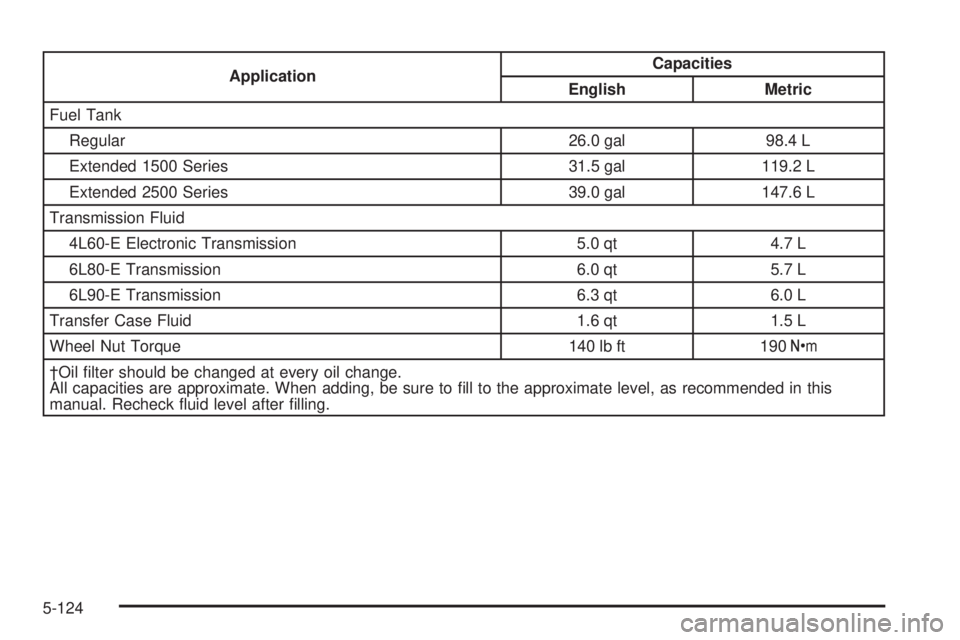
ApplicationCapacities
English Metric
Fuel Tank
Regular 26.0 gal 98.4 L
Extended 1500 Series 31.5 gal 119.2 L
Extended 2500 Series 39.0 gal 147.6 L
Transmission Fluid
4L60-E Electronic Transmission 5.0 qt 4.7 L
6L80-E Transmission 6.0 qt 5.7 L
6L90-E Transmission 6.3 qt 6.0 L
Transfer Case Fluid 1.6 qt 1.5 L
Wheel Nut Torque 140 lb ft 190Y
†Oil lter should be changed at every oil change.
All capacities are approximate. When adding, be sure to ll to the approximate level, as recommended in this
manual. Recheck uid level after lling.
5-124
Page 533 of 576
(f)Lubricate all key lock cylinders, hood latch assembly,
secondary latch, pivots, spring anchor, release pawl,
rear compartment hinges, outer liftgate handle pivot
points, rear door detent link, roller mechanism, liftgate
handle pivot points, latch bolt, fuel door hinge, cargo door
hinge, locks, and folding seat hardware. More frequent
lubrication may be required when exposed to a corrosive
environment. Applying silicone grease on weatherstrips
with a clean cloth will make them last longer, seal better,
and not stick or squeak.
(g)Check vent hose at transfer case for kinks and proper
installation. Check to be sure vent hose is unobstructed,
clear, and free of debris. During any maintenance, if a
power washer is used to clean mud and dirt from the
underbody, care should be taken to not directly spray the
transfer case output seals. High pressure water can
overcome the seals and contaminate the transfer case
fluid. Contaminated fluid will decrease the life of the
transfer case and should be replaced.
(h)Change automatic transmission fluid and filter if the
vehicle is mainly driven under one or more of these
conditions:
In heavy city traffic where the outside temperature
regularly reaches 90°F (32°C) or higher.
In hilly or mountainous terrain.
When doing frequent trailer towing.
Uses such as found in taxi, police, or delivery
service.(i)Drain, flush, and refill cooling system. This service can
be complex; you should have your dealer/retailer perform
this service. See Engine Coolant on page 5-29 for what to
use. Inspect hoses. Clean radiator, condenser, pressure
cap, and filler neck. Pressure test the cooling system and
pressure cap.
(j)A fluid loss in any vehicle system could indicate a
problem. Have the system inspected and repaired and
the fluid level checked. Add fluid if needed.
(k)Inspect system. Check all fuel and vapor lines
and hoses for proper hook-up, routing, and condition.
Check that the purge valve works properly, if equipped.
Replace as needed.
(l)If driving regularly under dusty conditions, inspect the
filter at each engine oil change.
(m)Visually inspect belt for fraying, excessive cracks, or
obvious damage. Replace belt if necessary.
(n)Severe Service: Change transfer case fluid if the
vehicle is mainly used for trailer towing or driven in city
traffic, wet environment, or high ambient temperatures.
6-9
Page 564 of 576
Audio System(s).............................................3-86
Rear Side Window Antenna.........................3-138
Automatic Headlamp System............................3-16
Automatic Transmission
Fluid..................................................5-21, 5-24
Operation...................................................2-29
Autoride
®.......................................................4-51
Auxiliary Roof Mounted Lamp Switch.................3-18
B
Battery..........................................................5-44
Electric Power Management..........................3-20
Run-Down Protection...................................3-20
Bench Seat, Split (60/40).................................1-14
Bluetooth
®....................................................3-114
Brake
Emergencies................................................ 4-6
Brake Fluid....................................................5-41
Brakes..........................................................5-41
System Warning Light..................................3-40
Braking........................................................... 4-4
Braking in Emergencies..................................... 4-6
Break-In, New Vehicle.....................................2-24
Bucket Seats, Rear.........................................1-20
Bulb Replacement...........................................5-57
Halogen Bulbs............................................5-57
Headlamp Aiming........................................5-54
License Plate Lamps....................................5-59Bulb Replacement (cont.)
Replacement Bulbs......................................5-60
Taillamps, Turn Signal, Stoplamps and
Back-up Lamps........................................5-58
Buying New Tires...........................................5-80
C
Calibration.....................................................3-61
California Fuel.................................................. 5-6
California Perchlorate Materials
Requirements............................................... 5-4
California Proposition 65 Warning....................... 5-4
Canadian Owners............................................... iii
Capacities and Specications..........................5-123
Carbon Monoxide...................2-12, 2-14, 2-46, 4-29
Care of
Safety Belts..............................................5-110
Cargo Cover..................................................2-77
CD, MP3 ............................................3-102, 3-107
Center Console Storage Area...........................2-75
Center Seat...................................................1-13
Chains, Tire...................................................5-86
Charging System Light....................................3-39
Check
Engine Lamp..............................................3-44
Checking Things Under the Hood......................5-12
Chemical Paint Spotting.................................5-114
2