power steering GMC YUKON 2009 User Guide
[x] Cancel search | Manufacturer: GMC, Model Year: 2009, Model line: YUKON, Model: GMC YUKON 2009Pages: 576, PDF Size: 3.06 MB
Page 413 of 576
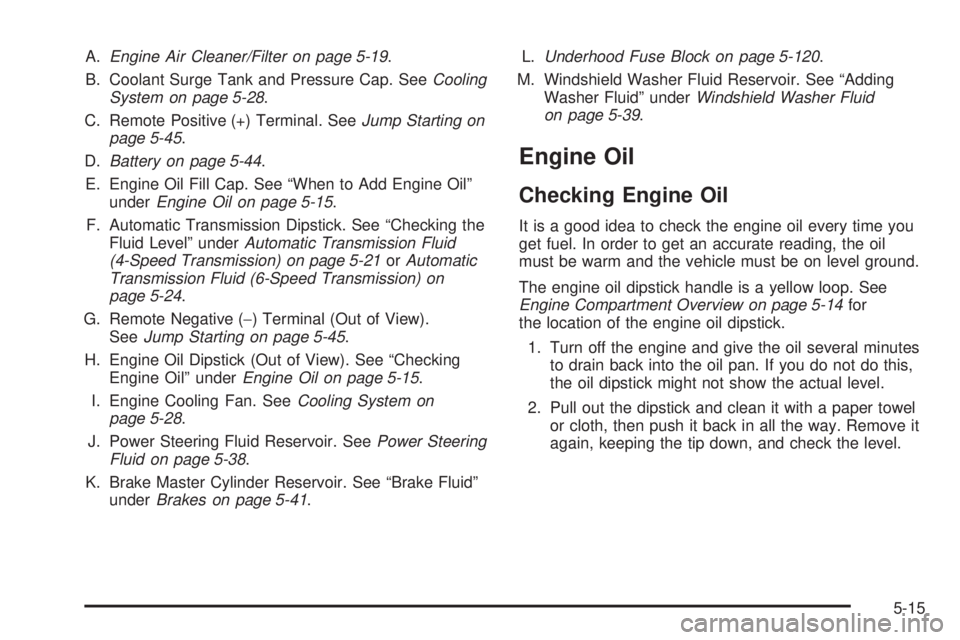
A.Engine Air Cleaner/Filter on page 5-19.
B. Coolant Surge Tank and Pressure Cap. SeeCooling
System on page 5-28.
C. Remote Positive (+) Terminal. SeeJump Starting on
page 5-45.
D.Battery on page 5-44.
E. Engine Oil Fill Cap. See “When to Add Engine Oil”
underEngine Oil on page 5-15.
F. Automatic Transmission Dipstick. See “Checking the
Fluid Level” underAutomatic Transmission Fluid
(4-Speed Transmission) on page 5-21orAutomatic
Transmission Fluid (6-Speed Transmission) on
page 5-24.
G. Remote Negative (−) Terminal (Out of View).
SeeJump Starting on page 5-45.
H. Engine Oil Dipstick (Out of View). See “Checking
Engine Oil” underEngine Oil on page 5-15.
I. Engine Cooling Fan. SeeCooling System on
page 5-28.
J. Power Steering Fluid Reservoir. SeePower Steering
Fluid on page 5-38.
K. Brake Master Cylinder Reservoir. See “Brake Fluid”
underBrakes on page 5-41.L.Underhood Fuse Block on page 5-120.
M. Windshield Washer Fluid Reservoir. See “Adding
Washer Fluid” underWindshield Washer Fluid
on page 5-39.
Engine Oil
Checking Engine Oil
It is a good idea to check the engine oil every time you
get fuel. In order to get an accurate reading, the oil
must be warm and the vehicle must be on level ground.
The engine oil dipstick handle is a yellow loop. See
Engine Compartment Overview on page 5-14for
the location of the engine oil dipstick.
1. Turn off the engine and give the oil several minutes
to drain back into the oil pan. If you do not do this,
the oil dipstick might not show the actual level.
2. Pull out the dipstick and clean it with a paper towel
or cloth, then push it back in all the way. Remove it
again, keeping the tip down, and check the level.
5-15
Page 436 of 576
Engine Fan Noise
If the vehicle has a clutched engine cooling fan, when the
clutch is engaged, the fan spins faster to provide more air
to cool the engine. In most everyday driving conditions,
the fan is spinning slower and the clutch is not fully
engaged. This improves fuel economy and reduces fan
noise. Under heavy vehicle loading, trailer towing, and/or
high outside temperatures, the fan speed increases as
the clutch more fully engages, so you may hear an
increase in fan noise. This is normal and should not be
mistaken as the transmission slipping or making extra
shifts. It is merely the cooling system functioning properly.
The fan will slow down when additional cooling is not
required and the clutch disengages.
You may also hear this fan noise when you start the
engine. It will go away as the fan clutch partially
disengages.
If the vehicle has electric cooling fans, you may hear the
fans spinning at low speed during most everyday driving.
The fans may turn off if no cooling is required. Under
heavy vehicle loading, trailer towing, and/or high outside
temperatures, or if you are operating the air conditioning
system, the fans may change to high speed and you
may hear an increase in fan noise. This is normal and
indicates that the cooling system is functioning properly.
The fans will change to low speed when additional
cooling is no longer required.
Power Steering Fluid
If the vehicle is a Two-mode Hybrid, see the Two-mode
Hybrid manual for more information.
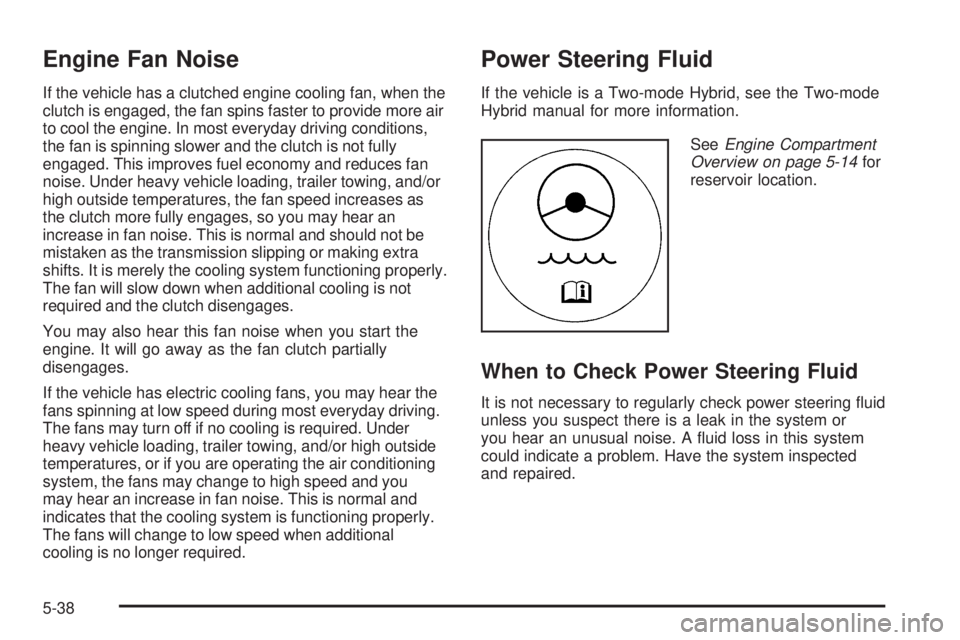
SeeEngine Compartment
Overview on page 5-14for
reservoir location.
When to Check Power Steering Fluid
It is not necessary to regularly check power steering uid
unless you suspect there is a leak in the system or
you hear an unusual noise. A uid loss in this system
could indicate a problem. Have the system inspected
and repaired.
5-38
Page 437 of 576
How to Check Power Steering Fluid
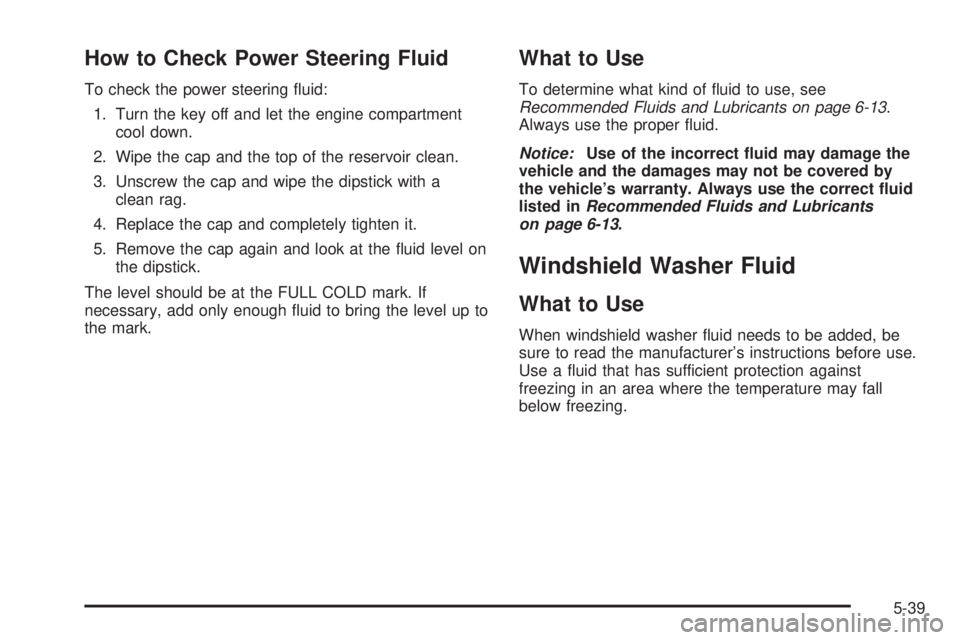
To check the power steering uid:
1. Turn the key off and let the engine compartment
cool down.
2. Wipe the cap and the top of the reservoir clean.
3. Unscrew the cap and wipe the dipstick with a
clean rag.
4. Replace the cap and completely tighten it.
5. Remove the cap again and look at the uid level on
the dipstick.
The level should be at the FULL COLD mark. If
necessary, add only enough uid to bring the level up to
the mark.
What to Use
To determine what kind of uid to use, see
Recommended Fluids and Lubricants on page 6-13.
Always use the proper uid.
Notice:Use of the incorrect uid may damage the
vehicle and the damages may not be covered by
the vehicle’s warranty. Always use the correct uid
listed inRecommended Fluids and Lubricants
on page 6-13.
Windshield Washer Fluid
What to Use
When windshield washer uid needs to be added, be
sure to read the manufacturer’s instructions before use.
Use a uid that has sufficient protection against
freezing in an area where the temperature may fall
below freezing.
5-39
Page 465 of 576
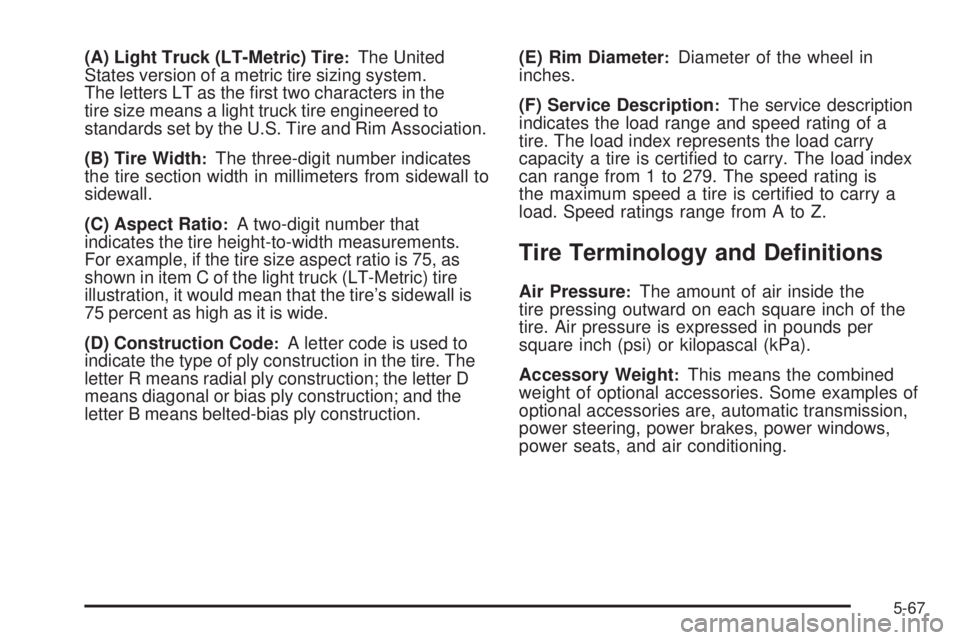
(A) Light Truck (LT-Metric) Tire:The United
States version of a metric tire sizing system.
The letters LT as the rst two characters in the
tire size means a light truck tire engineered to
standards set by the U.S. Tire and Rim Association.
(B) Tire Width
:The three-digit number indicates
the tire section width in millimeters from sidewall to
sidewall.
(C) Aspect Ratio
:A two-digit number that
indicates the tire height-to-width measurements.
For example, if the tire size aspect ratio is 75, as
shown in item C of the light truck (LT-Metric) tire
illustration, it would mean that the tire’s sidewall is
75 percent as high as it is wide.
(D) Construction Code
:A letter code is used to
indicate the type of ply construction in the tire. The
letter R means radial ply construction; the letter D
means diagonal or bias ply construction; and the
letter B means belted-bias ply construction.(E) Rim Diameter
:Diameter of the wheel in
inches.
(F) Service Description
:The service description
indicates the load range and speed rating of a
tire. The load index represents the load carry
capacity a tire is certied to carry. The load index
can range from 1 to 279. The speed rating is
the maximum speed a tire is certied to carry a
load. Speed ratings range from A to Z.
Tire Terminology and Denitions
Air Pressure:The amount of air inside the
tire pressing outward on each square inch of the
tire. Air pressure is expressed in pounds per
square inch (psi) or kilopascal (kPa).
Accessory Weight
:This means the combined
weight of optional accessories. Some examples of
optional accessories are, automatic transmission,
power steering, power brakes, power windows,
power seats, and air conditioning.
5-67
Page 515 of 576
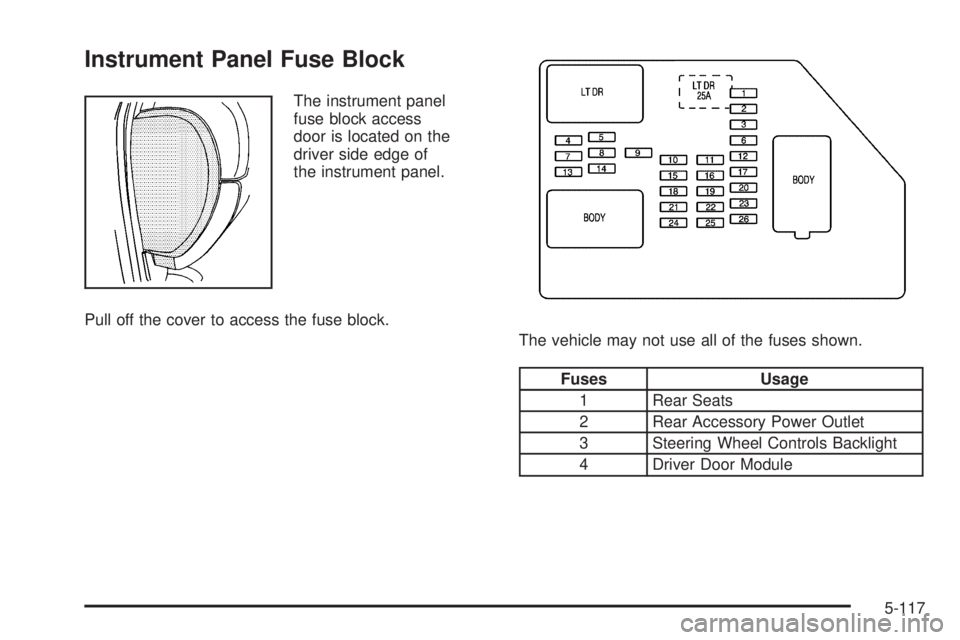
Instrument Panel Fuse Block
The instrument panel
fuse block access
door is located on the
driver side edge of
the instrument panel.
Pull off the cover to access the fuse block.
The vehicle may not use all of the fuses shown.
Fuses Usage
1 Rear Seats
2 Rear Accessory Power Outlet
3 Steering Wheel Controls Backlight
4 Driver Door Module
5-117
Page 517 of 576
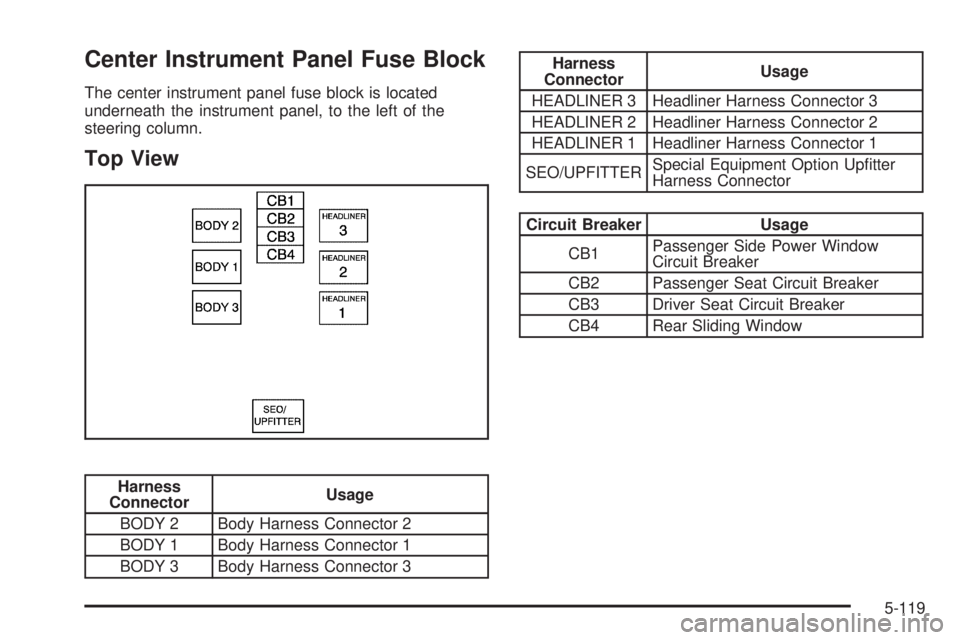
Center Instrument Panel Fuse Block
The center instrument panel fuse block is located
underneath the instrument panel, to the left of the
steering column.
Top View
Harness
ConnectorUsage
BODY 2 Body Harness Connector 2
BODY 1 Body Harness Connector 1
BODY 3 Body Harness Connector 3
Harness
ConnectorUsage
HEADLINER 3 Headliner Harness Connector 3
HEADLINER 2 Headliner Harness Connector 2
HEADLINER 1 Headliner Harness Connector 1
SEO/UPFITTERSpecial Equipment Option Uptter
Harness Connector
Circuit Breaker Usage
CB1Passenger Side Power Window
Circuit Breaker
CB2 Passenger Seat Circuit Breaker
CB3 Driver Seat Circuit Breaker
CB4 Rear Sliding Window
5-119
Page 532 of 576
Maintenance Footnotes
†The U.S. Environmental Protection Agency or the
California Air Resources Board has determined that the
failure to perform this maintenance item will not nullify
the emission warranty or limit recall liability prior to
the completion of the vehicle’s useful life. We, however,
urge that all recommended maintenance services be
performed at the indicated intervals and the
maintenance be recorded.
#Lubricate the front suspension, steering linkage, and
parking brake cable guides. Control arm ball joints on
2500 series vehicles require lubrication but should not be
lubricated unless their temperature is 10°F (−12°C) or
higher, or they could be damaged. Control arm ball joints
on 1500 series vehicles are maintenance-free.
(a)Visually inspect brake lines and hoses for proper
hook-up, binding, leaks, cracks, chafing, etc. Inspect disc
brake pads for wear and rotors for surface condition.
Inspect other brake parts, including calipers, parking
brake, etc.(b)Visually inspect front and rear suspension and
steering system for damaged, loose, or missing parts,
signs of wear, or lack of lubrication. Inspect power
steering lines and hoses for proper hook-up, binding,
leaks, cracks, chafing, etc. Visually check constant
velocity joints, rubber boots, and axle seals for leaks.
(c)Visually inspect hoses and have them replaced if they
are cracked, swollen, or deteriorated. Inspect all pipes,
fittings, and clamps; replace with genuine parts as
needed. To help ensure proper operation, a pressure test
of the cooling system and pressure cap and cleaning the
outside of the radiator and air conditioning condenser is
recommended at least once a year.
(d)Inspect wiper blades for wear, cracking, or
contamination. Clean the windshield and wiper blades,
if contaminated. Replace wiper blades that are worn or
damaged. See Windshield Wiper Blade Replacement on
page 5-60 and Windshield, Backglass, and Wiper Blades
on page 5-112 for more information.
(e)Make sure the safety belt reminder light and safety
belt assemblies are working properly. Look for any other
loose or damaged safety belt system parts. If you see
anything that might keep a safety belt system from doing
its job, have it repaired. Have any torn or frayed safety
belts replaced. Also see Checking the Restraint Systems
on page 1-98.
6-8
Page 537 of 576
Underbody Flushing Service
At least every spring, use plain water to ush any
corrosive materials from the underbody. Take care to
clean thoroughly any areas where mud and other debris
can collect.
Recommended Fluids and
Lubricants
Fluids and lubricants identied below by name, part
number, or specication can be obtained from your
dealer/retailer.
Usage Fluid/Lubricant
Engine OilEngine oil which meets GM
Standard GM6094M and displays
the American Petroleum Institute
Certied for Gasoline Engines
starburst symbol. To determine the
proper viscosity for your vehicle’s
engine, seeEngine Oil on
page 5-15.
Engine Coolant50/50 mixture of clean, drinkable
water and use only DEX-COOL
®
Coolant. SeeEngine Coolant on
page 5-29.
Usage Fluid/Lubricant
Hydraulic Brake
SystemDelco
®Supreme 11 Brake Fluid or
equivalent DOT-3 brake uid.
Windshield
WasherOptikleen
®Washer Solvent.
Power Steering
SystemGM Power Steering Fluid
(GM Part No. U.S. 89021184,
in Canada 89021186).
Automatic
TransmissionDEXRON
®-VI Automatic
Transmission Fluid.
Key Lock
CylindersMulti-Purpose Lubricant, Superlube
(GM Part No. U.S. 12346241,
in Canada 10953474).
Chassis
LubricationChassis Lubricant
(GM Part No. U.S. 12377985,
in Canada 88901242) or lubricant
meeting requirements of NLGI #2,
Category LB or GC-LB.
Front Axle
(1500 Series
Vehicles with
Four-Wheel
Drive)SAE 80W-90 Axle Lubricant
(GM Part No. U.S. 89021671,
in Canada 89021672).
6-13
Page 563 of 576
A
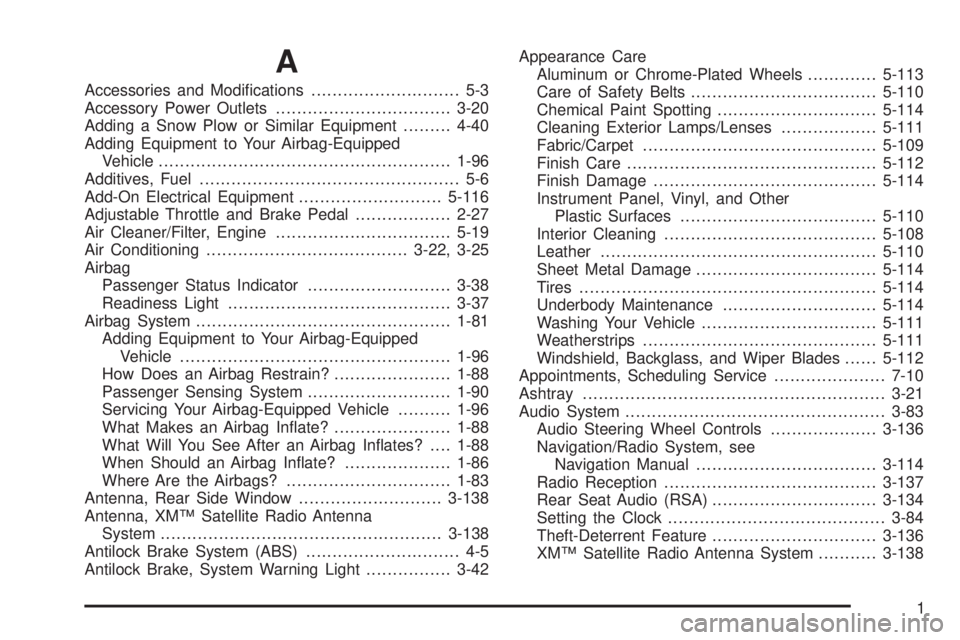
Accessories and Modications............................ 5-3
Accessory Power Outlets.................................3-20
Adding a Snow Plow or Similar Equipment.........4-40
Adding Equipment to Your Airbag-Equipped
Vehicle.......................................................1-96
Additives, Fuel................................................. 5-6
Add-On Electrical Equipment...........................5-116
Adjustable Throttle and Brake Pedal..................2-27
Air Cleaner/Filter, Engine.................................5-19
Air Conditioning......................................3-22, 3-25
Airbag
Passenger Status Indicator...........................3-38
Readiness Light..........................................3-37
Airbag System................................................1-81
Adding Equipment to Your Airbag-Equipped
Vehicle...................................................1-96
How Does an Airbag Restrain?......................1-88
Passenger Sensing System...........................1-90
Servicing Your Airbag-Equipped Vehicle..........1-96
What Makes an Airbag Inate?......................1-88
What Will You See After an Airbag Inates?....1-88
When Should an Airbag Inate?....................1-86
Where Are the Airbags?...............................1-83
Antenna, Rear Side Window...........................3-138
Antenna, XM™ Satellite Radio Antenna
System.....................................................3-138
Antilock Brake System (ABS)............................. 4-5
Antilock Brake, System Warning Light................3-42Appearance Care
Aluminum or Chrome-Plated Wheels.............5-113
Care of Safety Belts...................................5-110
Chemical Paint Spotting..............................5-114
Cleaning Exterior Lamps/Lenses..................5-111
Fabric/Carpet............................................5-109
Finish Care...............................................5-112
Finish Damage..........................................5-114
Instrument Panel, Vinyl, and Other
Plastic Surfaces.....................................5-110
Interior Cleaning........................................
5-108
Leather....................................................5-110
Sheet Metal Damage..................................5-114
Tires........................................................5-114
Underbody Maintenance.............................5-114
Washing Your Vehicle.................................5-111
Weatherstrips............................................5-111
Windshield, Backglass, and Wiper Blades......5-112
Appointments, Scheduling Service.....................7-10
Ashtray.........................................................3-21
Audio System.................................................3-83
Audio Steering Wheel Controls....................3-136
Navigation/Radio System, see
Navigation Manual..................................3-114
Radio Reception........................................3-137
Rear Seat Audio (RSA)...............................3-134
Setting the Clock.........................................3-84
Theft-Deterrent Feature...............................3-136
XM™ Satellite Radio Antenna System...........3-138
1
Page 567 of 576
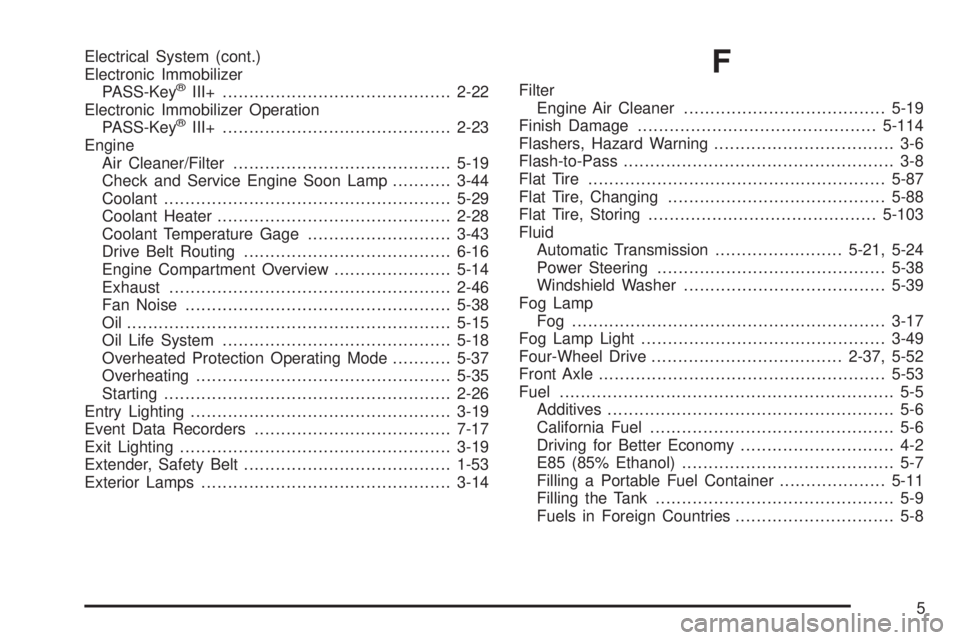
Electrical System (cont.)
Electronic Immobilizer
PASS-Key
®III+...........................................2-22
Electronic Immobilizer Operation
PASS-Key
®III+...........................................2-23
Engine
Air Cleaner/Filter.........................................5-19
Check and Service Engine Soon Lamp...........3-44
Coolant......................................................5-29
Coolant Heater............................................2-28
Coolant Temperature Gage...........................3-43
Drive Belt Routing.......................................6-16
Engine Compartment Overview......................5-14
Exhaust.....................................................2-46
Fan Noise..................................................5-38
Oil .............................................................5-15
Oil Life System...........................................5-18
Overheated Protection Operating Mode...........5-37
Overheating................................................5-35
Starting......................................................2-26
Entry Lighting.................................................3-19
Event Data Recorders.....................................7-17
Exit Lighting...................................................3-19
Extender, Safety Belt.......................................1-53
Exterior Lamps...............................................3-14
F
Filter
Engine Air Cleaner......................................5-19
Finish Damage.............................................5-114
Flashers, Hazard Warning.................................. 3-6
Flash-to-Pass................................................... 3-8
Flat Tire........................................................5-87
Flat Tire, Changing.........................................5-88
Flat Tire, Storing...........................................5-103
Fluid
Automatic Transmission........................5-21, 5-24
Power Steering...........................................5-38
Windshield Washer......................................5-39
Fog Lamp
Fog ...........................................................3-17
Fog Lamp Light..............................................3-49
Four-Wheel Drive....................................2-37, 5-52
Front Axle......................................................5-53
Fuel............................................................... 5-5
Additives...................................................... 5-6
California Fuel.............................................. 5-6
Driving for Better Economy............................. 4-2
E85 (85% Ethanol)........................................ 5-7
Filling a Portable Fuel Container....................5-11
Filling the Tank............................................. 5-9
Fuels in Foreign Countries.............................. 5-8
5