wheel GMC YUKON DENALI 2002 Repair Manual
[x] Cancel search | Manufacturer: GMC, Model Year: 2002, Model line: YUKON DENALI, Model: GMC YUKON DENALI 2002Pages: 407, PDF Size: 2.76 MB
Page 293 of 407

5-34
7. Make sure the tire is stored securely. Push, pull, and
then try to rotate or turn the tire. If the tire moves,
use the wheel wrench to tighten the cable.
Replace the jack, tools and spare tire lock.To store the tools, follow these procedures:
For Yukon Denali Models:Yukon Denali Models (Under Driver's Side Rear Seat)
A. Tool Kit with Jack Tools and Gloves
B. Bracket and Wing Nut
Page 295 of 407

5-36
For Yukon XL Denali Models:
Yukon XL Denali Models
A. Bottle Jack
B. Wheel Blocks
C. Wing Nut
D. Mounting Bracket
E. Removable TrayF. Retaining Hook
G. Retaining Bracket
and Wing Nut
H. Tool Kit with Jack
Tools and Gloves1. Return the tool kit to the tool bag (H) and place them
back in the side storage box.
2. Assemble wheel blocks and bottle jack (A) together
with the wing nut (C).
Spare Tire
Your vehicle, when new, had a fully inflated spare tire.
A spare tire may lose air over time, so check its inflation
pressure regularly. See ªInflation
-Tire Pressureº and
ªLoading Your Vehicleº in the Index for information
regarding proper tire inflation and loading your vehicle.
For instruction on how to remove, install or store a spare
tire, see ªChanging a Flat Tireº in the Index.
After installing the spare tire on your vehicle, you
should stop as soon as possible and make sure the spare
is correctly inflated. Have the damaged or flat road tire
repaired or replaced as soon as you can and installed
back onto your vehicle. This way, a spare tire will be
available in case you need it again.
If your vehicle has a spare tire that does not match your
vehicle's original road tires and wheels in size and type,
do not include the spare in the tire rotation.
Page 296 of 407
5-37
If You're Stuck: In Sand, Mud,
Ice or Snow
In order to free your vehicle when it is stuck, you will
need to spin the wheels, but you don't want to spin
your wheels too fast. The method known as ªrockingº
can help you get out when you're stuck, but you must
use caution.
CAUTION:
If you let your tires spin at high speed, they can
explode, and you or others could be injured.
And, the transmission or other parts of the
vehicle can overheat. That could cause an engine
compartment fire or other damage. When you're
stuck, spin the wheels as little as possible. Don't
spin the wheels above 35 mph (55 km/h) as shown
on the speedometer.
NOTICE:
Spinning your wheels can destroy parts of your
vehicle as well as the tires. If you spin the wheels
too fast while shifting your transmission back
and forth, you can destroy your transmission.
For information about using tire chains on your vehicle,
see ªTire Chainsº in the Index.
Page 297 of 407
5-38 Rocking Your Vehicle To Get It Out
First, turn your steering wheel left and right. That will
clear the area around your front wheels. Then shift back
and forth between REVERSE (R) and a forward gear,
spinning the wheels as little as possible. Release the
accelerator pedal while you shift, and press lightly on
the accelerator pedal when the transmission is in gear.
By slowly spinning your wheels in the forward and
reverse directions, you will cause a rocking motion that
may free your vehicle. If that doesn't get you out after a
few tries, you may need to be towed out. Or, you can use
your recovery hooks if your vehicle has them. If you do
need to be towed out, see ªTowing Your Vehicleº in
the Index.
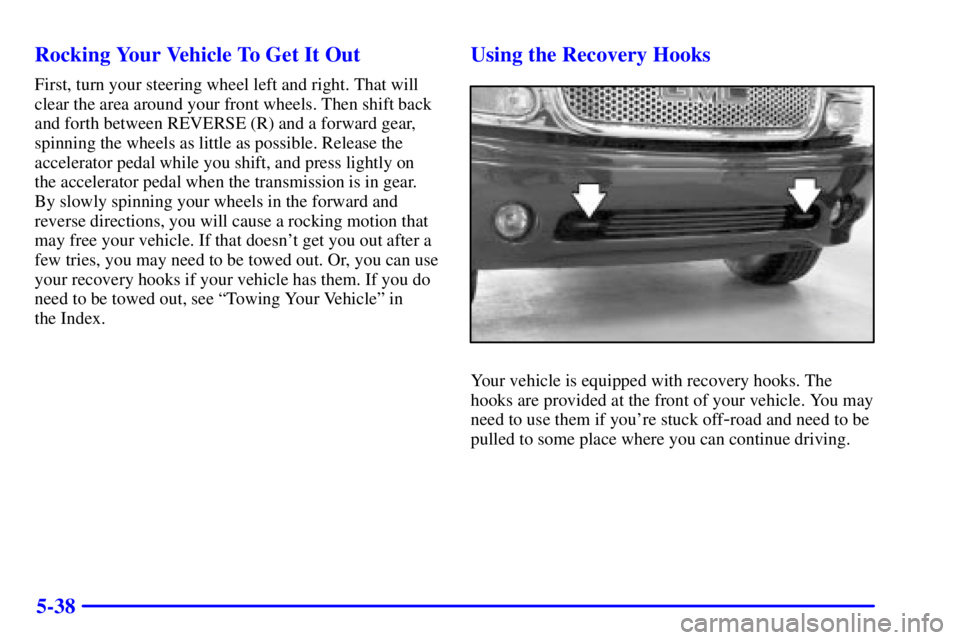
Using the Recovery Hooks
Your vehicle is equipped with recovery hooks. The
hooks are provided at the front of your vehicle. You may
need to use them if you're stuck off
-road and need to be
pulled to some place where you can continue driving.
Page 299 of 407
6-
6-1
Section 6 Service and Appearance Care
Here you will find information about the care of your vehicle. This section begins with service and fuel information,
and then it shows how to check important fluid and lubricant levels. There is also technical information about your
vehicle, and a part devoted to its appearance care.
6
-2 Service
6
-3 Fuel
6
-5 Fuels in Foreign Countries
6
-6 Filling Your Tank
6
-8 Filling a Portable Fuel Container
6
-8 Checking Things Under the Hood
6
-11 Engine Oil
6
-17 Engine Air Cleaner/Filter
6
-19 Passenger Compartment Air Filter
6
-20 Automatic Transmission Fluid
6
-23 Rear Axle
6
-24 All-Wheel Drive
6
-26 Engine Coolant
6
-29 Coolant Surge Tank Pressure Cap
6
-30 Power Steering Fluid6
-31 Windshield Washer Fluid
6
-32 Brakes
6
-36 Battery
6
-37 Bulb Replacement
6
-41 Windshield Wiper Blade Replacement
6
-42 Tires
6
-51 Appearance Care
6
-51 Cleaning the Inside of Your Vehicle
6
-55 Cleaning the Outside of Your Vehicle
6
-59 GM Vehicle Care/Appearance Materials
6
-60 Vehicle Identification Number (VIN)
6
-61 Electrical System
6
-69 Replacement Bulbs
6
-70 Capacities and Specifications
6
-71 Normal Maintenance Replacement Parts
Page 307 of 407
6-9 Hood Release
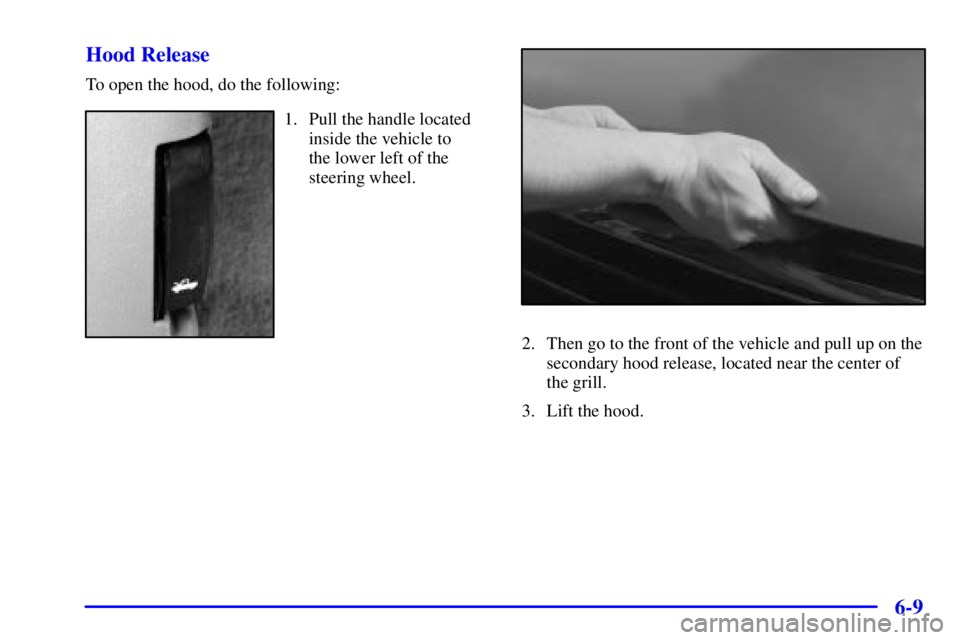
To open the hood, do the following:
1. Pull the handle located
inside the vehicle to
the lower left of the
steering wheel.
2. Then go to the front of the vehicle and pull up on the
secondary hood release, located near the center of
the grill.
3. Lift the hood.
Page 322 of 407

6-24 What to Use
Refer to the Maintenance Schedule to determine what
kind of lubricant to use. See ªRecommended Fluids
and Lubricantsº in the Index.
All-Wheel Drive
Lubricant checks in this section also apply to these
vehicles. However, there are two additional systems
that need lubrication.
Transfer Case
When to Check Lubricant
Refer to the Maintenance Schedule to determine how
often to check the lubricant. See ªPeriodic Maintenance
Inspectionsº in the Index.How to Check Lubricant
Automatic Transfer Case
(A) Filler Plug (B) Drain Plug
To get an accurate reading, the vehicle should be on a
level surface.
If the level is below the bottom of the filler plug hole,
you'll need to add some lubricant. Add enough lubricant
to raise the level to the bottom of the filler plug hole.
Use care not to overtighten the plug.
Page 333 of 407
6-35 Brake Wear
Your vehicle has four-wheel disc brakes.
Disc brake pads have built
-in wear indicators that
make a high
-pitched warning sound when the brake
pads are worn and new pads are needed. The sound
may come and go or be heard all the time your vehicle
is moving (except when you are pushing on the brake
pedal firmly).
CAUTION:
The brake wear warning sound means that soon
your brakes won't work well. That could lead to
an accident. When you hear the brake wear
warning sound, have your vehicle serviced.
NOTICE:
Continuing to drive with worn-out brake pads
could result in costly brake repair.
Some driving conditions or climates may cause a brake
squeal when the brakes are first applied or lightly
applied. This does not mean something is wrong with
your brakes.
Properly torqued wheel nuts are necessary to help
prevent brake pulsation. When tires are rotated, inspect
brake pads for wear and evenly tighten wheel nuts in the
proper sequence to GM torque specifications.
Brake linings should always be replaced as complete
axle sets.
See ªBrake System Inspectionº in Section 7 of this manual
under Part C ªPeriodic Maintenance Inspections.º
Brake Pedal Travel
See your dealer if the brake pedal does not return to
normal height, or if there is a rapid increase in pedal
travel. This could be a sign of brake trouble.
Brake Adjustment
Every time you make a brake stop, your disc brakes
adjust for wear.
Page 342 of 407
6-44 Tire Inspection and Rotation
Tires should be rotated every 6,000 to 8,000 miles
(10 000 to 13 000 km). Any time you notice unusual
wear, rotate your tires as soon as possible and check
wheel alignment. Also check for damaged tires or
wheels. See ªWhen It's Time for New Tiresº and
ªWheel Replacementº later in this section for more
information. Make sure the spare tire is stored securely.
Push, pull, and then try to rotate or turn the tire. If it
moves, use the wheel wrench to tighten the cable. See
ªStoring a Flat or Spare Tire and Toolsº in the Index.
The purpose of regular rotation is to achieve more uniform
wear for all tires on the vehicle. The first rotation is the
most important. See ªScheduled Maintenance Servicesº in
the Index for scheduled rotation intervals.
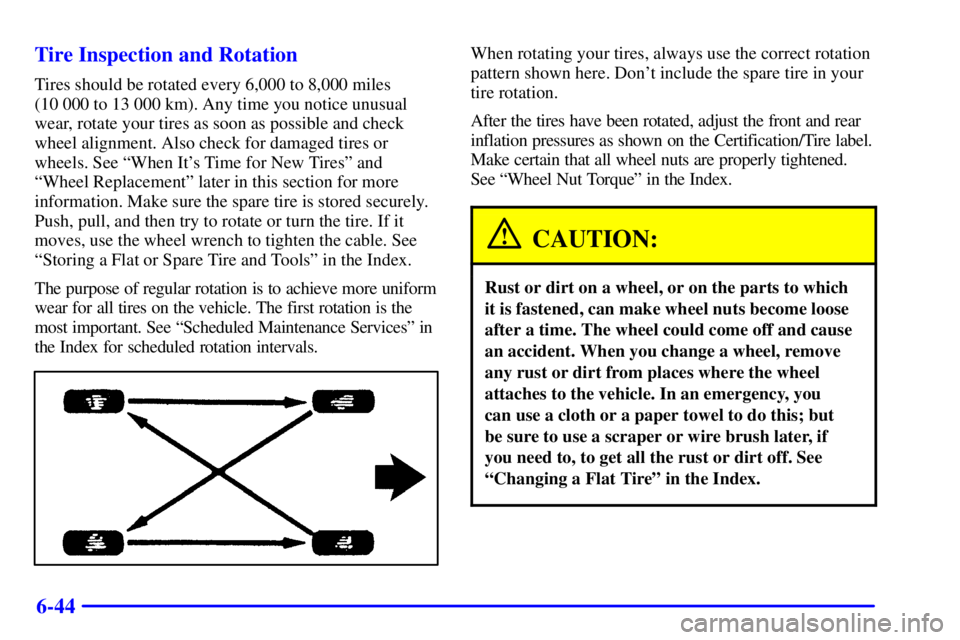
When rotating your tires, always use the correct rotation
pattern shown here. Don't include the spare tire in your
tire rotation.
After the tires have been rotated, adjust the front and rear
inflation pressures as shown on the Certification/Tire label.
Make certain that all wheel nuts are properly tightened.
See ªWheel Nut Torqueº in the Index.
CAUTION:
Rust or dirt on a wheel, or on the parts to which
it is fastened, can make wheel nuts become loose
after a time. The wheel could come off and cause
an accident. When you change a wheel, remove
any rust or dirt from places where the wheel
attaches to the vehicle. In an emergency, you
can use a cloth or a paper towel to do this; but
be sure to use a scraper or wire brush later, if
you need to, to get all the rust or dirt off. See
ªChanging a Flat Tireº in the Index.
Page 344 of 407
6-46 Buying New Tires
To find out what kind and size of tires you need, look at
the Certification/Tire label.
The tires installed on your vehicle when it was new had
a Tire Performance Criteria Specification (TPC Spec)
number on each tire's sidewall. When you get new tires,
get ones with that same TPC Spec number. That way
your vehicle will continue to have tires that are designed
to give proper endurance, handling, speed rating,
traction, ride and other things during normal service on
your vehicle. If your tires have an all
-season tread
design, the TPC number will be followed by an ªMSº
(for mud and snow).
If you ever replace your tires with those not having
a TPC Spec number, make sure they are the same
size, load range, speed rating and construction type
(bias, bias
-belted or radial) as your original tires.
CAUTION:
Mixing tires could cause you to lose control while
driving. If you mix tires of different sizes or types
(radial and bias
-belted tires), the vehicle may not
handle properly, and you could have a crash.
Using tires of different sizes may also cause
damage to your vehicle. Be sure to use the same
size and type tires on all wheels.
If your vehicle has 17 inch road tires (those
originally installed on your vehicle) it is all right
to drive with the 16 inch spare tire that came
with your vehicle. When new, your vehicle
included a spare tire and wheel assembly with the
same overall diameter as your vehicle's road tires
and wheels. Because this spare tire was developed
for use on your vehicle, it will not affect vehicle
handling or cause damage to your vehicle.