seats GMC YUKON DENALI 2003 Owner's Manual
[x] Cancel search | Manufacturer: GMC, Model Year: 2003, Model line: YUKON DENALI, Model: GMC YUKON DENALI 2003Pages: 447, PDF Size: 21.97 MB
Page 68 of 447
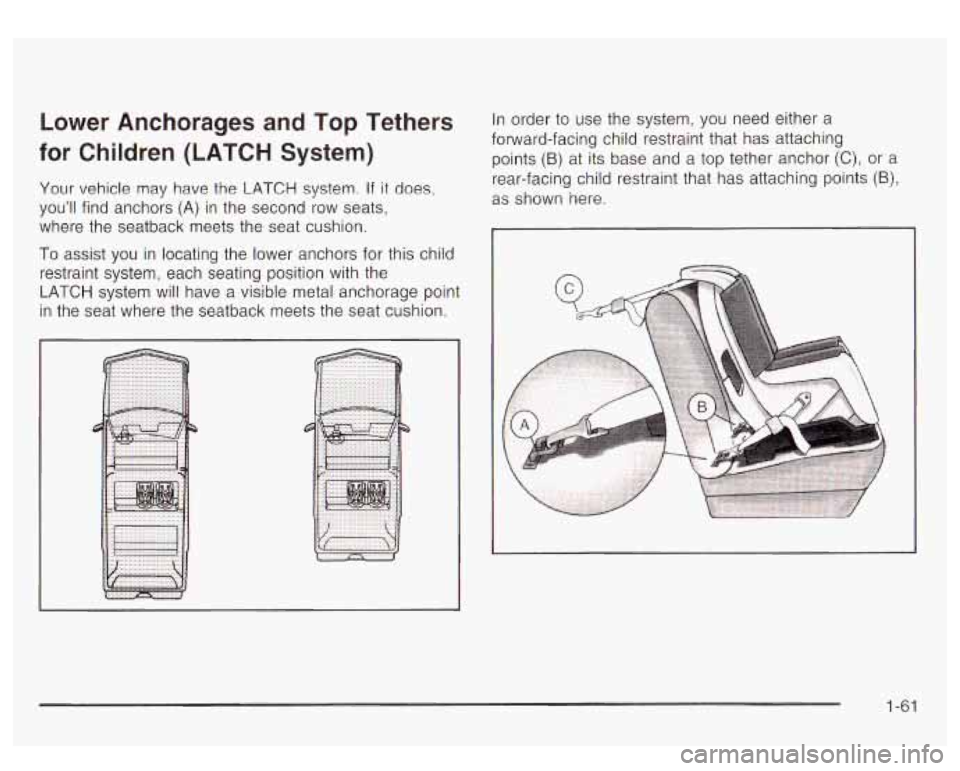
Lower Anchorages and Top Tethers
for Children (LATCH System)
Your vehicle ma.y have the LATCH system. If it does;
you’ll find anchors
(A) in the second row seats,
where the seatback meets the seat cushion.
To assist you in locating the lower anchors for this child
restraint system, each seating position with the
LATCH system will have a visible metal anchorage point
in the seat where the seatback meets the seat cushion. In order
to use
the system, you need either a
forward-facing child restraint that has attaching
points
(B) at its base and a top tether anchor (C), or a
rear-facing child restraint that has attaching points
(B),
as shown here.
1-61
Page 76 of 447
A child in a rear-facing child restraint can be
seriously injured or killed if the right front passenger’s air bag inflates. This
is because
the back of the rear facing child restraint
would be very close
to the inflating air bag.
Be sure the air bag is
off before using a
rear-facing child restraint
in the right front seat
position.
Even though the passenger sensing system is
designed to turn
off the passenger’s frontal air
bag if the system detects a rear-facing child
restraint, no system is fail-safe, and no one
can guarantee that an air bag will not deploy under some unusual circumstance, even
though
it is turned off. General Motors
therefore recommends that rear-facing child restraints be secured in the rear seat whenever
possible, even
if the air bag is off.
You’ll be using the lap-shoulder belt. See Top Strap on
page
1-57 if the child restraint has one. Be sure to
follow the instructions that came with the child restraint.
Secure the child in the child restraint when and as
the instructions say.
1. Because your vehicle has a right front passenger
air bag, always move the seat as far back as it will
go before securing a child restraint,
if you need
to secure a forward-facing child restraint in the right
front seat position. See
Power Seats on page 1-3.
If your vehicle has the passenger sensing
system and you are using a rear-facing child
restraint in this seat, make sure the frontal air bag
is
off. See Passenger Sensing System on
page
1-8 1.
When the passenger sensing system has turned off
the right front passenger’s frontal air bag, the off
indicator on the inside rearview mirror will light and
stay lit when you turn the ignition to RUN or
START.
2. Put the restraint on the seat.
3. Pick up the latch plate, and run the lap and shoulder
portions of the vehicle’s safety belt through or
around the restraint. The child restraint instructions
will show
you how.
1-69
Page 84 of 447
When Should an Air Bag Inflate?
Frontal Air Bags
The driver’s and right front passenger’s frontal air bags
are designed
to inflate in moderate to severe frontal
or near-frontal crashes. But they are designed to inflate
only
if the impact speed is above the system’s
designed “threshold level.”
In addition, your vehicle has “dual stage” frontal air
bags, which adjust the amount of restraint according to
crash severity. For moderate frontal impacts, these
air bags inflate at a level less than full deployment. For
more severe frontal impacts, full deployment occurs.
If the front of your vehicle goes straight into a wall that
doesn’t move or deform, the threshold level for the
reduced deployment is about
10 to 16 mph
(16 to 25 km/h), and the threshold level for a full
deployment is about
20 to 25 mph (32 to 40 km/h).
The threshold level can vary, however, with specific
vehicle design,
so that it can be somewhat above
or below this range.
If your vehicle strikes something that will move or
deform, such as a parked car, the threshold level will be
higher. The driver’s and right front passenger’s frontal
air bags are not designed
to inflate in rollovers, rear
impacts, or in many side impacts because inflation
would not help the occupant.
Seat Position Sensors
Vehicles with dual stage air bags are also equipped with
special sensors which enable the sensing system to
monitor
the position of both the driver and passenger
front seats. The seat position sensor provides information which is used
to determine if the air bags
should deploy at a reduced level or at full depoyment.
Side Impact Air Bags
Your vehicle may or may not have a side impact air
bag. See
Air Bag Systems on page 1-72. Side impact air
bags are designed
to inflate in moderate to severe
side crashes.
A side impact air bag will inflate if
the crash severity is above the system’s designed
“threshold level.” The threshold level can vary with
specific vehicle design. Side impact air bags are
not designed
to inflate in frontal or near-frontal impacts,
rollovers or rear impacts, because inflation would not
help the occupant.
A side impact air bag will only deploy
on the side of the vehicle that is struck.
Air Bag Systems
In any particular crash, no one can say whether an air
bag should have inflated simply because of the damage
to a vehicle or because of what the repair costs were.
For frontal air bags, inflation is determined by the angle
of the impact and how quickly the vehicle slows down
1-77
Page 129 of 447
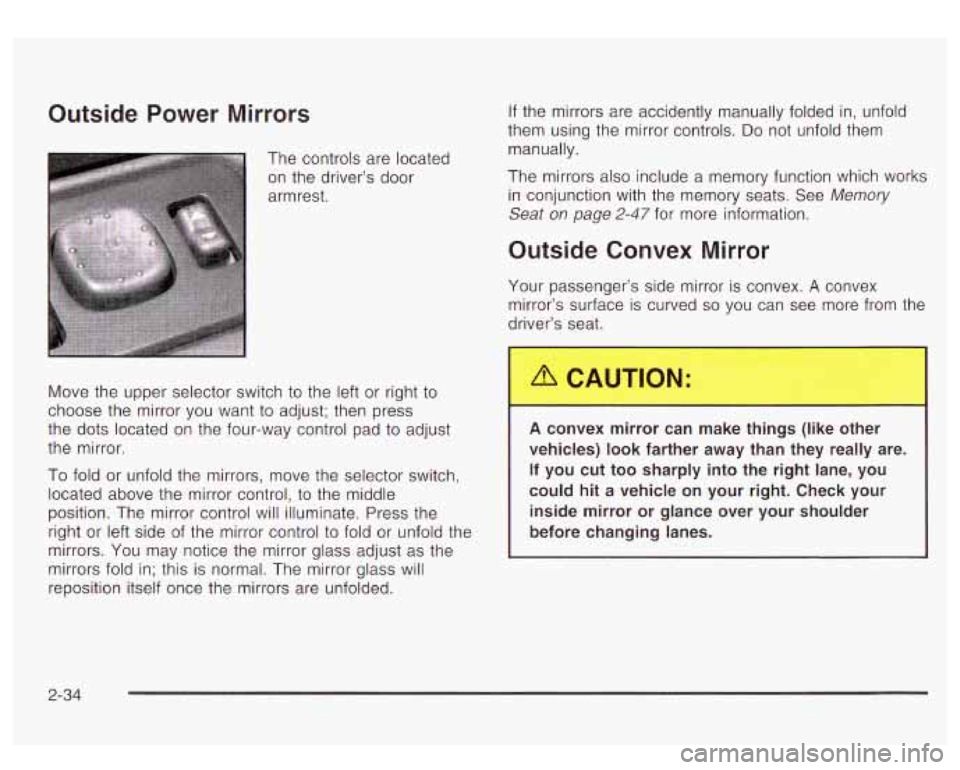
Outside Power Mirrors
The controls are located
on the driver’s door
armrest.
If the mirrors are accidently manually folded in, unfold
them using the mirror controls.
Do not unfold them
manually.
The mirrors also include a memory function which works
in conjunction with the memory seats. See
Memory
Seat on page 2-47 for more information.
Move the upper selector switch
to the left or right to
choose the mirror you want to adjust; then press
the dots located on the four-way control pad to adjust
the mirror.
To fold or unfold the mirrors, move the selector switch,
located above the mirror control,
to the middle
position. The mirror control will illuminate. Press the
right or left side of the mirror control to fold or unfold the
mirrors. You may notice the mirror glass adjust as the
mirrors fold in; this is normal. The mirror glass will
reposition itself once the mirrors are unfolded.
Outside Convex Mirror
Your passenger’s side mirror is convex. A convex
mirror’s surface is curved
so you can see more from the
driver’s seat.
A convex mirror can make things (like other
vehicles) look farther away than they really are.
If you cut too sharply into the right lane, you
could hit a vehicle on your right. Check your
inside mirror or glance over your shoulder
before changing lanes.
2-34
Page 137 of 447
Storage Areas
Glove Box
To open your glove box, lift up the latch and pull the
door open.
Cupholder(s)
Your vehicle is equipped with cupholders for the front
and rear passengers.
The cupholders are located in the center console for the
front passengers and on the rear of the center console
for the rear passengers.
To use the front cupholders, press down on the access
door and release. The door will then open. Push the
door back down
to close it.
To use the rear cupholders, pull down on the door
located on the back
of the console.
Center Console Storage Area
Your vehicle has a console compartment between the
bucket seats.
To open it, press the button on the side of the console
and swing the console lid open.
The console may be equipped with an accessory power
outlet inside. See
Accessory Power Outlets on
page 3- 17.
The rear of the console also has a cupholder that
swings down for the rear seat passengers
to use.
Luggage Carrier
You can load things on top of your vehicle with this
feature.
The luggage carrier has slats and siderails attached to
the roof and crossrails which can be moved back
and forth
to help secure cargo. Tie the load to the
siderails or siderail supports.
Notice: Loading cargo that weighs more than 200
Ibs. (91 kg) on the luggage carrier may damage your
vehicle. When you carry large things, never let
them hang over the rear or the sides
of your vehicle.
Load your cargo
so that it rests on the slats and
does not scratch or damage the vehicle. Put
the cargo against the side rails and fasten it
securely to the luggage carrier. Put the main weight
as far forward as
you can.
2-42
Page 168 of 447
Outlet Adjustment
Use the air outlets located in the center and on the side
of your instrument panel to direct the airflow.
Your vehicle has air outlets that allow you to adjust the
direction and amount of airflow inside the vehicle.
Move the louvers up or down. Use the thumbwheel next
to or underneath the outlet
to close the louvers. For
the most efficient airflow and temperature control, keep
the outlet in the fully opened position.
Operation Tips
e
e
Keep the hood and front air inlets free of ice, snow,
or any other obstruction (such as leaves). The
heater and defroster will work far better, reducing
the chance of fogging the inside of your windows.
Keep the air path under the front seats clear
of objects. This helps air to circulate throughout
your vehicle.
Adding outside equipment
to the front of your
vehicle, such as hood-air deflectors, etc., may affect
the performance of the heating and air conditioning
system. Check with your dealer before adding
equipment to the outside of your vehicle.
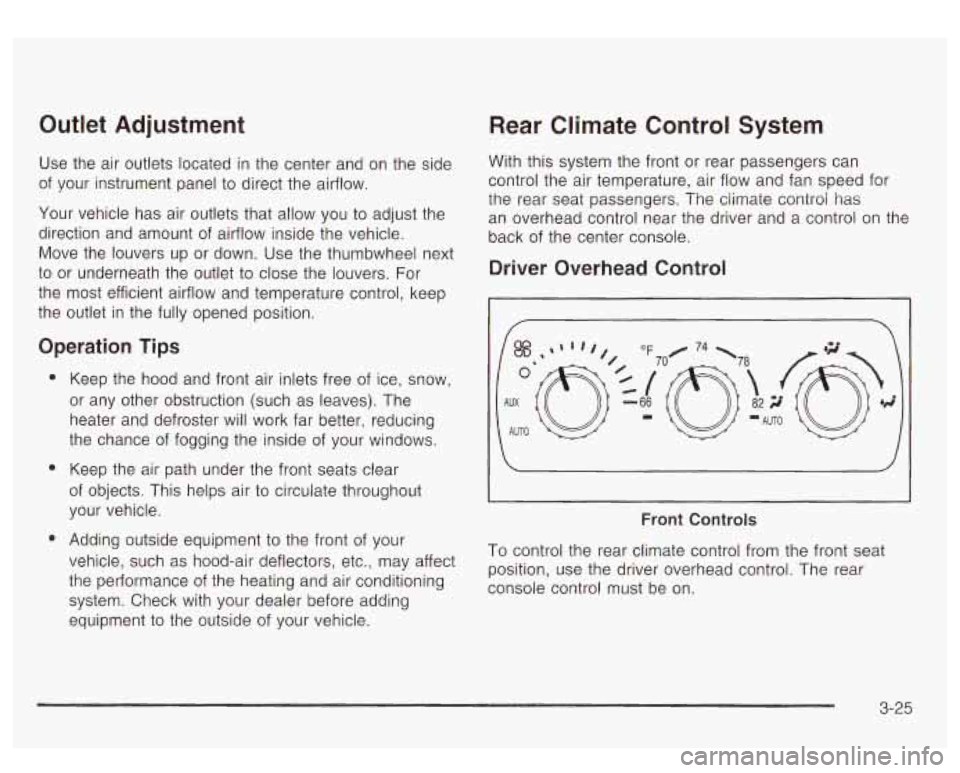
Rear Climate Control System
With this system the front or rear passengers can
control the air temperature, air flow and fan speed for
the rear seat passengers. The climate control has
an overhead control near the driver and a control on the
back of the center console.
Driver Overhead Control
I/
I
Front Controls
To control the rear climate control from the front seat
position, use the driver overhead control. The rear
console control must be on.
3-25
Page 278 of 447
weigh station and weigh your vehicle. Your dealer can If
you put things inside your vehicle - like suitcases,
help you with this. Be sure to spread out your load
tools, packages, or anything else
- they go as fast as
equally on both sides of the centerline.
the vehicle goes.
If you have to stop or turn quickly,
Never exceed the GVWR for your vehicle, or the GAWR
for either the front or rear axle. or
if there
is a crash, they’ll keep going.
And,
if you do have a heavy load, you should
spread it out.
Do no. .Jad ,3ur vehic., any heavier than the
GVWR, or either the maximum front or rear
GAWR. If you do, parts on your vehicle can
break, and
it can change the way your vehicle
handles. These could cause you to lose
control and crash.
Also, overloading can
shorten the life
of your vehicle.
Your warranty does not cover parts or components that
fail because
of overloading.
The label will help you decide how much cargo and
installed equipment your truck can carry.
Using heavier suspension components to get added
durability might not change your weight ratings. Ask your
dealer to help you load your vehicle the right way. Things you put inside your vehicle can strike
and injure people
in a sudden stop or turn, or
in a crash.
Put things in the cargo area of your
vehicle. Try to spread the weight evenly.
0 Never stack heavier things, like suitcases,
inside the vehicle
so that some of them
are above the tops of the seats.
* Don’t leave an unsecured child restraint in
your vehicle.
When you carry something inside the
vehicle, secure
it whenever you can.
Don’t leave a seat folded down unless you
need to.
There’s also important loading information for off-road
driving
in this manual. See “Loading Your Vehicle
for Off-Road Driving” under Operating Your
All-Wheel-Drive Vehicle
Off Paved Roads on page 4-16.
4-45
Page 362 of 447
incorrect wheel nuts or improperly tightened
wheel nuts can cause the wheel to come loose
and even come
off. This could lead to an
accident. Be sure to use the correct wheel
nuts.
If you have to replace them, be sure to
get new
GM original equipment wheel nuts.
Stop somewhere as soon as you can and have
the nuts tightened with a torque wrench to the
proper torque specification. See “Capacities
and Specifications”
in the Index for wheel nut
torque specification.
Notice: Improperly tightened wheel nuts can lead
to brake pulsation and rotor damage.
To avoid
expensive brake repairs, evenly tighten the wheel nuts in the proper sequence and to the proper
torque specification. See “Capacities and
Specifications” in the index for the wheel nut
torque specification. When
you reinstall the regular wheel and tire, you must
also reinstall the center cap. Place the cap on the
wheel and tap it into place until
it seats flush with the
wheel. The cap only goes
on one way. Be sure to line up
the tab
on the center cap with the indentation on the
wheel.
Storing a Flat or Spare Tire, Jack
and Tools
Storing a jack, a tire, or other equipment in the
passenger compartment of the vehicle could
cause injury. In a sudden stop or collision, loose equipment could strike someone. Store
all these in the proper place.
Notice: An aluminum wheel with a flat tire should
always be stored under the vehicle with the
hoist. However, storing
it that way for an extended
period of time could damage the wheel.
To avoid
this, always stow the wheel properly with the valve stem pointing up and have the wheel repaired as
soon as possible.
5-73
Page 382 of 447
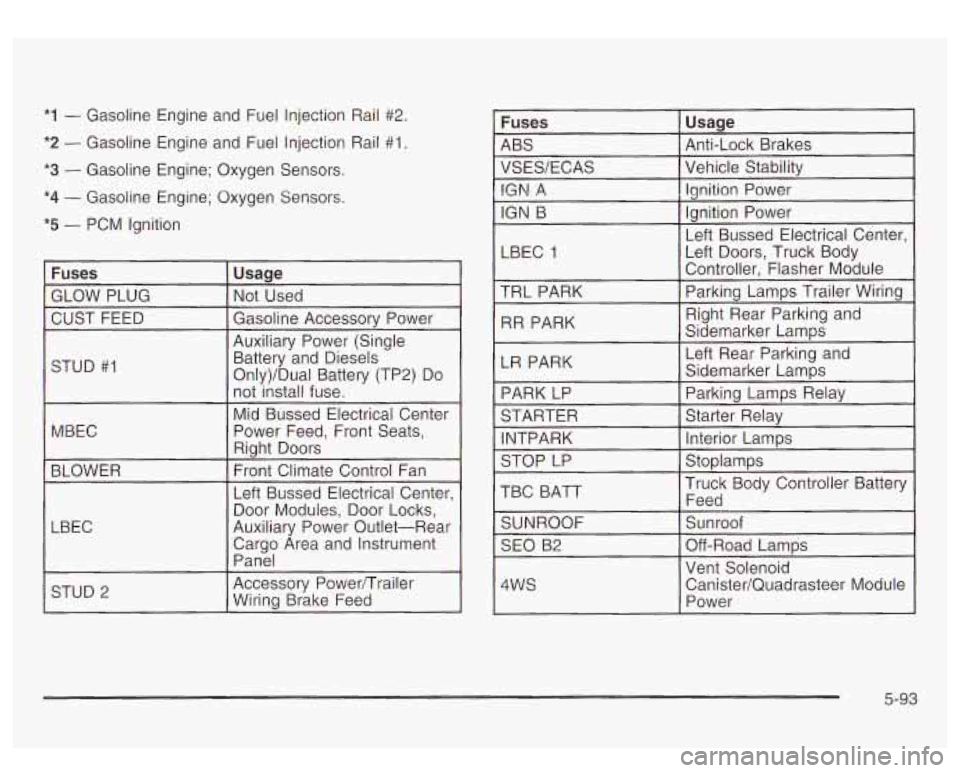
*I - Gasoline Engine and Fuel Injection Rail #2.
*2 - Gasoline Engine and Fuel Injection Rail #l.
*3 - Gasoline Engine; Oxygen Sensors.
*4 - Gasoline Engine; Oxygen Sensors.
*5 - PCM Ignition
I Fuses I Usage I
I STUD #1 I
Battery-and Diesels
Only)/Dual Battery (TP2) Do
not -install fuse.
Mid Bussed Electrical Center
MBEC Power
Feed, Front Seats,
LBEC Door Modules, Door Locks,
Auxiliary Power Outlet-Rear
Cargo Area and Instrument
Panel
STUD 2 Accessory
Powerflrailer
Wirinq Brake Feed LBEC
1
~~
I RR PARK I
Right
Rear Parking and
Sidemarker LamDs
I
5-93
Page 426 of 447
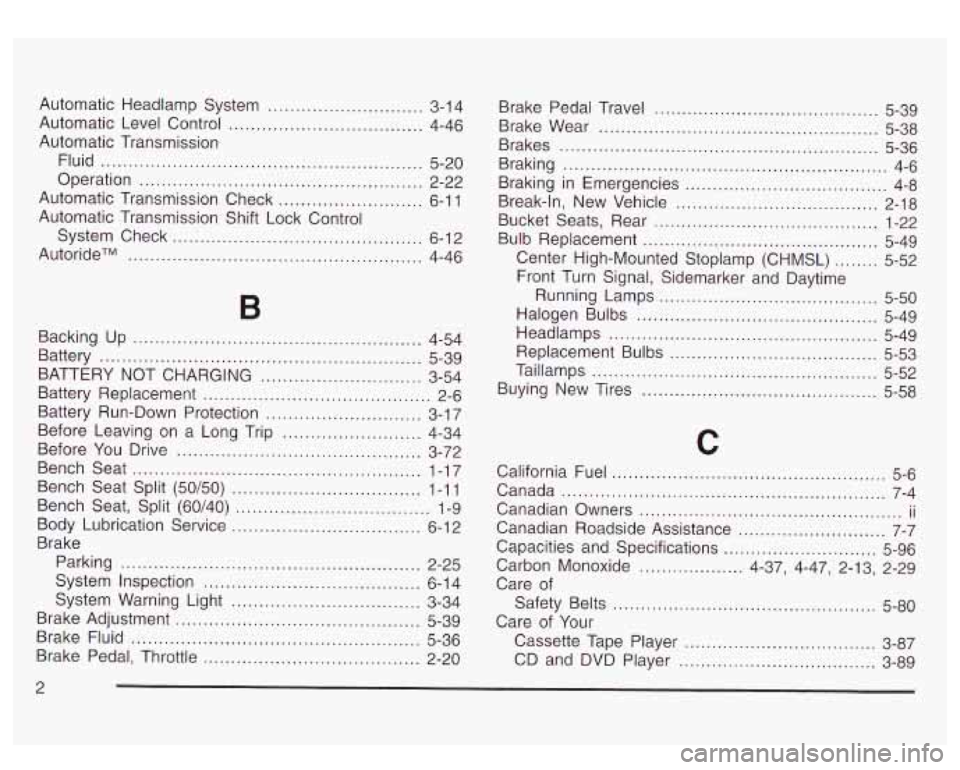
Automatic Headlamp System ............................ 3-1 4
Automatic Level Control
................................... 4-46
Automatic Transmission Fluid
.......................................................... 5-20
Operation
................................................... 2-22
Automatic Transmission Check
.......................... 6-1 1
Automatic Transmission Shift Lock Control
System Check
............................................. 6-12
AutorideTM
................................................. 4-46
B
Backing Up .................................................... 4-54
Battery
.......................................................... 5-39
Battery Replacement
......................................... 2-6
Battery Run-Down Protection
............................ 3-1 7
Before You Drive
............................................ 3-72
Bench Seat
.................................................... 1-17
Bench Seat Split (50/50)
.................................. 1-1 1
Bench Seat, Split (60/40)
................................... 1-9
Body Lubrication Service
.................................. 6-12
Brake
Parking
...................................................... 2-25
System Inspection
....................................... 6-1 4
BATTERY NOT
CHARGING
............................. 3-54
Before Leaving on a Long Trip
......................... 4-34
System Warning Light
.................................. 3-34
Brake
Brake
Brake
2 Adjustment
............................................ 5-39
Fluid
.................................................... 5-36
Pedal. Throttle
....................................... 2-20 Brake Pedal Travel
......................................... 5-39
Brake Wear
................................................... 5-38
Brakes
.......................................................... 5-36
Braking
........................................................... 4-6
Braking in Emergencies
..................................... 4-8
Break-in, New Vehicle
..................................... 2-18
Bucket Seats, Rear
......................................... 1-22
Bulb Replacement
........................................... 5-49
Center High-Mounted Stoplamp (CHMSL)
........ 5-52
Front Turn Signal, Sidemarker and Daytime
Halogen Bulbs
............................................ 5-49
Headlamps
................................................. 5-49
Replacement Bulbs
...................... ........ 5-53
Taillamps
........................................ .... 5-52
Buying New Tires
....................................... 5-58
Running Lamps
........................................ 5-50
C
California Fuel ................................. .......... 5-6
Canada
........................................................... 7-4
Canadian Owners
................................................ ii
Canadian Roadside Assistance ........................... 7-7
Capacities and Specifications ............................ 5-96
Carbon Monoxide
................... 4-37, 4-47, 2.13, 2-29
Care
of
Safety Belts ............................. .... 5-80
Care
of Your
Cassette Tape Player
............................... 3-87
CD and DVD Player .................................... 3-89