oil GMC YUKON DENALI 2003 Owner's Guide
[x] Cancel search | Manufacturer: GMC, Model Year: 2003, Model line: YUKON DENALI, Model: GMC YUKON DENALI 2003Pages: 447, PDF Size: 21.97 MB
Page 371 of 447
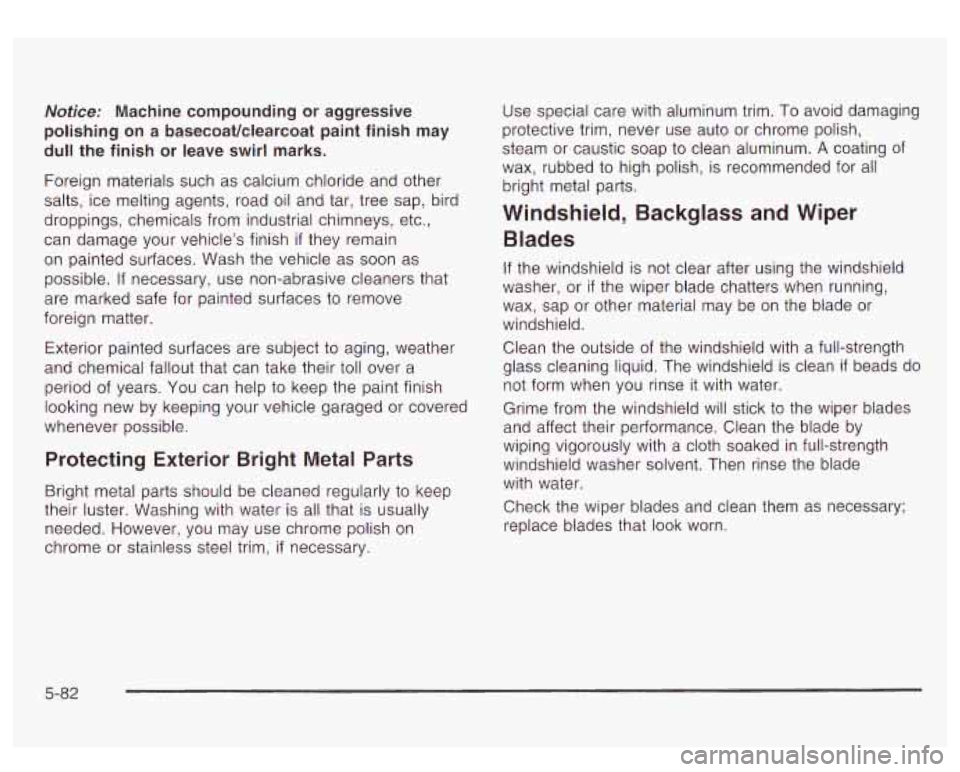
Notice: Machine compounding or aggressive
polishing on
a basecoatklearcoat paint finish may
dull the finish or leave swirl marks.
Foreign materials such as calcium chloride and other
salts, ice melting agents, road oil and tar, tree sap, bird
droppings, chemicals from industrial chimneys, etc.,
can damage your vehicle’s finish
if they remain
on painted surfaces. Wash the vehicle as soon as
possible.
If necessary, use non-abrasive cleaners that
are marked safe for painted surfaces
to remove
foreign matter.
Exterior painted surfaces are subject
to aging, weather
and chemical fallout that can take their
toll over a
period of years. You can help
to keep the paint finish
looking new by keeping your vehicle garaged or covered
whenever possible.
Protecting Exterior Bright Metal Parts
Bright metal parts should be cleaned regularly to keep
their luster. Washing with water is all that is usually
needed. However, you may use chrome polish
on
chrome or stainless steel trim, if necessary. Use
special care with aluminum trim.
To avoid damaging
protective trim, never use auto or chrome polish,
steam or caustic soap
to clean aluminum. A coating of
wax, rubbed
to high polish, is recommended for all
bright metal parts.
Windshield, Backglass and Wiper
Blades
If the windshield is not clear after using the windshield
washer, or
if the wiper blade chatters when running,
wax, sap or other material may be on the blade or
windshield.
Clean the outside of the windshield with a full-strength
glass cleaning liquid. The windshield is clean
if beads do
not form when you rinse it with water.
Grime from the windshield will stick
to the wiper blades
and affect their performance. Clean the blade by
wiping vigorously with a cloth soaked in full-strength
windshield washer solvent. Then rinse the blade
with water.
Check the wiper blades and clean them as necessary; replace blades that look worn.
5-82
Page 373 of 447
Underbody Maintenance
Chemicals used for ice and snow removal and dust
control can collect on the underbody. If these are not
removed, accelerated corrosion (rust) can occur on
the underbody parts such as fuel lines, frame, floor pan
and exhaust system even though they have corrosion protection.
At least every spring, flush these materials from the
underbody with plain water. Clean any areas where mud
and debris can collect. Dirt packed in close areas of
the frame should be loosened before being flushed. Your dealer or an underbody car washing system can
do this for you.
Chemical Paint Spotting
Some weather and atmospheric conditions can create a
chemical fallout. Airborne pollutants can fall upon and
attack painted surfaces
on your vehicle. This damage
can take two forms; blotchy, ringlet-shaped
discolorations, and small irregular dark spots etched into
the paint surface.
Although no defect in the paint job causes this,
GM will
repair, at no charge
to the owner, the surfaces of
new vehicles damaged by this fallout condition within
12 months or 12,000 miles (20 000 km) of purchase,
whichever occurs first.
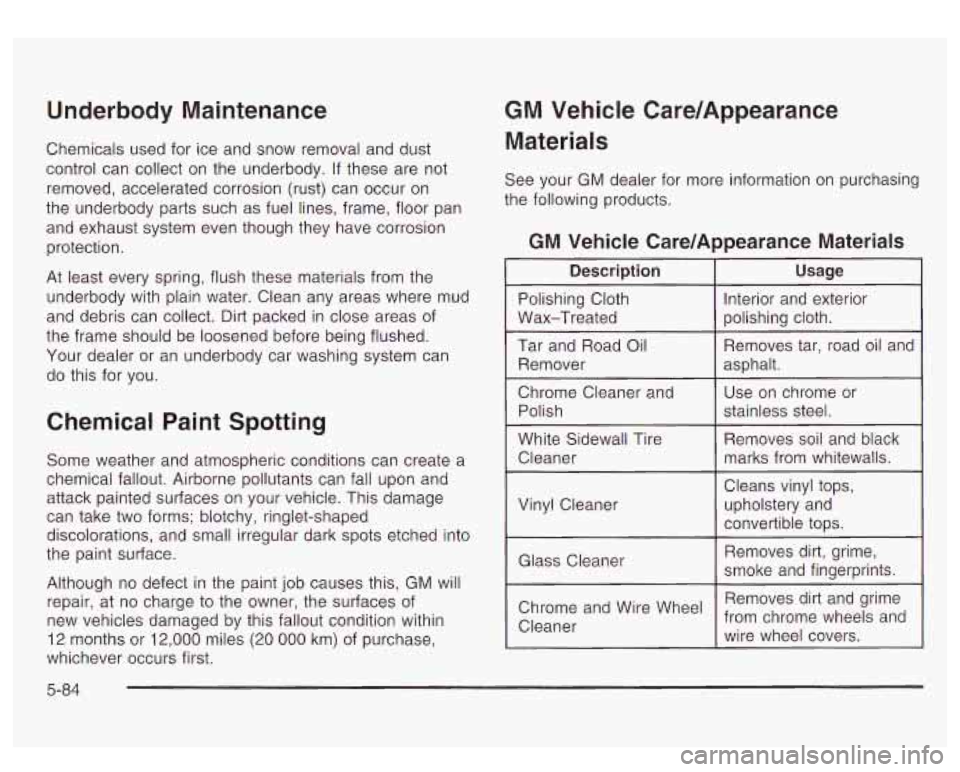
GM Vehicle Care/Appearance
Materials
See your GM dealer for more information on purchasing
the following products.
GM Vehicle Care/Appearance Materials -
Description I Usage
Polishing Cloth Interior and exterior
Wax-Treated
Tar and Road Oil Removes tar, road oil and
Remover asphalt.
-
Chrome Cleaner and Use on chrome or
Polish stainless steel.
White Sidewall Tire Removes soil and black
Cleaner marks
from whitewalls.
-
I Cleans vinyl tops,
Vinvl Cleaner I upholstery-and
I convertible tops. I
Glass Cleaner Removes dirt, grime,
smoke and fingerprints.
Removes dirt and grime
from chrome wheels and
wire wheel covers.
Cleaner
Chrome and Wire
5-84
Page 385 of 447
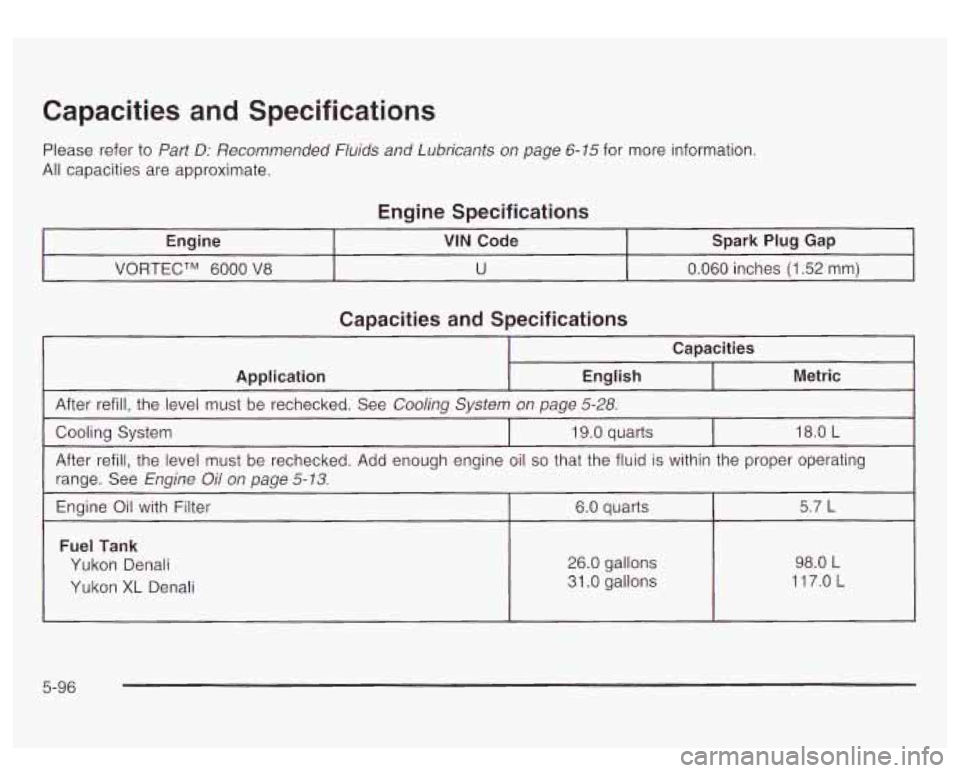
Capacities and Specifications
Please refer to Part D: Recommended Fluids and Lubricants on page 6-15 for more information.
All capacities are approximate.
Engine Specifications
Engine VIN Code 1 Spark Pluq GaD - I t -
VORTECTM 6000 V8 U I 0.060 inches (1.52 mm)
Capacities and Specifications
Capacities
Application Metric
English
After refill, the level must be rechecked. See Cooling System on page 5-28.
Cooling System 19.0 quarts 18.0 L
After refill, the level must be rechecked. Add enough engine oil so that the fluid is within the proper operating
range. See Engine Oil on page
5-13.
Engine Oil with Filter
Fuel Tank
5.7 L 6.0 quarts
Yukon Denali
Yukon
XL Denali
26.0 gallons
31 .O gallons
98.0 L
117.0 L
5-96
Page 387 of 447
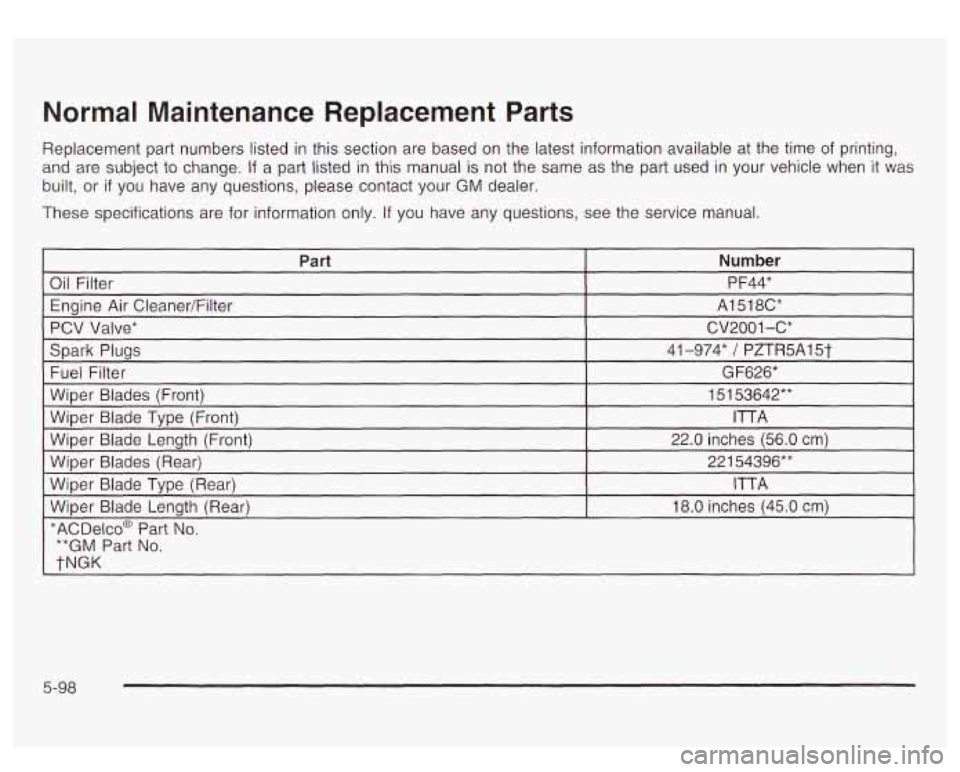
Normal Maintenance Replacement Parts
Replacement part numbers listed in this section are based on the latest information available at the time of printing,
and are subject
to change. If a part listed in this manual is not the same as the part used in your vehicle when it was
built, or
if you have any questions, please contact your GM dealer.
These specifications are for information only.
If you have any questions, see the service manual.
I Part 1 Number I
Oil Filter
G F626"
Fuel Filter 41
-974*
/ PZTR5A15t
Spark Plugs cv2001
-c* PCV Valve" AI
51 8C*
Engine Air CleanedFilter P F44*
Wiper Blades (Front)
ITTA
Wiper Blade Tvpe (Front)
151 53642**
Wiper Blade Length (Front)
ITTA WiDer Blade Tvpe (Rear) 221
54396**
Wiper Blades (Rear) 22.0
inches (56.0 cm) a. I
Wiper Blade Length (Rear) 18.0 inches (45.0 cm)
*ACDelco@ Part
No.
**GM Part No.
tNGK
5-98
Page 389 of 447
Maintenance Schedule
Introduction
1
IMPORTANT:
KEEP ENGINE OIL
AT THE PROPER
EVEL
AND CHANGE AS
RECOMMENDED
,. - .~
protectjon
I
Have you purchased the GM Protection Plan? The Plan
supplements your new vehicle warranties. See your
Warranty and Owner Assistance booklet or your dealer
for details.
Your Vehicle and the Environment
Proper vehicle maintenance not only helps to keep your
vehicle in good working condition, but also helps the
environment. All recommended maintenance procedures
are important. Improper vehicle maintenance can
even affect the quality of the air we breathe. Improper
fluid levels or the wrong tire inflation can increase
the level of emissions from your vehicle. To help protect
our environment, and to keep your vehicle in good
condition, please maintain your vehicle properly.
Maintenance Requirements
Maintenance intervals, checks, inspections and
recommended fluids and lubricants as prescribed in this
manual are necessary
to keep your vehicle in good
working condition. Any damage caused by failure
to follow recommended maintenance may not be
covered by warranty.
6-2
Page 391 of 447
Part A: Scheduled Maintenance
Services
This part contains engine oil and chassis lubrication
scheduled maintenance which explains the engine oil life
system and how it indicates when
to change the
engine oil and filter. Lubricate chassis components with
each oil change.
Also, listed are scheduled maintenance
services which are to be performed at the mileage
intervals specified.
Using Your Maintenance Schedule
We at General Motors want to help you keep your
vehicle in good working condition. But we don’t know
exactly how you’ll drive it. You may drive very short
distances only a few times a week. Or you may drive
long distances all the time in very hot, dusty weather.
You may use your vehicle in making deliveries. Or
you may drive it to work,
to do errands or in many
other ways.
Because of all the different ways people use their
vehicles, maintenance needs vary. You may need more
frequent checks and replacements.
So please read
the following and note how you drive. If you have any
questions on how to keep your vehicle in good condition,
see your dealer. This part tells you
the maintenance services you should
have done and when you should schedule them.
When you go
to your dealer for your service needs,
you’ll know that GM-trained and supported service
people will perform the work using genuine GM parts.
The proper fluids and lubricants
to use are listed in
Part
D. Make sure whoever services your vehicle uses
these.
All parts should be replaced and all necessary
repairs done before you or anyone else drives the
vehicle.
This schedule is for vehicles that:
carry passengers and cargo within recommended
limits. You will find these limits on your vehicle’s
Certificationflire label. See Loading Your Vehicle
on
page 4-44.
are driven on reasonable road surfaces within legal
driving limits.
are driven off-road in the recommended manner.
See Operating Your All- Wheel-Drive Vehicle
Off
Paved Roads on page 4- 16.
use the recommended fuel. See Gasoline Octane
on page 5-5.
6-4
Page 392 of 447
Scheduled Maintenance
The services shown in this schedule up to 100,000 miles
(1 66 000 km) should be repeated after 100,000 miles
(166
000 km) at the same intervals for the life of
this vehicle. The services shown at
150,000 miles
(240 000 km) should be repeated at the same interval
after 150,000 miles
(240 000 km) for the life of this
vehicle.
See Part B: Owner Checks and Services
on page 6- 10
and Part C: Periodic Maintenance Inspections on
page 6- 14.
Footnotes
t The U.S. Environmental Protection Agency or the
California Air Resources Board has determined that the
failure to perform this maintenance item will not nullify
the emission warranty or limit recall liability prior to
the completion of the vehicle
s useful life. We, however,
urge that all recommended maintenance services be
performed at the indicated intervals and the
maintenance be recorded.
+ A good time to check your brakes is during tire
rotation. See Brake System Inspection
on page 6-14.
Engine Oil and Chassis Lubrication
Scheduled Maintenance
Change engine oil and filter as indicated by the GM
Oil Life System (or every 12 months, whichever
occurs first). Reset the system.
Your vehicle has a computer system that lets you know
when
to change the engine oil and filter. This is
based on engine revolutions and engine temperature,
and not on mileage. Based on driving conditions,
the mileage at which an oil change will be indicated can
vary considerably. For the oil life system
to work
properly, you must reset the system every time the oil is
changed.
When the system has calculated that oil life has been
diminished, it will indicate that an oil change is
necessary. A CHANGE ENGINE
OIL message will
come on. Change your oil as soon as possible within
the next two times you stop for fuel.
It is possible that, if
you are driving under the best conditions, the oil life
system may not indicate that an oil change is necessary
for over a year. However, your engine oil and filter
must be changed at least once a year and at this time
the system must be reset.
It is also important to
check your oil regularly and keep it at the proper level.
6-5
Page 393 of 447
If the system is ever reset accidentally, you must
change your oil at
3,000 miles (5 000 km) since your
last oil change. Remember
to reset the oil life system
whenever the oil is changed. See Engine Oil on
page
5-13 for information on resetting the system.
An Emission Control Service.
Lubricate chassis components with each engine oil
and filter change.
Lubricate the front suspension, ball joints, steering
linkage, transmission shift linkage and parking brake
cable guides. Ball joints should not be lubricated unless
their temperature is 10°F (-12°C) or higher, or they
could be damaged.
After the services are performed, record the date,
odometer reading and who performed the service on the
maintenance record pages in Part
E of this schedule.
7,500 Miles (12 500 km)
U Check rear/front axle fluid level and add fluid as
needed. Check constant velocity joints and axle seals
for leaking.
page
5-56 for proper rotation pattern and additional
information. (See footnote
+.)
0 Rotate tires. See Tire Inspection and Rotation on
15,000 Miles (25 000 km)
17 Check readfront axle fluid level and add fluid as
needed. Check constant velocity joints and axle seals
for leaking.
page
5-56 for proper rotation pattern and additional
information. (See footnote
+.)
0 Rotate tires. See Tire lnspection and Rotation on
22,500 Miles (37 500 km)
0 Check readfront axle fluid level and add fluid as
needed. Check constant velocity joints and axle seals
for leaking.
page
5-56 for proper rotation pattern and additional
information. (See footnote
+.)
CI Rotate tires. See Tire Inspection and Rotation on
30,000 Miles (50 000 km)
3 Check readfront axle fluid level and add fluid as
needed. Check constant velocity joints and axle seals
for leaking.
page
5-56 for proper rotation pattern and additional
information. (See footnote
+.)
(See footnote t.)
U Rotate tires. See Tire Inspection and Rotation on
U Replace fuel filter. An Emission Control Service.
6-6
Page 397 of 447
Part B: Owner Checks and Services
Listed in this part are owner checks and services
which should be performed at the intervals specified
to
help ensure the safety, dependability and emission
control performance of your vehicle.
Be sure any necessary repairs are completed at once.
Whenever any fluids or lubricants are added
to your
vehicle, make sure they are the proper ones, as shown
in Part
D.
At Each Fuel Fill
It is important for you or a service station attendant to
perform these underhood checks at each fuel fill.
Engine Oil Level Check
Check the engine oil level and add the proper oil if
necessary. See Engine Oil on page 5-13 for further
details.
Engine Coolant Level Check
Check the engine coolant level and add DEX-COOL@
coolant mixture
if necessary. See Engine Coolant
on page 5-22 for further details.
Windshield Washer Fluid Level Check
Check the windshield washer fluid level in the windshield
washer tank and add the proper fluid
if necessary.
See Windshield Washer Fluid
on page 5-34 for further
details.
At Least Once a Month
Tire Inflation Check
Make sure tries are inflated to the correct pressures.
Don’t forget
to check your spare tire. See Tires on
page 5-55 for further details.
Cassette Tape Player Service
Clean cassette tape player. Cleaning should be done
every
50 hours of tape play. See Audio System(s)
on page 3-58 for further details.
At Least Twice a Year
Restraint System Check
Make sure the safety belt reminder light and all your
belts, buckles, latch plates, retractors and anchorages
are working properly. Look for any other loose or
damaged safety belt system parts. If you see anything
that might keep a safety belt system from doing its
job, have it repaired. Have any torn or frayed safety belts
replaced.
6-1 0
Page 398 of 447
Also look for any opened or broken air bag coverings,
and have them repaired or replaced. (The air bag
system does not need regular maintenance.)
Inspect wiper blades for wear or cracking. Replace
blade inserts that appear worn or damaged or that
streak or miss areas of the windshield.
Also see
Cleaning the Outside
of Your Vehicle on page 5-81.
Spare Tire Check
At least twice a year, after the monthly inflation check of
the spare tire determines that the spare is inflated
to
the correct tire inflation pressure, make sure that
the spare tire is stored securely. Push, pull, and then
try
to rotate or turn the tire. If it moves, use the wheel
wrenchhatchet
to tighten the cable. See Changing a Flat
Tire
on page 5-63.
Engine Air Cleaner Filter Restriction
Indicator Check
Your vehicle has an engine air cleaner filter restriction
indicator located on the air cleaner in the engine
compartment. The indicator lets you know when the air
cleaner filter is dirty and needs
to be changed. Check
the indicator at least twice a year or when your engine oil is changed,
whichever occurs first. See Engine Air
Cleaner/Filter
on page 5- 17 for more information. Inspect
your air cleaner filter restriction indicator more often
if
the vehicle is used in dusty areas or under off road
conditions.
Weatherstrip Lubrication
Silicone grease on weatherstrips will make them last
longer, seal better, and not stick or squeak. Apply
silicone grease with a clean cloth. During very cold,
damp weather more frequent application may be required. See
Part D: Recommended Fluids and
Lubricants
on page 6- 15.
Automatic Transmission Check
Check the transmission fluid level; add if needed. See
Automatic Transmission Fluid on page
5-20. A fluid loss
may indicate a problem. Check the system and repair
if needed.
At Least Once a Year
Key Lock Cylinders Service
Lubricate the key lock cylinders with the lubricant
specified in Part D.