lock GMC YUKON DENALI 2003 Workshop Manual
[x] Cancel search | Manufacturer: GMC, Model Year: 2003, Model line: YUKON DENALI, Model: GMC YUKON DENALI 2003Pages: 447, PDF Size: 21.97 MB
Page 144 of 447
Section 3 Instrument Panel
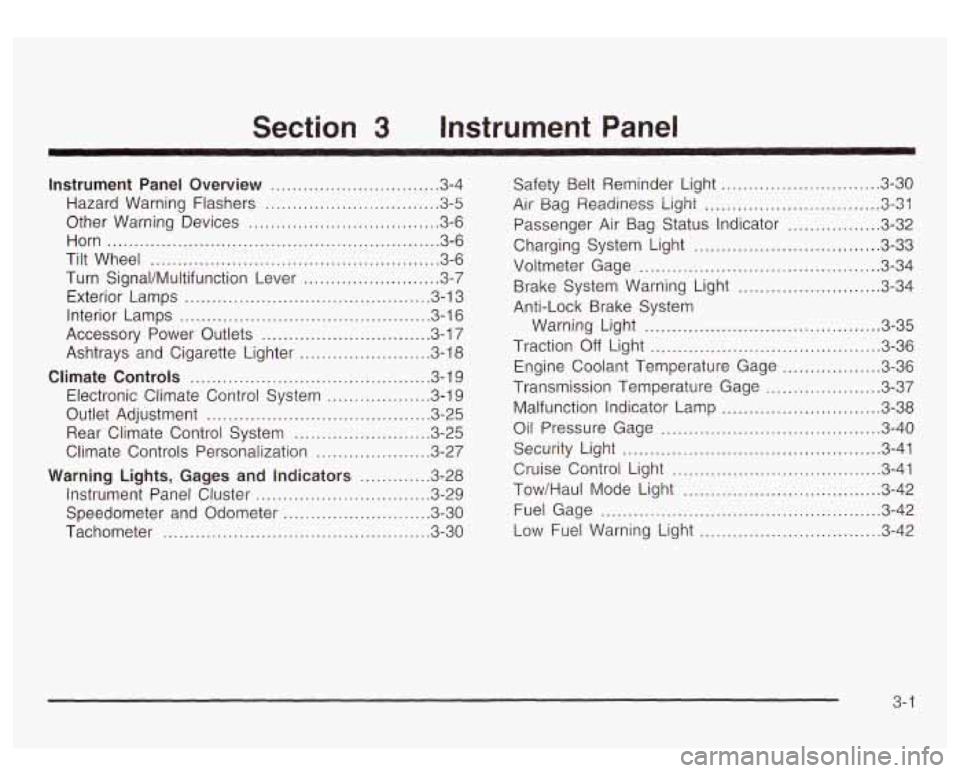
Instrument Panel Overview ............................... 3.4
Hazard Warning Flashers
................................ 3.5
Other Warning Devices ................................... 3.6
Horn
............................................................. 3.6
Tilt Wheel
..................................................... 3-6
Turn SignaVMultifunction Lever
......................... 3.7
Exterior Lamps
............................................. 3.13
Interior Lamps
.............................................. 3.16
Accessory Power Outlets
............................... 3.17
Ashtrays and Cigarette Lighter
........................ 3.18
Climate Controls ............................................ 3. 1 9
Electronic Climate Control System
................... 3.19
Outlet Adjustment
......................................... 3.25
Rear Climate Control System
......................... 3.25
Climate Controls Personalization
..................... 3.27
Warning Lights, Gages and Indicators ............. 3.28
Instrument Panel Cluster
................................ 3.29
Speedometer and Odometer
........................... 3.30
Tachometer
................................ ......... 3.30
~
Safety Belt Reminder Light ............................. 3.30
Air Bag Readiness Light
................................ 3.31
Passenger Air Bag Status Indicator ................ -3-32
Charging System Light
.................................. 3-33
Voltmeter Gage
............................................ 3-34
Brake System Warning Light
...................... 3-34
Anti-Lock Brake System Warning Light
........................................... 3-35
Traction
Off Light .......................................... 3-36
Transmission Temperature Gage
..................... 3-37
Malfunction Indicator Lamp
............................. 3-38
Oil Pressure Gage ........................................ 3-40
Security Light
............................................... 3-41
Tow/Haul Mode Light .................................... 3-42
Fuel Gage
................................................... 3-42
Low Fuel Warning Light
............................. 3-42
Engine Coolant Temperature Gage
.................. 3-36
Cruise Control
Light ...................................... 3-41
3- 1
Page 149 of 447
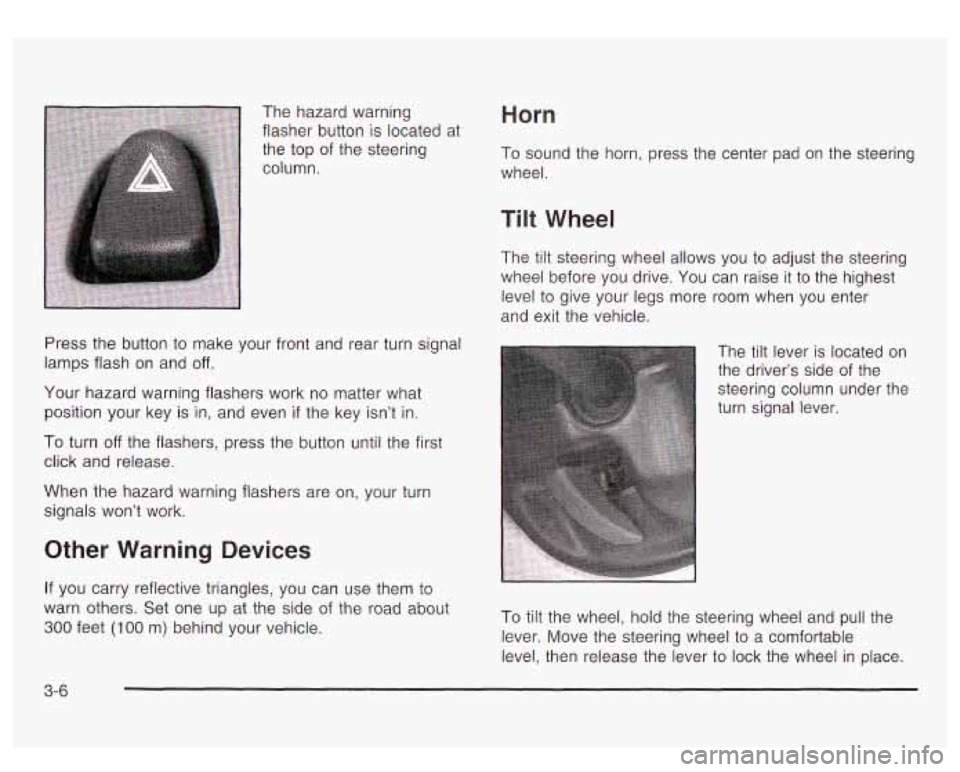
The hazard warning
flasher button
is located at
the top of the steering
column.
Press the button
to make your front and rear turn signal
lamps flash on and
off.
Your hazard warning flashers work no matter what
position your key is in, and even
if the key isn’t in.
To turn off the flashers, press the button until the first
click and release.
When the hazard warning flashers are on, your turn
signals won’t work.
Other Warning Devices
If you carry reflective triangles, you can use them to
warn others. Set one up at the side of the road about
300 feet (1 00 m) behind your vehicle.
Horn
To sound the horn, press the center pad on the steering
wheel.
Tilt Wheel
The tilt steering wheel allows you to adjust the steering
wheel before you drive. You can raise it
to the highest
level
to give your legs more room when you enter
and exit the vehicle.
The tilt lever is located on
the driver’s side of the
steering column under the
turn signal lever.
To tilt the wheel, hold the steering wheel and
pull the
lever. Move the steering wheel
to a comfortable
level, then release the lever to lock the wheel in place.
3-6
Page 152 of 447
(High Speed): For high-speed wiping, turn the
band further, to the second solid band past the
delay settings.
0 (Off): To stop the wipers, move the band to off.
Be sure to clear ice and snow from the wiper blades
before using them. If they're frozen to the windshield,
carefully loosen or thaw them. If your blades do become
worn or damaged, get new blades or blade inserts.
Windshield Washer
(Washer Fluid): There is a paddle marked with the
windshield washer symbol at the top
of the multifunction
lever. To spray washer fluid on the windshield, push
the paddle. The wipers will clear the window and then
either stop or return to your preset speed.
In
freezing weatt.-., dl_-.'t use your washer
until the windshield
is warmed. Otherwise the
washer fluid can form ice
on the windshield,
blocking your vision.
Rear Window WasherNViper
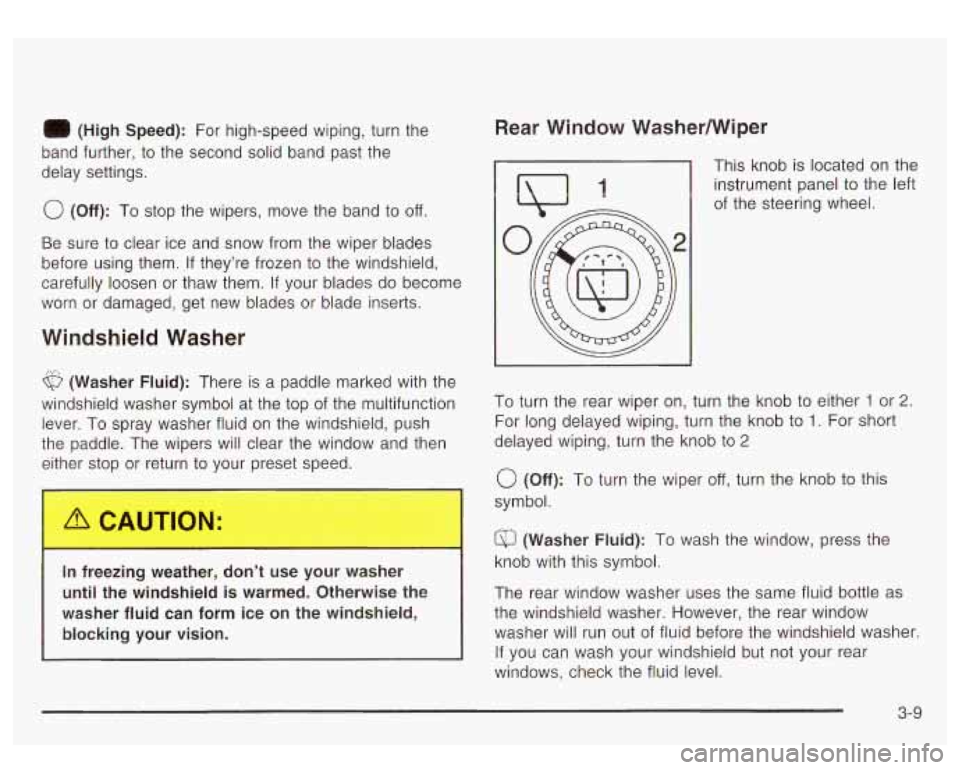
This knob is located on the
instrument panel to the left
of the steering wheel.
To turn the rear wiper on, turn the knob to either
1 or 2.
For long delayed wiping, turn the knob to 1. For short
delayed wiping, turn the knob
to 2
0 (Off): To turn the wiper off, turn the knob to this
symbol.
a (Washer Fluid): To wash the window, press the
knob with this symbol.
The rear window washer uses the same fluid bottle
as
the windshield washer. However, the rear window
washer will run out
of fluid before the windshield washer.
If you can wash your windshield but not your rear
windows, check the fluid level.
3-9
Page 157 of 447
Automatic Headlamp System
When it is dark enough outside and the headlamp
switch is in AUTO, your automatic headlamp system will
turn on your headlamps at the normal brightness
along with other lamps such as the taillamps,
sidemarker, parking lamps, roof marker lamps and the
instrument panel lights. The radio lights will also be dim.
To turn off the automatic headlamp system, turn the
exterior lamps switch
to the off position and then
release.
Your vehicle has a light sensor located on the top of the
instrument panel. Be sure
it is not covered, or the
system will be on whenever the ignition is on.
The system may also turn on your headlamps when
driving through a parking garage, heavy overcast
weather or a tunnel. This is normal.
There is a delay in the transition between the daytime
and nighttime operation of the Daytime Running
Lamps (DRL) and the automatic headlamp systems
so
that driving under bridges or bright overhead street
lights does not affect the system. The DRL and
automatic headlamp system will only be affected when
the light sensor sees a change in lighting lasting
longer than the delay. If
you start your vehicle in a dark garage, the automatic
headlamp system will come on immediately. Once
you leave the garage,
it will take approximately
one minute for the automatic headlamp system to
change
to DRL if it is light outside. During that delay,
your instrument panel cluster may not be as bright
as usual. Make sure your instrument panel brightness
control is in the full bright position. See ”Instrument
Panel Brightness” under lnterior
Lamps on page 3-76.
Lamps On Reminder
If a door is open, a reminder chime will sound when
your headlamps or parking lamps are manually turned
on and your key is out of the ignition. To turn off
the chime, turn the headlamp switch
to off or AUTO and
then back on. In the automatic mode, the headlamps
turn off once the ignition is in LOCK and the headlamps
on at exit delay ends
(if enabled in the DIC).
Daytime Running Lamps
Daytime Running Lamps (DRL) can make it easier for
others
to see the front of your vehicle during the
day. DRL can be helpful in many different driving
conditions, but they can be especially helpful in the short
periods after dawn and before sunset. Fully functional
daytime running lamps are required on all vehicles
first sold in Canada.
3-1 4
Page 158 of 447
The DRL system will come on when the following
conditions are met:
0 The ignition is on,
the exterior lamps control is in AUTO,
the transmission is not in PARK (P), and
0 the light sensor determines it is daytime.
When the DRL are on, only your DRL lamps will be on
The taillamps, sidemarker and other lamps won’t be
on. The instrument panel won’t be
lit up either.
When it begins
to get dark, the automatic headlamp
system will switch from DRL
to the headlamps.
As with any vehicle, you should turn on the regular
headlamp system when you need it.
Puddle Lamps
Your vehicle is equipped with puddle lamps to help you
see the area near the base of the front doors when
it
is dark out. The puddle lamps will illuminate when a door
is opened or when you press the unlock button on the
keyless entry transmitter. The lamps will time out or turn
off once the engine is started.
Fog Lamps
Use the fog lamps for better vision in foggy or misty
conditions. Your parking lamps and/or low-beam
headlamps must be on for your fog lamps
to work.
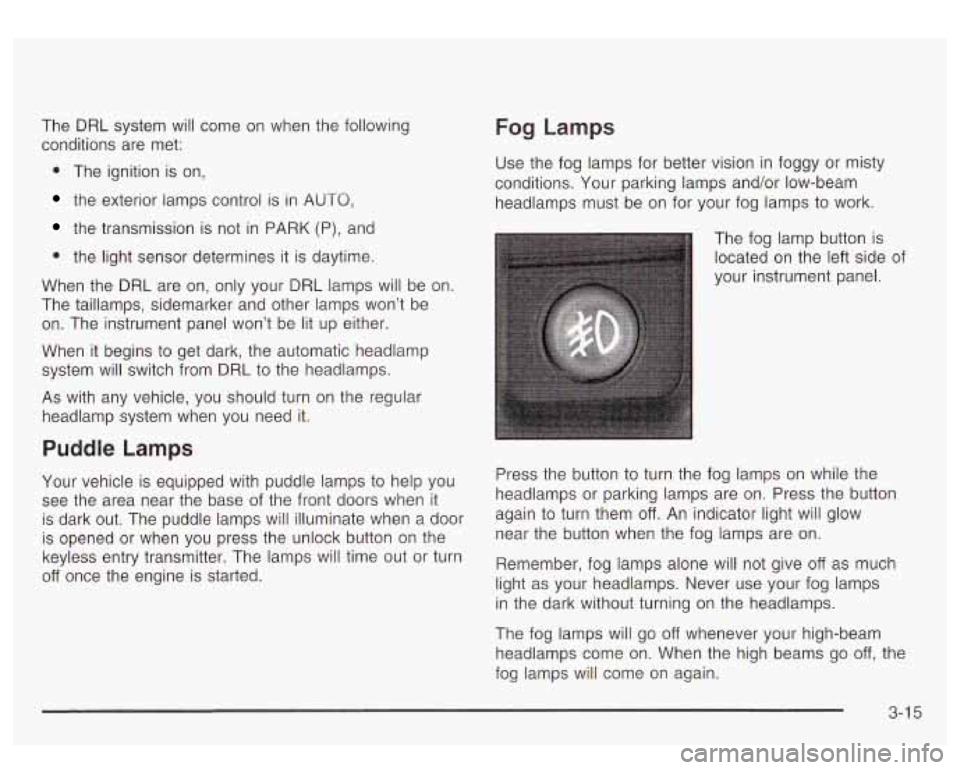
The fog lamp button
is
located on the left side of
your instrument panel.
Press the button
to turn the fog lamps on while the
headlamps or parking lamps are on. Press the button
again to turn them
off. An indicator light will glow
near the button when the fog lamps are on.
Remember, fog lamps alone will not give
off as much
light as your headlamps. Never use your fog lamps
in the dark without turning on the headlamps.
The fog lamps will go
off whenever your high-beam
headlamps come on. When the high beams go
off, the
fog lamps will come on again.
3-1 5
Page 160 of 447
Reading Lamps
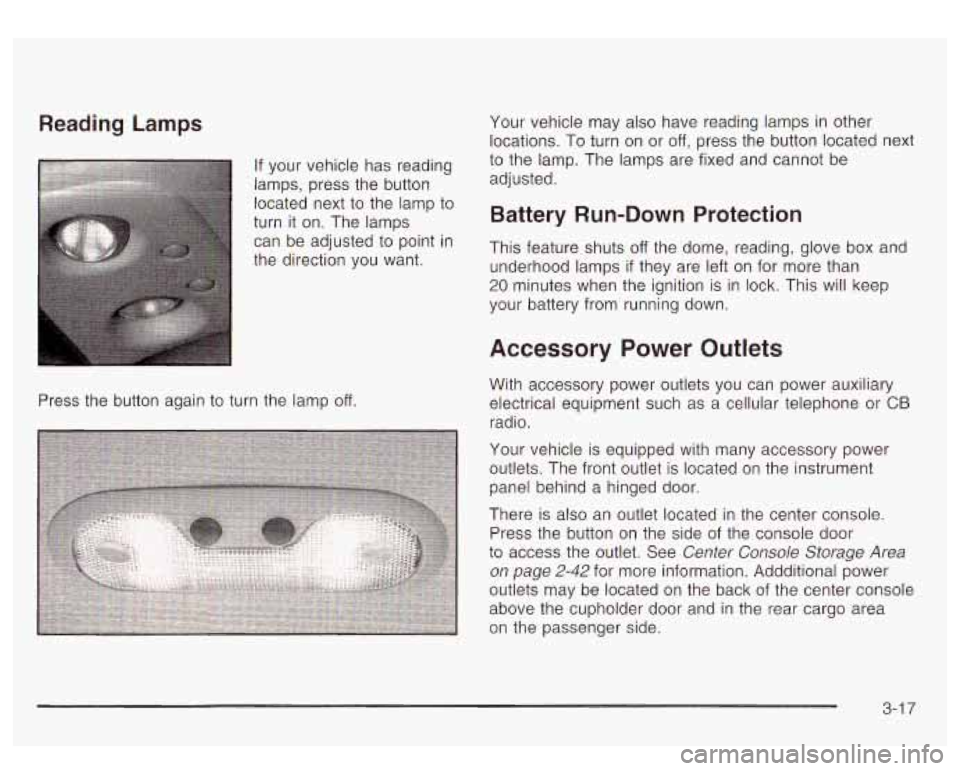
If your vehicle has reading
lamps, press the button located next
to the lamp to
turn it on. The lamps can be adjusted
to point in
the direction you want.
Press the button again to turn the lamp
off.
Your vehicle may also have reading lamps in other
locations.
To turn on or off, press the button located next
to the lamp. The lamps are fixed and cannot be
adjusted.
Battery Run-Down Protection
This feature shuts off the dome, reading, glove box and
underhood lamps
if they are left on for more than
20 minutes when the ignition is in lock. This will keep
your battery from running down.
Accessory Power Outlets
With accessory power outlets you can power auxiliary
electrical equipment such as a cellular telephone or
CB
radio.
Your vehicle is equipped with many accessory power
outlets. The front outlet is located on the instrument
panel behind a hinged door.
There is also an outlet located in the center console.
Press the button on the side of the console door
to access the outlet. See Center Console Storage Area
on page 2-42 for more information. Addditional power
outlets may be located on the back of the center console
above the cupholder door and in the rear cargo area
on the passenger side.
3-1 7
Page 162 of 447
Climate Controls
Electronic Climate Control System
With this system, you can control the heating, cooling
and ventilation in your vehicle. Your vehicle also
has a flow-through ventilation system described later in
this section.
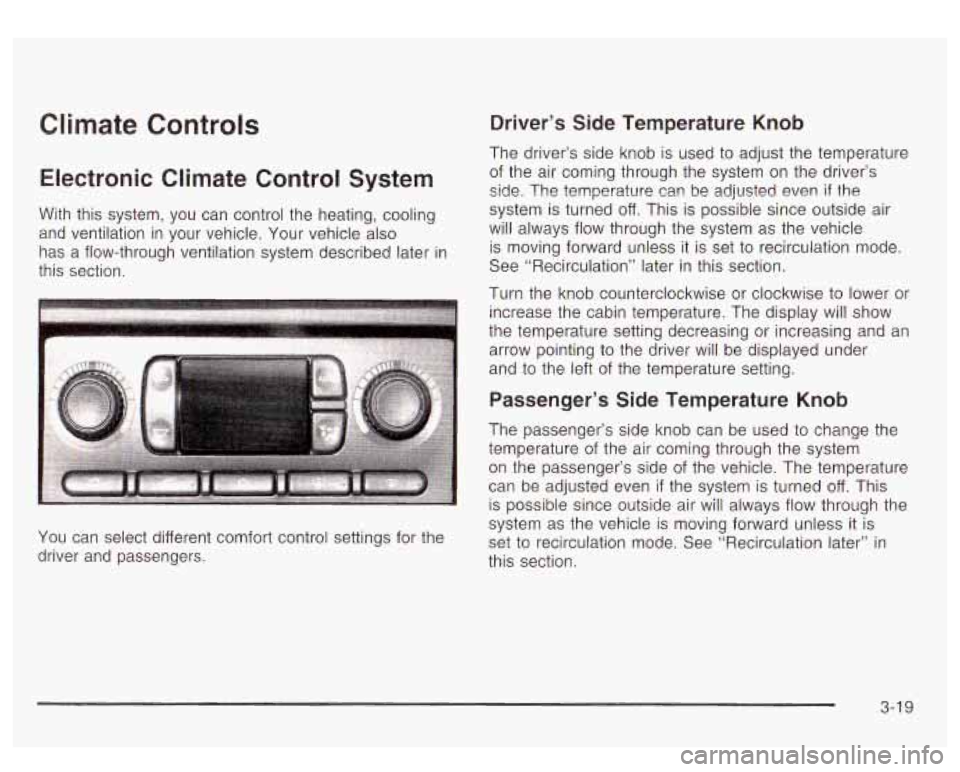
You can select different comfort control settings for the
driver and passengers.
Driver’s Side Temperature Knob
The driver’s side knob is used to adjust the temperature
of the air coming through the system on the driver’s
side. The temperature can be adjusted even if the
system is turned off. This is possible since outside air
will always
flow through the system as the vehicle
is moving forward unless it is set
to recirculation mode.
See “Recirculation” later in this section.
Turn the knob counterclockwise or clockwise
to lower or
increase the cabin temperature. The display will show
the temperature setting decreasing or increasing and an
arrow pointing
to the driver will be displayed under
and
to the left of the temperature setting.
Passenger’s Side Temperature Knob
The passenger’s side knob can be used to change the
temperature of the air coming through the system
on the passenger’s side
of the vehicle. The temperature
can be adjusted even
if the system is turned off. This
is possible since outside air will always flow through the
system as the vehicle is moving forward unless
it is
set
to recirculation mode. See “Recirculation later” in
this section.
3-1 9
Page 163 of 447
Turn the knob counterclockwise or clockwise to lower or
increase the cabin temperature. The display will show
the temperature setting decreasing or increasing and an
arrow pointing
to the passenger will be displayed
under and
to the right of the temperature setting.
The passenger’s temperature setting can be set
to
match the driver’s temperature setting by pressing and
holding the AUTO button for four seconds. Both the
driver and passenger arrows will be displayed.
Automatic Operation
AUTO (Automatic): When automatic operation is
active the system will control the inside temperature, the
air delivery, and the fan speed.
0 (Off): Press this button to turn off the entire climate
control system. Outside air will still enter the vehicle,
and will be directed
to the floor. This direction can
be changed by pressing the mode button. The
temperature can also be adjusted using either
temperature knob. Press the up or down arrows on the
fan switch, the defrost button, the AUTO button, or
the air conditioning button
to turn the system on when it
is off.
Use the steps below to place the entire system in
automatic mode:
1. Press the AUTO button.
When AUTO is selected, the display will change
to
show the current driver’s set temperature, delivery
mode and fan speed. Press the AUTO button again
within five seconds
to display the passenger’s set
temperature.
If the driver and passenger’s temperature settings
are not the same, the opposite side temperature
setting will be displayed for an additional five
seconds. To make the passenger’s temperature the
same as the driver’s press and hold the AUTO
button for approximately four seconds.
When auto is selected, the air conditioning operation
and air inlet will be automatically controlled. The
air conditioning compressor will run when the
outside temperature is over approximately
40°F
(4°C). The air inlet will normally be set to outside air.
If it’s hot outside, the air inlet may automatically
switch
to recirculate inside air to help quickly cool
down your vehicle. The light on the button will
illuminate in recirculation.
3-20
Page 169 of 447
AUX: Turn the knob, located on the left side of the
control panel, to this position
to allow the rear seat
passengers
to have control over the rear climate control
system. See “Rear Passenger Console Control’’ later
for more information.
0 (Off): Turn the knob, located on the left side of the
control panel,
to this position to turn the rear climate
control system
off.
@ (Fan): To adjust the airflow speed, turn the fan
knob located on the left side of the control panel
to the
desired setting. Choose AUTO
if you want the system
to automatically choose the fan speed to maintain
a selected temperature. See “Auto Mode” later in this
section for more information on using this feature.
“F (“C): To adjust the air temperature, turn the
temperature knob on the center of the control panel. For
cooler or warmer air turn the knob counterclockwise
toward
66°F (1 9°C) or clockwise toward 82°F (27°C).
To regulate the airflow direction, adjust the right knob on
the control panel. Turn the knob clockwise for floor
vent airflow or counterclockwise for headliner vent
airflow. Generally, the upper vents are used for air
conditioning and the floor vents for heating. The knob
can be set
to any blend setting. Choose AUTO if
you want the system to automatically regulate the
airflow. See “Auto Mode” later in this section for more
information on using this feature.
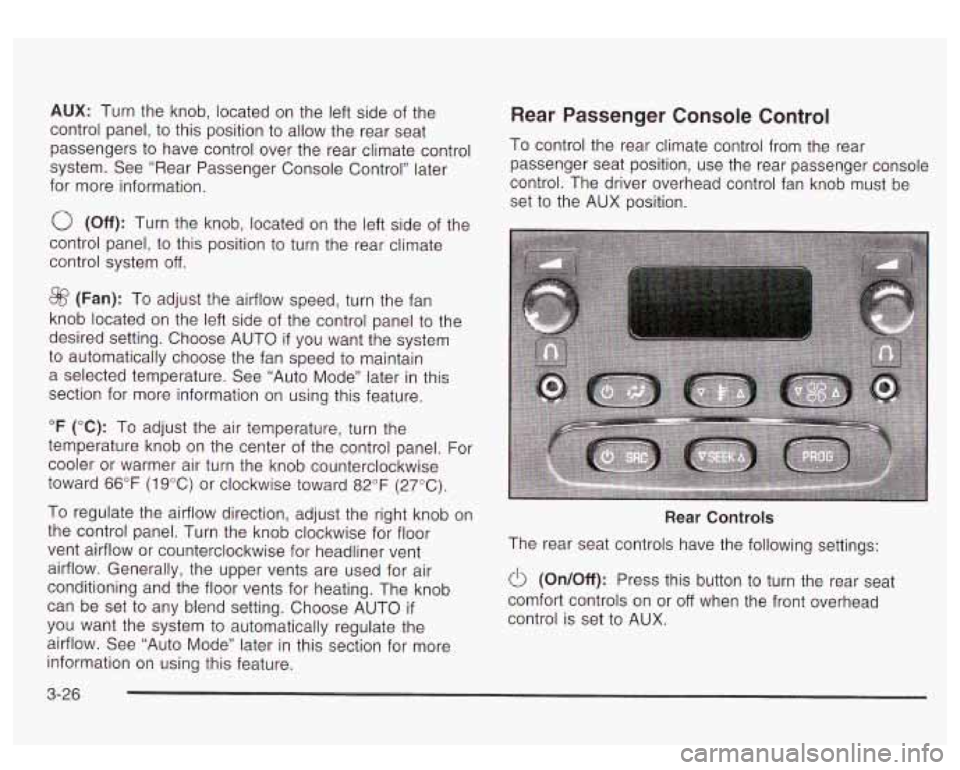
Rear Passenger Console Control
To control the rear climate control from the rear
passenger seat position, use the rear passenger console
control. The driver overhead control fan knob must be
set
to the AUX position.
Rear Controls
The rear seat controls have the following settings:
0 (OnIOff): Press this button to turn the rear seat
Comfort controls on or
off when the front overhead
control is set
to AUX.
3-26
Page 170 of 447
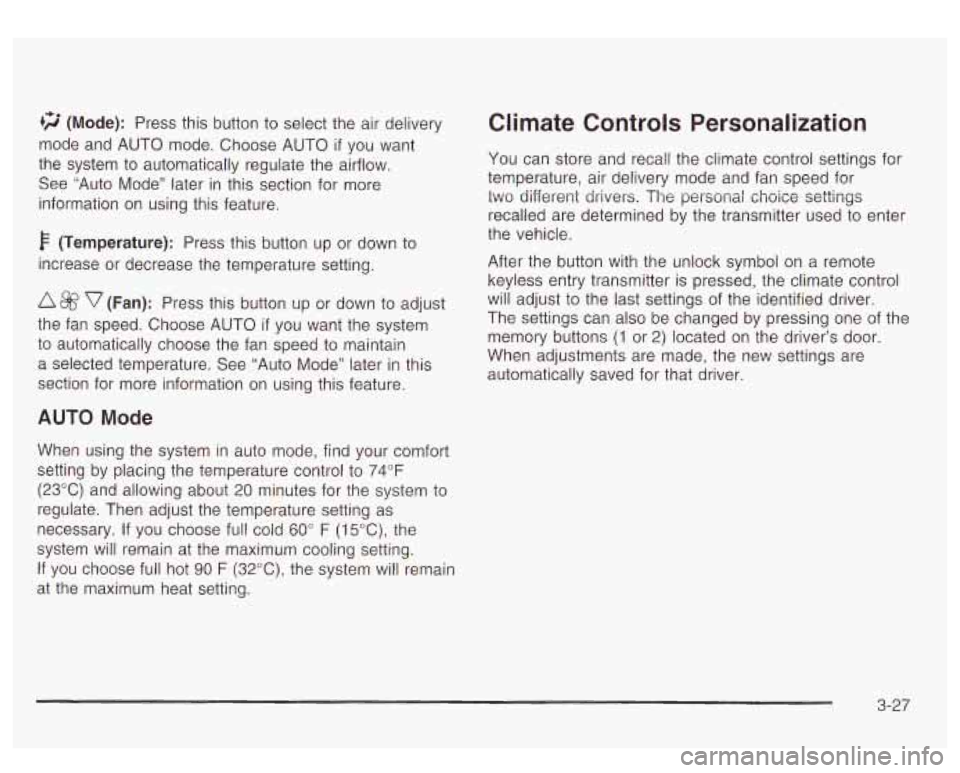
r5;’ (Mode): Press this button to select the air delivery
mode and AUTO mode. Choose AUTO
if you want
the system
to automatically regulate the airflow.
See
“Auto Mode” later in this section for more
information on using this feature.
(Temperature): Press this button up or down to
increase or decrease the temperature setting.
A @ 7 (Fan): Press this button up or down to adjust
the fan speed. Choose AUTO
if you want the system
to automatically choose the fan speed to maintain
a selected temperature. See “Auto Mode” later in this
section for more information on using this feature.
AUTO Mode
When using the system in auto mode, find your comfort
setting by placing the temperature control
to 74°F
(23°C) and allowing about 20 minutes for the system to
regulate. Then adjust the temperature setting as
necessary. If you choose full cold
60” F (15”C), the
system will remain at the maximum cooling setting.
If you choose full hot 90 F (32”C), the system will remain
at the maximum heat setting.
Climate Controls Personalization
You can store and recall the climate control settings for
temperature, air delivery mode and fan speed for
two different
drivers. The personal ch~i~e settings
recalled are determined by the transmitter used
to enter
the vehicle.
After the button with the unlock symbol on a remote
keyless entry transmitter is pressed, the climate control
will adjust
to the last settings of the identified driver.
The settings can also be changed by pressing one of the
memory buttons
(1 or 2) located on the driver’s door.
When adjustments are made, the new settings are
automatically saved for that driver.
3-27