fuel cap GMC YUKON DENALI 2004 User Guide
[x] Cancel search | Manufacturer: GMC, Model Year: 2004, Model line: YUKON DENALI, Model: GMC YUKON DENALI 2004Pages: 468, PDF Size: 3.18 MB
Page 341 of 468
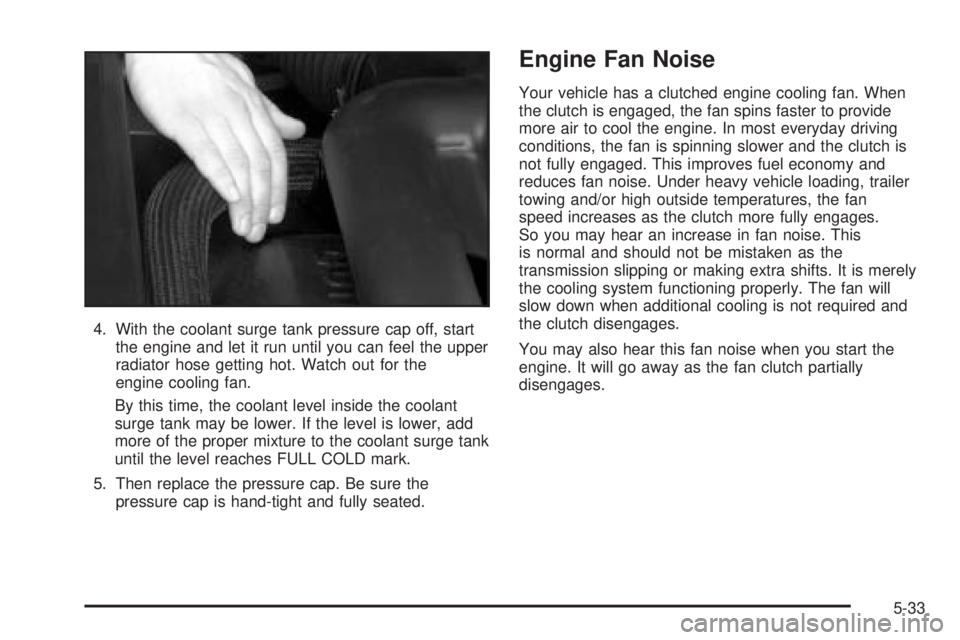
4. With the coolant surge tank pressure cap off, start
the engine and let it run until you can feel the upper
radiator hose getting hot. Watch out for the
engine cooling fan.
By this time, the coolant level inside the coolant
surge tank may be lower. If the level is lower, add
more of the proper mixture to the coolant surge tank
until the level reaches FULL COLD mark.
5. Then replace the pressure cap. Be sure the
pressure cap is hand-tight and fully seated.
Engine Fan Noise
Your vehicle has a clutched engine cooling fan. When
the clutch is engaged, the fan spins faster to provide
more air to cool the engine. In most everyday driving
conditions, the fan is spinning slower and the clutch is
not fully engaged. This improves fuel economy and
reduces fan noise. Under heavy vehicle loading, trailer
towing and/or high outside temperatures, the fan
speed increases as the clutch more fully engages.
So you may hear an increase in fan noise. This
is normal and should not be mistaken as the
transmission slipping or making extra shifts. It is merely
the cooling system functioning properly. The fan will
slow down when additional cooling is not required and
the clutch disengages.
You may also hear this fan noise when you start the
engine. It will go away as the fan clutch partially
disengages.
5-33
Page 368 of 468
Tire Terminology and De®nitions
Air Pressure:The amount of air inside the tire pressing
outward on each square inch of the tire. Air pressure
is expressed in pounds per square inch (psi) or
kilopascal (kPa).
Accessory Weight:This means the combined weight
of optional accessories. Some examples of optional
accessories are, automatic transmission, power steering,
power brakes, power windows, power seats, and air
conditioning.
Aspect Ratio:The relationship of a tire's height
to its width.
Belt:A rubber coated layer of cords that is located
between the plies and the tread. Cords may be made
from steel or other reinforcing materials.
Bead:The tire bead contains steel wires wrapped by
steel cords that hold the tire onto the rim.
Bias Ply Tire:A pneumatic tire in which the plies are
laid at alternate angles less than 90 degrees to the
centerline of the tread.Cold In¯ation Pressure:The amount of air pressure in
a tire, measured in pounds per square inch (psi) or
kilopascals (kPa) before a tire has built up heat
from driving. SeeIn¯ation - Tire Pressure on page 5-62.
Curb Weight:This means the weight of a motor
vehicle with standard and optional equipment including
the maximum capacity of fuel, oil and coolant, but
without passengers and cargo.
DOT Markings:A code molded into the sidewall of a
tire signifying that the tire is in compliance with the U.S.
Department of Transportation motor vehicle safety
standards. The DOT code includes the Tire Identi®cation
Number (TIN), an alphanumeric designator which can
also identify the tire manufacturer, production plant,
brand and date of production.
GVWR:Gross Vehicle Weight Rating, see
Loading
Your Vehicle on page 4-44.
GAWR FRT:Gross Axle Weight Rating for the front
axle, see
Loading Your Vehicle on page 4-44.
GAWR RR:Gross Axle Weight Rating for the rear axle,
see
Loading Your Vehicle on page 4-44.
5-60
Page 371 of 468
Notice:Don't let anyone tell you that underin¯ation
or overin¯ation is all right. It's not. If your tires
don't have enough air (underin¯ation), you can get
the following:
·Too much ¯exing
·Too much heat
·Tire overloading
·Bad wear
·Bad handling
·Bad fuel economy
If your tires have too much air (overin¯ation), you
can get the following:
·Unusual wear
·Bad handling
·Rough ride
·Needless damage from road hazards
When to Check
Check your tires once a month or more.
Also, check the tire pressure of the spare tire.
How to Check
Use a good quality pocket-type gage to check tire
pressure. You can't tell if your tires are properly in¯ated
simply by looking at them. Radial tires may look
properly in¯ated even when they're underin¯ated. Check
the tire's in¯ation pressure when the tires are cold.
cold means your vehicle has been sitting for at least
three hours or driven no more than 1 mile (1.6 km).
Remove the valve cap from the tire valve stem. Press
the tire gage ®rmly onto the valve to get a pressure
measurement. If the cold tire in¯ation pressure matches
the recommended pressure on the tire and loading
information label, no further adjustment is necessary.
If the pressure is low, add air until you reach the
recommended amount.
If you over®ll the tire, release air by pushing on the
metal stem in the center of the tire valve. Recheck the
tire pressure with the tire gage.
Be sure to put the valve caps back on the valve stems.
They help prevent leaks by keeping out dirt and
moisture.
5-63
Page 420 of 468
Capacities and Speci®cations
Please refer toRecommended Fluids and Lubricants on page 6-13for more information.
All capacities are approximate.
Engine Speci®cations
Engine VIN Code Spark Plug Gap
VORTECŸ 6000 V8 U 0.040 inches (1.01 mm)
Capacities and Speci®cations
ApplicationCapacities
English Metric
After re®ll, the level must be rechecked. See
Cooling System on page 5-28.
Cooling System 16.0 quarts 15.0 L
After re®ll, the level must be rechecked. Add enough engine oil so that the ¯uid is within the proper operating
range. See
Engine Oil on page 5-13.
Engine Oil with Filter 6.0 quarts 5.7 L
Fuel Tank
Yukon Denali
Yukon XL Denali26.0 gallons
31.0 gallons98.0 L
117.0 L
5-112
Page 430 of 468
Maintenance Footnotes
²The U.S. Environmental Protection Agency or the
California Air Resources Board has determined that the
failure to perform this maintenance item will not nullify
the emission warranty or limit recall liability prior to
the completion of the vehicle's useful life. We, however,
urge that all recommended maintenance services be
performed at the indicated intervals and the
maintenance be recorded.
#Lubricate the front suspension, ball joints, steering
linkage, transmission shift linkage and parking
brake cable guides. Ball joints should not be lubricated
unless their temperature is 10ÉF (-12ÉC) or higher,
or they could be damaged.
(a)Visually inspect brake lines and hoses for proper
hook-up, binding, leaks, cracks, cha®ng, etc. Inspect
disc brake pads for wear and rotors for surface
condition. Inspect other brake parts, including calipers,
parking brake, etc.
(b)Visually inspect front and rear suspension and
steering system for damaged, loose or missing parts,
signs of wear or lack of lubrication. Inspect power
steering lines and hoses for proper hook-up, binding,
leaks, cracks, cha®ng, etc. Visually check constant
velocity joints, rubber boots and axle seals for leaks.
(c)Visually inspect hoses and have them replaced if they
are cracked, swollen or deteriorated. Inspect all pipes,
®ttings and clamps; replace with genuine GM parts as
needed. To help ensure proper operation, a pressure test
of the cooling system and pressure cap and cleaning the
outside of the radiator and air conditioning condenser is
recommended at least once a year.
(d)Visually inspect wiper blades for wear or cracking.
Replace blade inserts that appear worn or damaged
or that streak or miss areas of the windshield.
(e)Make sure the safety belt reminder light and all your
belts, buckles, latch plates, retractors and anchorages
are working properly. Look for any other loose or
damaged safety belt system parts. If you see anything
that might keep a safety belt system from doing its
job, have it repaired. Have any torn or frayed safety belts
replaced. Also look for any opened or broken air bag
coverings, and have them repaired or replaced. (The air
bag system does not need regular maintenance.)
(f)Lubricate all key lock cylinders, hood latch assembly,
secondary latch, pivots, spring anchor, release pawl, door
hinges, liftgate hinge, liftgate linkage, liftgate handle pivot
points, latch bolt, fuel door hinge, locks and folding seat
hardware. More frequent lubrication may be required
when exposed to a corrosive environment. Applying
silicone grease on weatherstrips with a clean cloth will
make them last longer, seal better and not stick or
squeak.
6-8
Page 431 of 468
(g)Inspect system. Check all fuel and vapor lines and
hoses for proper hook-up, routing and condition.
Check that the purge valve works properly (if equipped).
Replace as needed.
(h)Change automatic transmission ¯uid and ®lter if the
vehicle is mainly driven under one or more of these
conditions:
þIn heavy city traffic where the outside temperature
regularly reaches 90ÉF (32ÉC) or higher.
þIn hilly or mountainous terrain.
þWhen doing frequent trailer towing.
þUses such as found in taxi, police or delivery
service.
(i)Drain, ¯ush and re®ll cooling system. See Engine
Coolant on page 5-23for what to use. Inspect hoses.
Clean radiator, condenser, pressure cap and ®ller neck.
Pressure test the cooling system and pressure cap.
(j)
A ¯uid loss in any vehicle system could indicate a
problem. Have the system inspected and repaired and
the ¯uid level checked. Add ¯uid if needed.
Owner Checks and Services
These owner checks and services should be performed
at the intervals speci®ed to help ensure the safety,
dependability and emission control performance of your
vehicle. Your GM Goodwrench dealer can assist you
with these checks and services.
Be sure any necessary repairs are completed at once.
Whenever any ¯uids or lubricants are added to your
vehicle, make sure they are the proper ones, as shown
in
Recommended Fluids and Lubricants on page 6-13.
At Each Fuel Fill
It is important to perform these underhood checks at
each fuel ®ll.
Engine Oil Level Check
Check the engine oil level and add the proper oil if
necessary. SeeEngine Oil on page 5-13for further
details.
Notice:It is important to check your oil regularly
and keep it at the proper level. Failure to keep your
engine oil at the proper level can cause damage
to your engine not covered by your warranty.
6-9
Page 445 of 468
GM Mobility Program for Persons
with Disabilities
This program, available to
quali®ed applicants, can
reimburse you up to $1,000
toward eligible aftermarket
driver or passenger
adaptive equipment you
may require for your vehicle
(hand controls, wheelchair/
scooter lifts, etc.).
This program can also provide you with free resource
information, such as area driver assessment centers and
mobility equipment installers. The offer is available for
a limited period of time from the date of vehicle
purchase/lease. For more details, or to determine your
vehicle's eligibility, see your GM dealer or call the
GM Mobility Assistance Center at 1-800-323-9935.
Text telephone (TTY) users, call 1-800-833-9935.
GM of Canada also has a Mobility Program. Call
1-800-GM-DRIVE (463-7483) for details. All TTY users
call 1-800-263-3830.
Roadside Assistance Program
Security While You Travel
1-800-GMC-8782 (1-800-462-8782, Roadside
Assistance prompt)
As the proud owner of a new GMC vehicle, you are
automatically enrolled in the GMC Roadside Assistance
program. This value-added service is intended to
provide you with peace of mind as you drive in the city
or travel the open road. GMC's Roadside Assistance
toll-free number is staffed by courteous and capable
Roadside Assistance Representatives who are available
24 hours a day, 365 days a year.
We will provide the following services during the
Bumper-to-Bumper warranty period, at no expense
to you:
·Fuel Delivery:Delivery of enough fuel ($5
maximum) for the customer to get to the nearest
service station.
·Lock-out Service (identi®cation required):
Replacement keys or locksmith service will
be covered at no charge if you are unable to gain
entry into your vehicle. Delivery of the replacement
key will be covered within 10 miles.
7-5
Page 454 of 468
Audio System(s) (cont.)
Theft-Deterrent Feature................................3-96
Understanding Radio Reception.....................3-97
XMŸ Satellite Radio Antenna System............3-99
Automatic Dimming Mirror Operation..................2-33
Automatic Headlamp System............................3-15
Automatic Level Control...................................4-50
Automatic Transmission
Fluid..........................................................5-20
Operation...................................................2-22
AutorideŸ.....................................................4-50
B
Backing Up....................................................4-59
Battery..........................................................5-39
BATTERY NOT CHARGING.............................3-57
Battery Replacement......................................... 2-6
Battery Run-Down Protection............................3-18
Before Leaving on a Long Trip.........................4-34
Before You Drive............................................3-80
Before You Go Off-Roading..............................4-16
Bench Seat....................................................1-17
Bench Seat Split (50/50)..................................1-11
Bench Seat, Split (60/40)................................... 1-9
Brake
Parking......................................................2-26
System Warning Light..................................3-36
Brake Adjustment............................................5-39Brake Fluid....................................................5-36
Brake Pedal, Throttle.......................................2-21
Brake Pedal Travel.........................................5-39
Brake Wear...................................................5-38
Brakes..........................................................5-36
Braking........................................................... 4-6
Braking in Emergencies..................................... 4-8
Break-In, New Vehicle.....................................2-18
Bucket Seats, Rear.........................................1-22
BUCKLE PASSENGER....................................3-58
BUCKLE SEATBELT.......................................3-57
Bulb Replacement...........................................5-48
Center High-Mounted Stoplamp (CHMSL)........5-51
Front Turn Signal, Sidemarker and Daytime
Running Lamps........................................5-49
Halogen Bulbs............................................5-48
Headlamps.................................................5-48
Replacement Bulbs......................................5-52
Taillamps....................................................5-51
Buying New Tires...........................................5-68
C
California Fuel.................................................. 5-5
Canada........................................................... 7-4
Canadian Owners................................................ ii
Canadian Roadside Assistance........................... 7-7
Capacities and Speci®cations..........................5-112
Carbon Monoxide...................4-37, 4-51, 2-13, 2-30
2
Page 466 of 468
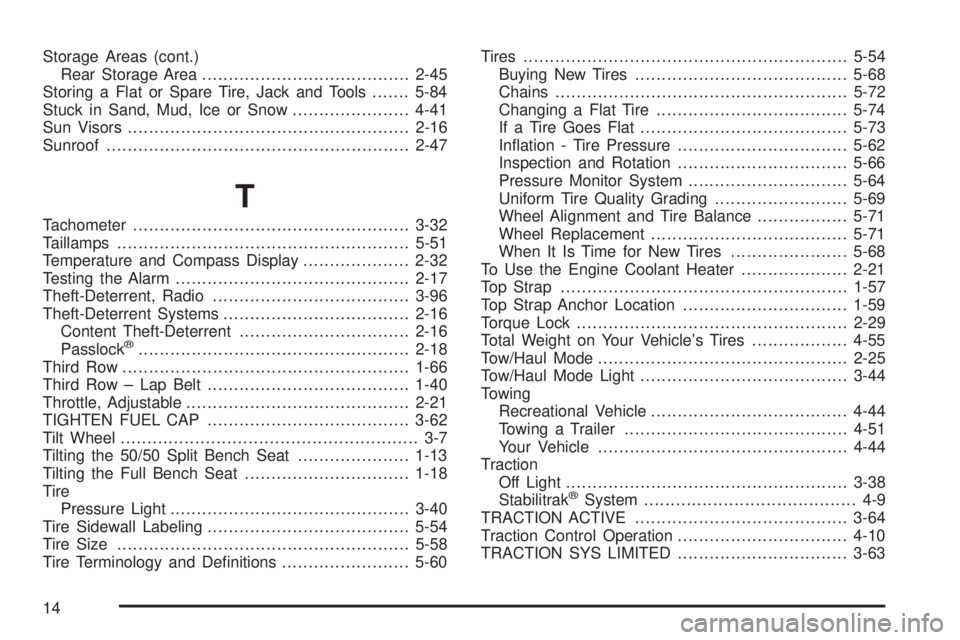
Storage Areas (cont.)
Rear Storage Area.......................................2-45
Storing a Flat or Spare Tire, Jack and Tools.......5-84
Stuck in Sand, Mud, Ice or Snow......................4-41
Sun Visors.....................................................2-16
Sunroof.........................................................2-47
T
Tachometer....................................................3-32
Taillamps.......................................................5-51
Temperature and Compass Display....................2-32
Testing the Alarm............................................2-17
Theft-Deterrent, Radio.....................................3-96
Theft-Deterrent Systems...................................2-16
Content Theft-Deterrent................................2-16
Passlock
ž...................................................2-18
Third Row......................................................1-66
Third Row ± Lap Belt......................................1-40
Throttle, Adjustable..........................................2-21
TIGHTEN FUEL CAP......................................3-62
Tilt Wheel........................................................ 3-7
Tilting the 50/50 Split Bench Seat.....................1-13
Tilting the Full Bench Seat...............................1-18
Tire
Pressure Light.............................................3-40
Tire Sidewall Labeling......................................5-54
Tire Size.......................................................5-58
Tire Terminology and De®nitions........................5-60Tires.............................................................5-54
Buying New Tires........................................5-68
Chains.......................................................5-72
Changing a Flat Tire....................................5-74
If a Tire Goes Flat.......................................5-73
In¯ation - Tire Pressure................................5-62
Inspection and Rotation................................5-66
Pressure Monitor System..............................5-64
Uniform Tire Quality Grading.........................5-69
Wheel Alignment and Tire Balance.................5-71
Wheel Replacement.....................................5-71
When It Is Time for New Tires......................5-68
To Use the Engine Coolant Heater....................2-21
Top Strap......................................................1-57
Top Strap Anchor Location...............................1-59
Torque Lock...................................................2-29
Total Weight on Your Vehicle's Tires..................4-55
Tow/Haul Mode...............................................2-25
Tow/Haul Mode Light.......................................3-44
Towing
Recreational Vehicle.....................................4-44
Towing a Trailer..........................................4-51
Your Vehicle...............................................4-44
Traction
Off Light.....................................................3-38
Stabilitrak
žSystem........................................ 4-9
TRACTION ACTIVE........................................3-64
Traction Control Operation................................4-10
TRACTION SYS LIMITED................................3-63
14