Ac hot GMC YUKON DENALI 2004 Owner's Guide
[x] Cancel search | Manufacturer: GMC, Model Year: 2004, Model line: YUKON DENALI, Model: GMC YUKON DENALI 2004Pages: 468, PDF Size: 3.18 MB
Page 339 of 468
{CAUTION:
Adding only plain water to your cooling
system can be dangerous. Plain water, or
some other liquid such as alcohol, can boil
before the proper coolant mixture will. Your
vehicle's coolant warning system is set for the
proper coolant mixture. With plain water or the
wrong mixture, your engine could get too hot
but you would not get the overheat warning.
Your engine could catch ®re and you or others
could be burned. Use a 50/50 mixture of clean,
drinkable water and DEX-COOL
žcoolant.
Notice:In cold weather, water can freeze and crack
the engine, radiator, heater core and other parts.
Use the recommended coolant and the proper
coolant mixture.
{CAUTION:
You can be burned if you spill coolant on hot
engine parts. Coolant contains ethylene glycol
and it will burn if the engine parts are hot
enough. Do not spill coolant on a hot engine.
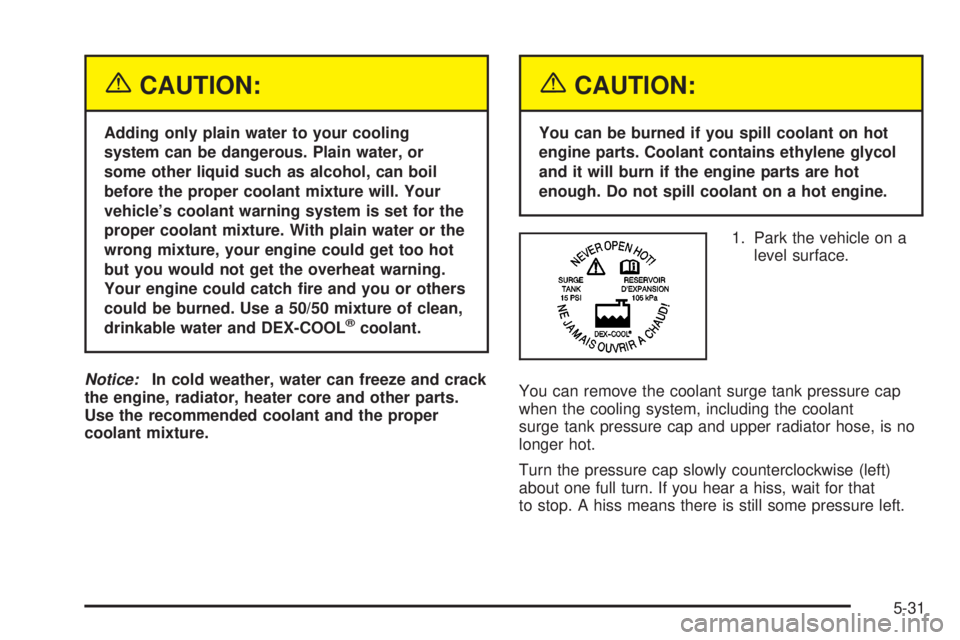
1. Park the vehicle on a
level surface.
You can remove the coolant surge tank pressure cap
when the cooling system, including the coolant
surge tank pressure cap and upper radiator hose, is no
longer hot.
Turn the pressure cap slowly counterclockwise (left)
about one full turn. If you hear a hiss, wait for that
to stop. A hiss means there is still some pressure left.
5-31
Page 341 of 468
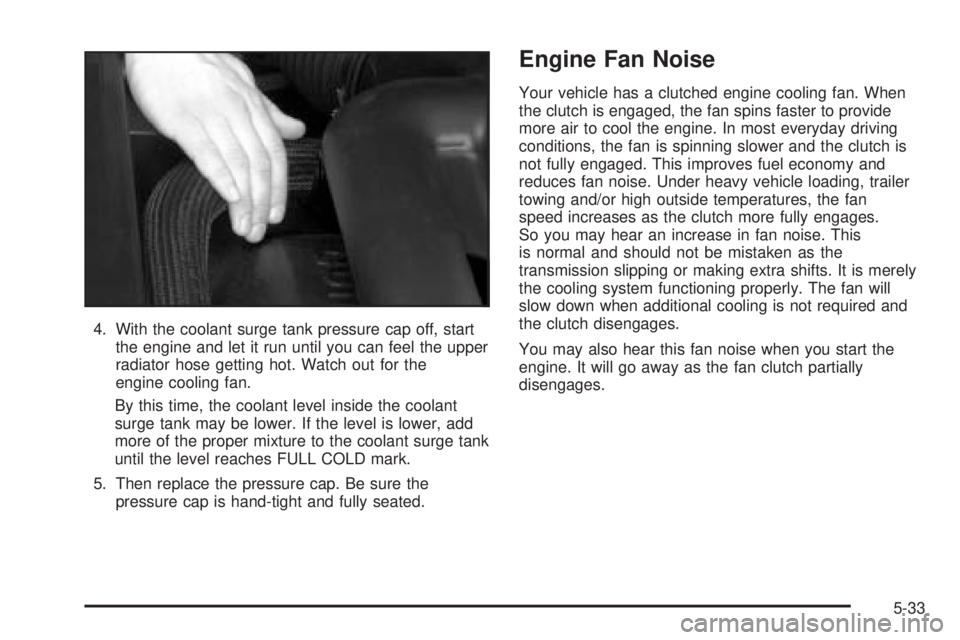
4. With the coolant surge tank pressure cap off, start
the engine and let it run until you can feel the upper
radiator hose getting hot. Watch out for the
engine cooling fan.
By this time, the coolant level inside the coolant
surge tank may be lower. If the level is lower, add
more of the proper mixture to the coolant surge tank
until the level reaches FULL COLD mark.
5. Then replace the pressure cap. Be sure the
pressure cap is hand-tight and fully seated.
Engine Fan Noise
Your vehicle has a clutched engine cooling fan. When
the clutch is engaged, the fan spins faster to provide
more air to cool the engine. In most everyday driving
conditions, the fan is spinning slower and the clutch is
not fully engaged. This improves fuel economy and
reduces fan noise. Under heavy vehicle loading, trailer
towing and/or high outside temperatures, the fan
speed increases as the clutch more fully engages.
So you may hear an increase in fan noise. This
is normal and should not be mistaken as the
transmission slipping or making extra shifts. It is merely
the cooling system functioning properly. The fan will
slow down when additional cooling is not required and
the clutch disengages.
You may also hear this fan noise when you start the
engine. It will go away as the fan clutch partially
disengages.
5-33
Page 344 of 468
Brakes
Brake Fluid
Your brake master cylinder reservoir is ®lled with DOT-3
brake ¯uid. SeeEngine Compartment Overview on
page 5-12for the location of the reservoir.
There are only two reasons why the brake ¯uid level in
the reservoir might go down. The ®rst is that the
brake ¯uid goes down to an acceptable level during
normal brake lining wear. When new linings are put in,
the ¯uid level goes back up. The other reason is
that ¯uid is leaking out of the brake system. If it is, you
should have your brake system ®xed, since a leak
means that sooner or later your brakes will not work
well, or will not work at all.
So, it is not a good idea to ªtop offº your brake ¯uid.
Adding brake ¯uid will not correct a leak. If you add ¯uid
when your linings are worn, then you will have too
much ¯uid when you get new brake linings. You should
add (or remove) brake ¯uid, as necessary, only when
work is done on the brake hydraulic system.
{CAUTION:
If you have too much brake ¯uid, it can spill on
the engine. The ¯uid will burn if the engine is
hot enough. You or others could be burned,
and your vehicle could be damaged. Add brake
¯uid only when work is done on the brake
hydraulic system. See ªChecking Brake Fluidº
in this section.
Refer to the Maintenance Schedule to determine when
to check your brake ¯uid. See
Scheduled Maintenance
on page 6-4.
5-36
Page 400 of 468
Spare Tire
Your vehicle, when new, had a fully in¯ated spare tire.
A spare tire may lose air over time, so check its
in¯ation pressure regularly. See
Tires on page 5-54andLoading Your Vehicle on page 4-44for more information
regarding proper tire in¯ation and loading your vehicle.
For instruction on how to remove or store a spare
tire, see
Changing a Flat Tire on page 5-74.
After installing the spare tire on your vehicle, you should
stop as soon as possible and make sure the spare is
correctly in¯ated. Have the damaged or ¯at road
tire repaired or replaced as soon as you can and
installed back onto your vehicle. This way, a spare tire
will be available in case you need it again.
Your vehicle may have a different size spare tire than
the road tires, those originally installed on your vehicle.
This spare tire was developed for use on your vehicle,
so it is all right to drive on it.
Appearance Care
Remember, cleaning products can be hazardous. Some
are toxic. Others can burst into ¯ames if you strike a
match or get them on a hot part of the vehicle. Some are
dangerous if you breathe their fumes in a closed
space. When you use anything from a container to clean
your vehicle, be sure to follow the manufacturer's
warnings and instructions. And always open your doors
or windows when you are cleaning the inside.
Never use these to clean your vehicle:
·Gasoline
·Benzene
·Naphtha
·Carbon Tetrachloride
·Acetone
·Paint Thinner
·Turpentine
·Lacquer Thinner
·Nail Polish Remover
They can all be hazardous Ð some more than
others Ð and they can all damage your vehicle, too.
5-92
Page 425 of 468
Using Your Maintenance Schedule
We at General Motors want to help you keep your
vehicle in good working condition. But we do not know
exactly how you will drive it. You may drive very
short distances only a few times a week. Or you may
drive long distances all the time in very hot, dusty
weather. You may use your vehicle in making deliveries.
Or you may drive it to work, to do errands or in many
other ways.
Because of all the different ways people use their
vehicles, maintenance needs vary. You may need more
frequent checks and replacements. So please read
the following and note how you drive. If you have any
questions on how to keep your vehicle in good condition,
see your GM Goodwrench dealer.
This schedule is for vehicles that:
·carry passengers and cargo within recommended
limits. You will ®nd these limits on the tire and
loading information label. See
Loading Your Vehicle
on page 4-44.
·are driven on reasonable road surfaces within legal
driving limits.
·are driven off-road in the recommended manner.
See
Operating Your All-Wheel-Drive Vehicle Off
Paved Roads on page 4-16.
·use the recommended fuel. SeeGasoline Octane
on page 5-4
.
The services in
Scheduled Maintenance on page 6-4should be performed when indicated. SeeAdditional
Required Services on page 6-6andMaintenance
Footnotes on page 6-8for further information.
{CAUTION:
Performing maintenance work on a vehicle can
be dangerous. In trying to do some jobs, you
can be seriously injured. Do your own
maintenance work only if you have the
required know-how and the proper tools and
equipment for the job. If you have any doubt,
see your GM Goodwrench dealer to have a
quali®ed technician do the work.
6-3
Page 450 of 468
Reporting Safety Defects
Reporting Safety Defects to the
United States Government
If you believe that your vehicle has a defect which could
cause a crash or could cause injury or death, you
should immediately inform the National Highway Traffic
Safety Administration (NHTSA), in addition to notifying
General Motors.
If NHTSA receives similar complaints, it may open an
investigation, and if it ®nds that a safety defect exists in
a group of vehicles, it may order a recall and remedy
campaign. However, NHTSA cannot become involved in
individual problems between you, your dealer or
General Motors.To contact NHTSA, you may either call the Auto Safety
Hotline toll-free at 1-800-424-9393 (or 366-0123 in
the Washington, D.C. area) or write to:
NHTSA, U.S. Department of Transportation
Washington, D.C. 20590
You can also obtain other information about motor
vehicle safety from the hotline.
Reporting Safety Defects to the
Canadian Government
If you live in Canada, and you believe that your vehicle
has a safety defect, you should immediately notify
Transport Canada, in addition to notifying General
Motors of Canada Limited. You may write to:
Transport Canada
330 Sparks Street
Tower C
Ottawa, Ontario K1A 0N5
7-10
Page 458 of 468
ENGINE COOLANT HOT.................................3-59
Engine Oil Additives........................................5-16
ENGINE OVERHEATED..................................3-59
Entering or Exiting the Third Row Seats.............. 1-7
Entertainment System
Cleaning the Video Screen...........................3-99
DVD Distortion............................................3-97
Entry Lighting.................................................3-17
Environmental Concerns..................................4-17
Erasing HomeLink
žButtons..............................2-42
Event Data Records (EDR)................................ 7-9
Exit Lighting...................................................3-17
Express-Down Windows...................................2-15
Extender, Safety Belt.......................................1-47
Exterior Lamps...............................................3-14
F
Filter
Engine Air Cleaner......................................5-18
Finding a Program Type (PTY) Station
(RDS and XMŸ).........................................3-70
Finding a Station............................................3-67
Finish Care....................................................5-96
Finish Damage...............................................5-99
Fixed Mast Antenna........................................3-99
Flash-to-Pass................................................... 3-9
Flat Tire........................................................5-73
Flat Tire, Changing.........................................5-74Fluid
Automatic Transmission................................5-20
Power Steering...........................................5-34
Windshield Washer......................................5-35
FM Stereo.....................................................3-97
Fog Lamps....................................................3-16
Folding the Seatback.......................................1-17
Folding the Seatbacks.............................1-12, 1-22
Folding the Seatbacks (60/40 Split Bench Seat)....... 1-9
Following Distance..........................................4-59
Front Axle......................................................5-47
Frontal Air Bags.............................................1-77
Fuel............................................................... 5-4
Additives...................................................... 5-6
California Fuel.............................................. 5-5
Filling a Portable Fuel Container..................... 5-9
Filling Your Tank........................................... 5-7
Fuels in Foreign Countries.............................. 5-7
Gage.........................................................3-45
Gasoline Octane........................................... 5-4
Gasoline Speci®cations.................................. 5-5
Low Warning Light.......................................3-45
Fuel Information Button....................................3-49
FUEL LEVEL LOW.........................................3-59
Fuses
Fuses and Circuit Breakers.........................5-103
Windshield Wiper.......................................5-103
6
Page 467 of 468
Trailer
Recommendations.......................................4-51
Trailer Brakes.................................................4-57
Trailer Wiring Harness.....................................4-62
TRANS HOT IDLE ENGINE.............................3-63
Transfer Case................................................5-45
Transmission
Fluid, Automatic...........................................5-20
Temperature Gage.......................................3-39
TRANSMISSION HOT.....................................3-63
Transmission Operation, Automatic....................2-22
Transmission, Transaxle, Transfer Case Unit
Repair Manual............................................7-11
Transportation Options...................................... 7-7
Traveling to Remote Areas...............................4-18
Trip Information Button....................................3-47
Turn and Lane Change Signals.......................... 3-8
TURN SIGNAL ON.........................................3-64
Turn Signal/Multifunction Lever........................... 3-7
Turn Signals When Towing a Trailer..................4-59
U
Underhood Fuse Block...................................5-107
Understanding Radio Reception........................3-97
Unfolding the Seatback....................................1-18
Unfolding the Seatbacks..................................1-12
Uniform Tire Quality Grading............................5-69
United States................................................... 7-4Using HomeLink
ž...........................................2-42
Using the Recovery Hooks...............................4-42
V
Vehicle
Control........................................................ 4-5
Damage Warnings........................................... iv
Loading......................................................4-44
Symbols......................................................... iv
Vehicle Data Collection and Event Data Records..... 7-9
Vehicle Identi®cation
Number (VIN)............................................5-102
Service Parts Identi®cation Label..................5-102
Vehicle Personalization
Memory Seat..............................................2-48
Vehicle Storage..............................................5-39
Ventilation Adjustment......................................3-26
Video Screen.................................................3-83
Visors...........................................................2-16
Voltmeter Gage..............................................3-36
W
Warning Lights, Gages and Indicators................3-30
Warnings
DIC Warnings and Messages........................3-57
Hazard Warning Flashers............................... 3-6
Other Warning Devices.................................. 3-6
15