tow GMC YUKON DENALI 2004 Owners Manual
[x] Cancel search | Manufacturer: GMC, Model Year: 2004, Model line: YUKON DENALI, Model: GMC YUKON DENALI 2004Pages: 468, PDF Size: 3.18 MB
Page 1 of 468
Seats and Restraint Systems........................... 1-1
Front Seats
............................................... 1-3
Rear Seats
............................................... 1-7
Safety Belts
.............................................1-25
Child Restraints
.......................................1-48
Air Bag Systems
......................................1-72
Restraint System Check
............................1-86
Features and Controls..................................... 2-1
Keys
........................................................ 2-3
Doors and Locks
....................................... 2-8
Windows
.................................................2-14
Theft-Deterrent Systems
............................2-16
Starting and Operating Your Vehicle
...........2-18
Mirrors
....................................................2-32
OnStar
žSystem
......................................2-37
HomeLinkžTransmitter
.............................2-39
Storage Areas
.........................................2-43
Sunroof
..................................................2-47
Vehicle Personalization
.............................2-48
Instrument Panel............................................. 3-1
Instrument Panel Overview
.......................... 3-4
Climate Controls
......................................3-20
Warning Lights, Gages and Indicators
.........3-30
Driver Information Center (DIC)
..................3-46
Audio System(s)
.......................................3-64Driving Your Vehicle....................................... 4-1
Your Driving, the Road, and Your Vehicle
..... 4-2
Towing
...................................................4-44
Service and Appearance Care.......................... 5-1
Service
..................................................... 5-3
Fuel
......................................................... 5-4
Checking Things Under
the Hood
.............................................5-10
All-Wheel Drive
........................................5-45
Rear Axle
...............................................5-46
Front Axle
...............................................5-47
Bulb Replacement
....................................5-48
Windshield Wiper Blade Replacement
.........5-53
Tires
......................................................5-54
Spare Tire
...............................................5-92
Appearance Care
.....................................5-92
Vehicle Identi®cation
...............................5-102
Electrical System
....................................5-103
Capacities and Speci®cations
...................5-112
Maintenance Schedule..................................... 6-1
Maintenance Schedule
................................ 6-2
Customer Assistance and Information.............. 7-1
Customer Assistance and Information
........... 7-2
Reporting Safety Defects
...........................7-10
Index................................................................ 1
2004 GMC Yukon Denali/Yukon XL Denali Owner ManualM
Page 9 of 468
Front Seats
Power Seats
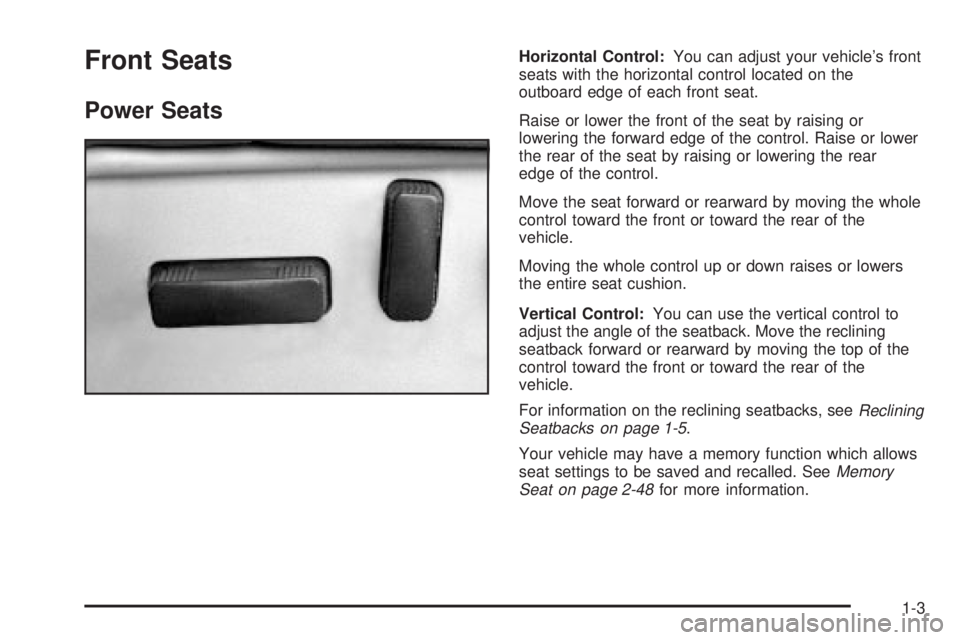
Horizontal Control:You can adjust your vehicle's front
seats with the horizontal control located on the
outboard edge of each front seat.
Raise or lower the front of the seat by raising or
lowering the forward edge of the control. Raise or lower
the rear of the seat by raising or lowering the rear
edge of the control.
Move the seat forward or rearward by moving the whole
control toward the front or toward the rear of the
vehicle.
Moving the whole control up or down raises or lowers
the entire seat cushion.
Vertical Control:You can use the vertical control to
adjust the angle of the seatback. Move the reclining
seatback forward or rearward by moving the top of the
control toward the front or toward the rear of the
vehicle.
For information on the reclining seatbacks, see
Reclining
Seatbacks on page 1-5.
Your vehicle may have a memory function which allows
seat settings to be saved and recalled. See
Memory
Seat on page 2-48for more information.
1-3
Page 12 of 468
Head Restraints
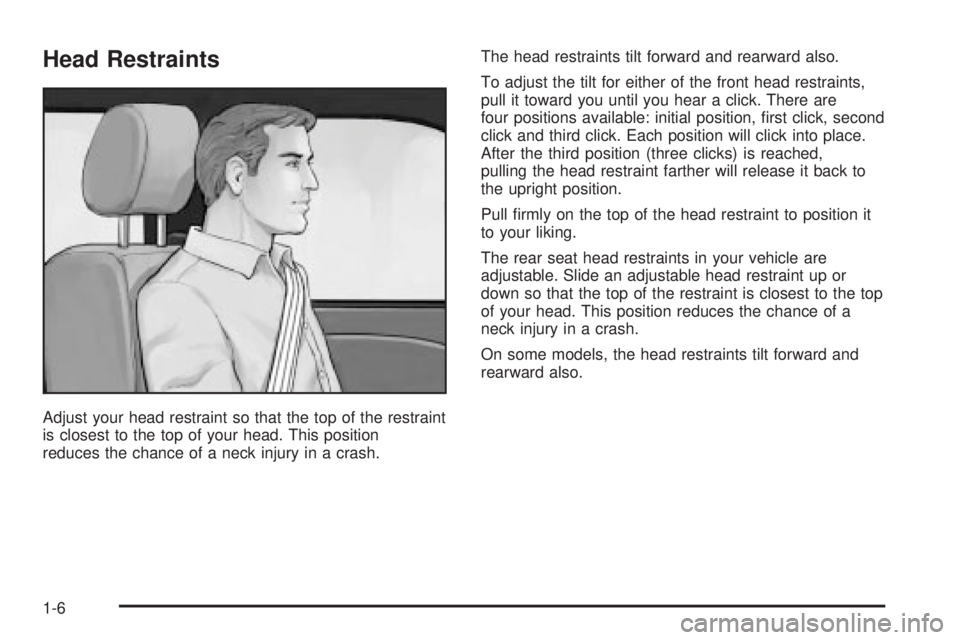
Adjust your head restraint so that the top of the restraint
is closest to the top of your head. This position
reduces the chance of a neck injury in a crash.The head restraints tilt forward and rearward also.
To adjust the tilt for either of the front head restraints,
pull it toward you until you hear a click. There are
four positions available: initial position, ®rst click, second
click and third click. Each position will click into place.
After the third position (three clicks) is reached,
pulling the head restraint farther will release it back to
the upright position.
Pull ®rmly on the top of the head restraint to position it
to your liking.
The rear seat head restraints in your vehicle are
adjustable. Slide an adjustable head restraint up or
down so that the top of the restraint is closest to the top
of your head. This position reduces the chance of a
neck injury in a crash.
On some models, the head restraints tilt forward and
rearward also.
1-6
Page 13 of 468
Rear Seats
Rear Seat Operation
Entering or Exiting the Third Row
Seats
Yukon Denali:To enter or exit the third row seat you
must fold the second row seat down following the
instructions later in this section. See ªFolding the
Seatbackº under
60/40 Split Bench Seat on page 1-9.If
you are exiting the third row seat with no assistance
do the following:
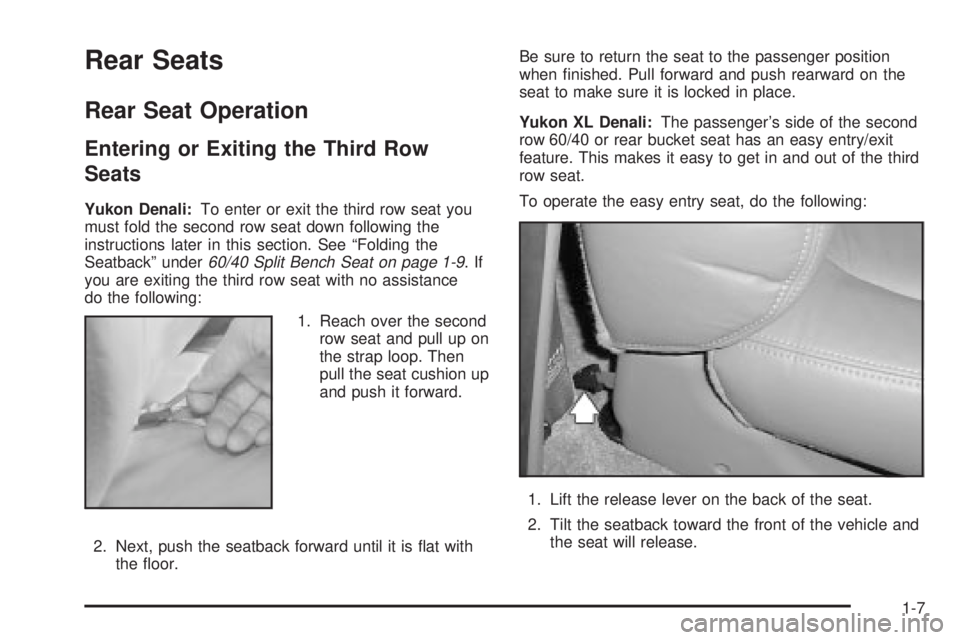
1. Reach over the second
row seat and pull up on
the strap loop. Then
pull the seat cushion up
and push it forward.
2. Next, push the seatback forward until it is ¯at with
the ¯oor.Be sure to return the seat to the passenger position
when ®nished. Pull forward and push rearward on the
seat to make sure it is locked in place.
Yukon XL Denali:The passenger's side of the second
row 60/40 or rear bucket seat has an easy entry/exit
feature. This makes it easy to get in and out of the third
row seat.
To operate the easy entry seat, do the following:
1. Lift the release lever on the back of the seat.
2. Tilt the seatback toward the front of the vehicle and
the seat will release.
1-7
Page 19 of 468
Tilting the 50/50 Split Bench Seat
1. Fold the seatbacks forward using the instructions
listed previously.
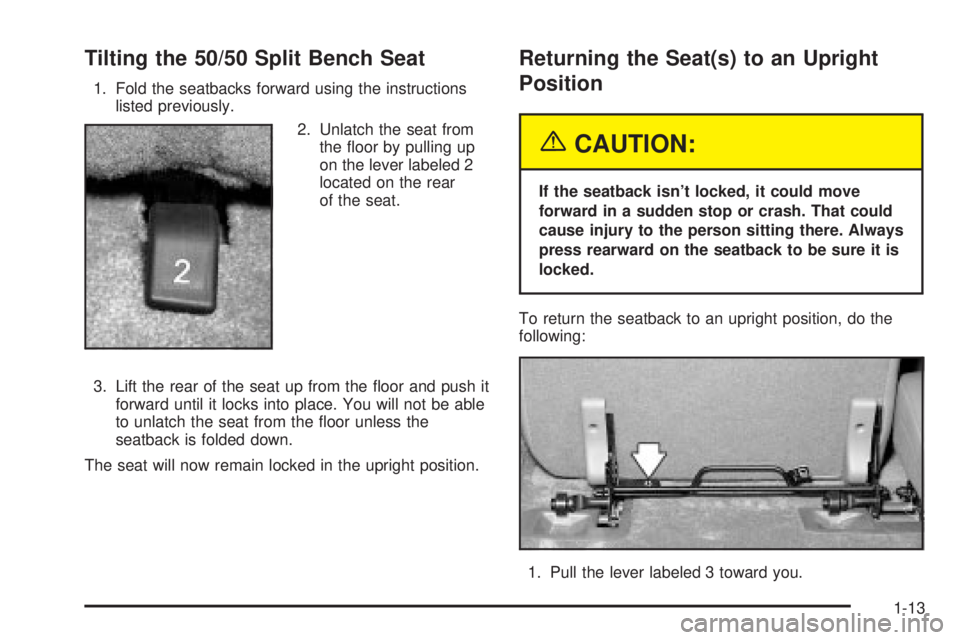
2. Unlatch the seat from
the ¯oor by pulling up
on the lever labeled 2
located on the rear
of the seat.
3. Lift the rear of the seat up from the ¯oor and push it
forward until it locks into place. You will not be able
to unlatch the seat from the ¯oor unless the
seatback is folded down.
The seat will now remain locked in the upright position.
Returning the Seat(s) to an Upright
Position
{CAUTION:
If the seatback isn't locked, it could move
forward in a sudden stop or crash. That could
cause injury to the person sitting there. Always
press rearward on the seatback to be sure it is
locked.
To return the seatback to an upright position, do the
following:
1. Pull the lever labeled 3 toward you.
1-13
Page 20 of 468
2. While still holding the lever 3 toward you, grasp the
top of the seat and pull it toward you slightly.
3. Let go of lever 3 and pull the seat completely down.
4. Push down on the seat ®rmly. Try pulling it up to
be sure it is locked into place.
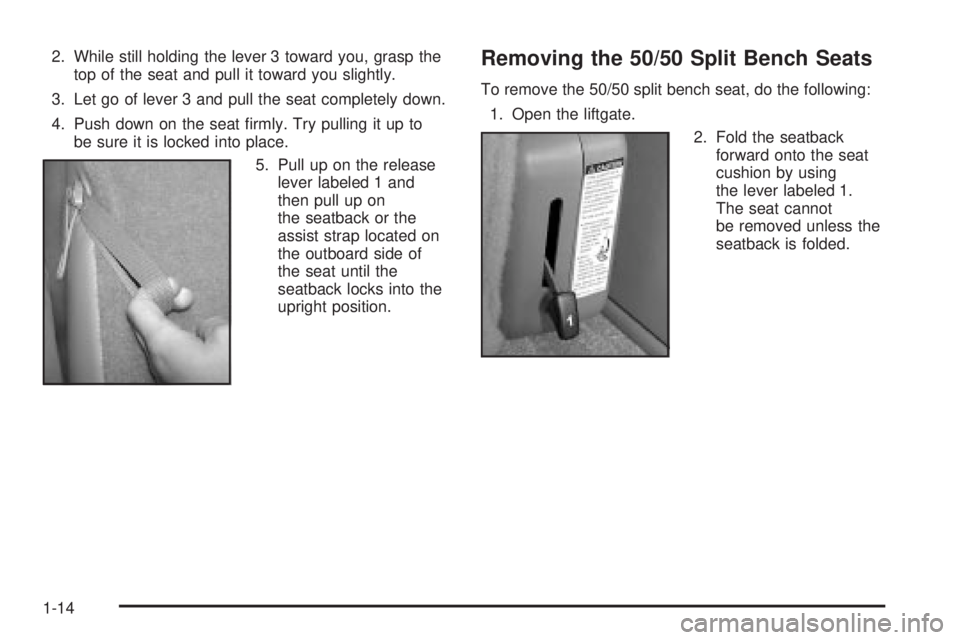
5. Pull up on the release
lever labeled 1 and
then pull up on
the seatback or the
assist strap located on
the outboard side of
the seat until the
seatback locks into the
upright position.Removing the 50/50 Split Bench Seats
To remove the 50/50 split bench seat, do the following:
1. Open the liftgate.
2. Fold the seatback
forward onto the seat
cushion by using
the lever labeled 1.
The seat cannot
be removed unless the
seatback is folded.
1-14
Page 25 of 468
3. Lift the rear of the seat up from the ¯oor and push it
forward. You will not be able to unlatch the seat
from the ¯oor unless the seatback is folded down.
{CAUTION:
If the support rod isn't properly engaged, the
folded third row seat could come loose in a
sudden stop or crash. That could cause injury
to people and damage to your vehicle. Always
be sure the support rod is properly engaged
when the third row seat is folded forward.
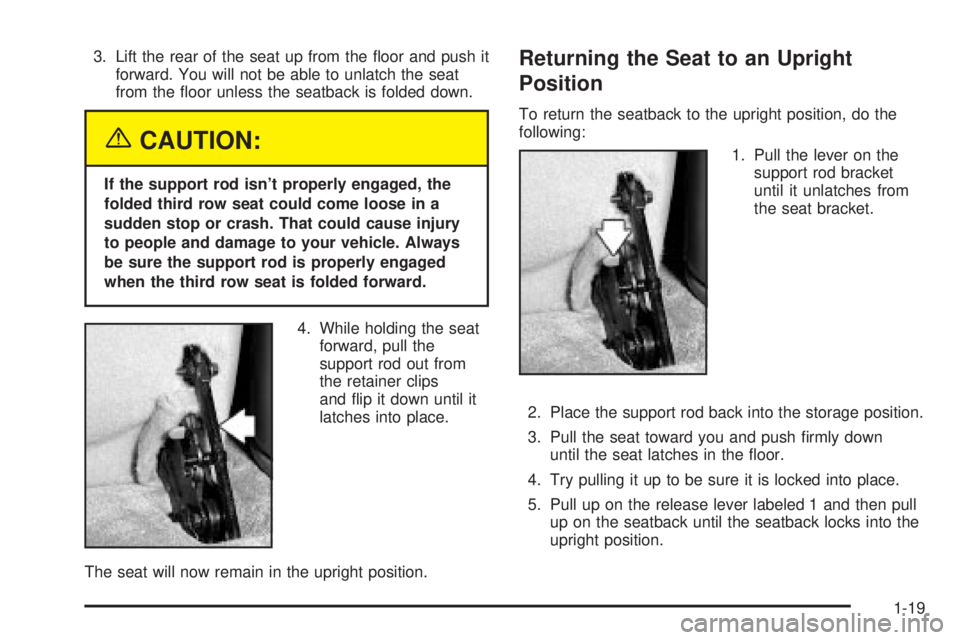
4. While holding the seat
forward, pull the
support rod out from
the retainer clips
and ¯ip it down until it
latches into place.
The seat will now remain in the upright position.
Returning the Seat to an Upright
Position
To return the seatback to the upright position, do the
following:
1. Pull the lever on the
support rod bracket
until it unlatches from
the seat bracket.
2. Place the support rod back into the storage position.
3. Pull the seat toward you and push ®rmly down
until the seat latches in the ¯oor.
4. Try pulling it up to be sure it is locked into place.
5. Pull up on the release lever labeled 1 and then pull
up on the seatback until the seatback locks into the
upright position.
1-19
Page 55 of 468
{CAUTION:
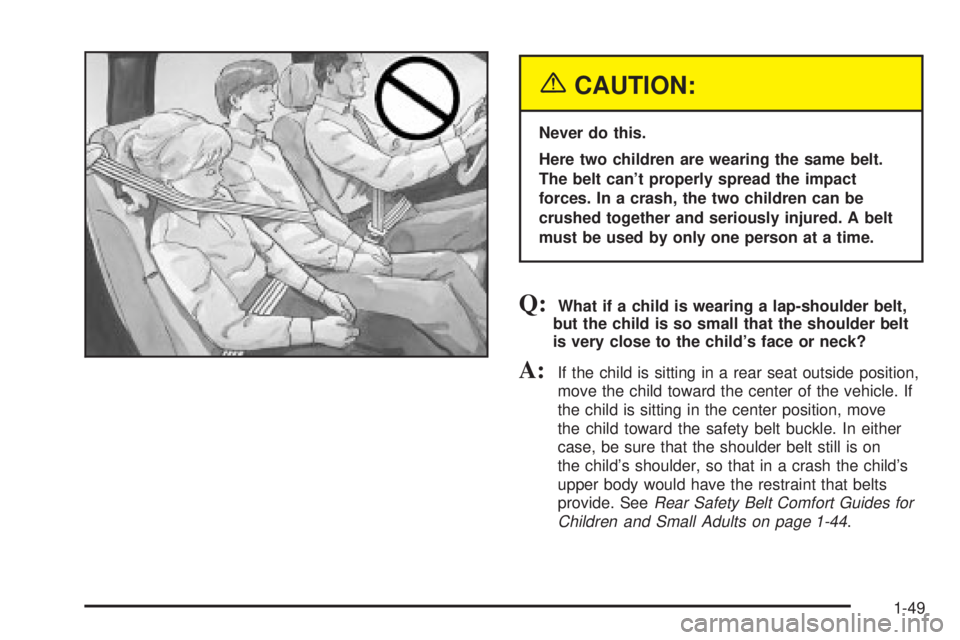
Never do this.
Here two children are wearing the same belt.
The belt can't properly spread the impact
forces. In a crash, the two children can be
crushed together and seriously injured. A belt
must be used by only one person at a time.
Q:What if a child is wearing a lap-shoulder belt,
but the child is so small that the shoulder belt
is very close to the child's face or neck?
A:If the child is sitting in a rear seat outside position,
move the child toward the center of the vehicle. If
the child is sitting in the center position, move
the child toward the safety belt buckle. In either
case, be sure that the shoulder belt still is on
the child's shoulder, so that in a crash the child's
upper body would have the restraint that belts
provide. See
Rear Safety Belt Comfort Guides for
Children and Small Adults on page 1-44
.
1-49
Page 60 of 468
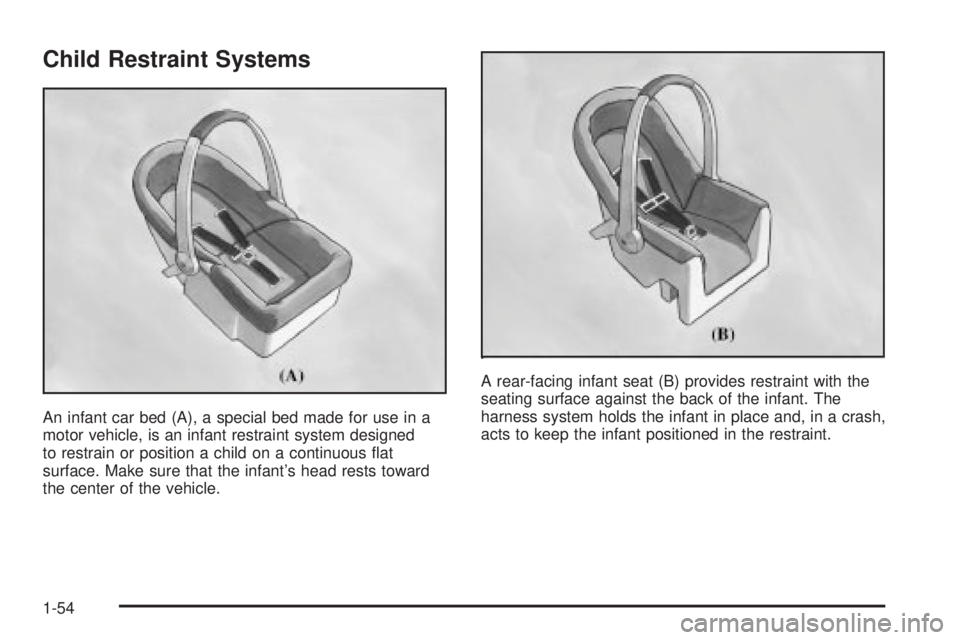
Child Restraint Systems
An infant car bed (A), a special bed made for use in a
motor vehicle, is an infant restraint system designed
to restrain or position a child on a continuous ¯at
surface. Make sure that the infant's head rests toward
the center of the vehicle.A rear-facing infant seat (B) provides restraint with the
seating surface against the back of the infant. The
harness system holds the infant in place and, in a crash,
acts to keep the infant positioned in the restraint.
1-54
Page 84 of 468
in frontal and near-frontal impacts. For side impact air
bags, in¯ation is determined by the location and severity
of the impact.
The air bag system is designed to work properly under
a wide range of conditions, including off-road usage.
Observe safe driving speeds, especially on rough
terrain. As always, wear your safety belt. See
Operating
Your All-Wheel-Drive Vehicle Off Paved Roads on
page 4-16
for tips on off-road driving.
What Makes an Air Bag In¯ate?
In an impact of sufficient severity, the air bag sensing
system detects that the vehicle is in a crash. For
both frontal and side impact air bags, the sensing
system triggers a release of gas from the in¯ator, which
in¯ates the air bag. The in¯ator, the air bag and
related hardware are all part of the air bag modules.
Frontal air bag modules are located inside the steering
wheel and instrument panel. For vehicles with side
impact air bags, the air bag modules are located in the
seatback closest to the driver's and/or right front
passenger's door.
How Does an Air Bag Restrain?
In moderate to severe frontal or near frontal collisions,
even belted occupants can contact the steering wheel or
the instrument panel. In moderate to severe side
collisions, even belted occupants can contact the inside
of the vehicle. The air bag supplements the protection
provided by safety belts. Air bags distribute the force of
the impact more evenly over the occupant's upper
body, stopping the occupant more gradually. But the
frontal air bags would not help you in many types
of collisions, including rollovers, rear impacts, and many
side impacts, primarily because an occupant's motion
is not toward the air bag. Side impact air bags would not
help you in many types of collisions, including frontal
or near frontal collisions, rollovers, and rear impacts,
primarily because an occupant's motion is not toward
those air bags. Air bags should never be regarded
as anything more than a supplement to safety belts, and
then only in moderate to severe frontal or near-frontal
collisions for the driver's and right front passenger's
frontal air bags, and only in moderate to severe
side collisions for vehicles with a driver's and right front
passenger's side impact air bag.
1-78