5-1 GMC YUKON DENALI 2005 User Guide
[x] Cancel search | Manufacturer: GMC, Model Year: 2005, Model line: YUKON DENALI, Model: GMC YUKON DENALI 2005Pages: 468, PDF Size: 2.67 MB
Page 309 of 468
Service............................................................5-3
Doing Your Own Service Work.........................5-4
Adding Equipment to the Outside of Your
Vehicle......................................................5-5
Fuel................................................................5-5
Gasoline Octane............................................5-5
Gasoline Specications....................................5-5
California Fuel...............................................5-6
Additives.......................................................5-6
Fuels in Foreign Countries...............................5-7
Filling Your Tank............................................5-8
Filling a Portable Fuel Container.......................5-9
Checking Things Under the Hood....................5-10
Hood Release..............................................5-11
Engine Compartment Overview.......................5-12
Engine Oil...................................................5-14
Engine Oil Life System..................................5-17
Engine Air Cleaner/Filter................................5-19
Automatic Transmission Fluid.........................5-22
Engine Coolant.............................................5-25
Coolant Surge Tank Pressure Cap..................5-27
Engine Overheating.......................................5-28
Overheated Engine Protection Operating Mode . . .5-30
Cooling System............................................5-30
Engine Fan Noise.........................................5-35
Power Steering Fluid.....................................5-35Windshield Washer Fluid................................5-37
Brakes........................................................5-38
Battery........................................................5-41
Jump Starting...............................................5-42
All-Wheel Drive..............................................5-47
Rear Axle.......................................................5-48
Front Axle......................................................5-48
Bulb Replacement..........................................5-50
Halogen Bulbs..............................................5-50
Headlamps..................................................5-50
Front Turn Signal, Sidemarker and Daytime
Running Lamps.........................................5-51
Taillamps.....................................................5-53
Replacement Bulbs.......................................5-54
Windshield Wiper Blade Replacement..............5-55
Tires..............................................................5-56
Tire Sidewall Labelling...................................5-57
Tire Terminology and Denitions.....................5-60
Ination - Tire Pressure.................................5-62
Tire Pressure Monitor System.........................5-63
Tire Inspection and Rotation...........................5-66
When It Is Time for New Tires.......................5-68
Buying New Tires.........................................5-68
Uniform Tire Quality Grading..........................5-70
Wheel Alignment and Tire Balance..................5-71
Section 5 Service and Appearance Care
5-1
Page 310 of 468
Wheel Replacement......................................5-72
Tire Chains..................................................5-73
If a Tire Goes Flat........................................5-74
Changing a Flat Tire.....................................5-74
Removing the Spare Tire and Tools................5-76
Removing the Flat Tire and Installing the
Spare Tire................................................5-80
Secondary Latch System...............................5-86
Storing a Flat or Spare Tire and Tools............5-90
Spare Tire...................................................5-94
Appearance Care............................................5-94
Fabric/Carpet...............................................5-95
Vinyl...........................................................5-96
Leather.......................................................5-97
Instrument Panel..........................................5-97
Interior Plastic Components............................5-97
Wood Panels...............................................5-97
Speaker Covers............................................5-97
Glass Surfaces.............................................5-97
Care of Safety Belts......................................5-98
Weatherstrips...............................................5-98
Washing Your Vehicle...................................5-98
Cleaning Exterior Lamps/Lenses.....................5-98Finish Care..................................................5-99
Windshield, Backglass, and Wiper Blades.......5-100
Aluminum Wheels.......................................5-100
Tires.........................................................5-101
Sheet Metal Damage...................................5-101
Finish Damage...........................................5-101
Underbody Maintenance...............................5-102
Chemical Paint Spotting...............................5-102
Vehicle Care/Appearance Materials................5-103
Vehicle Identication.....................................5-104
Vehicle Identication Number (VIN)................5-104
Service Parts Identication Label...................5-104
Electrical System..........................................5-105
Add-On Electrical Equipment.........................5-105
Windshield Wiper Fuses...............................5-105
Power Windows and Other Power Options......5-105
Fuses and Circuit Breakers..........................5-105
Instrument Panel Fuse Block........................5-106
Center Instrument Panel Fuse Block..............5-108
Underhood Fuse Block................................5-109
Capacities and Specications........................5-114
Section 5 Service and Appearance Care
5-2
Page 318 of 468
Checking Things Under
the Hood
{CAUTION:
An electric fan under the hood can start up
and injure you even when the engine is not
running. Keep hands, clothing and tools away
from any underhood electric fan.
{CAUTION:
Things that burn can get on hot engine parts
and start a re. These include liquids like fuel,
oil, coolant, brake uid, windshield washer and
other uids, and plastic or rubber. You or
others could be burned. Be careful not to drop
or spill things that will burn onto a hot engine.
5-10
Page 319 of 468
Hood Release
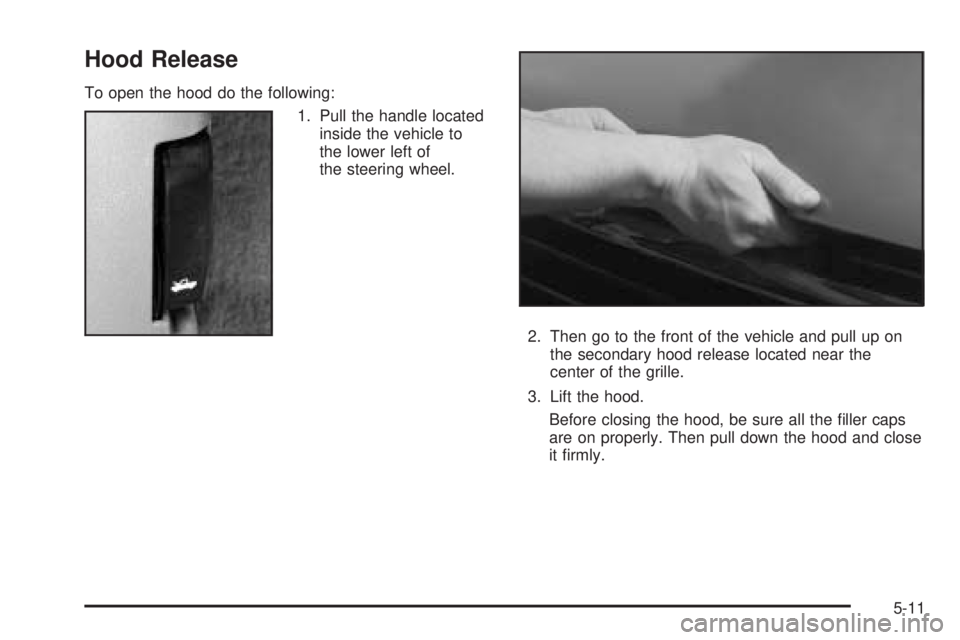
To open the hood do the following:
1. Pull the handle located
inside the vehicle to
the lower left of
the steering wheel.
2. Then go to the front of the vehicle and pull up on
the secondary hood release located near the
center of the grille.
3. Lift the hood.
Before closing the hood, be sure all the ller caps
are on properly. Then pull down the hood and close
it rmly.
5-11
Page 320 of 468
Engine Compartment Overview
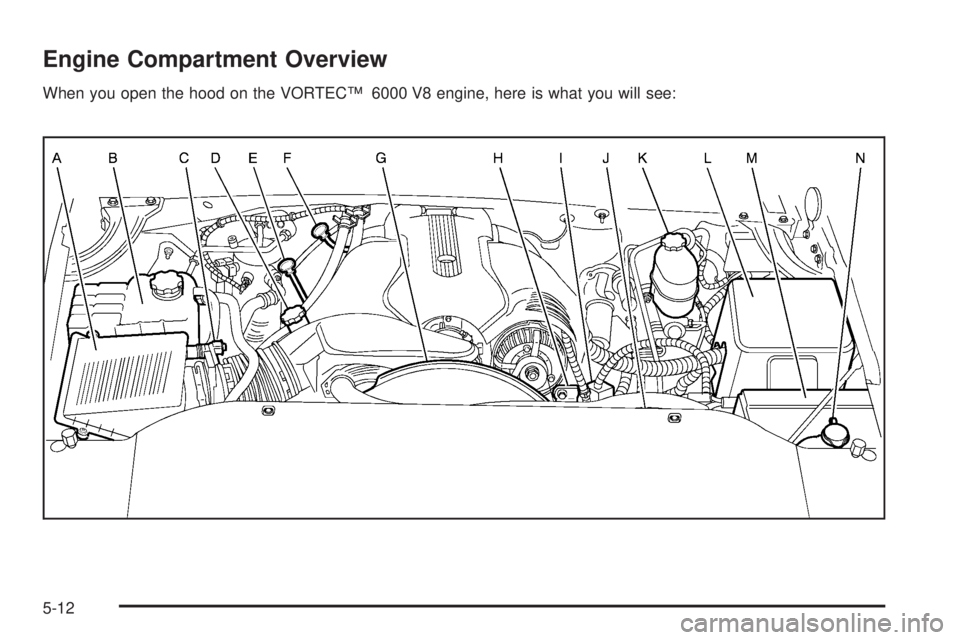
When you open the hood on the VORTEC™ 6000 V8 engine, here is what you will see:
5-12
Page 321 of 468
A. Engine Air Cleaner/Filter. SeeEngine Air
Cleaner/Filter on page 5-19.
B. Coolant Surge Tank and Pressure Cap. SeeCooling
System on page 5-30andCoolant Surge Tank
Pressure Cap on page 5-27.
C. Air Filter Restriction Indicator. SeeEngine Air
Cleaner/Filter on page 5-19.
D. Engine Oil Fill Cap. See “When to Add Engine Oil”
underEngine Oil on page 5-14.
E. Engine Oil Dipstick. See “Checking Engine Oil”
underEngine Oil on page 5-14.
F. Automatic Transmission Fluid Dipstick. See
“Checking the Fluid Level” underAutomatic
Transmission Fluid on page 5-22.
G. Electric Engine Cooling Fan (If Equipped). See
Cooling System on page 5-30.H. Remote Negative (−) Terminal (GND). SeeJump
Starting on page 5-42.
I. Remote Positive (+) Terminal. SeeJump Starting on
page 5-42.
J. Power Steering Fluid Reservoir (Out of View). See
Power Steering Fluid on page 5-35.
K. Brake Master Cylinder Reservoir. See “Brake Fluid”
underBrakes on page 5-38.
L. Underhood Fuse Block. SeeUnderhood Fuse Block
on page 5-109.
M. Battery. SeeBattery on page 5-41.
N. Windshield Washer Fluid Reservoir. See “Adding
Washer Fluid” underWindshield Washer Fluid
on page 5-37.
5-13
Page 322 of 468
Engine Oil
If the CHECK OIL LEVEL message appears on the
Driver Information Center (DIC), it means you need to
check your engine oil level right away. For more
information, see CHECK OIL LEVEL underDIC
Warnings and Messages on page 3-50.
You should check your engine oil level regularly; this is
an added reminder.
Checking Engine Oil
It is a good idea to check your engine oil every time you
get fuel. In order to get an accurate reading, the oil
must be warm and the vehicle must be on level ground.
The engine oil dipstick handle is a yellow loop. See
Engine Compartment Overview on page 5-12for
the location of the engine oil dipstick.
1. Turn off the engine and give the oil several minutes
to drain back into the oil pan. If you do not do this,
the oil dipstick might not show the actual level.
2. Pull out the dipstick and clean it with a paper towel
or cloth, then push it back in all the way. Remove it
again, keeping the tip down, and check the level.
5-14
Page 323 of 468
When to Add Engine Oil
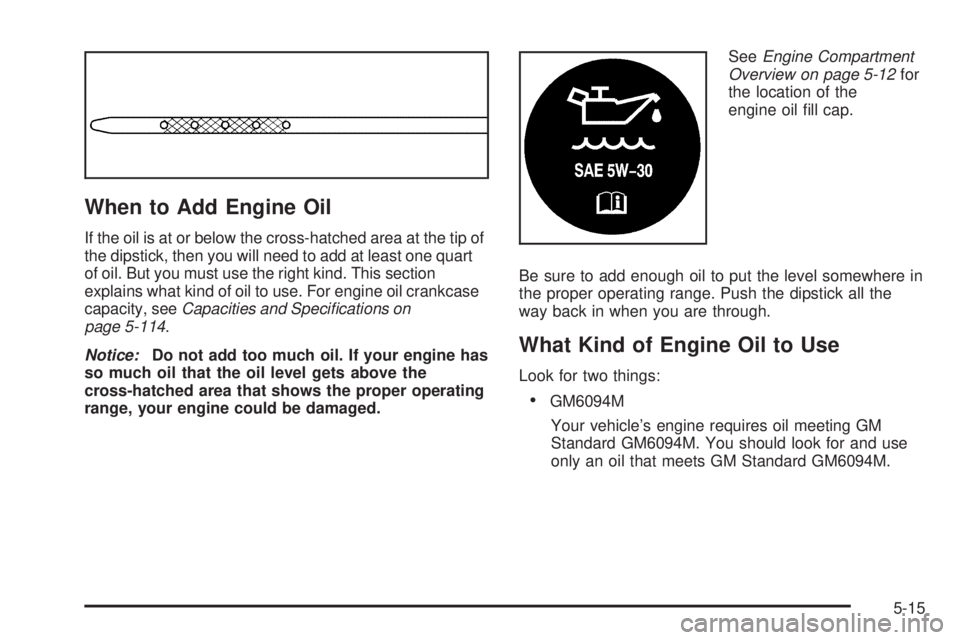
If the oil is at or below the cross-hatched area at the tip of
the dipstick, then you will need to add at least one quart
of oil. But you must use the right kind. This section
explains what kind of oil to use. For engine oil crankcase
capacity, seeCapacities and Specications on
page 5-114.
Notice:Do not add too much oil. If your engine has
so much oil that the oil level gets above the
cross-hatched area that shows the proper operating
range, your engine could be damaged.SeeEngine Compartment
Overview on page 5-12for
the location of the
engine oil ll cap.
Be sure to add enough oil to put the level somewhere in
the proper operating range. Push the dipstick all the
way back in when you are through.
What Kind of Engine Oil to Use
Look for two things:
GM6094M
Your vehicle’s engine requires oil meeting GM
Standard GM6094M. You should look for and use
only an oil that meets GM Standard GM6094M.
5-15
Page 324 of 468
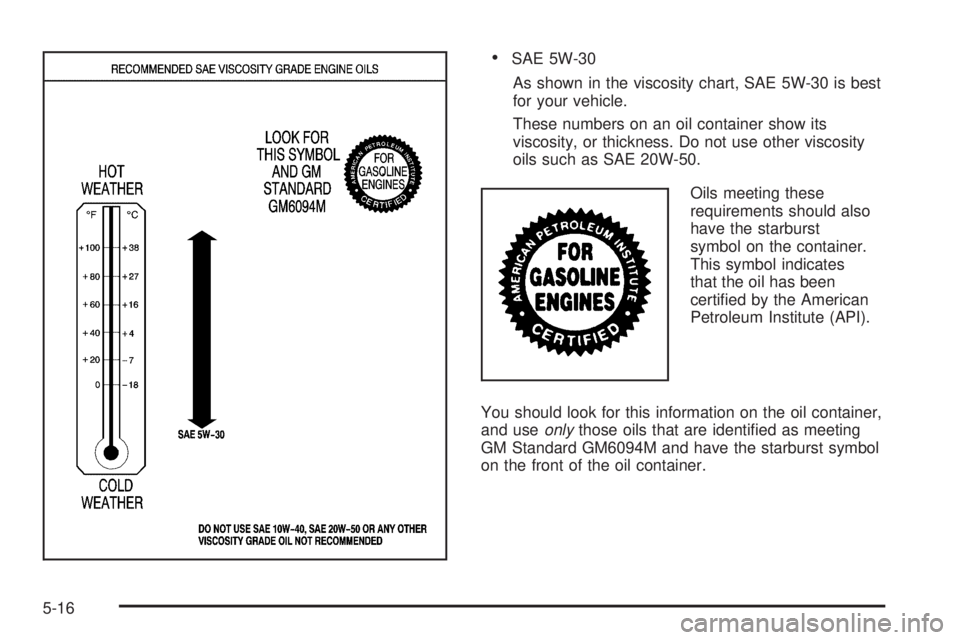
SAE 5W-30
As shown in the viscosity chart, SAE 5W-30 is best
for your vehicle.
These numbers on an oil container show its
viscosity, or thickness. Do not use other viscosity
oils such as SAE 20W-50.
Oils meeting these
requirements should also
have the starburst
symbol on the container.
This symbol indicates
that the oil has been
certied by the American
Petroleum Institute (API).
You should look for this information on the oil container,
and useonlythose oils that are identied as meeting
GM Standard GM6094M and have the starburst symbol
on the front of the oil container.
5-16
Page 325 of 468
Notice:Use only engine oil identied as meeting
GM Standard GM6094M and showing the American
Petroleum Institute Certied For Gasoline Engines
starburst symbol. Failure to use the recommended
oil can result in engine damage not covered by
your warranty.
GM Goodwrench
®oil meets all the requirements for
your vehicle.
If you are in an area of extreme cold, where the
temperature falls below−20°F (−29°C), it is
recommended that you use either an SAE 5W-30
synthetic oil or an SAE 0W-30 oil. Both will provide
easier cold starting and better protection for your engine
at extremely low temperatures.
Engine Oil Additives
Do not add anything to your oil. The recommended oils
with the starburst symbol that meet GM Standard
GM6094M are all you will need for good performance
and engine protection.
Engine Oil Life System
When to Change Engine Oil
Your vehicle has a computer system that lets you know
when to change the engine oil and lter. This is based on
engine revolutions and engine temperature, and not on
mileage. Based on driving conditions, the mileage at
which an oil change will be indicated can vary
considerably. For the oil life system to work properly, you
must reset the system every time the oil is changed.
When the system has calculated that oil life has been
diminished, it will indicate that an oil change is necessary.
A CHANGE ENGINE OIL message will come on. Change
your oil as soon as possible within the next 600 miles
(1 000 km). It is possible that, if you are driving under the
best conditions, the oil life system may not indicate that
an oil change is necessary for over a year. However, your
engine oil and lter must be changed at least once a year
and at this time the system must be reset. Your dealer
has GM-trained service people who will perform this work
using genuine GM parts and reset the system. It is also
important to check your oil regularly and keep it at the
proper level.
If the system is ever reset accidentally, you must
change your oil at 3,000 miles (5 000 km) since your
last oil change. Remember to reset the oil life system
whenever the oil is changed.
5-17