instrument panel GMC YUKON DENALI 2007 User Guide
[x] Cancel search | Manufacturer: GMC, Model Year: 2007, Model line: YUKON DENALI, Model: GMC YUKON DENALI 2007Pages: 608, PDF Size: 2.92 MB
Page 108 of 608
Restraint System Check
Checking the Restraint Systems
Now and then, make sure the safety belt reminder
light and all your belts, buckles, latch plates,
retractors and anchorages are working properly.
Look for any other loose or damaged safety
belt system parts. If you see anything that might
keep a safety belt system from doing its job, have
it repaired. Keep safety belts clean and dry.
SeeCare of Safety Belts on page 530for more
information.
Torn or frayed safety belts may not protect you in
a crash. They can rip apart under impact forces.
If a belt is torn or frayed, get a new one right away.Also look for any opened or broken airbag covers,
and have them repaired or replaced. The airbag
system does not need regular maintenance.
Notice:If you damage the covering for the
driver’s or the right front passenger’s airbag,
or the side impact airbag covering on the
ceiling near the side windows, the airbag may
not work properly. You may have to replace
the airbag module in the steering wheel, both
the airbag module and the instrument panel
for the right front passenger’s airbag, or
side impact airbag module and ceiling covering
for roof-mounted rollover airbags. Do not
open or break the airbag coverings.
108
Page 112 of 608
OnStar®System.......................................... 164
Universal Home Remote System................ 166
Universal Home Remote System
(With Three Round LED)....................... 166
Universal Home Remote System
(With One Triangular LED)..................... 167
Universal Home Remote System
Operation (With Three Round LED)....... 168
Universal Home Remote System
Operation (With One Triagular LED)....... 174Storage Areas............................................. 178
Glove Box................................................. 178
Cupholder(s).............................................. 178
Instrument Panel Storage Area.................. 178
Center Console Storage Area.................... 179
Luggage Carrier........................................ 179
Rear Storage Area.................................... 180
Convenience Net....................................... 180
Cargo Cover............................................. 181
Cargo Management System...................... 182
Sunroof....................................................... 185
Section 2 Features and Controls
112
Page 126 of 608
Liftgate/Liftglass
{CAUTION:
It can be dangerous to drive with the
liftglass or liftgate open because carbon
monoxide (CO) gas can come into your
vehicle. You cannot see or smell CO.
It can cause unconsciousness and
even death.
If you must drive with the liftglass or
liftgate open, or if electrical wiring or
other cable connections must pass
through the seal between the body and
the liftglass or liftgate:
Make sure all other windows are shut.
Turn the fan on your heating or
cooling system to its highest speed
with the recirculation mode off. That
will force outside air into your vehicle.
SeeDual Automatic Climate Control
System on page 214.
CAUTION: (Continued)
CAUTION: (Continued)
If you have air outlets on or under
the instrument panel, open them all
the way.
If your vehicle is equipped with a
power liftgate, disable the power
liftgate function.
SeeEngine Exhaust on page 156.
SeePower Liftgate on page 128for more
information on how to use the power liftgate.
To unlock the liftgate, use the power door lock
switch or press the door unlock button on
the Remote Keyless Entry (RKE) transmitter twice.
SeeRemote Keyless Entry System Operation
on page 116.
126
Page 131 of 608
When driving with the liftgate open, the power
liftgate should be switched to manual liftgate
operation — the overhead console switch set to
the “Disable” position.
Both the liftglass and liftgate have an electric
latch. If the battery is disconnected or has
low voltage, the liftglass and liftgate will not open.
The liftglass and liftgate will resume operation
when the battery is reconnected and charged.
If the battery is properly connected and has
adequate voltage, and the liftgate or liftglass still
will not function, your vehicle should be taken to a
dealership for service.
{CAUTION:
It can be dangerous to drive with the
liftglass or liftgate open because carbon
monoxide (CO) gas can come into your
vehicle. You cannot see or smell CO. It
can cause unconsciousness and even
death.
CAUTION: (Continued)
CAUTION: (Continued)
If you must drive with the liftglass or
liftgate open, or if electrical wiring or
other cable connections must pass
through the seal between the body and
the liftglass or liftgate:
Make sure all other windows are shut.
Turn the fan on your heating or
cooling system to its highest speed
with the recirculation mode off. That
will force outside air into your vehicle.
SeeDual Automatic Climate Control
System on page 214.
If you have air outlets on or under
the instrument panel, open them all
the way.
If your vehicle is equipped with a
power liftgate, disable the power
liftgate function.
SeeEngine Exhaust on page 156.
Do not drive with the liftgate open if at all possible.
131
Page 137 of 608
This device complies with RSS-210 of Industry
Canada. Operation is subject to the following
two conditions:
1. This device may not cause interference.
2. This device must accept any interference
received, including interference that may
cause undesired operation of the device.
Changes or modications to this system by other
than an authorized service facility could void
authorization to use this equipment.
PASS-Key
®III+ uses a radio frequency
transponder in the key that matches a decoder
in your vehicle.
PASS-Key®III+ Operation
Your vehicle has PASS-Key®III+ (Personalized
Automotive Security System) theft-deterrent
system. PASS-Key
®III+ is a passive
theft-deterrent system. This means you do not
have to do anything special to arm or disarm the
system. It works when you transition the key
to RUN, ACCESSORY or START from the
OFF position.When the PASS-Key
®III+ system senses that
someone is using the wrong key, it prevents the
vehicle from starting. Anyone using a trial-and-error
method to start the vehicle will be discouraged
because of the high number of electrical key codes.
If the engine does not start and the security light
on the instrument panel comes on when trying
to start the vehicle, the key may have a damaged
transponder. Turn the ignition off and try again.
If the engine still does not start, and the key
appears to be undamaged, try another ignition
key. At this time, you may also want to check
the fuse, seeFuses and Circuit Breakers on
page 538. If the engine still does not start with the
other key, your vehicle needs service. If your
vehicle does start, the rst key may be faulty. See
your dealer who can service the PASS-Key
®III+
to have a new key made. In an emergency,
contact Roadside Assistance.
137
Page 145 of 608
4. Before starting the engine, be sure to unplug
and store the cord as it was before to keep it
away from moving engine parts. If you do
not, it could be damaged.
How long should you keep the coolant heater
plugged in? The answer depends on the outside
temperature, the kind of oil you have, and
some other things. Instead of trying to list
everything here, we ask that you contact your
dealer in the area where you will be parking your
vehicle. The dealer can give you the best
advice for that particular area.Automatic Transmission Operation
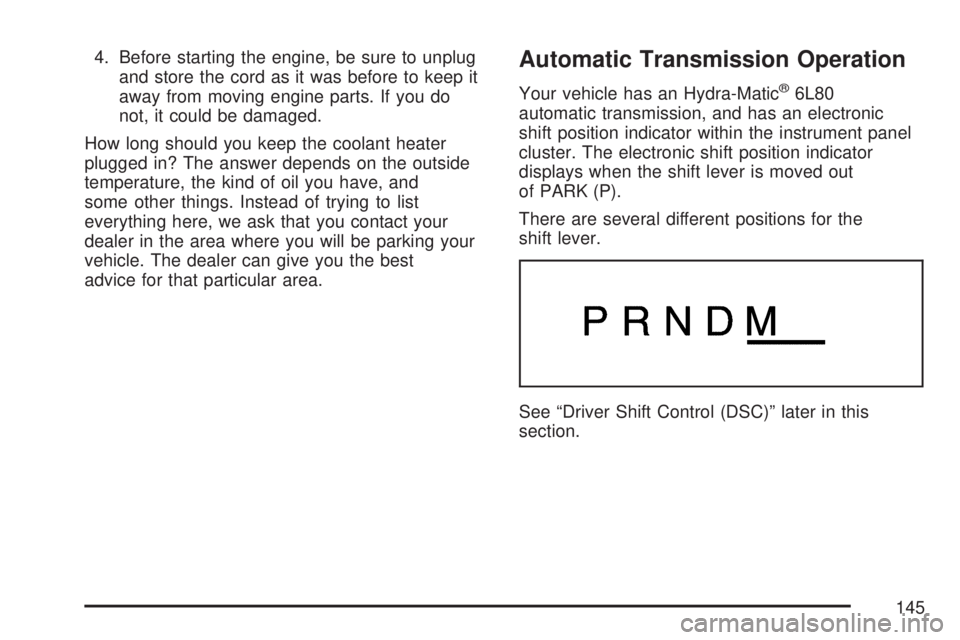
Your vehicle has an Hydra-Matic®6L80
automatic transmission, and has an electronic
shift position indicator within the instrument panel
cluster. The electronic shift position indicator
displays when the shift lever is moved out
of PARK (P).
There are several different positions for the
shift lever.
See “Driver Shift Control (DSC)” later in this
section.
145
Page 150 of 608
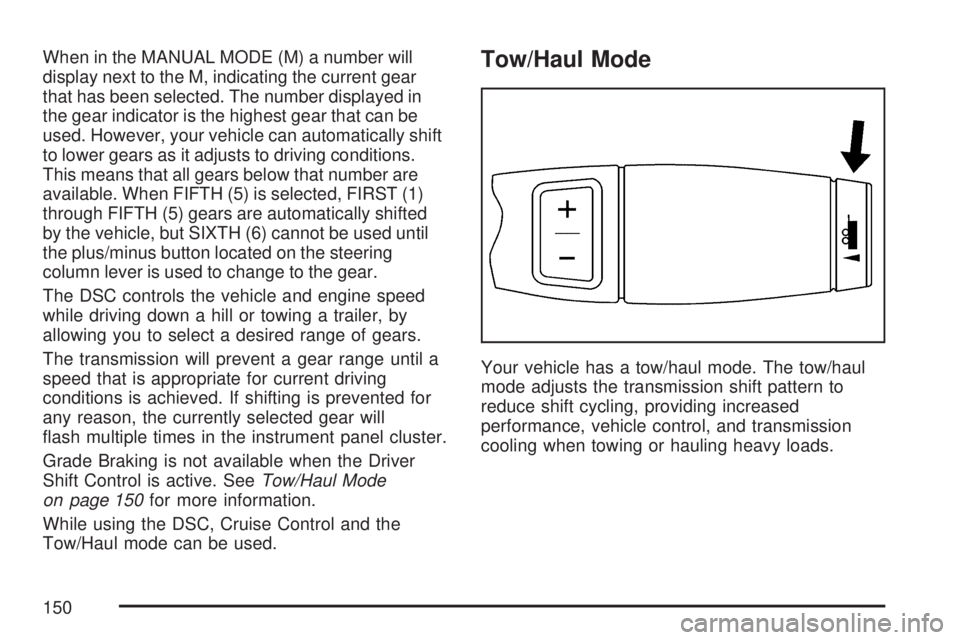
When in the MANUAL MODE (M) a number will
display next to the M, indicating the current gear
that has been selected. The number displayed in
the gear indicator is the highest gear that can be
used. However, your vehicle can automatically shift
to lower gears as it adjusts to driving conditions.
This means that all gears below that number are
available. When FIFTH (5) is selected, FIRST (1)
through FIFTH (5) gears are automatically shifted
by the vehicle, but SIXTH (6) cannot be used until
the plus/minus button located on the steering
column lever is used to change to the gear.
The DSC controls the vehicle and engine speed
while driving down a hill or towing a trailer, by
allowing you to select a desired range of gears.
The transmission will prevent a gear range until a
speed that is appropriate for current driving
conditions is achieved. If shifting is prevented for
any reason, the currently selected gear will
ash multiple times in the instrument panel cluster.
Grade Braking is not available when the Driver
Shift Control is active. SeeTow/Haul Mode
on page 150for more information.
While using the DSC, Cruise Control and the
Tow/Haul mode can be used.Tow/Haul Mode
Your vehicle has a tow/haul mode. The tow/haul
mode adjusts the transmission shift pattern to
reduce shift cycling, providing increased
performance, vehicle control, and transmission
cooling when towing or hauling heavy loads.
150
Page 151 of 608
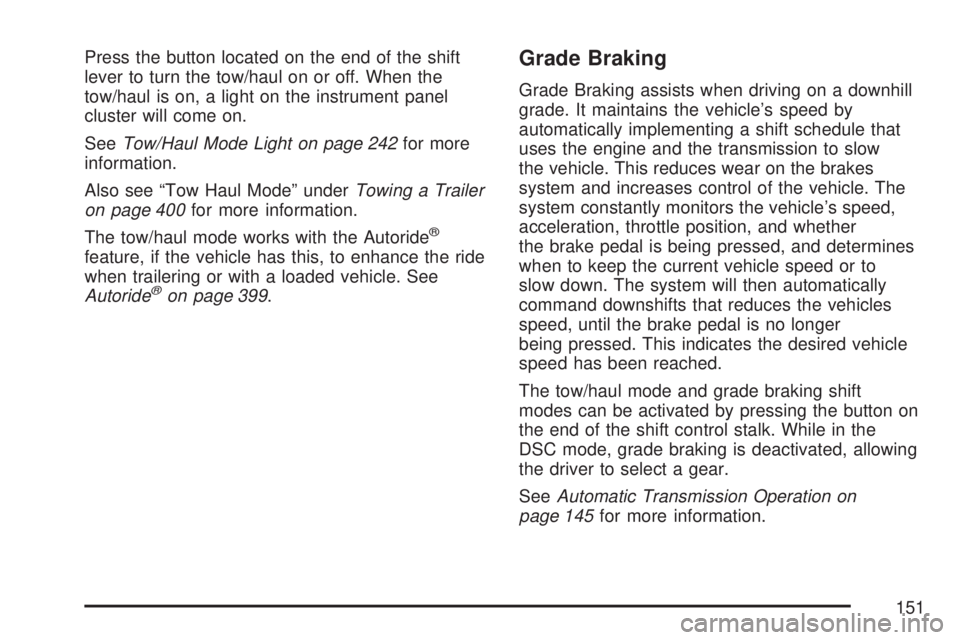
Press the button located on the end of the shift
lever to turn the tow/haul on or off. When the
tow/haul is on, a light on the instrument panel
cluster will come on.
SeeTow/Haul Mode Light on page 242for more
information.
Also see “Tow Haul Mode” underTowing a Trailer
on page 400for more information.
The tow/haul mode works with the Autoride
®
feature, if the vehicle has this, to enhance the ride
when trailering or with a loaded vehicle. See
Autoride
®on page 399.
Grade Braking
Grade Braking assists when driving on a downhill
grade. It maintains the vehicle’s speed by
automatically implementing a shift schedule that
uses the engine and the transmission to slow
the vehicle. This reduces wear on the brakes
system and increases control of the vehicle. The
system constantly monitors the vehicle’s speed,
acceleration, throttle position, and whether
the brake pedal is being pressed, and determines
when to keep the current vehicle speed or to
slow down. The system will then automatically
command downshifts that reduces the vehicles
speed, until the brake pedal is no longer
being pressed. This indicates the desired vehicle
speed has been reached.
The tow/haul mode and grade braking shift
modes can be activated by pressing the button on
the end of the shift control stalk. While in the
DSC mode, grade braking is deactivated, allowing
the driver to select a gear.
SeeAutomatic Transmission Operation on
page 145for more information.
151
Page 178 of 608
Storage Areas
Glove Box
Open the glove box by pulling the bottom of the
handle upward. Use key to lock.
Cupholder(s)
Your vehicle may have cupholders located in the
front and rear of the oor console or in the
fold down armrest. You may also have cupholders
in the second and third row seat armrest areas.
To use the front cupholder, press down on
the access door latch button and release. The
door will open. To close, push it back down.
The front cupholder liner can be removed for
cleaning by squeezing the top center of it
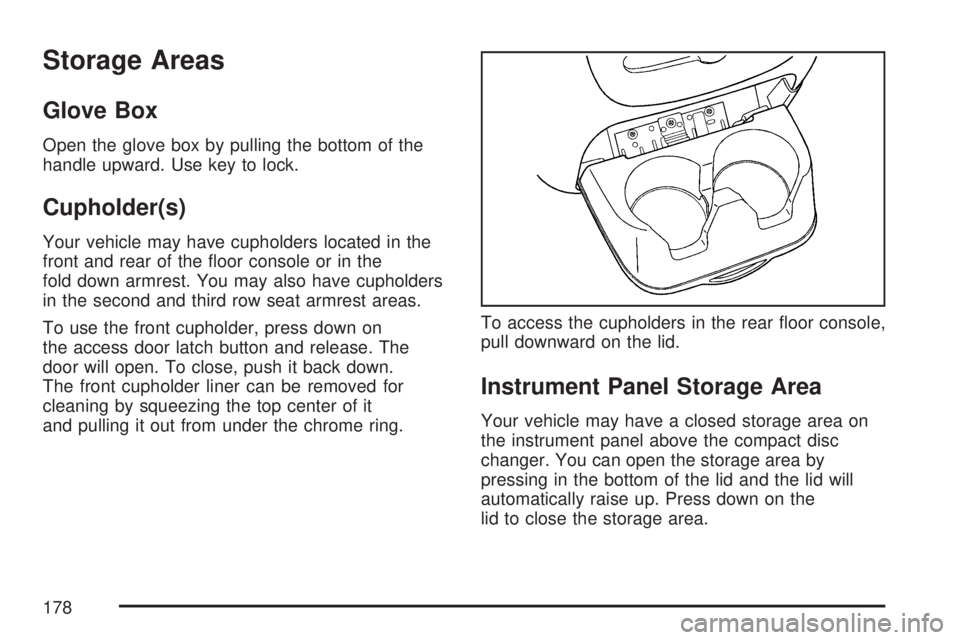
and pulling it out from under the chrome ring.To access the cupholders in the rear oor console,
pull downward on the lid.
Instrument Panel Storage Area
Your vehicle may have a closed storage area on
the instrument panel above the compact disc
changer. You can open the storage area by
pressing in the bottom of the lid and the lid will
automatically raise up. Press down on the
lid to close the storage area.
178
Page 187 of 608
Instrument Panel Overview........................ 190
Hazard Warning Flashers.......................... 192
Other Warning Devices............................. 192
Horn.......................................................... 192
Tilt Wheel.................................................. 193
Turn Signal/Multifunction Lever.................. 193
Turn and Lane-Change Signals................. 194
Headlamp High/Low-Beam Changer.......... 195
Flash-to-Pass............................................ 195
Windshield Wipers..................................... 196
Rainsense™ II Wipers............................... 197
Windshield Washer.................................... 198
Rear Window Wiper/Washer...................... 199
Cruise Control........................................... 200
Exterior Lamps.......................................... 203
Headlamps on Reminder........................... 205
Daytime Running Lamps (DRL)................. 205
Automatic Headlamp System..................... 205
Fog Lamps................................................ 206
Instrument Panel Brightness...................... 207
Dome Lamps............................................. 207
Dome Lamp Override................................ 207
Entry Lighting............................................ 207
Exit Lighting.............................................. 207Front Reading Lamps................................ 208
Battery Run-Down Protection..................... 208
Ultrasonic Rear Parking Assist (URPA)...... 208
Accessory Power Outlet(s)........................ 213
Ashtray(s) and Cigarette Lighter................ 214
Climate Controls......................................... 214
Dual Automatic Climate Control System....... 214
Outlet Adjustment...................................... 222
Rear Air Conditioning and Heating
System and Electronic Climate
Controls................................................. 223
Warning Lights, Gages, and Indicators..... 225
Instrument Panel Cluster........................... 226
Speedometer and Odometer...................... 227
Trip Odometer........................................... 227
Tachometer............................................... 227
Safety Belt Reminder Light........................ 228
Passenger Safety Belt Reminder Light....... 228
Airbag Readiness Light............................. 229
Passenger Airbag Status Indicator............. 230
Charging System Light.............................. 232
Voltmeter Gage......................................... 232
Brake System Warning Light..................... 233
Section 3 Instrument Panel
187