tow GMC YUKON DENALI 2007 User Guide
[x] Cancel search | Manufacturer: GMC, Model Year: 2007, Model line: YUKON DENALI, Model: GMC YUKON DENALI 2007Pages: 608, PDF Size: 2.92 MB
Page 62 of 608
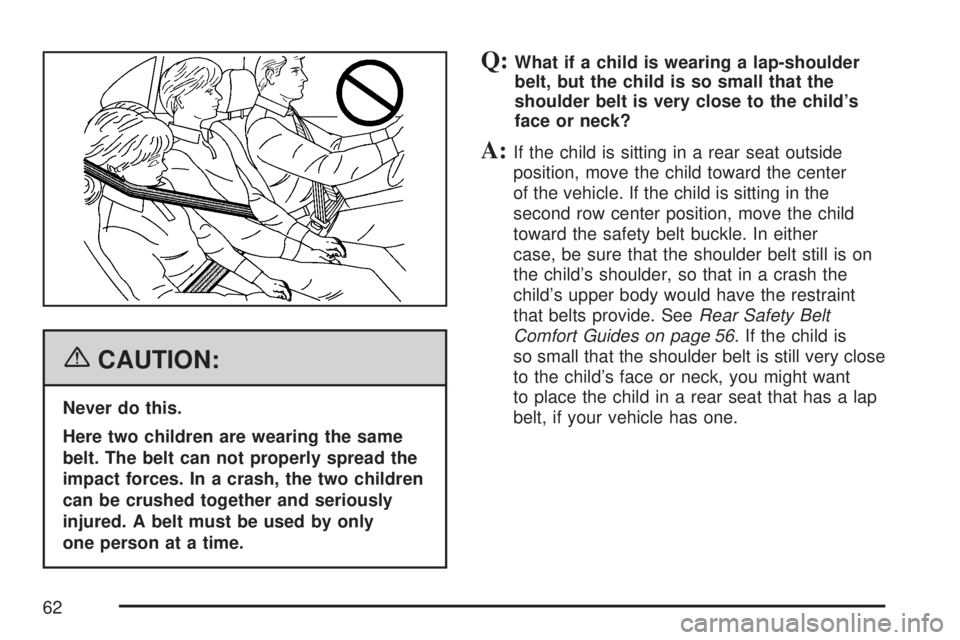
{CAUTION:
Never do this.
Here two children are wearing the same
belt. The belt can not properly spread the
impact forces. In a crash, the two children
can be crushed together and seriously
injured. A belt must be used by only
one person at a time.
Q:What if a child is wearing a lap-shoulder
belt, but the child is so small that the
shoulder belt is very close to the child’s
face or neck?
A:If the child is sitting in a rear seat outside
position, move the child toward the center
of the vehicle. If the child is sitting in the
second row center position, move the child
toward the safety belt buckle. In either
case, be sure that the shoulder belt still is on
the child’s shoulder, so that in a crash the
child’s upper body would have the restraint
that belts provide. SeeRear Safety Belt
Comfort Guides on page 56. If the child is
so small that the shoulder belt is still very close
to the child’s face or neck, you might want
to place the child in a rear seat that has a lap
belt, if your vehicle has one.
62
Page 68 of 608
{CAUTION:
The body structure of a young child is
quite unlike that of an adult or older child,
for whom the safety belts are designed. A
young child’s hip bones are still so small
that the vehicle’s regular safety belt may
not remain low on the hip bones, as it
should. Instead, it may settle up around
the child’s abdomen. In a crash, the belt
would apply force on a body area that is
unprotected by any bony structure. This
alone could cause serious or fatal injuries.
Young children always should be secured
in appropriate child restraints.
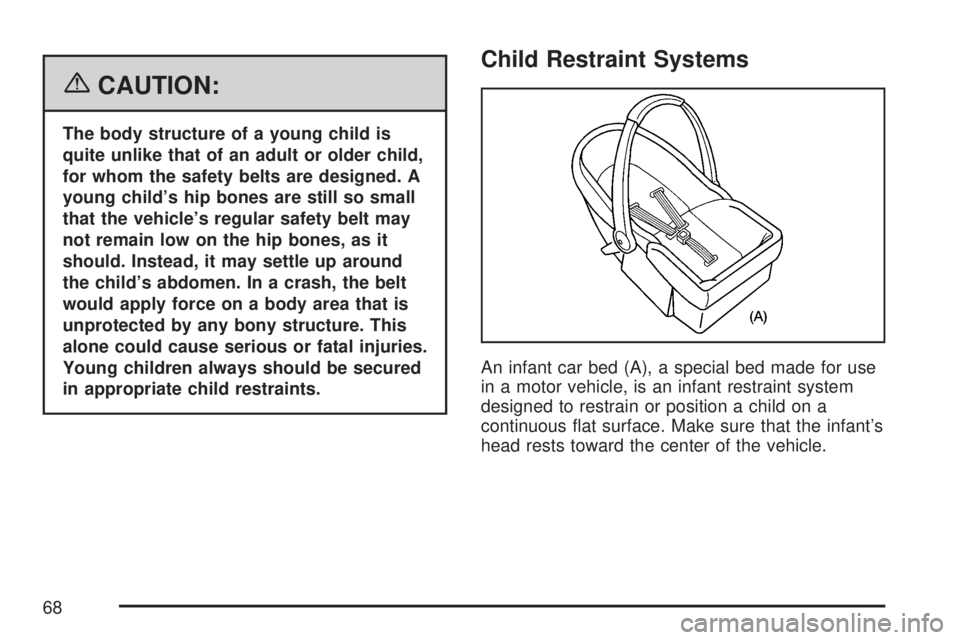
Child Restraint Systems
An infant car bed (A), a special bed made for use
in a motor vehicle, is an infant restraint system
designed to restrain or position a child on a
continuous at surface. Make sure that the infant’s
head rests toward the center of the vehicle.
68
Page 81 of 608
Folding an empty rear seat with the safety
belts secured, may cause damage to the safety
belt or the seat. When removing the child
restraint, always remember to return the safety
belts to their normal, stowed position before
folding the rear seat.
1. Attach and tighten the lower attachments to
the lower anchors. If the child restraint does
not have lower attachments or the desired
seating position does not have lower anchors,
secure the child restraint with the top tether
and the safety belts. Refer to your child
restraint manufacturer instructions and the
instructions in this manual.
1.1. Find the lower anchors for the desired
seating position.
1.2. Put the child restraint on the seat.
1.3. Attach and tighten the lower
attachments on the child restraint to the
lower anchors.2. If the child restraint manufacturer recommends
that the top tether be attached, attach and
tighten the top tether to the top tether anchor,
if the vehicle has one. Refer to the child
restraint instructions and the following steps:
2.1. Find the top tether anchor.
2.2. Route, attach and tighten the top tether
according to your child restraint
instructions and the following
instructions:
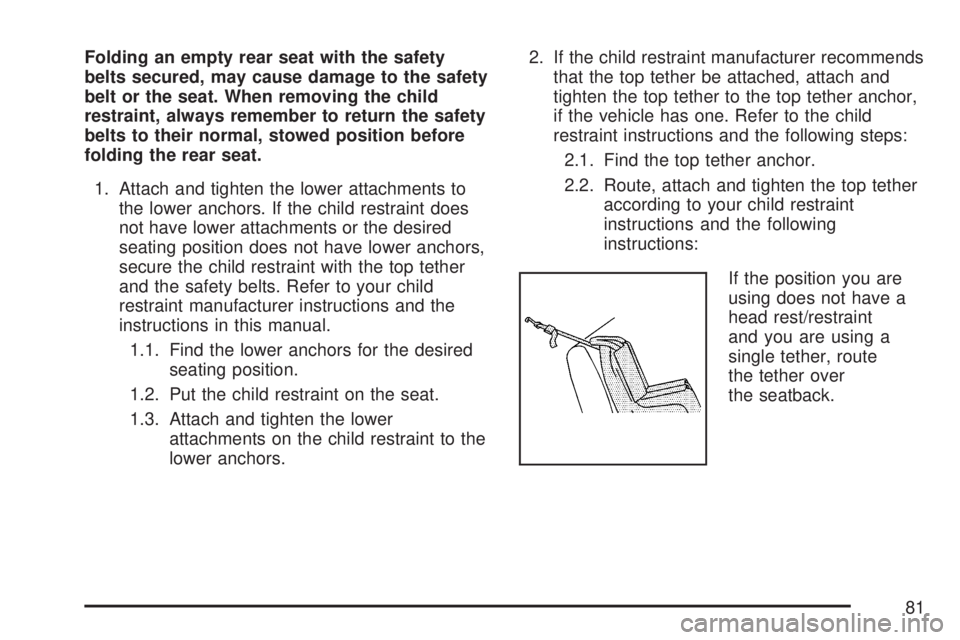
If the position you are
using does not have a
head rest/restraint
and you are using a
single tether, route
the tether over
the seatback.
81
Page 99 of 608
How Does an Airbag Restrain?
In moderate to severe frontal or near frontal
collisions, even belted occupants can contact
the steering wheel or the instrument panel.
In moderate to severe side collisions, even belted
occupants can contact the inside of the vehicle.
The airbag supplements the protection provided by
safety belts. Airbags distribute the force of the
impact more evenly over the occupant’s upper
body, stopping the occupant more gradually. But
the frontal airbags would not help you in many
types of collisions, including rollovers, rear
impacts, and many side impacts, primarily because
an occupant’s motion is not toward the airbag.Roof-mounted rollover airbags would not help
you in many types of collisions, including many
frontal or near frontal collisions, and rear impacts,
primarily because an occupant’s motion is not
toward the airbag. Airbags should never be
regarded as anything more than a supplement
to safety belts, and then only in moderate to
severe frontal or near-frontal collisions for the
driver’s and right front passenger’s frontal airbags,
and only in moderate to severe side collisions
for roof-mounted rollover airbags.
99
Page 105 of 608
{CAUTION:
If the airbag readiness light in the
instrument panel cluster ever comes on
and stays on, it means that something
may be wrong with the airbag system.
If this ever happens, have the vehicle
serviced promptly, because an adult-size
person sitting in the right front
passenger’s seat may not have the
protection of the frontal airbag. See
Airbag Readiness Light on page 229for
more on this, including important safety
information.Aftermarket equipment, such as seat covers, can
affect how well the passenger sensing system
operates. You may want to consider not using seat
covers or other aftermarket equipment if your
vehicle has the passenger sensing system. See
Adding Equipment to Your Airbag-Equipped
Vehicle on page 107for more information about
modications that can affect how the system
operates.
{CAUTION:
Stowing of articles under the passenger’s
seat or between the passenger’s seat
cushion and seatback may interfere with
the proper operation of the passenger
sensing system.
105
Page 111 of 608
Keys............................................................ 113
Remote Keyless Entry System.................. 114
Remote Keyless Entry System Operation ... 116
Doors and Locks........................................ 122
Door Locks................................................ 122
Power Door Locks..................................... 123
Delayed Locking........................................ 123
Programmable Automatic Door Locks........ 124
Rear Door Security Locks......................... 124
Lockout Protection..................................... 125
Liftgate/Liftglass......................................... 126
Power Liftgate........................................... 128
Power Running Boards.............................. 132
Windows...................................................... 132
Power Windows........................................ 133
Sun Visors................................................ 134
Theft-Deterrent Systems............................. 134
Content Theft-Deterrent............................. 135
PASS-Key
®III+......................................... 136
PASS-Key®III+ Operation......................... 137Starting and Operating Your Vehicle......... 139
New Vehicle Break-In................................ 139
Ignition Positions....................................... 140
Retained Accessory Power (RAP)............. 141
Starting the Engine.................................... 141
Adjustable Throttle and Brake Pedal.......... 143
Engine Coolant Heater.............................. 144
Automatic Transmission Operation............. 145
Tow/Haul Mode......................................... 150
Parking Brake........................................... 152
Shifting Into Park (P)................................. 153
Shifting Out of Park (P)............................. 154
Parking Over Things That Burn................. 155
Engine Exhaust......................................... 156
Running the Engine While Parked............. 157
Mirrors......................................................... 158
Automatic Dimming Rearview Mirror with
OnStar
®, Compass and Temperature
Display................................................... 158
Outside Power Foldaway Mirrors............... 161
Section 2 Features and Controls
111
Page 139 of 608
Starting and Operating Your
Vehicle
New Vehicle Break-In
Notice:Your vehicle does not need an
elaborate break-in. But it will perform better in
the long run if you follow these guidelines:
Keep your speed at 55 mph (88 km/h)
or less for the rst 500 miles (805 km).
Do not drive at any one constant speed,
fast or slow, for the rst 500 miles
(805 km). Do not make full-throttle starts.
Avoid downshifting to brake, or slow,
the vehicle.
Avoid making hard stops for the rst
200 miles (322 km) or so. During this
time your new brake linings are not yet
broken in. Hard stops with new linings
can mean premature wear and earlier
replacement. Follow this breaking-in
guideline every time you get new brake
linings.
Do not tow a trailer during break-in. See
Towing a Trailer on page 400for the
trailer towing capabilities of your vehicle
and more information.
Following break-in, engine speed and load can
be gradually increased.
139
Page 143 of 608
Adjustable Throttle and Brake Pedal
If your vehicle has this feature, you can change
the position of the throttle and brake pedals.
This feature is designed for shorter drivers, since
the pedals cannot move farther away from the
standard position, but can move toward the driver
for better pedal reach.
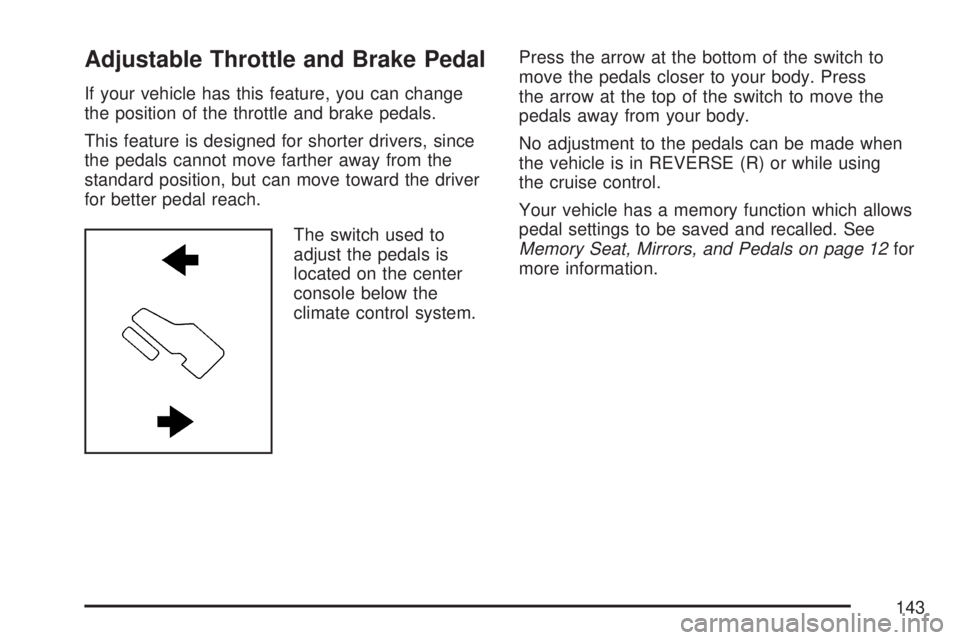
The switch used to
adjust the pedals is
located on the center
console below the
climate control system.Press the arrow at the bottom of the switch to
move the pedals closer to your body. Press
the arrow at the top of the switch to move the
pedals away from your body.
No adjustment to the pedals can be made when
the vehicle is in REVERSE (R) or while using
the cruise control.
Your vehicle has a memory function which allows
pedal settings to be saved and recalled. See
Memory Seat, Mirrors, and Pedals on page 12for
more information.
143
Page 146 of 608
PARK (P):This position locks your rear wheels. It
is the best position to use when you start your
engine because your vehicle cannot move easily.
When parked on a hill, especially when the
vehicle has a heavy load, you may notice an
increase in the effort to shift out of Park.
See Torque Lock (Automatic Transmission) under
Shifting Into Park (P) on page 153for more
information.
{CAUTION:
It is dangerous to get out of your vehicle
if the shift lever is not fully in PARK (P)
with the parking brake rmly set. Your
vehicle can roll.
Do not leave your vehicle when the engine
is running unless you have to. If you have
left the engine running, the vehicle can
move suddenly. You or others could be
injured. To be sure your vehicle will not
move, even when you are on fairly level
ground, always set your parking brake
and move the shift lever to PARK (P). See
Shifting Into Park (P) on page 153.Ifyou
are pulling a trailer, seeTowing a Trailer
on page 400.
146
Page 147 of 608
REVERSE (R):Use this gear to back up.
Notice:Shifting to REVERSE (R) while your
vehicle is moving forward could damage
the transmission. The repairs would not
be covered by your warranty. Shift to
REVERSE (R) only after your vehicle is
stopped.
To rock your vehicle back and forth to get out
of snow, ice, or sand without damaging your
transmission, seeIf Your Vehicle is Stuck in Sand,
Mud, Ice, or Snow on page 390.
NEUTRAL (N):In this position, your engine does
not connect with the wheels. To restart when
you are already moving, use NEUTRAL (N) only.
Also, use NEUTRAL (N) when your vehicle is
being towed.
{CAUTION:
Shifting into a drive gear while your
engine is running at high speed is
dangerous. Unless your foot is rmly on
the brake pedal, your vehicle could move
very rapidly. You could lose control and
hit people or objects. Do not shift into a
drive gear while your engine is running at
high speed.
Notice:Shifting out of PARK (P) or
NEUTRAL (N) with the engine running at high
speed may damage the transmission. The
repairs would not be covered by your warranty.
Be sure the engine is not running at high
speed when shifting your vehicle.
147