instrument cluster GMC YUKON DENALI 2007 Owner's Manual
[x] Cancel search | Manufacturer: GMC, Model Year: 2007, Model line: YUKON DENALI, Model: GMC YUKON DENALI 2007Pages: 608, PDF Size: 2.92 MB
Page 261 of 608
TRACTION CONTROL OFF
If your vehicle has StabiliTrak®, this message
will display when the traction control system
is turned off. Adjust your driving accordingly.
SeeStabiliTrak
®System on page 349for more
information.
TRANSMISSION HOT IDLE ENGINE
Notice:If you drive your vehicle while
the transmission uid is overheating and the
transmission temperature warning is displayed
on the instrument panel cluster and/or DIC,
you can damage the transmission. This could
lead to costly repairs that would not be
covered by your warranty. Do not drive your
vehicle with overheated transmission uid
or while the transmission temperature warning
is displayed.If the transmission uid in the vehicle gets hot,
this message will display along with a continuous
chime. Driving with the transmission uid
temperature high can cause damage to the
vehicle. Stop the vehicle and let it idle to allow the
transmission to cool. This message will clear
and the chime will stop when the uid temperature
reaches a safe level.TURN SIGNAL ON
If a turn signal is left on for 3/4 of a mile (1.2 km),
this message will display and a chime will
sound. Move the turn signal/multifunction lever to
the off position.
WASHER FLUID LOW ADD FLUID
If the washer uid level is low, this message will
display. Adding washer uid to the windshield
washer reservoir will clear the message. See
Windshield Washer Fluid on page 458.
This message will clear itself after 10 seconds,
until the next ignition cycle.
261
Page 350 of 608
If the system fails to turn on or activate, the
StabiliTrak®light along with one of the following
messages will be displayed on the Driver
Information Center (DIC): TRACTION CONTROL
OFF, SERVICE TRACTION CONTROL,
STABILITRAK OFF, SERVICE STABILITRAK. If
these DIC messages appear, make sure the
StabiliTrak
®system has not been turned off using
the StabiliTrak®on/off button. Then turn the
steering wheel clockwise from the nine o’clock
position to the three o’clock position. If this clears
the message(s), your vehicle does not need
servicing. If this does not clear the message(s),
then turn the vehicle off, wait 15 seconds, and then
turn it back on again to reset the system. If any
of these messages still appear on the Driver
Information Center (DIC), your vehicle should be
taken in for service. For more information on
the DIC messages, seeDriver Information Center
(DIC) on page 244.The StabiliTrak
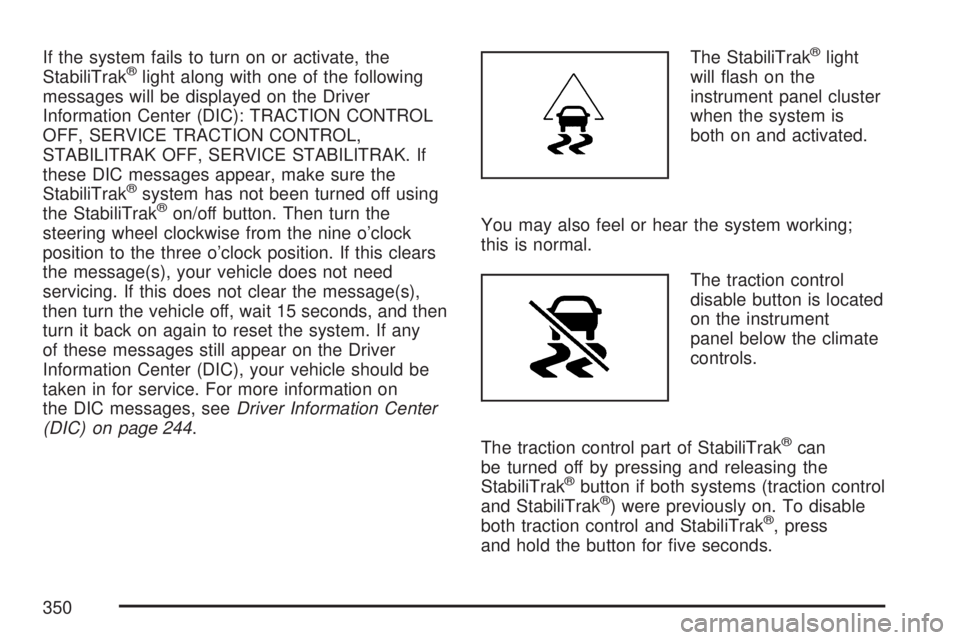
®light
will ash on the
instrument panel cluster
when the system is
both on and activated.
You may also feel or hear the system working;
this is normal.
The traction control
disable button is located
on the instrument
panel below the climate
controls.
The traction control part of StabiliTrak
®can
be turned off by pressing and releasing the
StabiliTrak
®button if both systems (traction control
and StabiliTrak®) were previously on. To disable
both traction control and StabiliTrak®, press
and hold the button for ve seconds.
350
Page 390 of 608
If Your Vehicle is Stuck in Sand,
Mud, Ice, or Snow
In order to free your vehicle when it is stuck, you
will need to spin the wheels, but you do not
want to spin your wheels too fast. The method
known as rocking can help you get out when you
are stuck, but you must use caution.
{CAUTION:
If you let your tires spin at high speed,
they can explode, and you or others could
be injured. And, the transmission or other
parts of the vehicle can overheat. That
could cause an engine compartment re
or other damage. When you are stuck,
spin the wheels as little as possible. Do
not spin the wheels above 35 mph
(55 km/h) as shown on the speedometer.Notice:Spinning your wheels can destroy
parts of your vehicle as well as the tires. If you
spin the wheels too fast while shifting your
transmission back and forth, you can destroy
your transmission.
For more information about using tire chains on
your vehicle, seeTire Chains on page 504.
Rocking Your Vehicle to Get It Out
First, turn your steering wheel left and right. That
will clear the area around your front wheels. If your
vehicle has the StabiliTrak
®System, turn the
system off by pressing the StabiliTrak®button so
that the STABILITY SYS DISABLED message
and the traction off light are illuminated on the
instrument panel cluster. Then shift back and forth
between REVERSE (R) and a forward gear,
spinning the wheels as little as possible. Release
the accelerator pedal while you shift, and press
lightly on the accelerator pedal when the
transmission is in gear.
390
Page 491 of 608
When a low tire pressure condition is detected,
the TPMS will illuminate the low tire pressure
warning symbol located on the instrument panel
cluster. If your vehicle has the DIC feature, a
message to check the pressure in a specic tire
will also appear on the DIC display. The low
tire pressure warning symbol on the instrument
panel cluster and the CHECK TIRE PRESSURE
warning message on the DIC display will appear at
each ignition cycle until the tires are inated to
the correct ination pressure. For additional
information and details about the DIC operation
and displays seeDIC Operation and Displays
(Using DIC Buttons) on page 245orDIC Operation
and Displays (Using Trip Odometer Reset Stem)
on page 250andDIC Warnings and Messages
on page 252.
You may notice, during cooler weather conditions,
that the tire pressure monitor light, located on
the instrument panel cluster, and the CHECK TIRE
PRESSURE message will appear when the
vehicle is rst started and then turn off as you
start to drive the vehicle. This could be an early
indicator that the tire pressures are getting low and
need to be inated to the proper pressure.Each tire, including the spare (if provided), should
be checked monthly when cold and inated to
the ination pressure recommended by the vehicle
manufacturer on the vehicle placard or tire
ination pressure label. (If your vehicle has tires of
a different size than the size indicated on the
vehicle placard or tire ination pressure label, you
should determine the proper tire ination
pressure for those tires.)
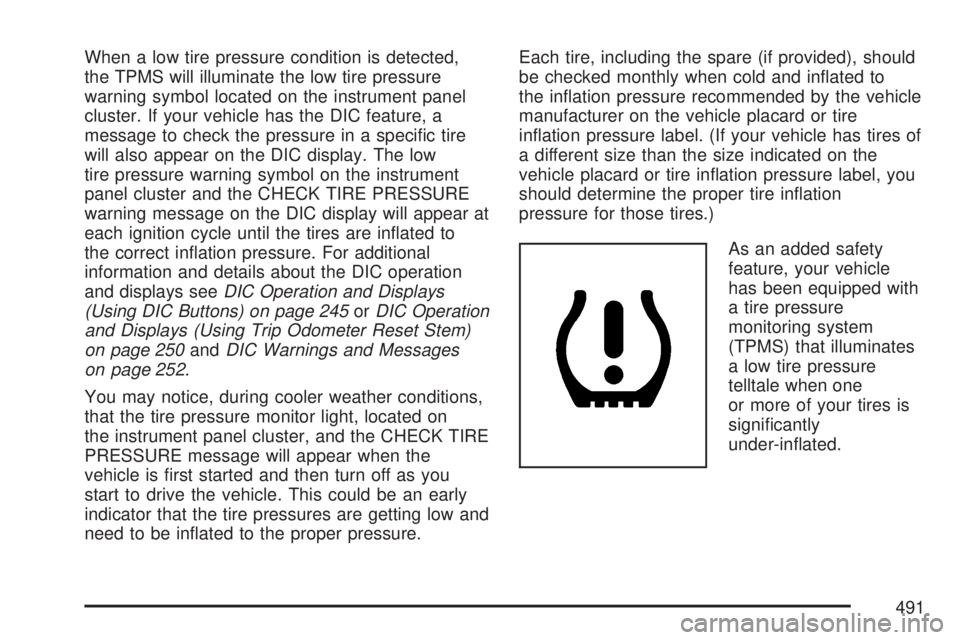
As an added safety
feature, your vehicle
has been equipped with
a tire pressure
monitoring system
(TPMS) that illuminates
a low tire pressure
telltale when one
or more of your tires is
signicantly
under-inated.
491
Page 544 of 608
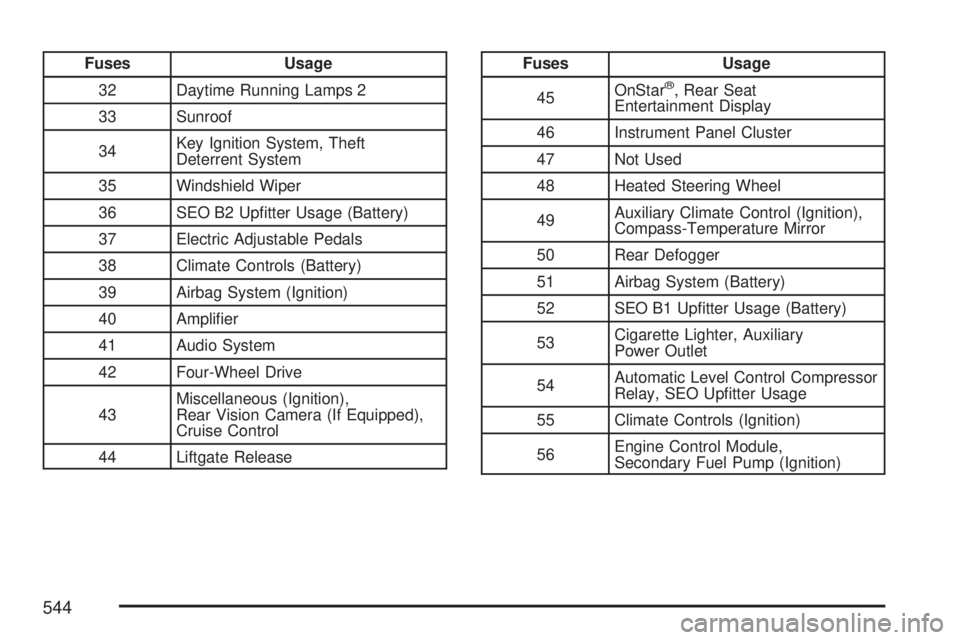
Fuses Usage
32 Daytime Running Lamps 2
33 Sunroof
34Key Ignition System, Theft
Deterrent System
35 Windshield Wiper
36 SEO B2 Uptter Usage (Battery)
37 Electric Adjustable Pedals
38 Climate Controls (Battery)
39 Airbag System (Ignition)
40 Amplier
41 Audio System
42 Four-Wheel Drive
43Miscellaneous (Ignition),
Rear Vision Camera (If Equipped),
Cruise Control
44 Liftgate ReleaseFuses Usage
45OnStar
®, Rear Seat
Entertainment Display
46 Instrument Panel Cluster
47 Not Used
48 Heated Steering Wheel
49Auxiliary Climate Control (Ignition),
Compass-Temperature Mirror
50 Rear Defogger
51 Airbag System (Battery)
52 SEO B1 Uptter Usage (Battery)
53Cigarette Lighter, Auxiliary
Power Outlet
54Automatic Level Control Compressor
Relay, SEO Uptter Usage
55 Climate Controls (Ignition)
56Engine Control Module,
Secondary Fuel Pump (Ignition)
544
Page 600 of 608
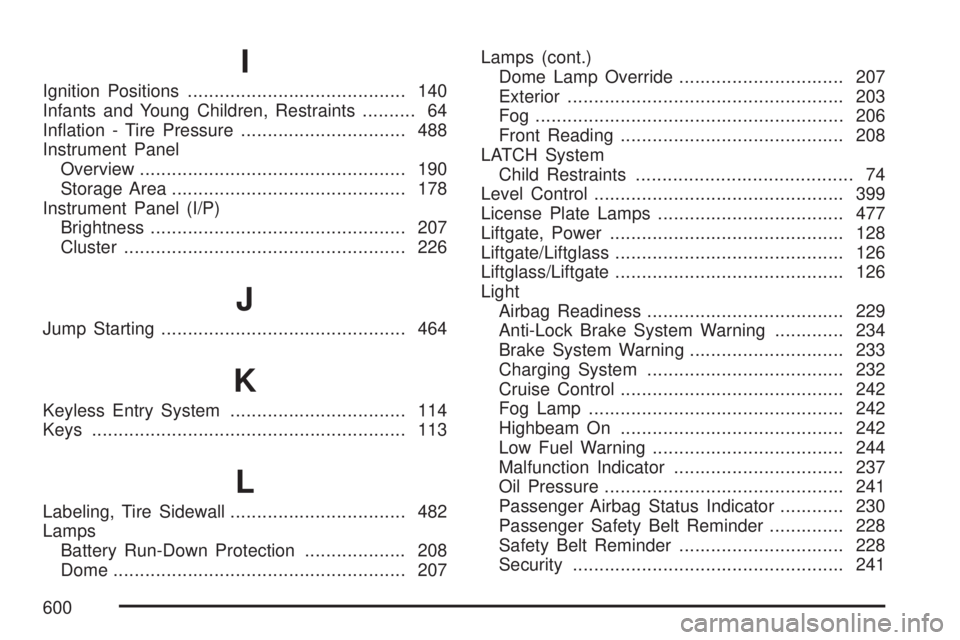
I
Ignition Positions......................................... 140
Infants and Young Children, Restraints.......... 64
Ination - Tire Pressure............................... 488
Instrument Panel
Overview.................................................. 190
Storage Area............................................ 178
Instrument Panel (I/P)
Brightness................................................ 207
Cluster..................................................... 226
J
Jump Starting.............................................. 464
K
Keyless Entry System................................. 114
Keys........................................................... 113
L
Labeling, Tire Sidewall................................. 482
Lamps
Battery Run-Down Protection................... 208
Dome....................................................... 207Lamps (cont.)
Dome Lamp Override............................... 207
Exterior.................................................... 203
Fog .......................................................... 206
Front Reading.......................................... 208
LATCH System
Child Restraints......................................... 74
Level Control............................................... 399
License Plate Lamps................................... 477
Liftgate, Power............................................ 128
Liftgate/Liftglass........................................... 126
Liftglass/Liftgate........................................... 126
Light
Airbag Readiness..................................... 229
Anti-Lock Brake System Warning............. 234
Brake System Warning............................. 233
Charging System..................................... 232
Cruise Control.......................................... 242
Fog Lamp................................................ 242
Highbeam On.......................................... 242
Low Fuel Warning.................................... 244
Malfunction Indicator................................ 237
Oil Pressure............................................. 241
Passenger Airbag Status Indicator............ 230
Passenger Safety Belt Reminder.............. 228
Safety Belt Reminder............................... 228
Security................................................... 241
600