steering wheel GMC YUKON DENALI 2007 Owner's Guide
[x] Cancel search | Manufacturer: GMC, Model Year: 2007, Model line: YUKON DENALI, Model: GMC YUKON DENALI 2007Pages: 608, PDF Size: 2.92 MB
Page 364 of 608
Scanning the Terrain
Off-road driving can take you over many different
kinds of terrain. You need to be familiar with
the terrain and its many different features. Here
are some things to consider.
Surface Conditions:Off-roading can take you
over hard-packed dirt, gravel, rocks, grass, sand,
mud, snow, or ice. Each of these surfaces
affects the steering, acceleration, and braking of
your vehicle in different ways. Depending upon the
kind of surface you are on, you may experience
slipping, sliding, wheel spinning, delayed
acceleration, poor traction, and longer braking
distances.Surface Obstacles:Unseen or hidden obstacles
can be hazardous. A rock, log, hole, rut, or
bump can startle you if you are not prepared for
them. Often these obstacles are hidden by
grass, bushes, snow, or even the rise and fall of
the terrain itself. Here are some things to consider:
Is the path ahead clear?
Will the surface texture change abruptly up
ahead?
Does the travel take you uphill or downhill?
There is more discussion of these subjects
later.
Will you have to stop suddenly or change
direction quickly?
When you drive over obstacles or rough terrain,
keep a rm grip on the steering wheel. Ruts,
troughs, or other surface features can jerk
the wheel out of your hands if you are not
prepared.
364
Page 366 of 608
Approaching a Hill
When you approach a hill, you need to decide if it is
one of those hills that is just too steep to climb,
descend, or cross. Steepness can be hard to judge.
On a very small hill, for example, there may be a
smooth, constant incline with only a small change in
elevation where you can easily see all the way to
the top. On a large hill, the incline may get steeper
as you near the top, but you may not see this
because the crest of the hill is hidden by bushes,
grass, or shrubs.
Here are some things to consider as you approach
a hill.
Is there a constant incline, or does the hill get
sharply steeper in places?
Is there good traction on the hillside, or will
the surface cause tire slipping?
Is there a straight path up or down the hill so
you will not have to make turning maneuvers?
Are there obstructions on the hill that can
block your path, such as boulders, trees, logs,
or ruts?
What is beyond the hill? Is there a cliff, an
embankment, a drop-off, a fence? Get out
and walk the hill if you do not know. It is the
smart way to nd out.
Is the hill simply too rough? Steep hills often
have ruts, gullies, troughs, and exposed
rocks because they are more susceptible to
the effects of erosion.
Driving Uphill
Once you decide you can safely drive up the hill,
you need to take some special steps.
Use a low gear and get a rm grip on the
steering wheel.
Get a smooth start up the hill and try to
maintain your speed. Do not use more power
than you need, because you do not want
the wheels to start spinning or sliding.
Try to drive straight up the hill if at all possible.
If the path twists and turns, you might want to
nd another route.
366
Page 368 of 608
As you are backing down the hill, put your left
hand on the steering wheel at the 12 o’clock
position. This way, you will be able to tell if the
wheels are straight and maneuver as you
back down. It is best that you back down the
hill with the wheels straight rather than in
the left or right direction. Turning the wheel
too far to the left or right will increase the
possibility of a rollover.
Here are some things youmust notdo if you stall,
or are about to stall, when going up a hill.
Never attempt to prevent a stall by shifting
into NEUTRAL (N) to rev-up the engine
and regain forward momentum. This will
not work. Your vehicle will roll backwards
very quickly and you could go out of control.
Instead, apply the regular brake to stop
the vehicle. Then apply the parking brake.
Shift to REVERSE (R), release the parking
brake, and slowly back straight down.
Never attempt to turn around if you are about
to stall when going up a hill. If the hill is steep
enough to stall your vehicle, it is steep
enough to cause you to roll over if you turn
around. If you cannot make it up the hill, you
must back straight down the hill.
Q:Suppose, after stalling, I try to back down
the hill and decide I just cannot do it. What
should I do?
A:Set the parking brake, put the transmission in
PARK (P) and turn off the engine. Leave the
vehicle and go get some help. Exit on the
uphill side and stay clear of the path the
vehicle would take if it rolled downhill.
Driving Downhill
When off-roading takes you downhill, you will want
to consider a number of things:
How steep is the downhill? Will I be able to
maintain vehicle control?
What is the surface like? Smooth? Rough?
Slippery? Hard-packed dirt? Gravel?
Are there hidden surface obstacles? Ruts?
Logs? Boulders?
What is at the bottom of the hill? Is there a
hidden creek bank or even a river bottom
with large rocks?
368
Page 373 of 608
When you drive on sand, you will sense a change
in wheel traction. But it will depend upon how
loosely packed the sand is. On loosely packed
sand, such as on beaches or sand dunes, the tires
will tend to sink into the sand. This has an effect
on steering, accelerating, and braking. Drive
at a reduced speed and avoid sharp turns
or abrupt maneuvers.
Hard packed snow and ice offer the worst tire
traction. On these surfaces, it is very easy to lose
control. On wet ice, for example, the traction is so
poor that you will have difficulty accelerating. And if
you do get moving, poor steering and difficult
braking can cause you to slide out of control.
{CAUTION:
Driving on frozen lakes, ponds, or rivers
can be dangerous. Underwater springs,
currents under the ice, or sudden thaws
can weaken the ice. Your vehicle could
fall through the ice and you and your
passengers could drown. Drive your
vehicle on safe surfaces only.
373
Page 375 of 608
After Off-Road Driving
Remove any brush or debris that has collected on
the underbody, chassis, or under the hood.
These accumulations can be a re hazard.
After operation in mud or sand, have the brake
linings cleaned and checked. These substances
can cause glazing and uneven braking. Check the
body structure, steering, suspension, wheels,
tires, and exhaust system for damage. Also, check
the fuel lines and cooling system for any leakage.
Your vehicle will require more frequent service
due to off-road use. Refer to the Maintenance
Schedule for additional information.
Driving at Night
Night driving is more dangerous than day driving.
One reason is that some drivers are likely to
be impaired — by alcohol or drugs, with night
vision problems, or by fatigue.
Here are some tips on night driving.
Drive defensively.
Do not drink and drive.
Adjust the inside rearview mirror to reduce the
glare from headlamps behind you.
Since you cannot see as well, you may need
to slow down and keep more space between
you and other vehicles.
Slow down, especially on higher speed roads.
Your vehicle’s headlamps can light up only so
much road ahead.
In remote areas, watch for animals.
If you are tired, pull off the road in a safe
place and rest.
No one can see as well at night as in the daytime.
But as we get older these differences increase.
A 50-year-old driver may require at least twice as
much light to see the same thing at night as a
20-year-old.
What you do in the daytime can also affect your
night vision. For example, if you spend the
day in bright sunshine you are wise to wear
sunglasses. Your eyes will have less trouble
adjusting to night. But if you are driving, do not
wear sunglasses at night. They may cut down on
glare from headlamps, but they also make a
lot of things invisible.
375
Page 387 of 608
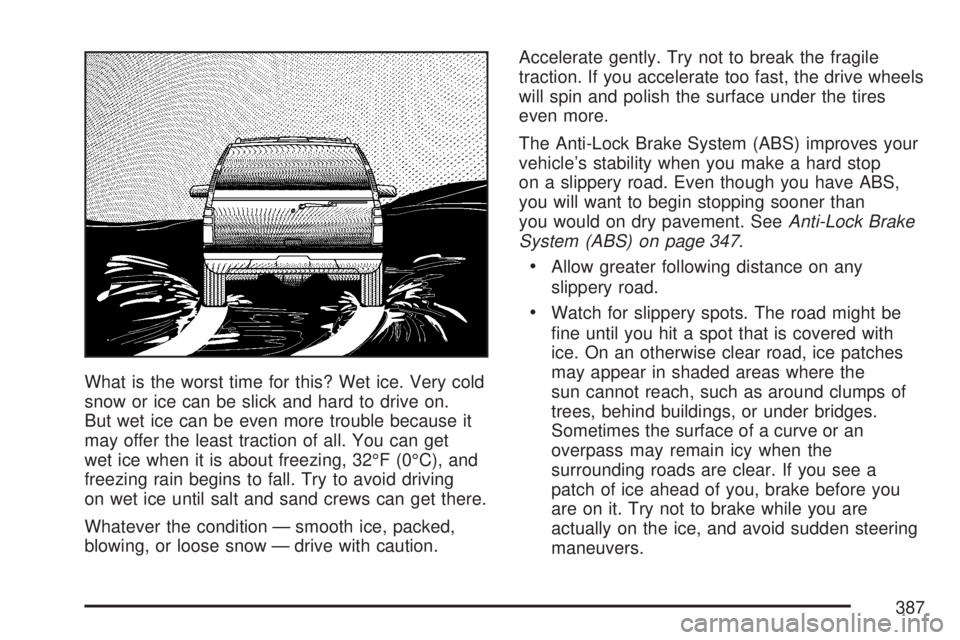
What is the worst time for this? Wet ice. Very cold
snow or ice can be slick and hard to drive on.
But wet ice can be even more trouble because it
may offer the least traction of all. You can get
wet ice when it is about freezing, 32°F (0°C), and
freezing rain begins to fall. Try to avoid driving
on wet ice until salt and sand crews can get there.
Whatever the condition — smooth ice, packed,
blowing, or loose snow — drive with caution.Accelerate gently. Try not to break the fragile
traction. If you accelerate too fast, the drive wheels
will spin and polish the surface under the tires
even more.
The Anti-Lock Brake System (ABS) improves your
vehicle’s stability when you make a hard stop
on a slippery road. Even though you have ABS,
you will want to begin stopping sooner than
you would on dry pavement. SeeAnti-Lock Brake
System (ABS) on page 347.
Allow greater following distance on any
slippery road.
Watch for slippery spots. The road might be
ne until you hit a spot that is covered with
ice. On an otherwise clear road, ice patches
may appear in shaded areas where the
sun cannot reach, such as around clumps of
trees, behind buildings, or under bridges.
Sometimes the surface of a curve or an
overpass may remain icy when the
surrounding roads are clear. If you see a
patch of ice ahead of you, brake before you
are on it. Try not to brake while you are
actually on the ice, and avoid sudden steering
maneuvers.
387
Page 390 of 608
If Your Vehicle is Stuck in Sand,
Mud, Ice, or Snow
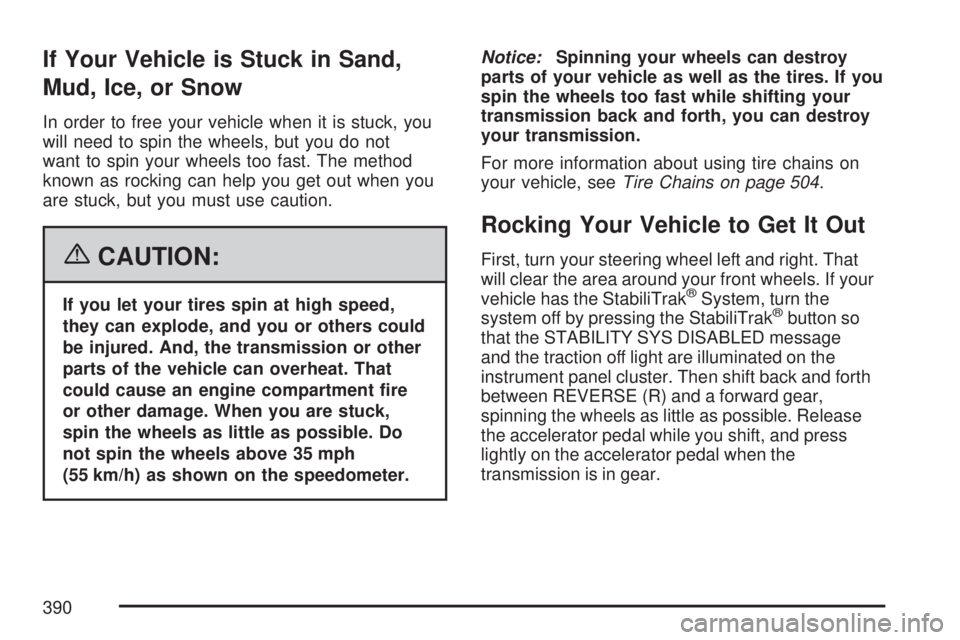
In order to free your vehicle when it is stuck, you
will need to spin the wheels, but you do not
want to spin your wheels too fast. The method
known as rocking can help you get out when you
are stuck, but you must use caution.
{CAUTION:
If you let your tires spin at high speed,
they can explode, and you or others could
be injured. And, the transmission or other
parts of the vehicle can overheat. That
could cause an engine compartment re
or other damage. When you are stuck,
spin the wheels as little as possible. Do
not spin the wheels above 35 mph
(55 km/h) as shown on the speedometer.Notice:Spinning your wheels can destroy
parts of your vehicle as well as the tires. If you
spin the wheels too fast while shifting your
transmission back and forth, you can destroy
your transmission.
For more information about using tire chains on
your vehicle, seeTire Chains on page 504.
Rocking Your Vehicle to Get It Out
First, turn your steering wheel left and right. That
will clear the area around your front wheels. If your
vehicle has the StabiliTrak
®System, turn the
system off by pressing the StabiliTrak®button so
that the STABILITY SYS DISABLED message
and the traction off light are illuminated on the
instrument panel cluster. Then shift back and forth
between REVERSE (R) and a forward gear,
spinning the wheels as little as possible. Release
the accelerator pedal while you shift, and press
lightly on the accelerator pedal when the
transmission is in gear.
390
Page 399 of 608
Level Control
Automatic Level Control
The automatic level control rear suspension is
available on light-duty vehicles and comes
as a part of the Autoride
®suspension, if equipped.
This type of level control is fully automatic and
will provide a better leveled riding position as well
as better handling under a variety of passenger
and loading conditions. An air compressor
connected to the rear shocks will raise or lower
the rear of the vehicle to maintain proper vehicle
height. The system is activated when the
ignition key is turned to RUN and will automatically
adjust vehicle height thereafter. The system
may exhaust (lower vehicle height) for up to
ten minutes after the ignition key has been turned
off. You may hear the air compressor operating
when the height is being adjusted.
If a weight-distributing hitch is being used, it is
recommended to allow the shocks to inate,
thereby leveling the vehicle prior to adjusting the
hitch.
Autoride®
The Autoride®feature provides improved vehicle
ride and handling under a variety of passenger and
loading conditions.
The system is fully automatic and uses a computer
controller to continuously monitor vehicle speed,
wheel to body position, lift/dive and steering
position of the vehicle. The controller then sends
signals to each shock absorber to independently
adjust the damping level to provide the optimum
vehicle ride.
Autoride
®also interacts with the tow/haul mode
that, when activated, will provide additional control
of the shock absorbers. This additional control
results in better ride and handling characteristics
when the vehicle is loaded or towing a trailer. See
“Tow/Haul Mode” underTowing a Trailer on
page 400for more information.
399
Page 410 of 608
Before you start, check all trailer hitch parts and
attachments, safety chains, electrical connector,
lamps, tires and mirror adjustment. If the trailer
has electric brakes, start your vehicle and
trailer moving and then apply the trailer brake
controller by hand to be sure the brakes are
working. This lets you check your electrical
connection at the same time.
During your trip, check occasionally to be sure
that the load is secure, and that the lamps and any
trailer brakes are still working.
Following Distance
Stay at least twice as far behind the vehicle ahead
as you would when driving your vehicle without
a trailer. This can help you avoid situations
that require heavy braking and sudden turns.
Passing
You’ll need more passing distance up ahead when
you’re towing a trailer. And, because you’re a
good deal longer, you’ll need to go much farther
beyond the passed vehicle before you can
return to your lane.
Backing Up
Hold the bottom of the steering wheel with
one hand. Then, to move the trailer to the left, just
move that hand to the left. To move the trailer
to the right, move your hand to the right. Always
back up slowly and, if possible, have someone
guide you.
Making Turns
Notice:Making very sharp turns while
trailering could cause the trailer to come in
contact with the vehicle. Your vehicle could
be damaged. Avoid making very sharp
turns while trailering.
When you’re turning with a trailer, make wider
turns than normal. Do this so your trailer
won’t strike soft shoulders, curbs, road signs,
trees or other objects. Avoid jerky or sudden
maneuvers. Signal well in advance.
410
Page 417 of 608
Service........................................................ 420
Accessories and Modications................... 421
California Proposition 65 Warning.............. 421
Doing Your Own Service Work.................. 422
Adding Equipment to the Outside
of Your Vehicle...................................... 423
Fuel............................................................. 423
Gasoline Octane........................................ 423
Gasoline Specications.............................. 424
California Fuel........................................... 424
Additives................................................... 424
Fuels in Foreign Countries........................ 425
Filling the Tank......................................... 426
Filling a Portable Fuel Container............... 428
Checking Things Under the Hood.............. 428
Hood Release........................................... 429
Engine Compartment Overview.................. 430
Engine Oil................................................. 432
Engine Oil Life System.............................. 435Engine Air Cleaner/Filter............................ 437
Automatic Transmission Fluid.................... 440
Engine Coolant.......................................... 445
Coolant Surge Tank Pressure Cap............ 448
Engine Overheating................................... 448
Overheated Engine Protection
Operating Mode..................................... 450
Cooling System......................................... 451
Engine Fan Noise..................................... 456
Power Steering Fluid................................. 457
Windshield Washer Fluid........................... 458
Brakes...................................................... 459
Battery...................................................... 463
Jump Starting............................................ 464
All-Wheel Drive........................................... 469
Rear Axle.................................................... 470
Front Axle................................................... 471
Headlamp Aiming........................................ 473
Section 5 Service and Appearance Care
417