radio GMC YUKON DENALI 2008 Workshop Manual
[x] Cancel search | Manufacturer: GMC, Model Year: 2008, Model line: YUKON DENALI, Model: GMC YUKON DENALI 2008Pages: 502, PDF Size: 6.18 MB
Page 379 of 502
Notice:If you leave your radio or other accessories
on during the jump starting procedure, they could
be damaged. The repairs would not be covered by
your warranty. Always turn off your radio and other
accessories when jump starting your vehicle.
3. Turn off the ignition on both vehicles. Unplug
unnecessary accessories plugged into the cigarette
lighter or the accessory power outlets. Turn off the
radio and all the lamps that are not needed. This
avoids sparks and helps save both batteries. And it
could save the radio!
4. Open the hood on the other vehicle and locate the
positive (+) and negative (−) terminal locations on
that vehicle.
Your vehicle has a remote positive (+) jump starting
terminal and a remote negative (−) jump starting
terminal. You should always use these remote
terminals instead of the terminals on the battery.
If the vehicle has a remote positive (+) terminal, it is
located under a red plastic cover at the positive
battery post. To uncover the remote positive (+)
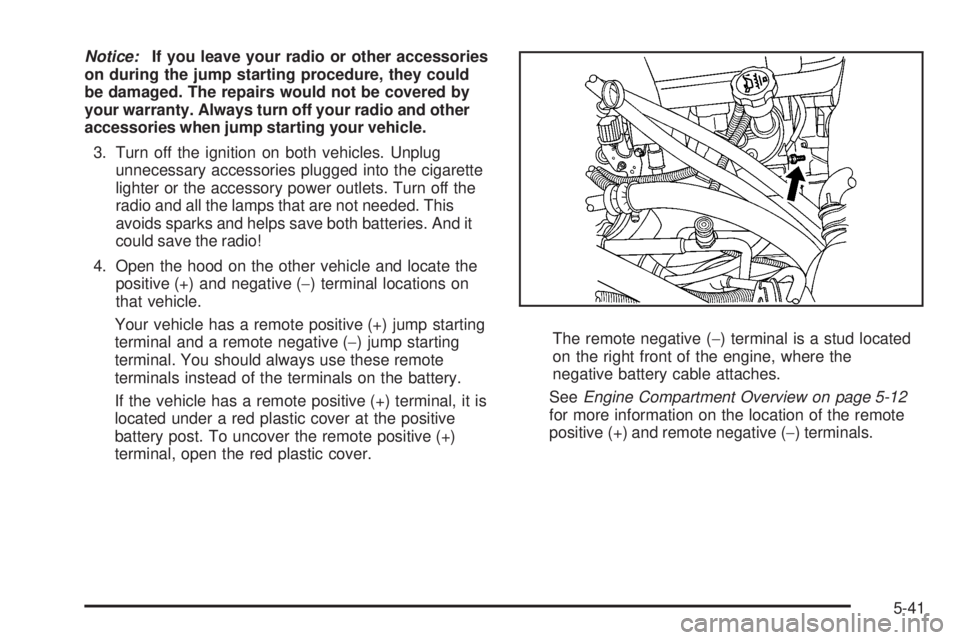
terminal, open the red plastic cover.The remote negative (−) terminal is a stud located
on the right front of the engine, where the
negative battery cable attaches.
SeeEngine Compartment Overview on page 5-12
for more information on the location of the remote
positive (+) and remote negative (−) terminals.
5-41
Page 400 of 502
High-Speed Operation
{CAUTION:
Driving at high speeds, 100 mph (160 km/h) or
higher, puts an additional strain on tires.
Sustained high-speed driving causes excessive
heat build up and can cause sudden tire failure.
You could have a crash and you or others could
be killed. Some high-speed rated tires require
ination pressure adjustment for high speed
operation. When speed limits and road
conditions are such that a vehicle can be driven
at high speeds, make sure the tires are rated for
high speed operation, in excellent condition,
and set to the correct cold tire ination pressure
for the vehicle load.
If your vehicle has P265/65R18 or P275/55R20 size
tires and you will be driving at high speeds, speeds of
100 mph (160 km/h) or higher, set the cold ination
pressure to 3 psi (20 kPa) above the recommended tire
pressure shown on the Tire and Loading Information
Label. When you end this high-speed driving, return the
tires to the cold ination pressure shown on the Tireand Loading Information label. SeeLoading Your
Vehicle on page 4-34andInflation - Tire Pressure
on page 5-60.
Tire Pressure Monitor System
The Tire Pressure Monitor System (TPMS) uses radio
and sensor technology to check tire pressure levels.
The TPMS sensors monitor the air pressure in your
vehicle’s tires and transmit tire pressure readings to a
receiver located in the vehicle.
Each tire, including the spare (if provided), should be
checked monthly when cold and inated to the ination
pressure recommended by the vehicle manufacturer
on the vehicle placard or tire ination pressure label.
(If your vehicle has tires of a different size than the size
indicated on the vehicle placard or tire ination
pressure label, you should determine the proper tire
ination pressure for those tires.)
As an added safety feature, your vehicle has been
equipped with a tire pressure monitoring system (TPMS)
that illuminates a low tire pressure telltale when one
or more of your tires is signicantly under-inated.
Accordingly, when the low tire pressure telltale
illuminates, you should stop and check your tires as
soon as possible, and inate them to the proper
pressure. Driving on a signicantly under-inated tire
causes the tire to overheat and can lead to tire failure.
5-62
Page 401 of 502
Under-ination also reduces fuel efficiency and tire tread
life, and may affect the vehicle’s handling and stopping
ability.
Please note that the TPMS is not a substitute for proper
tire maintenance, and it is the driver’s responsibility to
maintain correct tire pressure, even if under-ination has
not reached the level to trigger illumination of the TPMS
low tire pressure telltale.
Your vehicle has also been equipped with a TPMS
malfunction indicator to indicate when the system is not
operating properly. The TPMS malfunction indicator
is combined with the low tire pressure telltale. When the
system detects a malfunction, the telltale will ash
for approximately one minute and then remain
continuously illuminated. This sequence will continue
upon subsequent vehicle start-ups as long as the
malfunction exists.
When the malfunction indicator is illuminated, the
system may not be able to detect or signal low tire
pressure as intended. TPMS malfunctions may occur for
a variety of reasons, including the installation of
replacement or alternate tires or wheels on the vehicle
that prevent the TPMS from functioning properly.
Always check the TPMS malfunction telltale after
replacing one or more tires or wheels on your vehicle to
ensure that the replacement or alternate tires and
wheels allow the TPMS to continue to function properly.
SeeTire Pressure Monitor Operation on page 5-64, for
additional information.Federal Communications Commission
(FCC) and Industry and Science
Canada
The Tire Pressure Monitor System (TPMS) operates on
a radio frequency and complies with Part 15 of the
FCC Rules. Operation is subject to the following
two conditions:
1. This device may not cause harmful interference.
2. This device must accept any interference received,
including interference that may cause undesired
operation.
The Tire Pressure Monitor System (TPMS) operates on
a radio frequency and complies with RSS-210 of
Industry and Science Canada. Operation is subject to
the following two conditions:
1. This device may not cause interference.
2. This device must accept any interference received,
including interference that may cause undesired
operation of the device.
Changes or modications to this system by other than
an authorized service facility could void authorization to
use this equipment.
5-63
Page 403 of 502
TPMS Malfunction Light and Message
The TPMS will not function properly if one or more of the
TPMS sensors are missing or inoperable. When the
system detects a malfunction, the low tire warning light
ashes for about one minute and then stays on for the
remainder of the ignition cycle. A DIC warning message
is also displayed. The low tire warning light and DIC
warning message come on at each ignition cycle until the
problem is corrected. Some of the conditions that can
cause the malfunction light and DIC message to
come on are:
One of the road tires has been replaced with the
spare tire. The spare tire does not have a TPMS
sensor. The TPMS malfunction light and DIC
message should go off once you re-install the road
tire containing the TPMS sensor.
The TPMS sensor matching process was started but
not completed or not completed successfully after
rotating the vehicle’s tires. The DIC message and
TPMS malfunction light should go off once the TPMS
sensor matching process is performed successfully.
See “TPMS Sensor Matching Process” later in
this section.
One or more TPMS sensors are missing or
damaged. The DIC message and the TPMS
malfunction light should go off when the TPMS
sensors are installed and the sensor matching
process is performed successfully. See your
dealer/retailer for service.
Replacement tires or wheels do not match your
vehicle’s original equipment tires or wheels. Tires
and wheels other than those recommended for your
vehicle could prevent the TPMS from functioning
properly. SeeBuying New Tires on page 5-70.
Operating electronic devices or being near facilities
using radio wave frequencies similar to the TPMS
could cause the TPMS sensors to malfunction.
If the TPMS is not functioning it cannot detect or signal
a low tire condition. See your dealer/retailer for service if
the TPMS malfunction light and DIC message comes on
and stays on.
5-65
Page 446 of 502
Electrical System
Add-On Electrical Equipment
Notice:Do not add anything electrical to your
vehicle unless you check with your dealer/retailer
rst. Some electrical equipment can damage your
vehicle and the damage would not be covered by
your warranty. Some add-on electrical equipment can
keep other components from working as they should.
Add-on equipment can drain your vehicle’s battery, even
if your vehicle is not operating.
Your vehicle has an airbag system. Before attempting to
add anything electrical to your vehicle, seeServicing
Your Airbag-Equipped Vehicle on page 1-90.
Windshield Wiper Fuses
The windshield wiper motor is protected by an internal
circuit breaker and a fuse. If the motor overheats due to
heavy snow, etc., the wiper will stop until the motor
cools. If the overload is caused by some electrical
problem and not snow, etc., be sure to get it xed.
Power Windows and Other Power
Options
Circuit breakers protect the power windows and other
power accessories. If the current load is too heavy,
the circuit breaker opens and then closes after a cool
down period, protecting the circuit until the problem
is xed or goes away.
Fuses and Circuit Breakers
The wiring circuits in your vehicle are protected from
short circuits by a combination of fuses, circuit breakers
and fusible thermal links. This greatly reduces the
chance of res caused by electrical problems.
Look at the silver-colored band inside the fuse. If the
band is broken or melted, replace the fuse. Be sure you
replace a bad fuse with a new one of the identical
size and rating.
If you ever have a problem on the road and don’t have
a spare fuse, you can borrow one that has the same
amperage. Just pick some feature of your vehicle that
you can get along without – like the radio or cigarette
lighter – and use its fuse, if it is the correct amperage.
Replace it as soon as you can.
5-108
Page 471 of 502
Customer Assistance and Information...............7-2
Customer Satisfaction Procedure......................7-2
Online Owner Center......................................7-4
Customer Assistance for Text Telephone
(TTY) Users...............................................7-5
Customer Assistance Offices............................7-5
GM Mobility Reimbursement Program................7-6
Roadside Assistance Program..........................7-6
Scheduling Service Appointments.....................7-8
Courtesy Transportation...................................7-9
Collision Damage Repair................................7-10Reporting Safety Defects................................7-13
Reporting Safety Defects to the United
States Government....................................7-13
Reporting Safety Defects to the Canadian
Government..............................................7-14
Reporting Safety Defects to General Motors.....7-14
Service Publications Ordering Information.........7-14
Vehicle Data Recording and Privacy................7-15
Event Data Recorders...................................7-16
OnStar
®......................................................7-17
Navigation System........................................7-17
Radio Frequency Identication (RFID)..............7-17
Section 7 Customer Assistance Information
7-1
Page 485 of 502
Current and Past Model Order Forms
Technical Service Bulletins and Manuals are available
for current and past model GM vehicles. To request
an order form, specify year and model name of
the vehicle.
ORDER TOLL FREE: 1-800-551-4123
Monday-Friday 8:00 AM - 6:00 PM
Eastern Time
For Credit Card Orders Only
(VISA-MasterCard-Discover), visit Helm, Inc. on the
World Wide Web at: www.helminc.com
Or you can write to:
Helm, Incorporated
P.O. Box 07130
Detroit, MI 48207
Prices are subject to change without notice and without
incurring obligation. Allow ample time for delivery.
Note to Canadian Customers: All listed prices are
quoted in U.S. funds. Canadian residents are to make
checks payable in U.S. funds.
Vehicle Data Recording and
Privacy
Your GM vehicle has a number of sophisticated
computers that record information about the vehicle’s
performance and how it is driven. For example,
your vehicle uses computer modules to monitor and
control engine and transmission performance, to monitor
the conditions for airbag deployment and deploy
airbags in a crash and, if so equipped, to provide
antilock braking to help the driver control the vehicle.
These modules may store data to help your
dealer/retailer technician service your vehicle. Some
modules may also store data about how you operate the
vehicle, such as rate of fuel consumption or average
speed. These modules may also retain the owner’s
personal preferences, such as radio pre-sets, seat
positions, and temperature settings.
7-15
Page 487 of 502
OnStar®
If your vehicle has OnStar and you subscribe to the
OnStar services, please refer to the OnStar Terms and
Conditions for information on data collection and use.
See alsoOnStar
®System on page 2-47in this manual for
more information.
Navigation System
If your vehicle has a navigation system, use of the
system may result in the storage of destinations,
addresses, telephone numbers, and other trip
information. Refer to the navigation system operating
manual for information on stored data and for deletion
instructions.
Radio Frequency
Identication (RFID)
RFID technology is used in some vehicles for functions
such as tire pressure monitoring and ignition system
security, as well as in connection with conveniences
such as key fobs for remote door locking/unlocking and
starting, and in-vehicle transmitters for garage door
openers. RFID technology in GM vehicles does not use
or record personal information or link with any other
GM system containing personal information.
7-17
Page 489 of 502
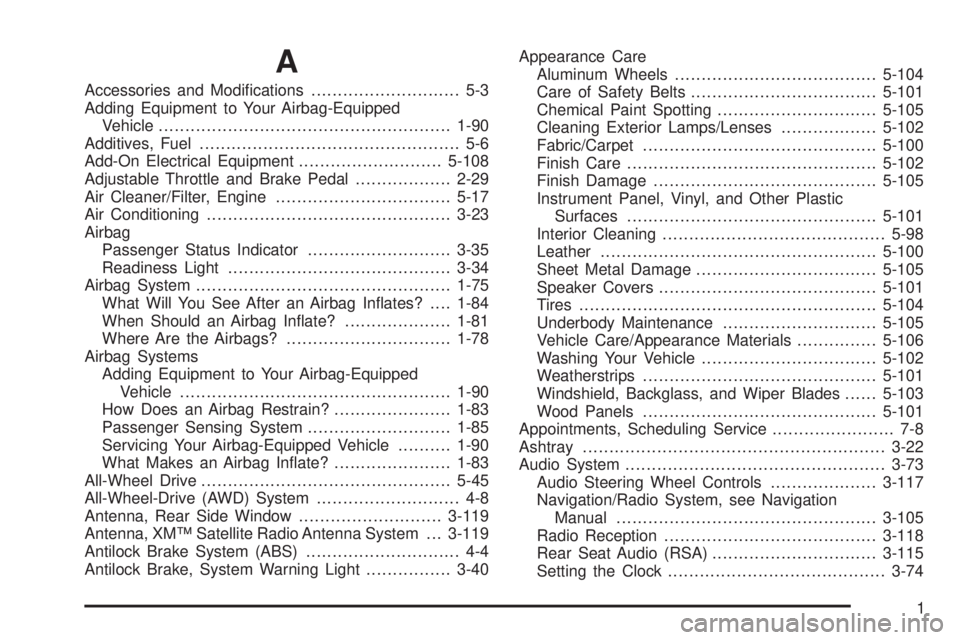
A
Accessories and Modications............................ 5-3
Adding Equipment to Your Airbag-Equipped
Vehicle.......................................................1-90
Additives, Fuel................................................. 5-6
Add-On Electrical Equipment...........................5-108
Adjustable Throttle and Brake Pedal..................2-29
Air Cleaner/Filter, Engine.................................5-17
Air Conditioning..............................................3-23
Airbag
Passenger Status Indicator...........................3-35
Readiness Light..........................................3-34
Airbag System................................................1-75
What Will You See After an Airbag Inates?....1-84
When Should an Airbag Inate?....................1-81
Where Are the Airbags?...............................1-78
Airbag Systems
Adding Equipment to Your Airbag-Equipped
Vehicle...................................................1-90
How Does an Airbag Restrain?......................1-83
Passenger Sensing System...........................1-85
Servicing Your Airbag-Equipped Vehicle..........1-90
What Makes an Airbag Inate?......................1-83
All-Wheel Drive...............................................5-45
All-Wheel-Drive (AWD) System........................... 4-8
Antenna, Rear Side Window...........................3-119
Antenna, XM™ Satellite Radio Antenna System . . . 3-119
Antilock Brake System (ABS)............................. 4-4
Antilock Brake, System Warning Light................3-40Appearance Care
Aluminum Wheels......................................5-104
Care of Safety Belts...................................5-101
Chemical Paint Spotting..............................5-105
Cleaning Exterior Lamps/Lenses..................5-102
Fabric/Carpet............................................5-100
Finish Care...............................................5-102
Finish Damage..........................................5-105
Instrument Panel, Vinyl, and Other Plastic
Surfaces...............................................5-101
Interior Cleaning..........................................5-98
Leather....................................................5-100
Sheet Metal Damage..................................5-105
Speaker Covers.........................................5-101
Tires........................................................5-104
Underbody Maintenance.............................5-105
Vehicle Care/Appearance Materials...............5-106
Washing Your Vehicle.................................5-102
Weatherstrips............................................5-101
Windshield, Backglass, and Wiper Blades......5-103
Wood Panels............................................5-101
Appointments, Scheduling Service....................... 7-8
Ashtray.........................................................3-22
Audio System.................................................3-73
Audio Steering Wheel Controls....................3-117
Navigation/Radio System, see Navigation
Manual.................................................3-105
Radio Reception........................................3-118
Rear Seat Audio (RSA)...............................3-115
Setting the Clock.........................................3-74
1
Page 490 of 502
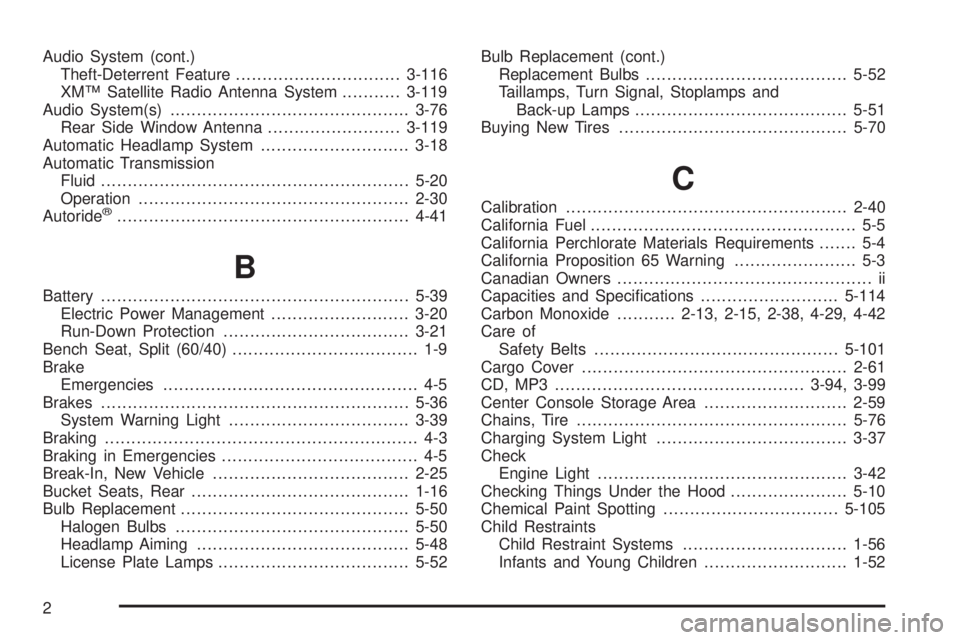
Audio System (cont.)
Theft-Deterrent Feature...............................3-116
XM™ Satellite Radio Antenna System...........3-119
Audio System(s).............................................3-76
Rear Side Window Antenna.........................3-119
Automatic Headlamp System............................3-18
Automatic Transmission
Fluid..........................................................5-20
Operation...................................................2-30
Autoride
®.......................................................4-41
B
Battery..........................................................5-39
Electric Power Management..........................3-20
Run-Down Protection...................................3-21
Bench Seat, Split (60/40)................................... 1-9
Brake
Emergencies................................................ 4-5
Brakes..........................................................5-36
System Warning Light..................................3-39
Braking........................................................... 4-3
Braking in Emergencies..................................... 4-5
Break-In, New Vehicle.....................................2-25
Bucket Seats, Rear.........................................1-16
Bulb Replacement...........................................5-50
Halogen Bulbs............................................5-50
Headlamp Aiming........................................5-48
License Plate Lamps....................................5-52Bulb Replacement (cont.)
Replacement Bulbs......................................5-52
Taillamps, Turn Signal, Stoplamps and
Back-up Lamps........................................5-51
Buying New Tires...........................................5-70
C
Calibration.....................................................2-40
California Fuel.................................................. 5-5
California Perchlorate Materials Requirements....... 5-4
California Proposition 65 Warning....................... 5-3
Canadian Owners................................................ ii
Capacities and Specications..........................5-114
Carbon Monoxide...........2-13, 2-15, 2-38, 4-29, 4-42
Care of
Safety Belts..............................................5-101
Cargo Cover..................................................2-61
CD, MP3 ...............................................3-94, 3-99
Center Console Storage Area...........................2-59
Chains, Tire...................................................5-76
Charging System Light....................................3-37
Check
Engine Light...............................................3-42
Checking Things Under the Hood......................5-10
Chemical Paint Spotting.................................5-105
Child Restraints
Child Restraint Systems...............................1-56
Infants and Young Children...........................1-52
2