instrument cluster GMC YUKON DENALI 2016 Owner's Guide
[x] Cancel search | Manufacturer: GMC, Model Year: 2016, Model line: YUKON DENALI, Model: GMC YUKON DENALI 2016Pages: 396, PDF Size: 5.5 MB
Page 254 of 396
GMC Yukon Denali/Yukon XL Denali Owner Manual (GMNA-Localizing-U.S./
Canada/Mexico-9159308) - 2016 - crc - 6/2/15
Driving and Operating 253
.White: Ground
. Light Green: Back-up Lamps
. Red/Green: Battery Feed
. Dark Blue: Trailer Brake
If charging a remote (non-vehicle)
battery, press the Tow/Haul mode
button at the end of the shift lever.
This will boost the vehicle system
voltage and properly charge the
battery. If the trailer is too light for
Tow/Haul mode, turn on the
headlamps as a second way to
boost the vehicle system and
charge the battery.
Electric Brake Control Wiring
Provisions
These wiring provisions are
included with the vehicle as part of
the trailer wiring package. These
provisions are for an electric brake
controller.
The harness should be installed by
your dealer or a qualified service
center.
Tow/Haul Mode
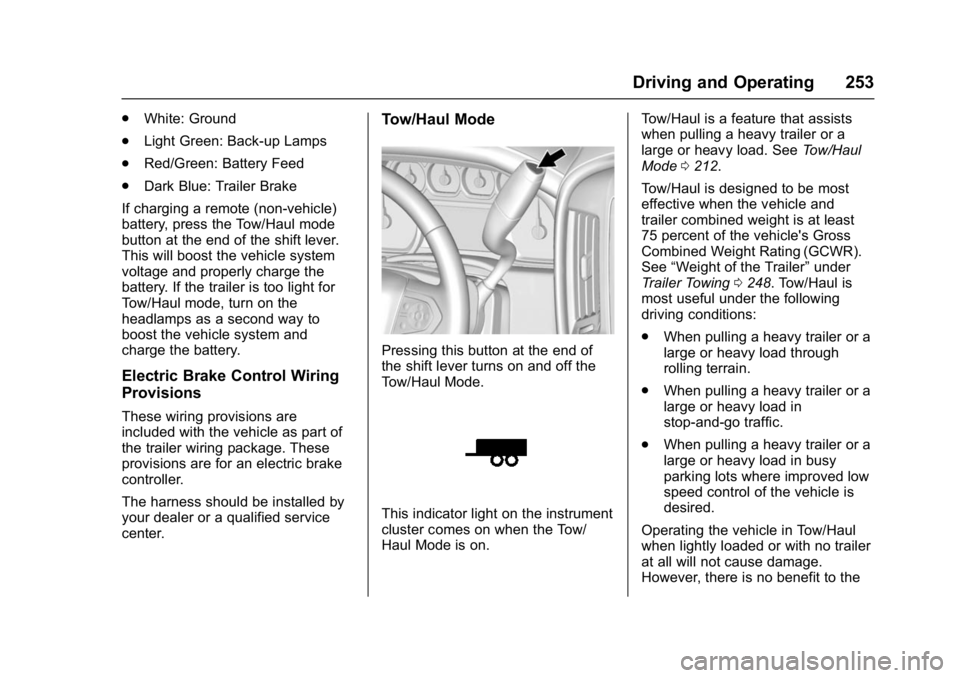
Pressing this button at the end of
the shift lever turns on and off the
Tow/Haul Mode.
This indicator light on the instrument
cluster comes on when the Tow/
Haul Mode is on. Tow/Haul is a feature that assists
when pulling a heavy trailer or a
large or heavy load. See
Tow/Haul
Mode 0212.
Tow/Haul is designed to be most
effective when the vehicle and
trailer combined weight is at least
75 percent of the vehicle's Gross
Combined Weight Rating (GCWR).
See “Weight of the Trailer” under
Trailer Towing 0248. Tow/Haul is
most useful under the following
driving conditions:
. When pulling a heavy trailer or a
large or heavy load through
rolling terrain.
. When pulling a heavy trailer or a
large or heavy load in
stop-and-go traffic.
. When pulling a heavy trailer or a
large or heavy load in busy
parking lots where improved low
speed control of the vehicle is
desired.
Operating the vehicle in Tow/Haul
when lightly loaded or with no trailer
at all will not cause damage.
However, there is no benefit to the
Page 259 of 396
GMC Yukon Denali/Yukon XL Denali Owner Manual (GMNA-Localizing-U.S./
Canada/Mexico-9159308) - 2016 - crc - 6/2/15
258 Driving and Operating
A GM dealer may be able to
diagnose and repair problems with
the trailer. However, any diagnosis
and repair of the trailer is not
covered under the vehicle warranty.
Contact your trailer dealer for
assistance with trailer repairs and
trailer warranty information.
Trailer Sway
Control (TSC)
Vehicles with StabiliTrak have a
TSC feature. Trailer sway is
unintended side-to-side motion of a
trailer while being towed. If the
vehicle is towing a trailer and the
TSC detects that sway is increasing,
the vehicle brakes are selectively
applied at each wheel, to help
reduce excessive trailer sway. If the
vehicle is equipped with the
Integrated Trailer Brake Control
(ITBC) system, and the trailer has
the electric actuated brake system,
StabiliTrak may also apply the trailer
brakes.
If TSC is enabled, the Traction
Control System (TCS)/StabiliTrak
warning light will flash on theinstrument cluster. Vehicle speed
must be reduced. If trailer sway
continues, StabiliTrak can reduce
engine torque to help slow the
vehicle. See
Traction Control/
Electronic Stability Control 0218.
{Warning
Even if the vehicle is equipped
with TSC, trailer sway could result
in loss of control and the vehicle
could crash. If excessive trailer
sway is detected, slow down to a
safe speed. Check the trailer and
vehicle to help correct possible
causes. These could include an
improperly or overloaded trailer,
unrestrained cargo, improper
trailer hitch configuration,
excessive vehicle-trailer speed,
or improperly inflated or incorrect
vehicle or trailer tires. See Towing
Equipment 0251 for trailer ratings
and hitch setup
recommendations. Adding non-dealer accessories can
affect the vehicle performance. See
Accessories and Modifications
0
262.
Page 274 of 396
GMC Yukon Denali/Yukon XL Denali Owner Manual (GMNA-Localizing-U.S./
Canada/Mexico-9159308) - 2016 - crc - 6/2/15
Vehicle Care 273
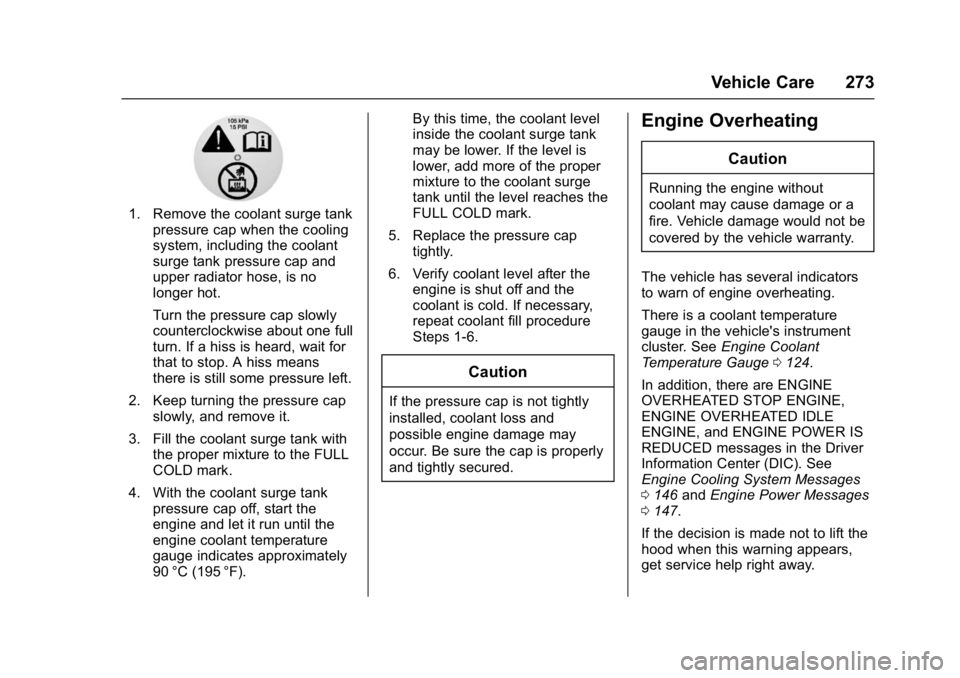
1. Remove the coolant surge tankpressure cap when the cooling
system, including the coolant
surge tank pressure cap and
upper radiator hose, is no
longer hot.
Turn the pressure cap slowly
counterclockwise about one full
turn. If a hiss is heard, wait for
that to stop. A hiss means
there is still some pressure left.
2. Keep turning the pressure cap slowly, and remove it.
3. Fill the coolant surge tank with the proper mixture to the FULL
COLD mark.
4. With the coolant surge tank pressure cap off, start the
engine and let it run until the
engine coolant temperature
gauge indicates approximately
90 °C (195 °F). By this time, the coolant level
inside the coolant surge tank
may be lower. If the level is
lower, add more of the proper
mixture to the coolant surge
tank until the level reaches the
FULL COLD mark.
5. Replace the pressure cap tightly.
6. Verify coolant level after the engine is shut off and the
coolant is cold. If necessary,
repeat coolant fill procedure
Steps 1-6.
Caution
If the pressure cap is not tightly
installed, coolant loss and
possible engine damage may
occur. Be sure the cap is properly
and tightly secured.
Engine Overheating
Caution
Running the engine without
coolant may cause damage or a
fire. Vehicle damage would not be
covered by the vehicle warranty.
The vehicle has several indicators
to warn of engine overheating.
There is a coolant temperature
gauge in the vehicle's instrument
cluster. See Engine Coolant
Temperature Gauge 0124.
In addition, there are ENGINE
OVERHEATED STOP ENGINE,
ENGINE OVERHEATED IDLE
ENGINE, and ENGINE POWER IS
REDUCED messages in the Driver
Information Center (DIC). See
Engine Cooling System Messages
0 146 andEngine Power Messages
0 147.
If the decision is made not to lift the
hood when this warning appears,
get service help right away.
Page 294 of 396
GMC Yukon Denali/Yukon XL Denali Owner Manual (GMNA-Localizing-U.S./
Canada/Mexico-9159308) - 2016 - crc - 6/2/15
Vehicle Care 293
Number Usage18 Mirror window module
19 Body control module 1
20 Front bolster (if equipped)
21 Not used
22 Not used
23 Not used
24 Heater, ventilation and air conditioning
ignition/Heater,
ventilation and air
conditioning auxiliary
25 Instrument cluster ignition/Sensing
diagnostic module
ignition
26 Tilt column/SEO, tilt column lock 1/SEO
27 Data link connector/ Driver seat module
28 Passive entry/Passive start/Heater,
ventilation and air
conditioning battery Number Usage
29 Content theft
30 Not used
31 Not used
32 Not used
33 SEO/Automatic level control
34 Park enable electric adjustable pedal (if
equipped)
35 Not used
36 Miscellaneous R/C
37 Heated steering wheel
38 Steering column lock 2 (if equipped)
39 Instrument cluster battery
40 Not used
41 Not used
42 Euro trailer (if equipped)
43 Left doors
44 Driver power seat Number Usage
45 Not used
46 Right heated, cooled seat
47 Left heated, cooled seat
48 Not used
49 Not used
50 Accessory power outlet 2
51 Not used
52 Retained accessory power/Accessory
relay
53 Run, crank relay
54 Not used
55 Not used
56 Not used
Page 307 of 396

GMC Yukon Denali/Yukon XL Denali Owner Manual (GMNA-Localizing-U.S./
Canada/Mexico-9159308) - 2016 - crc - 6/2/15
306 Vehicle Care
Accordingly, when the low tire
pressure telltale illuminates, you
should stop and check your tires as
soon as possible, and inflate them
to the proper pressure. Driving on a
significantly under-inflated tire
causes the tire to overheat and can
lead to tire failure. Under-inflation
also reduces fuel efficiency and tire
tread life, and may affect the
vehicle's handling and stopping
ability.
Please note that the TPMS is not a
substitute for proper tire
maintenance, and it is the driver's
responsibility to maintain correct tire
pressure, even if under-inflation has
not reached the level to trigger
illumination of the TPMS low tire
pressure telltale.
Your vehicle has also been
equipped with a TPMS malfunction
indicator to indicate when the
system is not operating properly.
The TPMS malfunction indicator is
combined with the low tire pressure
telltale. When the system detects a
malfunction, the telltale will flash for
approximately one minute and then
remain continuously illuminated.This sequence will continue upon
subsequent vehicle start-ups as
long as the malfunction exists.
When the malfunction indicator is
illuminated, the system may not be
able to detect or signal low tire
pressure as intended. TPMS
malfunctions may occur for a variety
of reasons, including the installation
of replacement or alternate tires or
wheels on the vehicle that prevent
the TPMS from functioning properly.
Always check the TPMS malfunction
telltale after replacing one or more
tires or wheels on your vehicle to
ensure that the replacement or
alternate tires and wheels allow the
TPMS to continue to function
properly.
See
Tire Pressure Monitor
Operation 0306.
See Radio Frequency Statement
0 370.Tire Pressure Monitor
Operation
This vehicle may have a Tire
Pressure Monitor System (TPMS).
The TPMS is designed to warn the
driver when a low tire pressure
condition exists. TPMS sensors are
mounted onto each tire and wheel
assembly, excluding the spare tire
and wheel assembly. The TPMS
sensors monitor the air pressure in
the tires and transmit the tire
pressure readings to a receiver
located in the vehicle.
When a low tire pressure condition
is detected, the TPMS illuminates
the low tire pressure warning light
located on the instrument cluster.
If the warning light comes on, stop
as soon as possible and inflate the
tires to the recommended pressure
Page 340 of 396
GMC Yukon Denali/Yukon XL Denali Owner Manual (GMNA-Localizing-U.S./
Canada/Mexico-9159308) - 2016 - crc - 6/2/15
Vehicle Care 339
material to parts repaired or
replaced to restore corrosion
protection.
Original manufacturer replacement
parts will provide the corrosion
protection while maintaining the
vehicle warranty.
Finish Damage
Quickly repair minor chips and
scratches with touch-up materials
available from your dealer to avoid
corrosion. Larger areas of finish
damage can be corrected in your
dealer's body and paint shop.
Chemical Paint Spotting
Airborne pollutants can fall upon
and attack painted vehicle surfaces
causing blotchy, ring-shaped
discolorations, and small, irregular
dark spots etched into the paint
surface. See“Finish Care”
previously in this section.
Interior Care
To prevent dirt particle abrasions,
regularly clean the vehicle's interior.
Immediately remove any soils. Newspapers or dark garments can
transfer color to the vehicle’s
interior.
Use a soft bristle brush to remove
dust from knobs and crevices on the
instrument cluster. Using a mild
soap solution, immediately remove
hand lotions, sunscreen, and insect
repellent from all interior surfaces or
permanent damage may result.
Use cleaners specifically designed
for the surfaces being cleaned to
prevent permanent damage. Apply
all cleaners directly to the cleaning
cloth. Do not spray cleaners on any
switches or controls. Remove
cleaners quickly.
Before using cleaners, read and
follow all safety instructions on the
label. While cleaning the interior,
open the doors and windows to get
proper ventilation.
To prevent damage, do not clean
the interior using the following
cleaners or techniques:
.
Never use a razor or any other
sharp object to remove soil from
any interior surface. .
Never use a brush with stiff
bristles.
. Never rub any surface
aggressively or with too much
pressure.
. Do not use laundry detergents or
dishwashing soaps with
degreasers. For liquid cleaners,
use approximately 20 drops per
3.8 L (1 gal) of water.
A concentrated soap solution will
create streaks and attract dirt.
Do not use solutions that contain
strong or caustic soap.
. Do not heavily saturate the
upholstery when cleaning.
. Do not use solvents or cleaners
containing solvents.
Interior Glass
To clean, use a terry cloth fabric
dampened with water. Wipe droplets
left behind with a clean dry cloth.
If necessary, use a commercial
glass cleaner after cleaning with
plain water.
Page 352 of 396
GMC Yukon Denali/Yukon XL Denali Owner Manual (GMNA-Localizing-U.S./
Canada/Mexico-9159308) - 2016 - crc - 6/2/15
Service and Maintenance 351
Battery
The 12-volt battery supplies power
to start the engine and operate any
additional electrical accessories.
.To avoid break-down or failure to
start the vehicle, maintain a
battery with full cranking power.
. Trained dealer technicians have
the diagnostic equipment to test
the battery and ensure that the
connections and cables are
corrosion-free.
Belts
. Belts may need replacing if they
squeak or show signs of
cracking or splitting.
. Trained dealer technicians have
access to tools and equipment
to inspect the belts and
recommend adjustment or
replacement when necessary. Brakes
Brakes stop the vehicle and are
crucial to safe driving.
.
Signs of brake wear may include
chirping, grinding, or squealing
noises, or difficulty stopping.
. Trained dealer technicians have
access to tools and equipment
to inspect the brakes and
recommend quality parts
engineered for the vehicle.
Fluids
Proper fluid levels and approved
fluids protect the vehicle’s systems
and components. See
Recommended Fluids and
Lubricants 0353 for GM approved
fluids.
. Engine oil and windshield
washer fluid levels should be
checked at every fuel fill.
. Instrument cluster lights may
come on to indicate that fluids
may be low and need to be
filled. Hoses
Hoses transport fluids and should
be regularly inspected to ensure
that there are no cracks or leaks.
With a multi-point inspection, your
dealer can inspect the hoses and
advise if replacement is needed.
Lamps
Properly working headlamps,
taillamps, and brake lamps are
important to see and be seen on
the road.
.
Signs that the headlamps need
attention include dimming, failure
to light, cracking, or damage.
The brake lamps need to be
checked periodically to ensure
that they light when braking.
. With a multi-point inspection,
your dealer can check the lamps
and note any concerns.
Page 387 of 396

GMC Yukon Denali/Yukon XL Denali Owner Manual (GMNA-Localizing-U.S./
Canada/Mexico-9159308) - 2016 - crc - 6/2/15
386 Index
Cleaning (cont'd)Interior Care . . . . . . . . . . . . . . . . . . 339
Climate Control Systems Dual Automatic . . . . . . . . . . . . . . . 174
Rear . . . . . . . . . . . . . . . . . . . . . . . . . . 178
Clock . . . . . . . . . . . . . . . . . . . . . . . . . . . 115
Cluster, Instrument . . . . . . . . . . . . . 120
Collision Damage Repair . . . . . . . 367
Compartments Storage . . . . . . . . . . . . . . . . . . . . . . . 106
Compass . . . . . . . . . . . . . . . . . . . . . . . 114 Messages . . . . . . . . . . . . . . . . . . . . 144
Connections OnStar
®. . . . . . . . . . . . . . . . . . . . . . 376
Control Traction and ElectronicStability . . . . . . . . . . . . . . . . . . . . . 218
Control of a Vehicle . . . . . . . . . . . . . 183
Convenience Net . . . . . . . . . . . . . . . 108
Convex Mirrors . . . . . . . . . . . . . . . . . . 44
Coolant
Engine . . . . . . . . . . . . . . . . . . . . . . . . 271
Engine Temperature Gauge . . 124
Engine TemperatureWarning Light . . . . . . . . . . . . . . . 133
Cooling System . . . . . . . . . . . . . . . . . 270 Engine Messages . . . . . . . . . . . . 146 Courtesy Transportation
Program . . . . . . . . . . . . . . . . . . . . . . . 366
Cover Cargo . . . . . . . . . . . . . . . . . . . . . . . . . 108
Cruise Control . . . . . . . . . . . . . . . . . . 221 Light . . . . . . . . . . . . . . . . . . . . . . . . . . 136
Messages . . . . . . . . . . . . . . . . . . . . 144
Cruise Control, Adaptive . . . . . . . . 224
Cupholders . . . . . . . . . . . . . . . . . . . . . 106
Customer Assistance . . . . . . . . . . . 363 Offices . . . . . . . . . . . . . . . . . . . . . . . . 362
Text Telephone (TTY)
Users . . . . . . . . . . . . . . . . . . . . . . . 363
Customer Information Service PublicationsOrdering Information . . . . . . . . 369
Customer Satisfaction Procedure . . . . . . . . . . . . . . . . . . . . . 360
D
Damage Repair, Collision . . . . . . . 367
Danger, Warning, and Caution . . . . 3
Data Recorders, Event . . . . . . . . . 372
Daytime RunningLamps (DRL) . . . . . . . . . . . . . . . . . . 166
Defensive Driving . . . . . . . . . . . . . . . 183
Delayed Locking . . . . . . . . . . . . . . . . . 35
Diagnostics
OnStar
®. . . . . . . . . . . . . . . . . . . . . . 378 Distracted Driving . . . . . . . . . . . . . . . 182
Dome Lamps . . . . . . . . . . . . . . . . . . . 170
Door
Ajar Light . . . . . . . . . . . . . . . . . . . . . 136
Ajar Messages . . . . . . . . . . . . . . . 145
Delayed Locking . . . . . . . . . . . . . . . . 35
Locks . . . . . . . . . . . . . . . . . . . . . . . . . . . 34
Power Locks . . . . . . . . . . . . . . . . . . . . 34
Drive Belt Routing, Engine . . . . . . 359
Driver Assistance Systems . . . . . 231
Driver Information Center (DIC) . . . . . . . . . . . . . . . . . . 137
Driving Assistance Systems . . . . . . . . . . 234
Characteristics andTowing Tips . . . . . . . . . . . . . . . . . 246
Defensive . . . . . . . . . . . . . . . . . . . . . 183
Drunk . . . . . . . . . . . . . . . . . . . . . . . . . 183
For Better Fuel Economy . . . . . . . 24
Hill and Mountain Roads . . . . . . 191
If the Vehicle is Stuck . . . . . . . . . 192
Loss of Control . . . . . . . . . . . . . . . 185
Off-Road . . . . . . . . . . . . . . . . . . . . . 185
Off-Road Recovery . . . . . . . . . . . 184
Vehicle Load Limits . . . . . . . . . . . 194
Wet Roads . . . . . . . . . . . . . . . . . . . 190
Winter . . . . . . . . . . . . . . . . . . . . . . . . 191
Page 390 of 396

GMC Yukon Denali/Yukon XL Denali Owner Manual (GMNA-Localizing-U.S./
Canada/Mexico-9159308) - 2016 - crc - 6/2/15
Index 389
Infotainment System . . . . . . . . . . . . 373
Instrument Cluster . . . . . . . . . . . . . . 120
Instrument PanelStorage Area . . . . . . . . . . . . . . . . . 106
Interior Rearview Mirrors . . . . . . . . . 46
Introduction . . . . . . . . . . . . . . . . . . . . . . . 2
J
Jump Starting - North America . . . . . . . . . . . . . . . . . . . . . . . 326
K
Key and Lock Messages . . . . . . . . 147
Keyless EntryRemote (RKE) System . . . . . . . . . 27
Keys . . . . . . . . . . . . . . . . . . . . . . . . . . . . . 25
L
Labeling, Tire Sidewall . . . . . . . . . . 299
Lamps Daytime Running (DRL) . . . . . . 166
Dome . . . . . . . . . . . . . . . . . . . . . . . . . 170
Exterior Controls . . . . . . . . . . . . . . 165
Exterior Lamps OffReminder . . . . . . . . . . . . . . . . . . . 166
License Plate . . . . . . . . . . . . . . . . . 286
Malfunction Indicator . . . . . . . . . 129
Messages . . . . . . . . . . . . . . . . . . . . 148
On Reminder . . . . . . . . . . . . . . . . . 136 Lamps (cont'd)
Reading . . . . . . . . . . . . . . . . . . . . . . 170
Lane Change Alert (LCA) . . . . . . . 238
Lane Departure Warning (LDW) . . . . . . . . . . . . . . . . 240
Lane Keep Assist (LKA) . . . . . . . . 240
Lane Keep Assist Light . . . . . . . . . 132
Lap-Shoulder Belt . . . . . . . . . . . . . . . 67
LATCH System Replacing Parts after aCrash . . . . . . . . . . . . . . . . . . . . . . . 100
LATCH, Lower Anchors and Tethers for Children . . . . . . . . . . . . 92
LED Lighting . . . . . . . . . . . . . . . . . . . . 285
Level Control
Automatic . . . . . . . . . . . . . . . . . . . . . 221
Liftgate . . . . . . . . . . . . . . . . . . . . . . . . . . 36
Lighting Entry . . . . . . . . . . . . . . . . . . . . . . . . . 171
Exit . . . . . . . . . . . . . . . . . . . . . . . . . . . 171
Illumination Control . . . . . . . . . . . 169
LED . . . . . . . . . . . . . . . . . . . . . . . . . . 285
Lights . . . . . . . . . . . . . . . . . . . . . . . . . . . 132
Airbag Readiness . . . . . . . . . . . . . 127
Antilock Brake System(ABS) Warning . . . . . . . . . . . . . . 131
Brake System Warning . . . . . . . 130
Charging System . . . . . . . . . . . . . 128 Lights (cont'd)
Cruise Control . . . . . . . . . . . . . . . . 136
Door Ajar . . . . . . . . . . . . . . . . . . . . . 136
Engine Coolant
Temperature Warning . . . . . . . 133
Engine Oil Pressure . . . . . . . . . . 134
Flash-to-Pass . . . . . . . . . . . . . . . . . 166
Four-Wheel-Drive . . . . . . . . . . . . . 131
Front Fog Lamp . . . . . . . . . . . . . . 136
High-Beam On . . . . . . . . . . . . . . . . 135
High/Low Beam Changer . . . . . 166
Low Fuel Warning . . . . . . . . . . . . 135
Safety Belt Reminders . . . . . . . . 126
Security . . . . . . . . . . . . . . . . . . . . . . 135
StabiliTrak
®OFF . . . . . . . . . . . . . 133
Tire Pressure . . . . . . . . . . . . . . . . . 134
Tow/Haul Mode . . . . . . . . . . . . . . . 132
Traction Control System (TCS)/StabiliTrak
®. . . . . . . . . . 133
Traction Off . . . . . . . . . . . . . . . . . . . 132
Locking Rear Axle . . . . . . . . . . . . . . 220
Locks Automatic Door . . . . . . . . . . . . . . . . . 35
Delayed Locking . . . . . . . . . . . . . . . . 35
Door . . . . . . . . . . . . . . . . . . . . . . . . . . . . 34
Lockout Protection . . . . . . . . . . . . . . 35
Power Door . . . . . . . . . . . . . . . . . . . . . 34
Safety . . . . . . . . . . . . . . . . . . . . . . . . . . 35