stop start GMC YUKON HYBRID 2009 User Guide
[x] Cancel search | Manufacturer: GMC, Model Year: 2009, Model line: YUKON HYBRID, Model: GMC YUKON HYBRID 2009Pages: 94, PDF Size: 0.53 MB
Page 37 of 94
Service............................................................5-2
Doing Your Own Service Work.........................5-2
Checking Things Under the Hood.....................5-3
High Voltage Devices and Wiring......................5-3
Engine Compartment Overview.........................5-4
Automatic Transmission Fluid...........................5-5
Drive Motor/Generator Control Module (DMCM)
Coolant Surge Tank Pressure Cap..................5-6
Drive Motor/Generator Control Module (DMCM)
Cooling System...........................................5-6
Power Steering Fluid.....................................5-11
Brakes........................................................5-11
Battery........................................................5-15
Jump Starting...............................................5-16
Bulb Replacement..........................................5-21
Taillamps, Turn Signal, Stoplamps and
Back-up Lamps.........................................5-21
Replacement Bulbs.......................................5-22Electrical System............................................5-22
Fuses and Circuit Breakers............................5-22
Underhood Fuse Block..................................5-22
Tires..............................................................5-24
Inflation - Tire Pressure.................................5-24
Tire Pressure Monitor Operation.....................5-25
Tire Inspection and Rotation...........................5-29
Tire Chains..................................................5-30
If a Tire Goes Flat........................................5-30
Tire Sealant and Compressor Kit
(Without Selector Switch)............................5-32
Tire Sealant and Compressor Kit
(With Selector Switch)................................5-42
Tire Sealant and Compressor Kit Storage.........5-50
Capacities and Specications..........................5-52
Section 5 Service and Appearance Care
5-1
Page 46 of 94
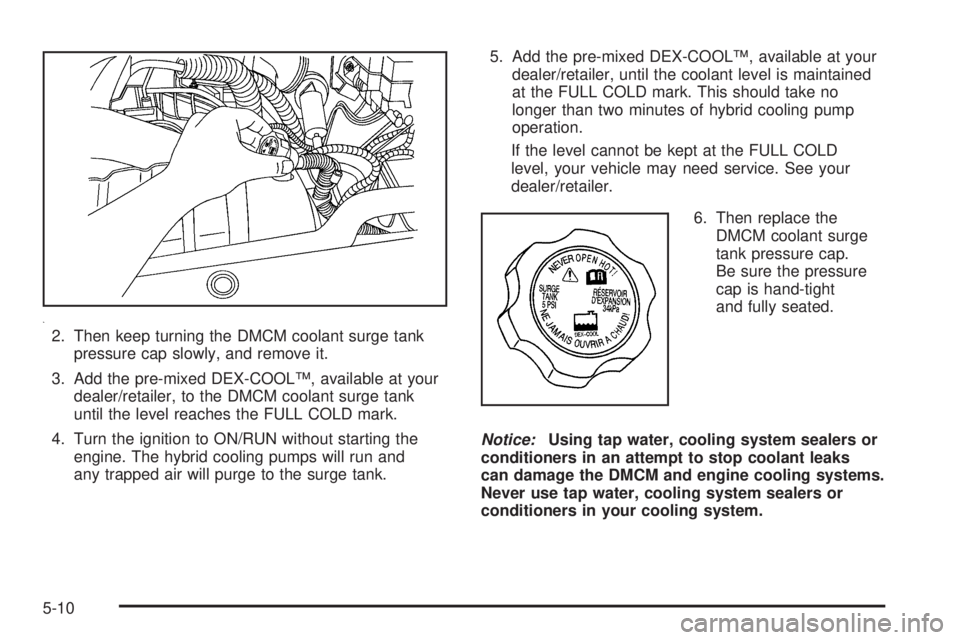
2. Then keep turning the DMCM coolant surge tank
pressure cap slowly, and remove it.
3. Add the pre-mixed DEX-COOL™, available at your
dealer/retailer, to the DMCM coolant surge tank
until the level reaches the FULL COLD mark.
4. Turn the ignition to ON/RUN without starting the
engine. The hybrid cooling pumps will run and
any trapped air will purge to the surge tank.5. Add the pre-mixed DEX-COOL™, available at your
dealer/retailer, until the coolant level is maintained
at the FULL COLD mark. This should take no
longer than two minutes of hybrid cooling pump
operation.
If the level cannot be kept at the FULL COLD
level, your vehicle may need service. See your
dealer/retailer.
6. Then replace the
DMCM coolant surge
tank pressure cap.
Be sure the pressure
cap is hand-tight
and fully seated.
Notice:Using tap water, cooling system sealers or
conditioners in an attempt to stop coolant leaks
can damage the DMCM and engine cooling systems.
Never use tap water, cooling system sealers or
conditioners in your cooling system.
5-10
Page 64 of 94
You have two minutes to match the first tire/wheel
position, and five minutes overall to match all four
tire/wheel positions. If it takes longer than two minutes,
to match the first tire and wheel, or more than
five minutes to match all four tire and wheel positions
the matching process stops and you need to start over.
The TPMS sensor matching process is outlined below:
1. Set the parking brake.
2. Turn the ignition switch to ON/RUN with the
engine off.
3. Press the Remote Keyless Entry (RKE) transmitter’s
LOCK and UNLOCK buttons at the same time for
approximately five seconds. The horn sounds twice
to signal the receiver is in relearn mode and TIRE
LEARNING ACTIVE message displays on the
DIC screen.
4. Start with the driver side front tire.
5. Remove the valve cap from the valve cap stem.
Activate the TPMS sensor by increasing or
decreasing the tire’s air pressure for five seconds,
or until a horn chirp sounds. The horn chirp,
which may take up to 30 seconds to sound,
confirms that the sensor identification code has
been matched to this tire and wheel position.6. Proceed to the passenger side front tire, and repeat
the procedure in Step 5.
7. Proceed to the passenger side rear tire, and repeat
the procedure in Step 5.
8. Proceed to the driver side rear tire, and repeat the
procedure in Step 5. The horn sounds two times to
indicate the sensor identification code has been
matched to the driver side rear tire, and the TPMS
sensor matching process is no longer active.
The TIRE LEARNING ACTIVE message on the
DIC display screen goes off.
9. Turn the ignition switch to LOCK/OFF.
10. Set all four tires to the recommended air pressure
level as indicated on the Tire and Loading
Information label.
11. Put the valve caps back on the valve stems.
5-28
Page 94 of 94
S
Seats
Manual Lumbar............................................. 1-2
Manual Reclining Seatbacks........................... 1-3
Power Seats................................................. 1-2
Service, Doing Your Own Work.......................... 5-2
Specifications, Capacities.................................5-52
StabiliTrak
®Indicator Light................................. 3-7
Starting Your Vehicle......................................... 2-3
Storing the Tire Sealant and Compressor Kit......5-50
T
Tachometer...................................................... 3-4
Taillamps
Turn Signal, Stoplamps and
Back-up Lamps........................................5-21
Tire Sealant
Storing.......................................................5-50Tires
Chains.......................................................5-30
If a Tire Goes Flat.......................................5-30
Inflation, Pressure........................................5-24
Inspection and Rotation................................5-29
Tire Sealant and Compressor Kit...........5-32, 5-42
Towing
Towing Your Vehicle...................................... 4-2
Trailer.......................................................... 4-2
Transmission, Automatic Fluid............................. 5-5
V
Vehicle
Running While Parked..................................2-10
Voltage Devices, High and Wiring....................... 5-3
W
Wiring, High Voltage Devices............................. 5-3
4