tow GMC YUKON HYBRID 2009 User Guide
[x] Cancel search | Manufacturer: GMC, Model Year: 2009, Model line: YUKON HYBRID, Model: GMC YUKON HYBRID 2009Pages: 94, PDF Size: 0.53 MB
Page 35 of 94
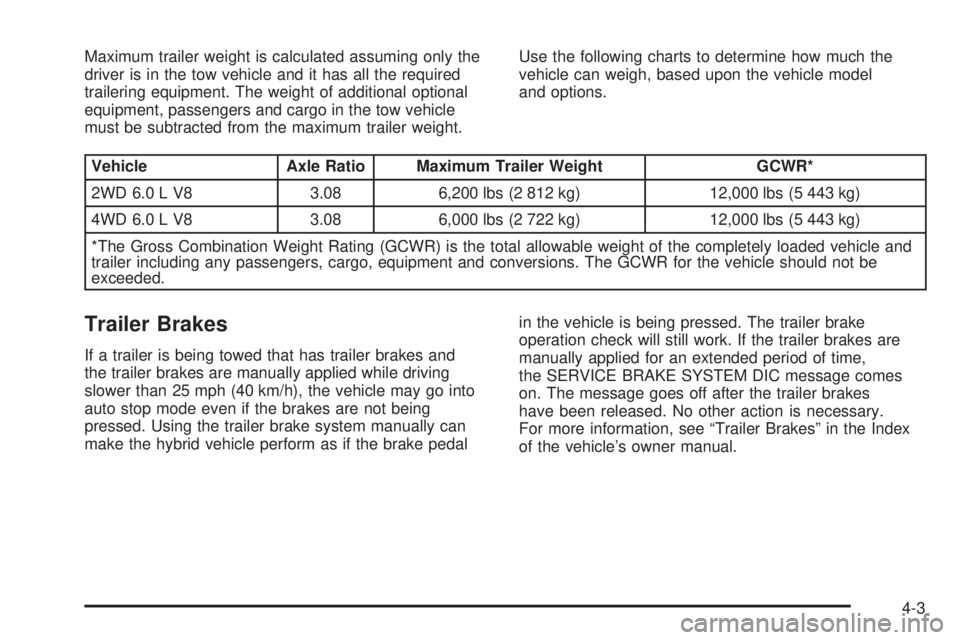
Maximum trailer weight is calculated assuming only the
driver is in the tow vehicle and it has all the required
trailering equipment. The weight of additional optional
equipment, passengers and cargo in the tow vehicle
must be subtracted from the maximum trailer weight.Use the following charts to determine how much the
vehicle can weigh, based upon the vehicle model
and options.
Vehicle Axle Ratio Maximum Trailer Weight GCWR*
2WD 6.0 L V8 3.08 6,200 lbs (2 812 kg) 12,000 lbs (5 443 kg)
4WD 6.0 L V8 3.08 6,000 lbs (2 722 kg) 12,000 lbs (5 443 kg)
*The Gross Combination Weight Rating (GCWR) is the total allowable weight of the completely loaded vehicle and
trailer including any passengers, cargo, equipment and conversions. The GCWR for the vehicle should not be
exceeded.
Trailer Brakes
If a trailer is being towed that has trailer brakes and
the trailer brakes are manually applied while driving
slower than 25 mph (40 km/h), the vehicle may go into
auto stop mode even if the brakes are not being
pressed. Using the trailer brake system manually can
make the hybrid vehicle perform as if the brake pedalin the vehicle is being pressed. The trailer brake
operation check will still work. If the trailer brakes are
manually applied for an extended period of time,
the SERVICE BRAKE SYSTEM DIC message comes
on. The message goes off after the trailer brakes
have been released. No other action is necessary.
For more information, see “Trailer Brakes” in the Index
of the vehicle’s owner manual.
4-3
Page 66 of 94
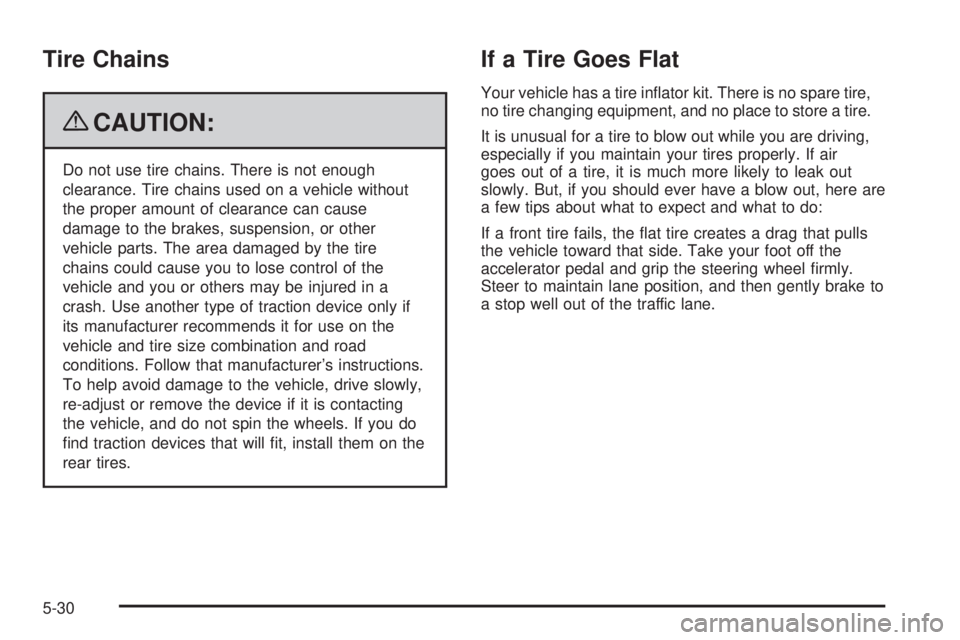
Tire Chains
{CAUTION:
Do not use tire chains. There is not enough
clearance. Tire chains used on a vehicle without
the proper amount of clearance can cause
damage to the brakes, suspension, or other
vehicle parts. The area damaged by the tire
chains could cause you to lose control of the
vehicle and you or others may be injured in a
crash. Use another type of traction device only if
its manufacturer recommends it for use on the
vehicle and tire size combination and road
conditions. Follow that manufacturer’s instructions.
To help avoid damage to the vehicle, drive slowly,
re-adjust or remove the device if it is contacting
the vehicle, and do not spin the wheels. If you do
find traction devices that will fit, install them on the
rear tires.
If a Tire Goes Flat
Your vehicle has a tire inflator kit. There is no spare tire,
no tire changing equipment, and no place to store a tire.
It is unusual for a tire to blow out while you are driving,
especially if you maintain your tires properly. If air
goes out of a tire, it is much more likely to leak out
slowly. But, if you should ever have a blow out, here are
a few tips about what to expect and what to do:
If a front tire fails, the flat tire creates a drag that pulls
the vehicle toward that side. Take your foot off the
accelerator pedal and grip the steering wheel firmly.
Steer to maintain lane position, and then gently brake to
a stop well out of the traffic lane.
5-30
Page 77 of 94
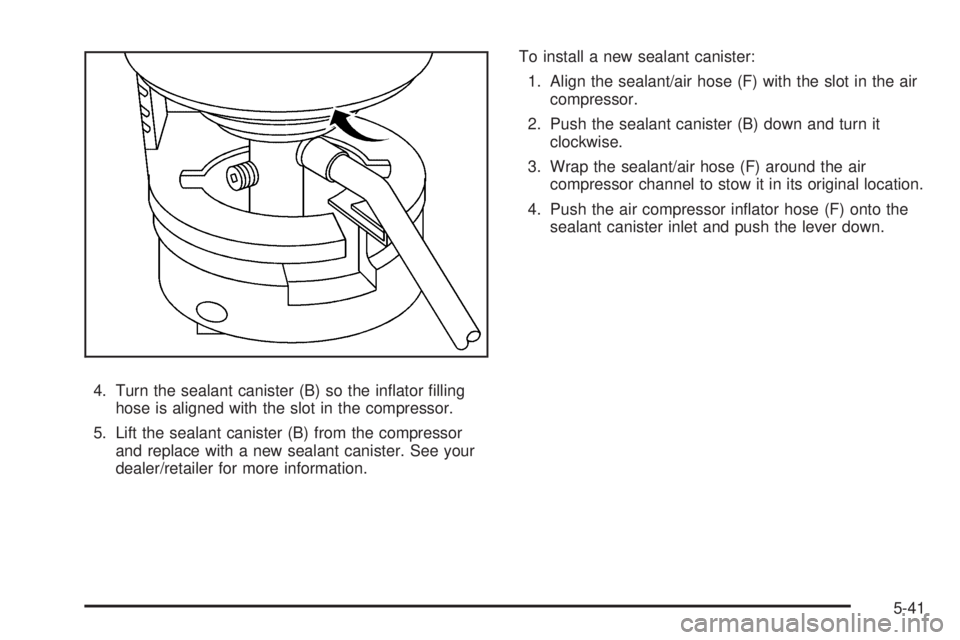
4. Turn the sealant canister (B) so the inflator filling
hose is aligned with the slot in the compressor.
5. Lift the sealant canister (B) from the compressor
and replace with a new sealant canister. See your
dealer/retailer for more information.To install a new sealant canister:
1. Align the sealant/air hose (F) with the slot in the air
compressor.
2. Push the sealant canister (B) down and turn it
clockwise.
3. Wrap the sealant/air hose (F) around the air
compressor channel to stow it in its original location.
4. Push the air compressor inflator hose (F) onto the
sealant canister inlet and push the lever down.
5-41
Page 94 of 94
S
Seats
Manual Lumbar............................................. 1-2
Manual Reclining Seatbacks........................... 1-3
Power Seats................................................. 1-2
Service, Doing Your Own Work.......................... 5-2
Specifications, Capacities.................................5-52
StabiliTrak
®Indicator Light................................. 3-7
Starting Your Vehicle......................................... 2-3
Storing the Tire Sealant and Compressor Kit......5-50
T
Tachometer...................................................... 3-4
Taillamps
Turn Signal, Stoplamps and
Back-up Lamps........................................5-21
Tire Sealant
Storing.......................................................5-50Tires
Chains.......................................................5-30
If a Tire Goes Flat.......................................5-30
Inflation, Pressure........................................5-24
Inspection and Rotation................................5-29
Tire Sealant and Compressor Kit...........5-32, 5-42
Towing
Towing Your Vehicle...................................... 4-2
Trailer.......................................................... 4-2
Transmission, Automatic Fluid............................. 5-5
V
Vehicle
Running While Parked..................................2-10
Voltage Devices, High and Wiring....................... 5-3
W
Wiring, High Voltage Devices............................. 5-3
4