wheel GMC YUKON HYBRID 2009 User Guide
[x] Cancel search | Manufacturer: GMC, Model Year: 2009, Model line: YUKON HYBRID, Model: GMC YUKON HYBRID 2009Pages: 94, PDF Size: 0.53 MB
Page 66 of 94
Tire Chains
{CAUTION:
Do not use tire chains. There is not enough
clearance. Tire chains used on a vehicle without
the proper amount of clearance can cause
damage to the brakes, suspension, or other
vehicle parts. The area damaged by the tire
chains could cause you to lose control of the
vehicle and you or others may be injured in a
crash. Use another type of traction device only if
its manufacturer recommends it for use on the
vehicle and tire size combination and road
conditions. Follow that manufacturer’s instructions.
To help avoid damage to the vehicle, drive slowly,
re-adjust or remove the device if it is contacting
the vehicle, and do not spin the wheels. If you do
find traction devices that will fit, install them on the
rear tires.
If a Tire Goes Flat
Your vehicle has a tire inflator kit. There is no spare tire,
no tire changing equipment, and no place to store a tire.
It is unusual for a tire to blow out while you are driving,
especially if you maintain your tires properly. If air
goes out of a tire, it is much more likely to leak out
slowly. But, if you should ever have a blow out, here are
a few tips about what to expect and what to do:
If a front tire fails, the flat tire creates a drag that pulls
the vehicle toward that side. Take your foot off the
accelerator pedal and grip the steering wheel firmly.
Steer to maintain lane position, and then gently brake to
a stop well out of the traffic lane.
5-30
Page 67 of 94
A rear blow out, particularly on a curve, acts much like
a skid and may require the same correction you
would use in a skid. In any rear blow out, remove your
foot from the accelerator pedal. Get the vehicle
under control by steering the way you want the vehicle
to go. It may be very bumpy and noisy, but you can
still steer. Gently brake to a stop, well off the road
if possible.
If a tire goes flat, avoid further tire and wheel damage
by driving slowly to a level place and stopping.
Then do this:
1. Turn on the hazard warning flashers.
2. Park your vehicle. Set the parking brake firmly
and put the shift lever in PARK (P).
3. Turn off the engine.
4. Inspect the flat tire.If the tire has been separated from the wheel or has
damaged sidewalls or large tears that allow rapid
air loss, call a tire repair facility. See “Roadside
Assistance Program” in the Index of the owner manual.
If the flat tire is due to a slow leak caused by a nail
or other similar road hazard, the tire inflator kit may be
used to repair the damaged tire temporarily. The kit
uses a liquid tire sealant to seal small punctures in the
tread area of the tire.
After repairing a tire with the tire inflator kit, take your
vehicle to an authorized retailer to have the tire
inspected and repaired as soon as possible. The tire
sealant is a temporary repair only. SeeTire Sealant and
Compressor Kit (Without Selector Switch) on page 5-32
orTire Sealant and Compressor Kit (With Selector
Switch) on page 5-42.
5-31
Page 69 of 94
{CAUTION:
Idling a vehicle in an enclosed area with poor
ventilation is dangerous. Engine exhaust may
enter the vehicle. Engine exhaust contains Carbon
Monoxide (CO) which cannot be seen or smelled.
It can cause unconsciousness and even death.
Never run the engine in an enclosed area that has
no fresh air ventilation. For more information,
see ”Engine Exhaust” in the owner manual.
{CAUTION:
Over-inflating a tire could cause the tire to rupture
and you or others could be injured. Be sure to
read and follow the tire sealant and compressor kit
instructions and inflate the tire to its recommended
pressure. Do not exceed the recommended
pressure.
{CAUTION:
Storing the tire sealant and compressor kit or
other equipment in the passenger compartment of
the vehicle could cause injury. In a sudden stop or
collision, loose equipment could strike someone.
Store the tire sealant and compressor kit in its
original location.
If this vehicle has a tire sealant and compressor kit,
there may not be a spare tire, tire changing equipment,
and on some vehicles there may not be a place to
store a tire.
The tire sealant and compressor can be used to
temporarily seal punctures up to
1⁄4inch (6 mm) in the
tread area of the tire. It can also be used to inflate
an under inflated tire.
If the tire has been separated from the wheel, has
damaged sidewalls, or has a large puncture, the tire is
too severely damaged for the tire sealant and
compressor kit to be effective. See “Roadside
Assistance Program” in the owner manual.
5-33
Page 74 of 94
19. Wipe off any sealant from the wheel, tire or vehicle.
20. Dispose of the used sealant canister (B) and
sealant/air hose (F) assembly at a local
dealer/retailer or in accordance with local state
codes and practices.
21. Replace it with a new canister available from your
dealer/retailer.
22. After temporarily sealing a tire using the tire sealant
and compressor kit, take the vehicle to an authorized
dealer/retailer within a 100 miles (161 km) of driving
to have the tire repaired or replaced.Using the Tire Sealant and Compressor
Kit without Sealant to Inate a Tire
(Not Punctured)
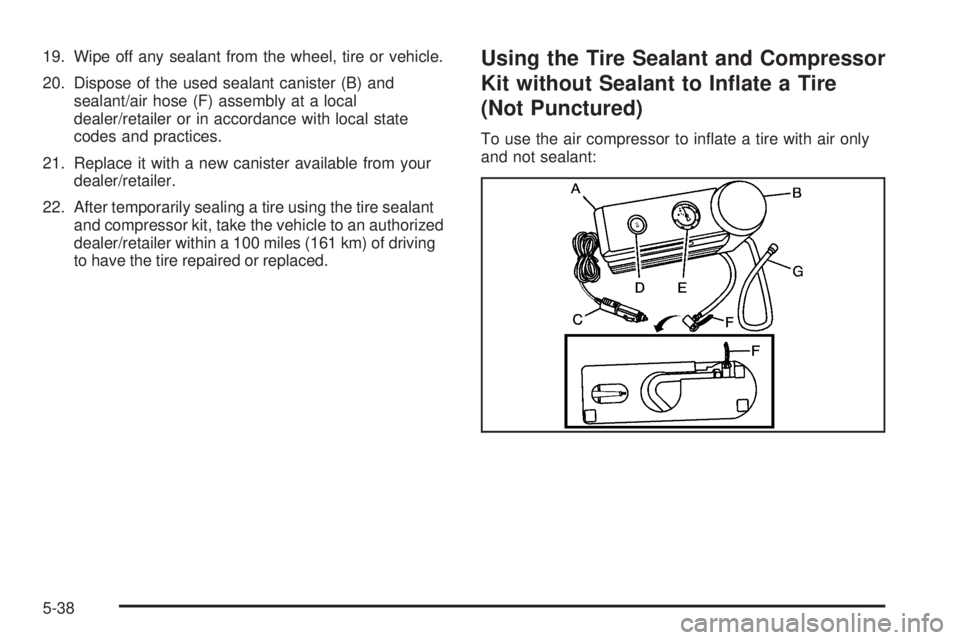
To use the air compressor to inflate a tire with air only
and not sealant:
5-38
Page 79 of 94
{CAUTION:
Idling a vehicle in an enclosed area with poor
ventilation is dangerous. Engine exhaust may
enter the vehicle. Engine exhaust contains Carbon
Monoxide (CO) which cannot be seen or smelled.
It can cause unconsciousness and even death.
Never run the engine in an enclosed area that has
no fresh air ventilation. For more information,
see ”Engine Exhaust” in the owner manual.
{CAUTION:
Over-inflating a tire could cause the tire to rupture
and you or others could be injured. Be sure to
read and follow the tire sealant and compressor kit
instructions and inflate the tire to its recommended
pressure. Do not exceed the recommended
pressure.
{CAUTION:
Storing the tire sealant and compressor kit or
other equipment in the passenger compartment of
the vehicle could cause injury. In a sudden stop or
collision, loose equipment could strike someone.
Store the tire sealant and compressor kit in its
original location.
If this vehicle has a tire sealant and compressor kit,
there may not be a spare tire, tire changing equipment,
and on some vehicles there may not be a place to
store a tire.
The tire sealant and compressor can be used to
temporarily seal punctures up to
1⁄4inch (6 mm) in the
tread area of the tire. It can also be used to inflate
an under inflated tire.
If the tire has been separated from the wheel, has
damaged sidewalls, or has a large puncture, the tire is
too severely damaged for the tire sealant and
compressor kit to be effective. See “Roadside
Assistance Program” in the owner manual.
5-43
Page 83 of 94
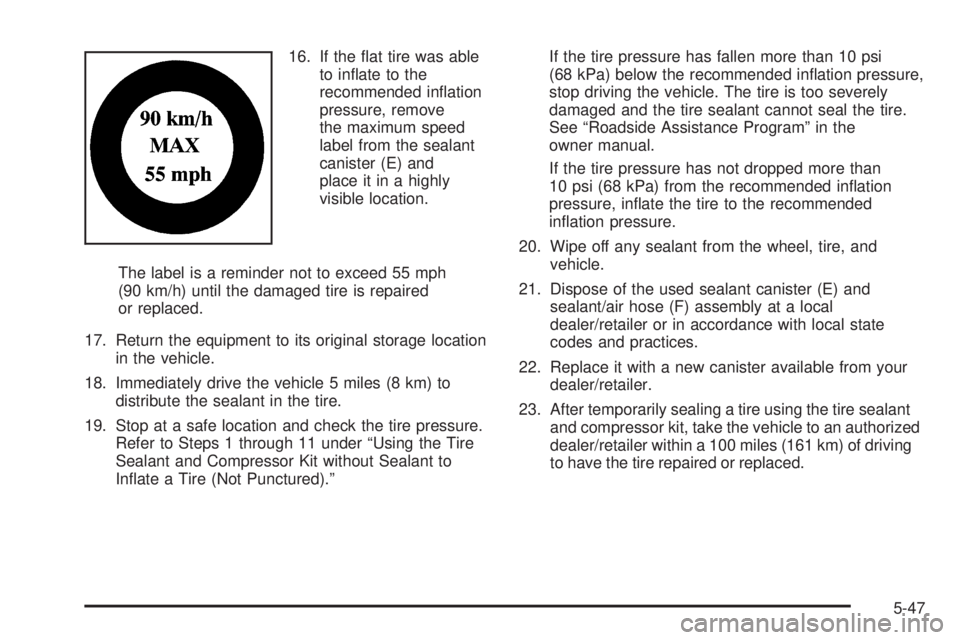
16. If the flat tire was able
to inflate to the
recommended inflation
pressure, remove
the maximum speed
label from the sealant
canister (E) and
place it in a highly
visible location.
The label is a reminder not to exceed 55 mph
(90 km/h) until the damaged tire is repaired
or replaced.
17. Return the equipment to its original storage location
in the vehicle.
18. Immediately drive the vehicle 5 miles (8 km) to
distribute the sealant in the tire.
19. Stop at a safe location and check the tire pressure.
Refer to Steps 1 through 11 under “Using the Tire
Sealant and Compressor Kit without Sealant to
Inflate a Tire (Not Punctured).”If the tire pressure has fallen more than 10 psi
(68 kPa) below the recommended inflation pressure,
stop driving the vehicle. The tire is too severely
damaged and the tire sealant cannot seal the tire.
See “Roadside Assistance Program” in the
owner manual.
If the tire pressure has not dropped more than
10 psi (68 kPa) from the recommended inflation
pressure, inflate the tire to the recommended
inflation pressure.
20. Wipe off any sealant from the wheel, tire, and
vehicle.
21. Dispose of the used sealant canister (E) and
sealant/air hose (F) assembly at a local
dealer/retailer or in accordance with local state
codes and practices.
22. Replace it with a new canister available from your
dealer/retailer.
23. After temporarily sealing a tire using the tire sealant
and compressor kit, take the vehicle to an authorized
dealer/retailer within a 100 miles (161 km) of driving
to have the tire repaired or replaced.
5-47
Page 86 of 94
Removal and Installation of the Sealant
Canister
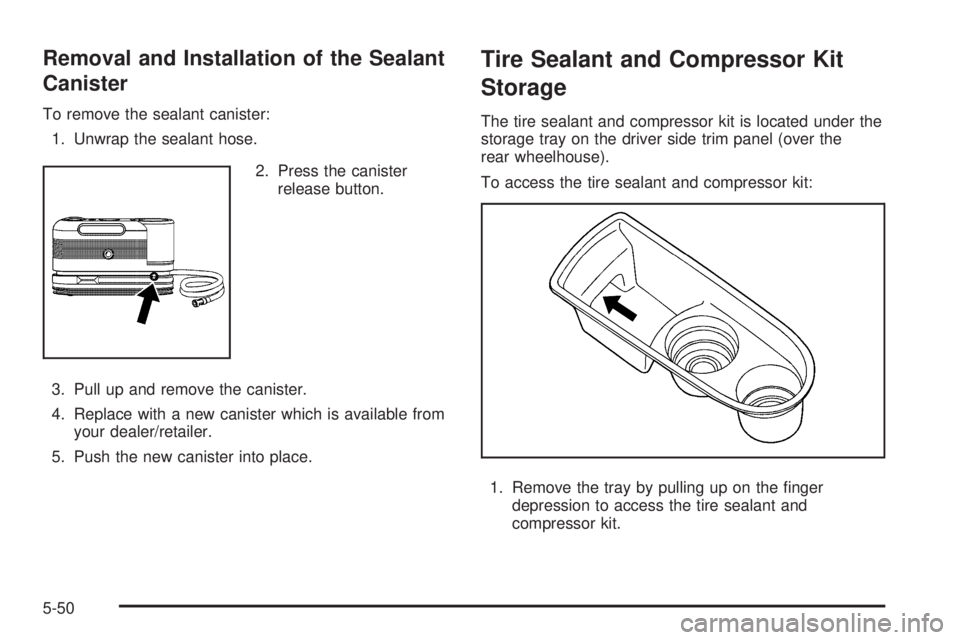
To remove the sealant canister:
1. Unwrap the sealant hose.
2. Press the canister
release button.
3. Pull up and remove the canister.
4. Replace with a new canister which is available from
your dealer/retailer.
5. Push the new canister into place.
Tire Sealant and Compressor Kit
Storage
The tire sealant and compressor kit is located under the
storage tray on the driver side trim panel (over the
rear wheelhouse).
To access the tire sealant and compressor kit:
1. Remove the tray by pulling up on the finger
depression to access the tire sealant and
compressor kit.
5-50