radio GMC YUKON HYBRID 2009 Owners Manual
[x] Cancel search | Manufacturer: GMC, Model Year: 2009, Model line: YUKON HYBRID, Model: GMC YUKON HYBRID 2009Pages: 94, PDF Size: 0.53 MB
Page 19 of 94
Climate Controls..............................................3-2
Warning Lights, Gages, and Indicators..............3-3
Instrument Panel Cluster.................................3-3
Tachometer...................................................3-4
Charging System Light....................................3-4
Fuel Economy Gage.......................................3-5
Brake System Warning Light............................3-6
Antilock Brake System (ABS) Warning Light.......3-7
StabiliTrak
®Indicator Light...............................3-7Engine Coolant Temperature Gage...................3-8
Oil Pressure Gage..........................................3-8
Oil Pressure Light.........................................3-10
Fuel Gage...................................................3-11
Driver Information Center (DIC).......................3-12
DIC Warnings and Messages.........................3-12
Audio System(s).............................................3-14
Navigation/Radio System...............................3-14
Section 3 Instrument Panel
3-1
Page 22 of 94
Tachometer
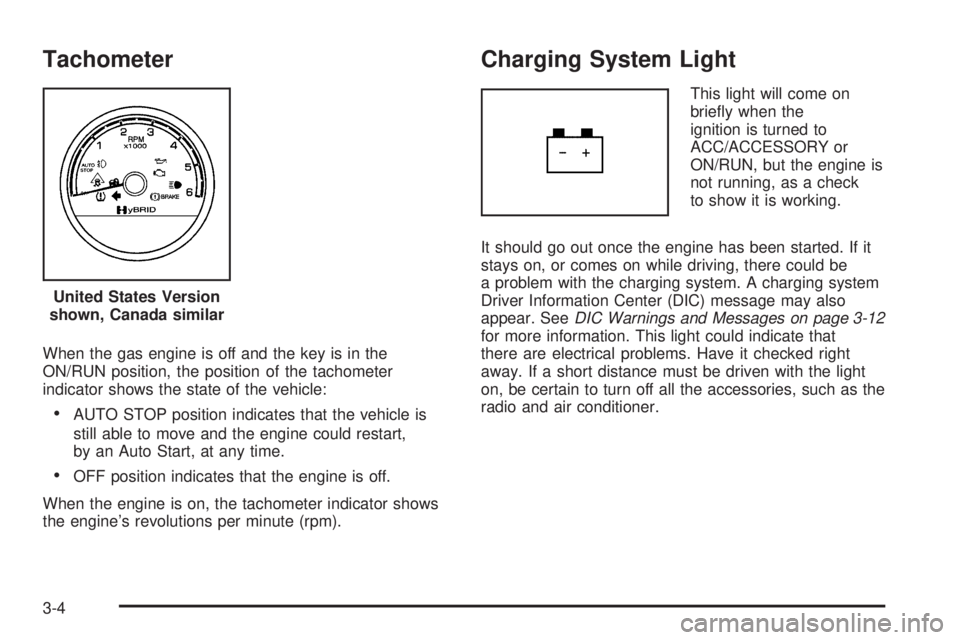
When the gas engine is off and the key is in the
ON/RUN position, the position of the tachometer
indicator shows the state of the vehicle:
•AUTO STOP position indicates that the vehicle is
still able to move and the engine could restart,
by an Auto Start, at any time.
•OFF position indicates that the engine is off.
When the engine is on, the tachometer indicator shows
the engine’s revolutions per minute (rpm).
Charging System Light
This light will come on
briefly when the
ignition is turned to
ACC/ACCESSORY or
ON/RUN, but the engine is
not running, as a check
to show it is working.
It should go out once the engine has been started. If it
stays on, or comes on while driving, there could be
a problem with the charging system. A charging system
Driver Information Center (DIC) message may also
appear. SeeDIC Warnings and Messages on page 3-12
for more information. This light could indicate that
there are electrical problems. Have it checked right
away. If a short distance must be driven with the light
on, be certain to turn off all the accessories, such as the
radio and air conditioner. United States Version
shown, Canada similar
3-4
Page 32 of 94
Audio System(s)
Navigation/Radio System
For vehicles with a navigation radio system, see the
Navigation System manual for more information.
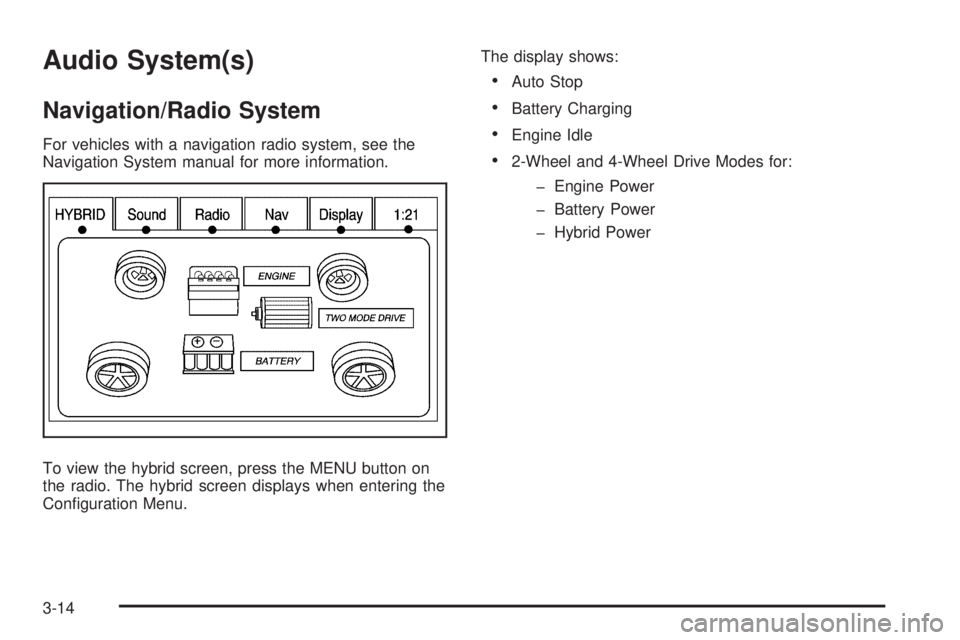
To view the hybrid screen, press the MENU button on
the radio. The hybrid screen displays when entering the
Configuration Menu.The display shows:
•Auto Stop
•Battery Charging
•Engine Idle
•2-Wheel and 4-Wheel Drive Modes for:
- Engine Power
- Battery Power
- Hybrid Power
3-14
Page 53 of 94
Notice:If you leave the radio or other accessories
on during the jump starting procedure, they
could be damaged. The repairs would not be
covered by the warranty. Always turn off the radio
and other accessories when jump starting the
vehicle.
3. Turn off the ignition on both vehicles. Unplug
unnecessary accessories plugged into the cigarette
lighter or the accessory power outlets. Turn off
the radio and all the lamps that are not needed.
This avoids sparks and helps save both batteries.
It could save the radio!
4. Open the hood on the other vehicle and locate the
positive (+) and negative (−) terminal locations on
that vehicle.
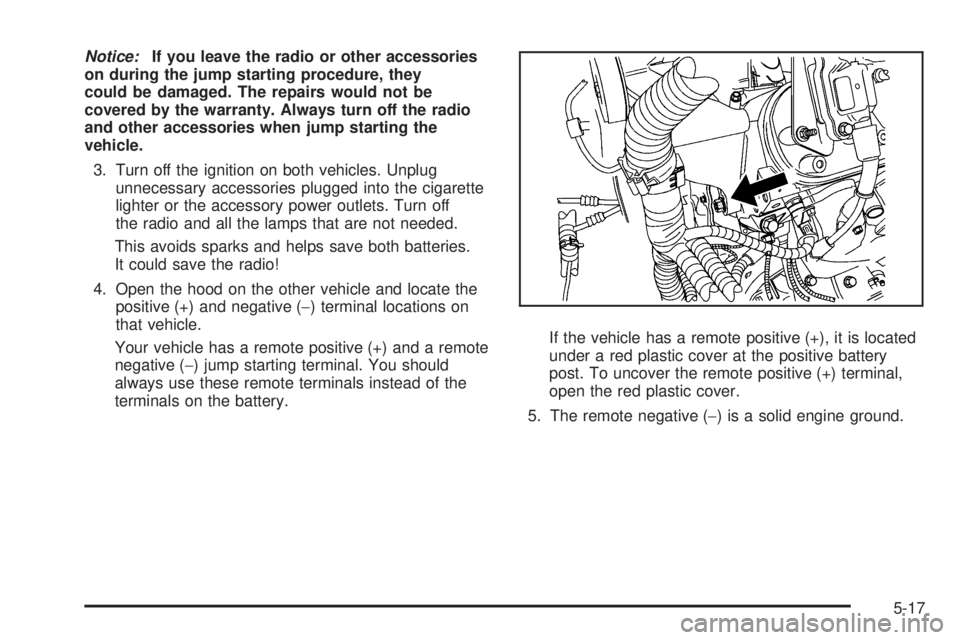
Your vehicle has a remote positive (+) and a remote
negative (−) jump starting terminal. You should
always use these remote terminals instead of the
terminals on the battery.If the vehicle has a remote positive (+), it is located
under a red plastic cover at the positive battery
post. To uncover the remote positive (+) terminal,
open the red plastic cover.
5. The remote negative (−) is a solid engine ground.
5-17
Page 58 of 94
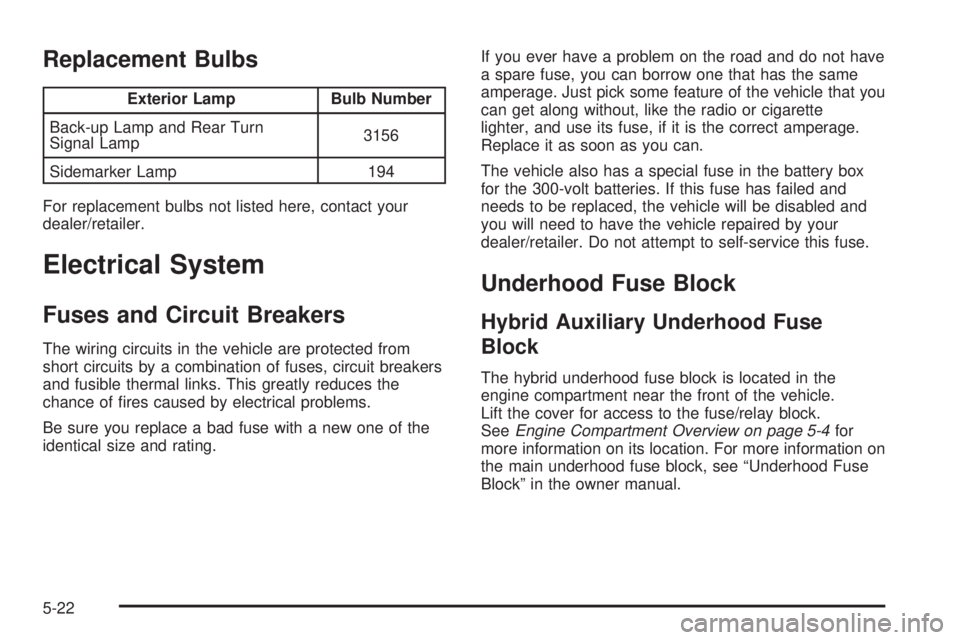
Replacement Bulbs
Exterior Lamp Bulb Number
Back-up Lamp and Rear Turn
Signal Lamp3156
Sidemarker Lamp 194
For replacement bulbs not listed here, contact your
dealer/retailer.
Electrical System
Fuses and Circuit Breakers
The wiring circuits in the vehicle are protected from
short circuits by a combination of fuses, circuit breakers
and fusible thermal links. This greatly reduces the
chance of fires caused by electrical problems.
Be sure you replace a bad fuse with a new one of the
identical size and rating.If you ever have a problem on the road and do not have
a spare fuse, you can borrow one that has the same
amperage. Just pick some feature of the vehicle that you
can get along without, like the radio or cigarette
lighter, and use its fuse, if it is the correct amperage.
Replace it as soon as you can.
The vehicle also has a special fuse in the battery box
for the 300-volt batteries. If this fuse has failed and
needs to be replaced, the vehicle will be disabled and
you will need to have the vehicle repaired by your
dealer/retailer. Do not attempt to self-service this fuse.
Underhood Fuse Block
Hybrid Auxiliary Underhood Fuse
Block
The hybrid underhood fuse block is located in the
engine compartment near the front of the vehicle.
Lift the cover for access to the fuse/relay block.
SeeEngine Compartment Overview on page 5-4for
more information on its location. For more information on
the main underhood fuse block, see “Underhood Fuse
Block” in the owner manual.
5-22
Page 63 of 94
•One or more TPMS sensors are missing or
damaged. The DIC message and the TPMS
malfunction light should go off when the TPMS
sensors are installed and the sensor matching
process is performed successfully. See your
dealer/retailer for service.
•Replacement tires or wheels do not match your
vehicle’s original equipment tires or wheels.
Tires and wheels other than those recommended
for your vehicle could prevent the TPMS from
functioning properly. See “Buying New Tires” in
the Index of the owner manual.
•Operating electronic devices or being near facilities
using radio wave frequencies similar to the TPMS
could cause the TPMS sensors to malfunction.
If the TPMS is not functioning it cannot detect or
signal a low tire condition. See your dealer/retailer for
service if the TPMS malfunction light and DIC message
comes on and stays on.
TPMS Sensor Matching Process
Each TPMS sensor has a unique identification code.
Any time you rotate your vehicle’s tires or replace one or
more of the TPMS sensors, the identification codes
will need to be matched to the new tire/wheel position.
The sensors are matched to the tire/wheel positions
in the following order: driver side front tire, passenger
side front tire, passenger side rear tire, and driver
side rear tire using a TPMS diagnostic tool. See your
dealer/retailer for service.
The TPMS sensors can also be matched to each
tire/wheel position by increasing or decreasing the tire’s
air pressure. If increasing the tire’s air pressure, do
not exceed the maximum inflation pressure indicated on
the tire’s sidewall.
To decrease air-pressure out of a tire you can use the
pointed end of the valve cap, a pencil-style air pressure
gage, or a key.
5-27
Page 91 of 94
A
Alternating Current
Power Outlet................................................ 2-2
Antilock Brake, System Warning Light.................. 3-7
Audio System(s)
Navigation/Radio System..............................3-14
Automatic Transmission, Fluid............................ 5-5
B
Battery..........................................................5-15
Brake Fluid....................................................5-11
Brakes..........................................................5-11
Regenerative Braking...................................2-10
System Warning Light.................................... 3-6
Bulb Replacement
Taillamps, Turn Signal, Stoplamps and
Back-up Lamps........................................5-21
C
Canadian Owners................................................ ii
Capacities and Specifications............................5-52
Chains, Tire...................................................5-30
Charging System Light...................................... 3-4Climate Controls............................................... 3-2
Compressor Kit
Storing.......................................................5-50
Compressor Kit, Tire Sealant....................5-32, 5-42
Coolant
Engine Temperature Gage.............................. 3-8
Coolant Surge Tank Pressure Cap, (DMCM)......... 5-6
Cooling System, (DMCM).................................. 5-6
D
Drive Motor/Generator Control Module (DMCM)
Coolant Surge Tank Pressure Cap................... 5-6
Drive Motor/Generator Control Module (DMCM)
Cooling System............................................. 5-6
Driver Information Center (DIC).........................3-12
Warnings and Messages...............................3-12
E
Engine
Compartment Overview.................................. 5-4
Coolant Temperature Gage............................. 3-8
Drive Belt Routing......................................... 6-2
1
Page 93 of 94
M
Maintenance Schedule
At Least Once a Year.................................... 6-2
Recommended Fluids and Lubricants............... 6-2
Manual, How to Use........................................... iii
Manual Lumbar Controls.................................... 1-2
Manual Reclining Seatbacks............................... 1-3
N
Navigation/Radio System..................................3-14
O
Oil
Pressure Light.............................................3-10
Oil Pressure Gage............................................ 3-8
Orange Covered Wiring..................................... 5-3
Owners, Canadian............................................... ii
P
Power
Seat............................................................ 1-2
Power Outlet Alternating Current......................... 2-2
Power Steering Fluid.......................................5-11
R
Radios
Navigation/Radio System..............................3-14
Reclining Seatbacks, Manual.............................. 1-3
Recommended Fluids and Lubricants.................. 6-2
Regenerative Braking......................................2-10
Restraint System Check
Replacing Restraint System Parts
After a Crash............................................ 1-3
Routing, Engine Drive Belt................................. 6-2
Running the Vehicle While Parked.....................2-10
3